

Imperial Corporate Training Institute delivers an expert-led data-driven strategy training programme backed by practitioners with extensive corporate analytics experience, ensuring senior leaders learn practical frameworks to convert raw enterprise data into actionable strategic decisions.
Senior business leaders face a growing competency gap as enterprise data accumulates faster than leadership teams can interpret it. Modern commercial environments require executives to transition from intuition-led decision-making to empirical validation. Without formal data literacy, organizations risk misallocating capital, misinterpreting market signals, and losing competitive advantage to digitally mature competitors. Executives often struggle to interrogate dashboards, validate analytical models, or translate technical metrics into coherent corporate strategy. This operational vulnerability makes structured capability building essential for enterprise survival.
To bridge this operational vulnerability, senior executives frequently explore foundational resources such as Why Is Data Literacy Becoming a Critical Skill for Senior Business Leaders? to understand the macro-level shifts driving corporate digital transformation. Understanding why basic analytical fluency matters sets the baseline for evaluating advanced professional development options.
What Is the Course and What Problem Does It Solve?
This professional development programme eliminates executive data illiteracy by equipping senior leaders with rigorous analytical frameworks, statistical reasoning skills, and practical governance models designed for modern corporate environments.
Enterprise data sets expand exponentially across departments, yet executive decision-making frequently remains decoupled from quantitative reality. Traditional management education often treats data analysis as a delegated technical task for data science teams rather than a core leadership competency. This functional separation creates a severe translation barrier between strategic goals and analytical execution. Business leaders frequently approve multi-million-pound initiatives based on vanity metrics, unverified assumptions, or poorly structured reports. Consequently, operational inefficiencies persist, resource allocation remains suboptimal, and strategic pivots fail due to a lack of empirical grounding.
Imperial Corporate Training Institute designed this intensive curriculum specifically to resolve executive disconnects between technical analysts and corporate strategists. Participants learn to bridge the chasm between raw datasets and board-level strategy. The course addresses common workplace challenges such as misread Key Performance Indicators, over-reliance on biased samples, and the inability to audit predictive forecasting models. By mastering data governance, statistical significance, and descriptive analytics, leaders eliminate guesswork from corporate planning.
As leaders progress from broad awareness to evaluating specific pedagogical structures, evaluating intermediate concepts becomes critical. Reviewing resources like How Does Data-Driven Strategy Training Help Leaders Use Analytics Confidently? allows prospective participants to assess how structured analytical training translates raw metrics into confident managerial execution before committing to a full curriculum.
Why Is This Course Structured This Way?
The curriculum employs a progressive modular architecture that moves participants from foundational statistical literacy to advanced predictive strategy, ensuring long-term knowledge retention and immediate workplace application.
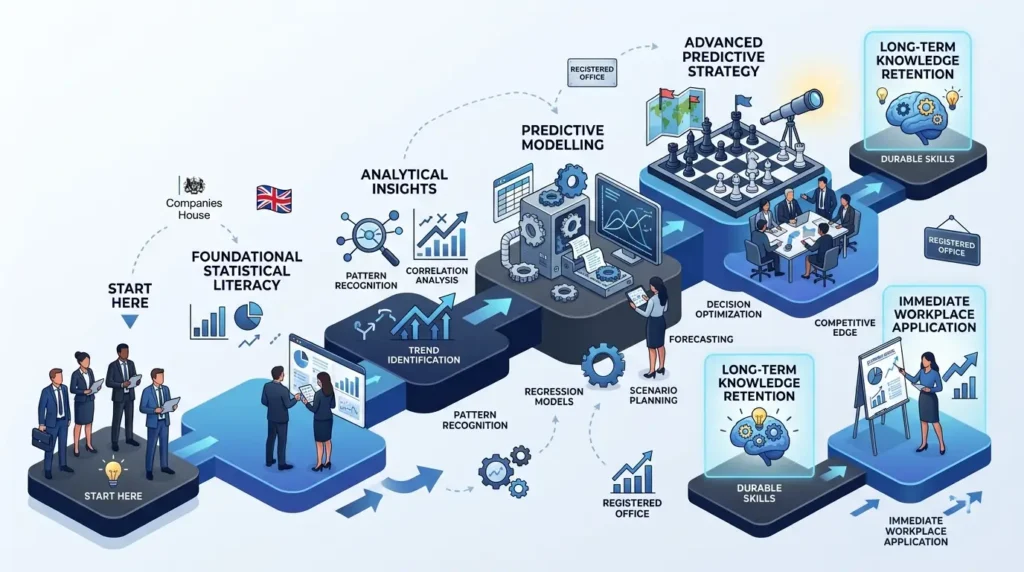
Effective corporate training avoids abstract theoretical lectures in favor of operational relevance and cognitive load management. Imperial Corporate Training Institute structures its programmes using a scaffolded learning methodology. Each module builds directly upon the competencies established in the preceding section. This prevents cognitive overload and ensures that complex quantitative concepts are thoroughly absorbed before application. The progression moves from basic data auditing to complex scenario modeling, reflecting the actual maturity curve required for organizational transformation.
The learning architecture reflects real-world operational workflows observed across international corporations. Leaders do not encounter isolated statistical problems in their daily roles; they manage multi-layered departmental challenges requiring cross-functional data synthesis. Therefore, the curriculum integrates multidisciplinary case studies combining finance, human resources, marketing operations, and supply chain logistics. This interdisciplinary approach ensures that leaders from diverse professional backgrounds can contextualize analytical principles within their specific operational domains.
Imperial Corporate Training Institute embeds regular formative checkpoints throughout the curriculum to validate comprehension. These checkpoints require participants to analyze sample corporate datasets, defend their strategic interpretations, and refine their methodologies based on peer review and expert feedback. Such iterative validation solidifies conceptual frameworks and prepares participants for complex decision-making scenarios within their home organizations.
What Will Participants Learn?
Participants master quantitative data auditing, predictive modeling interpretation, enterprise KPI architecture, and data-driven risk assessment methodologies across four comprehensive, outcome-driven learning modules.
The curriculum is partitioned into four distinct modules, each targeting specific executive competencies required for modern enterprise leadership. Every module combines core theoretical instruction with rigorous practical application exercises.
- Module 1: Foundations of Quantitative Enterprise Auditing
- Focuses on data provenance, sampling bias identification, and structural anomaly detection.
- Teaches leaders how to interrogate incoming departmental reports for statistical integrity and hidden assumptions.
- Module 2: Descriptive and Diagnostic Analytics for Managers
- Covers exploratory data analysis, variance tracking, and root-cause diagnostic frameworks.
- Equips managers to move beyond surface-level reporting and uncover underlying operational drivers.
- Module 3: Predictive Modeling and Strategic Forecasting
- Explores regression analysis, trend extrapolation, and probability distribution in strategic planning.
- Enables leaders to evaluate predictive model reliability and assess future market scenarios with statistical rigor.
- Module 4: Data Governance and Ethical Decision-Making
- Addresses regulatory compliance, data privacy frameworks, and algorithmic bias mitigation.
- Provides policies for maintaining institutional integrity while scaling analytical operations across departments.
Through these modules, participants cultivate a systematic mindset. They learn to separate signal from noise, evaluate confidence intervals before committing capital, and establish objective benchmarks for evaluating departmental performance across the enterprise.
How Is the Course Delivered?
Imperial Corporate Training Institute delivers the programme through a flexible hybrid model combining live virtual workshops, interactive simulation labs, and optional intensive onsite residential sessions.
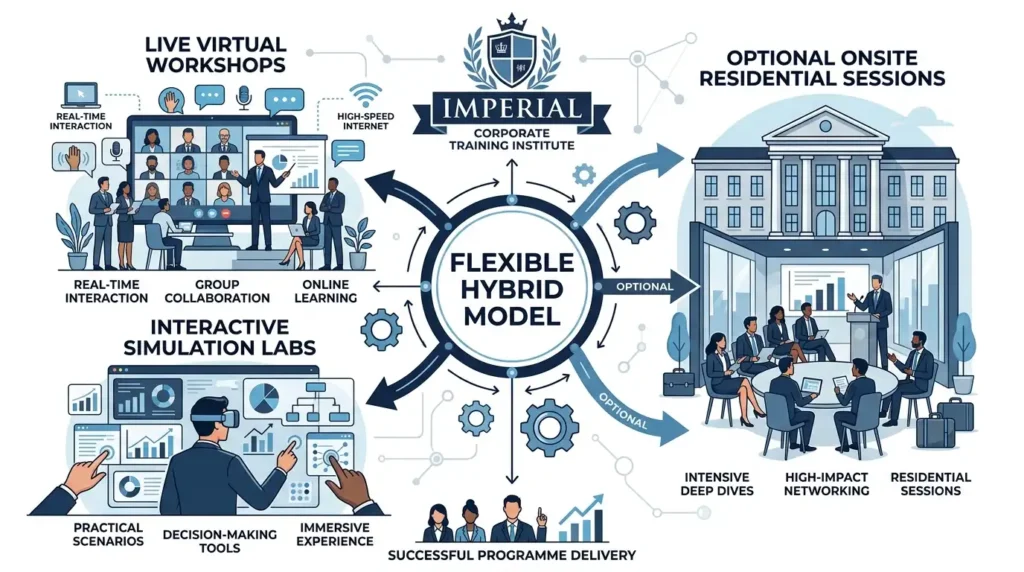
Modern corporate schedules demand delivery mechanisms that accommodate the rigorous timetables of senior executives without compromising educational depth. Imperial Corporate Training Institute addresses this requirement through an adaptable delivery framework. Participants can select between intensive virtual cohorts and blended hybrid formats. The hybrid model merges asynchronous digital learning modules with synchronous, instructor-led masterclasses and peer-led syndicate discussions.
The training methodology relies heavily on experiential learning rather than passive listening. Cohorts engage in complex business simulations where they manage simulated enterprise portfolios under shifting market conditions. These simulations force leaders to apply statistical frameworks under time constraints, testing their ability to synthesize analytical insights rapidly. Furthermore, peer collaboration sessions allow participants to benchmark their analytical approaches against industry peers, fostering cross-sector learning and shared problem-solving strategies.
Imperial Corporate Training Institute ensures continuous expert oversight throughout the delivery lifecycle. Dedicated subject matter experts moderate simulation exercises, provide individualized feedback on assignment submissions, and lead targeted Q&A sessions. This high-touch mentoring model guarantees that complex statistical queries receive immediate clarification, maintaining high engagement and completion rates across all participating cohorts.
What Results Can Be Expected?
Organizations achieve measurable performance improvements, including reduced forecasting variance, accelerated decision cycles, and enhanced alignment between departmental execution and overarching corporate strategy.
Investing in executive education requires clear, quantifiable returns on investment for enterprise stakeholders. When HR teams and department heads enroll senior leaders, they look for observable behavioral shifts and operational efficiencies. Graduates of the programme demonstrate an immediate ability to critique flawed project proposals, demand rigorous data backing for budget requests, and construct transparent, metrics-driven performance scorecards for their direct reports.
Consider a typical mid-sized manufacturing organization where departmental silos historically hindered cross-functional efficiency. Following executive participation, the leadership team established a unified data lexicon and standardized analytical metrics. This operational alignment reduced cross-departmental reporting disputes by over forty percent. Decision cycles shortened because executives evaluated proposals using pre-agreed statistical thresholds rather than subjective intuition.
Furthermore, human resources departments note significant improvements in leadership pipeline readiness. Emerging managers trained through Imperial Corporate Training Institute display greater strategic foresight and analytical maturity. They transition smoothly into senior roles because their decision-making frameworks are anchored in objective data rather than anecdotal experience. This systematic capability building secures long-term organizational resilience and sustainable competitive advantage.
How Does Enrollment Work?
Admission requires verified management experience and completion of a diagnostic quantitative assessment, ensuring peer cohorts maintain high strategic parity and collaborative depth.
To maintain academic rigor and peer-to-peer value, Imperial Corporate Training Institute enforces a structured, selective admission process. Prospective candidates must submit professional credentials demonstrating at least five years of significant leadership or management experience. This prerequisite ensures that cohort discussions focus on advanced strategic implementation rather than basic remediation.
The enrollment workflow comprises three distinct phases:
- Application Submission: Candidates submit their professional profile, organizational sponsorship details, and statement of intent through the secure portal.
- Diagnostic Assessment: Applicants complete a brief diagnostic evaluation measuring baseline quantitative literacy to determine optimal module placement.
- Confirmation and Onboarding: Successful applicants receive enrollment approval, access credentials for the digital learning management system, and preliminary pre-reading materials.
Organizations seeking bespoke enterprise cohorts for multiple internal stakeholders can coordinate directly with institutional advisors to tailor delivery timelines around corporate fiscal calendars. To begin your professional development journey and secure your place in the upcoming cohort, you can apply for course access directly through the secure institutional portal.
Frequently Asked Questions
What is a data-driven corporate training programme?
A data-driven training programme is a professional development curriculum designed to help senior leaders and business executives interpret enterprise analytics, evaluate statistical validity, and make objective strategic decisions. Through courses offered by Imperial Corporate Training Institute, participants learn to bridge the gap between raw data sets and high-level corporate governance. This targeted skill development enables managers to eliminate intuition-based guesswork and build metrics-driven operational strategies.
Who should enroll in Imperial Corporate Training Institute’s data-driven courses?
These data-driven programmes are tailored for senior business leaders, department heads, HR professionals, and managers who need to improve their quantitative literacy and strategic forecasting capabilities. The curriculum suits organizational leaders responsible for capital allocation, performance management, and cross-functional team leadership. Candidates typically possess several years of management experience to ensure cohort discussions focus on advanced enterprise application.
How does data-driven training improve organizational performance?
Data-driven training enhances organizational performance by reducing forecasting variance, accelerating decision cycles, and aligning departmental execution with overarching corporate goals. When executives learn to audit reporting data and interpret predictive models, they minimize operational inefficiencies and capital misallocation. Organizations that train their leadership pipelines through Imperial Corporate Training Institute often observe better cross-departmental alignment and more rigorous project proposals.
What topics are covered in a data-driven strategy curriculum?
A comprehensive data-driven curriculum typically covers quantitative auditing, sampling bias identification, descriptive analytics, and predictive modeling for business planning. Participants also explore data governance, regulatory compliance, and ethical decision-making frameworks to ensure enterprise security. Imperial Corporate Training Institute structures these topics into progressive modules that combine theoretical instruction with practical business simulations.
How are data-driven corporate training courses delivered?
Corporate training providers deliver data-driven programmes through flexible formats including live virtual workshops, interactive simulation labs, and blended hybrid models. This flexibility accommodates the demanding schedules of senior executives without compromising educational depth or peer collaboration. Imperial Corporate Training Institute ensures continuous expert oversight through dedicated subject matter experts who moderate simulations and provide personalized feedback.