

Data-driven strategy training transforms executive decision-making by replacing intuition-based choices with statistical certainty, structured hypothesis testing, and rigorous performance telemetry. Modern enterprise leaders navigate complex operating environments where unstructured data streams, market volatility, and operational metrics dictate competitive survival. Traditional management paradigms rely on historical precedent and anecdotal evidence, which introduces cognitive bias and strategic vulnerability. Systematic analytics training equips directors and department heads with the mental models, statistical literacy, and governance frameworks required to interpret complex dashboards, interrogate underlying data pipelines, and execute strategic interventions with measurable precision.
As organizations scale their digital infrastructure, the volume of telemetry generated by enterprise resource planning systems, customer relationship management platforms, and financial ledgers expands exponentially. Senior executives frequently suffer from analysis paralysis or default to confirmation bias, accepting dashboard summaries at face value without understanding sample biases, statistical significance, or margin of error. This capability gap stalls operational agility and misallocates capital. When organizations explore foundational concepts around metric interpretation, understanding Why Is Data Literacy Becoming a Critical Skill for Senior Business Leaders? provides the necessary context on how baseline numerical fluency underpins enterprise-wide digital transformation and cross-functional alignment.
Why Do Traditional Leadership Styles Struggle With Modern Enterprise Analytics?
Traditional management approaches fail in modern data ecosystems because legacy frameworks prioritize qualitative storytelling over empirical validation, leaving decision-makers ill-equipped to parse probabilistic risk models. Historical corporate hierarchies fostered an environment where executive authority superseded empirical evidence. Leaders made strategic choices based on tenure, past successes, and subjective market assessments. In contemporary digital markets, this methodology introduces catastrophic blind spots. Enterprise data ecosystems generate millions of data points daily across supply chains, customer touchpoints, and financial transactions. Leaders who lack analytical training view these metrics as static reports rather than dynamic operational signals.
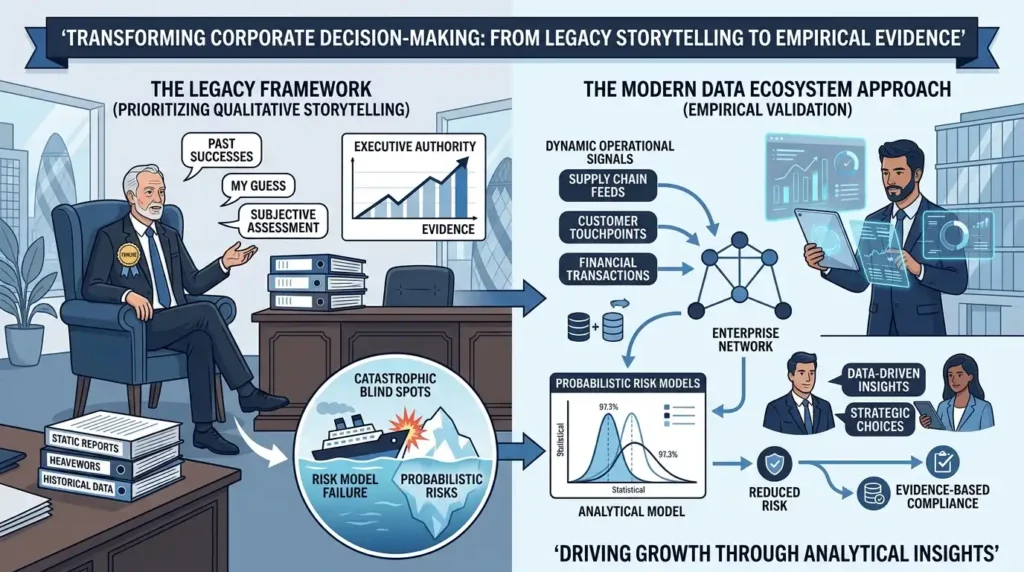
This cognitive disconnect manifests in several critical operational failures. Executives misinterpret correlation for causation, authorize capital expenditure based on vanity metrics, and fail to establish quantifiable key performance indicators for strategic initiatives. Furthermore, data silos across departments prevent leadership teams from forming a unified single source of truth. Marketing tracks engagement metrics, finance monitors cash burn, and operations measure throughput, yet few leaders possess the cross-functional analytical framework required to synthesize these disparate streams into a coherent corporate strategy.
Bridging this gap requires structured capability development that moves beyond basic spreadsheet navigation. Organizations must evaluate how formal learning interventions alter executive behavior. When human resources directors and executive boards evaluate structured capability programs, implementing Imperial’s Data-Driven Strategy Training Programme accelerates this transition by embedding statistical rigor directly into operational planning workflows.
How Does Statistical Literacy Eliminate Executive Bias and Decision Paralysis?
Statistical literacy eliminates executive bias by establishing rigorous validation protocols that test underlying assumptions, quantify variance, and isolate signal from noise in complex data sets. Executive decision-making is routinely distorted by psychological biases, including survivorship bias, anchoring, and the clustering illusion. Leaders recall dramatic anomalies while ignoring aggregate trends, leading to reactionary policy shifts and mismanaged operational responses. Structured analytical training introduces systematic hypothesis testing, null hypothesis formulation, and confidence interval calculation into daily managerial routines.
When leaders understand standard deviation, regression analysis, and p-values, they stop treating dashboards as infallible mirrors of reality. Instead, they interrogate the data collection methodology, evaluate sample size adequacy, and recognize when confounding variables skew performance reports. For example, a retail executive reviewing regional sales growth without statistical adjustment might increase inventory in an underperforming district driven entirely by a seasonal anomaly. An analytically trained leader applies cohort analysis and seasonal decomposition to isolate structural demand from temporary spikes, protecting working capital from inefficient deployment.
| Analytical Concept | Traditional Executive Approach | Data-Driven Leadership Approach | Strategic Business Impact |
| Variance Analysis | Reacts to month-over-month percentage swings | Evaluates standard deviation and historical trend lines | Prevents overreaction to normal operational noise |
| Hypothesis Testing | Relies on anecdotal customer feedback or intuition | Formulates null hypotheses and calculates statistical significance | Validates product-market fit before capital allocation |
| Attribution Modeling | Credits final conversion touchpoint for revenue | Utilizes multi-touch attribution and econometric modeling | Optimizes marketing spend across complex customer journeys |
| Risk Assessment | Uses qualitative risk matrices based on consensus | Employs Monte Carlo simulations and probabilistic forecasting | Quantifies downside exposure with mathematical precision |
This methodological shift changes how leadership teams conduct strategic reviews. Rather than debating opinions in boardrooms, executives evaluate competing hypotheses supported by empirical telemetry. This approach shortens decision cycles, reduces organizational friction, and builds psychological safety around data-backed experimentation.
What Frameworks Enable Leaders to Translate Raw Data Into Actionable Strategic Roadmaps?
Leaders translate raw data into actionable strategic roadmaps by deploying structured translation frameworks like the OODA loop integrated with predictive analytics, balanced scorecards, and data-to-decision pipelines. Raw telemetry holds zero intrinsic value until it undergoes systematic processing, contextualization, and alignment with organizational objectives. Many corporations invest millions in business intelligence infrastructure only to find that senior leaders ignore the dashboards. This adoption failure occurs because tools lack a standardized cognitive framework for translation.
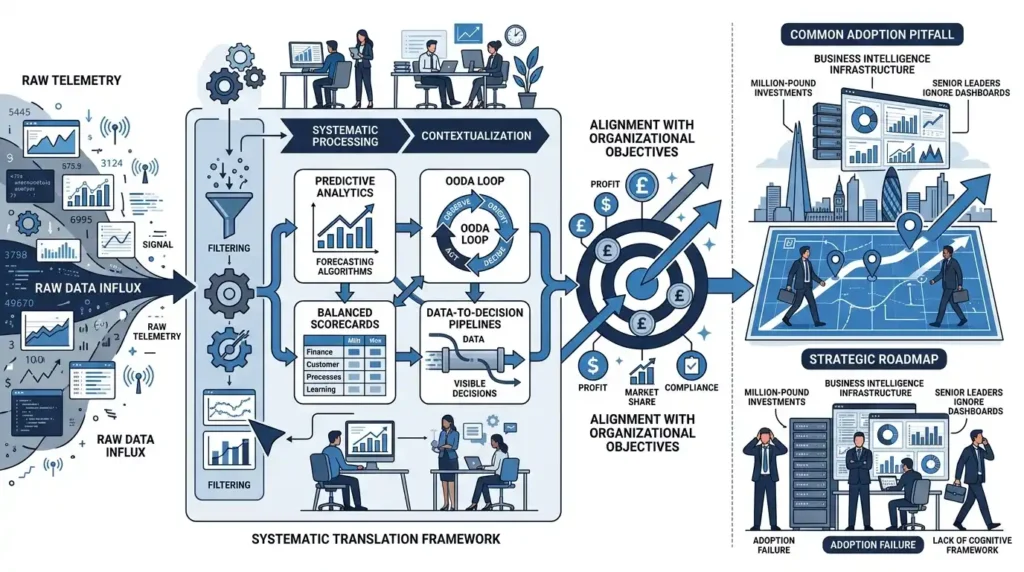
Effective data-driven strategy training instills repeatable mental models that bridge technical data science outputs and executive execution. The primary framework utilized in high-performing enterprises is the structured decision pipeline, which consists of four distinct phases: ingestion, interrogation, synthesis, and execution.
- Ingestion and Normalization: Leaders establish data governance standards to ensure incoming metrics across disparate systems maintain integrity, timeliness, and contextual relevance.
- Interrogation and Diagnostic Analysis: Management teams apply root-cause analysis techniques, such as the 5 Whys combined with cohort segmentation, to understand why metrics shifted rather than merely observing the movement.
- Synthesis and Predictive Modeling: Executives utilize scenario planning and predictive analytics to forecast the probability-weighted outcomes of alternative strategic paths.
- Execution and Telemetry Tracking: Strategy implementation is broken down into measurable milestones tracked via automated feedback loops, allowing for real-time course correction.
Implementing these frameworks requires deliberate practice and organizational alignment. Enterprises utilizing Imperial’s Data-Driven Strategy Training Programme embed these exact decision pipelines into management development curricula, ensuring leaders transition smoothly from passive data consumers to active strategic architects.
How Do HR Teams Measure the ROI of Executive Analytics Training Programs?
Human resources and learning development teams measure the return on investment of executive analytics training by tracking operational velocity, capital allocation efficiency, forecasting accuracy, and strategic initiative success rates. Quantifying the financial impact of leadership development has historically challenged human resources departments. Traditional evaluations rely on participant satisfaction surveys, which measure engagement rather than behavioral change or business impact. Data-driven strategy training simplifies ROI measurement because the subject matter directly impacts quantitative business metrics.
Organizations evaluate training efficacy across four specific performance tiers:
- Forecasting Variance Reduction: Measuring the percentage decrease in variance between quarterly financial forecasts and actual performance. Mature analytics leaders typically reduce forecasting error by 18% to 30% within twelve post-training months.
- Capital Expenditure Efficiency: Tracking the reduction of failed strategic initiatives or abandoned pilot projects. Data-trained leaders kill underperforming projects faster, saving millions in sunk costs.
- Time-to-Decision Metrics: Calculating the duration required to move from market signal identification to strategic resource deployment. Streamlined analytical frameworks accelerate decision velocity by up to 40%.
- Cross-Functional Data Adoption: Measuring the frequency of data platform utilization across executive review meetings and the integration of empirical KPIs into departmental OKRs.
By establishing baseline metrics prior to training deployment and auditing performance at 90-day, 180-day, and 365-day intervals, HR leaders build empirical cases for continuous learning investments.
Frequently Asked Questions
How does Imperial Corporate Training Institute deliver its Data-Driven training?
Imperial Corporate Training Institute delivers its Data-Driven training through interactive, industry-tailored workshops that focus on real-world enterprise analytics and practical problem-solving. Programs combine statistical literacy frameworks with hands-on decision-making simulations designed specifically for senior managers and corporate leadership teams.
What core skills are taught in the Data-Driven strategy courses?
The Data-Driven strategy courses teach leaders how to interpret complex operational dashboards, perform rigorous hypothesis testing, and eliminate cognitive biases from strategic planning. Participants gain advanced proficiency in variance analysis, predictive forecasting, and converting raw business intelligence into actionable corporate roadmaps.
Who should attend the Data-Driven training programmes at Imperial?
These Data-Driven training programmes are specifically designed for C-suite executives, department directors, human resources leaders, and senior managers responsible for strategic planning and capital allocation. The curriculum targets professionals seeking to transition from intuition-based decision-making to evidence-based enterprise management.
How do organizations measure the ROI of Data-Driven corporate training?
Organizations measure the return on investment of Data-Driven training by tracking key performance indicators such as forecasting accuracy improvements, reduced capital waste on failed projects, and accelerated decision velocity. Human resources teams audit these metrics through structured 90-day and 365-day post-training performance evaluations.
Why is Data-Driven leadership training essential for modern businesses?
Data-Driven leadership training is critical because modern enterprise ecosystems generate vast streams of operational telemetry that traditional qualitative management styles fail to parse effectively. Equipping leaders with analytical frameworks ensures cross-functional alignment, minimizes operational risk, and maintains competitive advantage in data-heavy markets.