

The growth of Building Information Modelling (BIM) and Revit has transformed how construction projects are designed, coordinated, and managed. Organisations involved in mechanical, electrical, and plumbing (MEP) engineering increasingly rely on digital workflows to improve collaboration and reduce project risks. This shift raises an important question for employers, training managers, and engineering teams: What is the future of AutoCAD in HVAC design as BIM adoption continues to expand?
Understanding the role of AutoCAD within modern HVAC workflows helps organisations plan workforce development, close technical skill gaps, and build effective learning strategies. Businesses investing in engineering talent need clarity on how traditional drafting tools and BIM platforms coexist within contemporary project environments.
Why does AutoCAD remain relevant in HVAC design despite BIM adoption?
AutoCAD remains relevant because organisations continue to use 2D documentation, legacy project files, detailed drafting workflows, and industry-specific design standards. Many engineering teams integrate AutoCAD alongside BIM tools to support project delivery, compliance requirements, and multidisciplinary coordination across construction environments.
AutoCAD is a computer-aided design (CAD) software application used to create precise technical drawings. In HVAC design, it supports the creation of duct layouts, equipment schedules, mechanical plans, and construction documentation.
Many organisations have accumulated thousands of AutoCAD files over 10 to 20 years. Replacing these assets is neither practical nor cost-effective. Engineering departments frequently reference existing drawings when upgrading facilities, renovating buildings, or expanding infrastructure.
Industries like healthcare, manufacturing, education, and commercial real estate continue to maintain extensive AutoCAD-based documentation libraries. These organisations require professionals who can interpret, modify, and manage existing design information efficiently.
AutoCAD also remains valuable for rapid drafting tasks. Engineers can quickly produce schematic layouts before transferring information into BIM environments for coordination and analysis.
From a workforce development perspective, AutoCAD continues to represent a foundational technical skill that supports broader digital engineering capabilities.
What is changing in HVAC design with the growth of BIM and Revit?
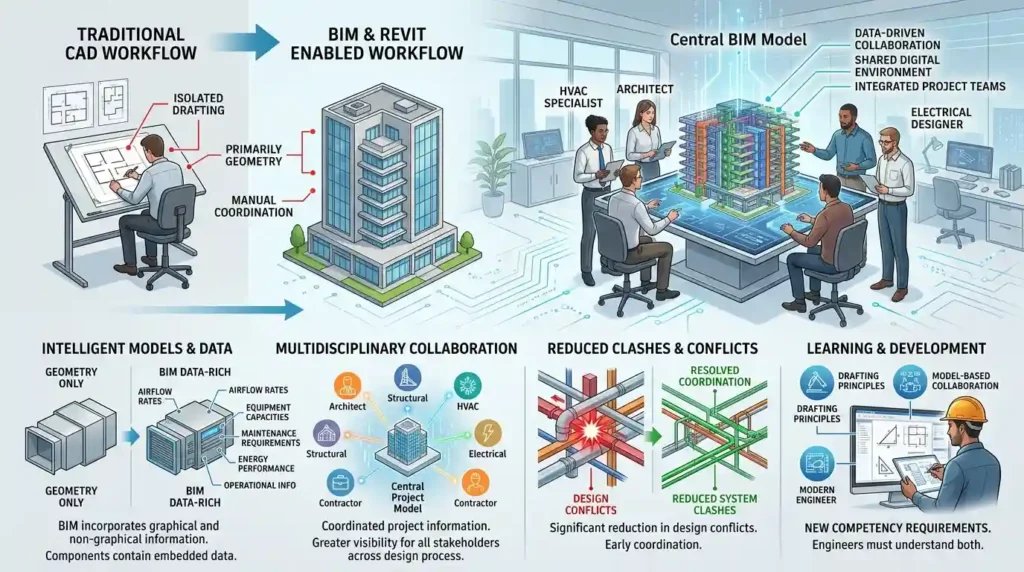
BIM and Revit are shifting HVAC design from isolated drafting processes to data-driven collaboration. Teams now work within shared digital environments that integrate design, coordination, construction planning, asset management, and lifecycle information across multiple project stakeholders.
BIM is a methodology that uses intelligent digital models containing graphical and non-graphical building information. Revit is a BIM software platform that enables multidisciplinary design collaboration.
Traditional CAD workflows focus primarily on geometry. BIM workflows combine geometry with project data, specifications, performance metrics, and operational information.
In a BIM environment, HVAC components contain embedded information such as airflow rates, equipment capacities, maintenance requirements, and energy performance characteristics.
Project teams benefit from greater visibility throughout the design process. Architects, structural engineers, HVAC specialists, electrical designers, and contractors access coordinated project information within a shared environment.
This integration reduces clashes between building systems. Industry studies consistently report significant reductions in design conflicts when BIM coordination processes are implemented early in project development.
For learning and development teams, this evolution creates new competency requirements. Engineers must understand both drafting principles and model-based collaboration processes.
How do AutoCAD and Revit work together in modern MEP workflows?
AutoCAD and Revit operate as complementary technologies within many organisations. AutoCAD supports drafting, detailing, and legacy project management, while Revit enables intelligent modelling, coordination, clash detection, and information-rich project delivery across multidisciplinary teams.
Many organisations operate in hybrid technology environments.
Existing facilities often contain AutoCAD documentation. New developments increasingly require BIM deliverables. Engineering teams must navigate both requirements simultaneously.
A typical workflow begins with existing AutoCAD drawings. Engineers review site conditions and develop preliminary concepts. Information is then incorporated into Revit models for coordination and detailed design development.
Legacy Documentation Management
Large organisations maintain substantial drawing archives.
Facilities management teams frequently update mechanical layouts, equipment locations, and maintenance documentation using AutoCAD-based records.
Training programmes therefore include methods for managing historical design information while supporting digital transformation initiatives.
BIM-Based Coordination
Revit enables coordinated project delivery.
HVAC engineers can identify system conflicts before construction begins. Mechanical systems interact with structural elements, electrical systems, and architectural components within a unified model.
This coordination process improves project efficiency and reduces costly site modifications.
What skills do organisations need from future HVAC design professionals?
Future HVAC professionals require blended competencies that combine AutoCAD drafting, BIM collaboration, Revit modelling, data management, interdisciplinary communication, and digital project coordination. Organisations increasingly prioritise technical adaptability alongside software-specific expertise.
Workforce capability requirements are expanding.
Technical teams must understand design principles, engineering standards, software workflows, and collaborative project delivery methods.
Key competencies include:
CAD Drafting Skills
Engineers must understand drawing standards, layer management, annotation practices, plotting procedures, and documentation control.
These capabilities remain essential for maintaining quality and consistency across engineering projects.
BIM Knowledge
Professionals need to understand BIM execution plans, model coordination processes, information management requirements, and digital project workflows.
BIM literacy supports collaboration across multiple disciplines.
Revit Modelling Skills
Teams increasingly create intelligent HVAC systems within Revit environments.
These skills include family creation, system modelling, parameter management, and model coordination techniques.
Data and Information Management
Digital engineering depends on accurate information.
Professionals must manage design data, project documentation, asset information, and compliance records throughout project lifecycles.
How is HVAC software training delivered in corporate environments?
Corporate HVAC software training combines structured learning pathways, practical exercises, project simulations, competency assessments, and workplace application activities. Organisations use blended delivery methods to improve knowledge retention, productivity, and measurable business performance outcomes.
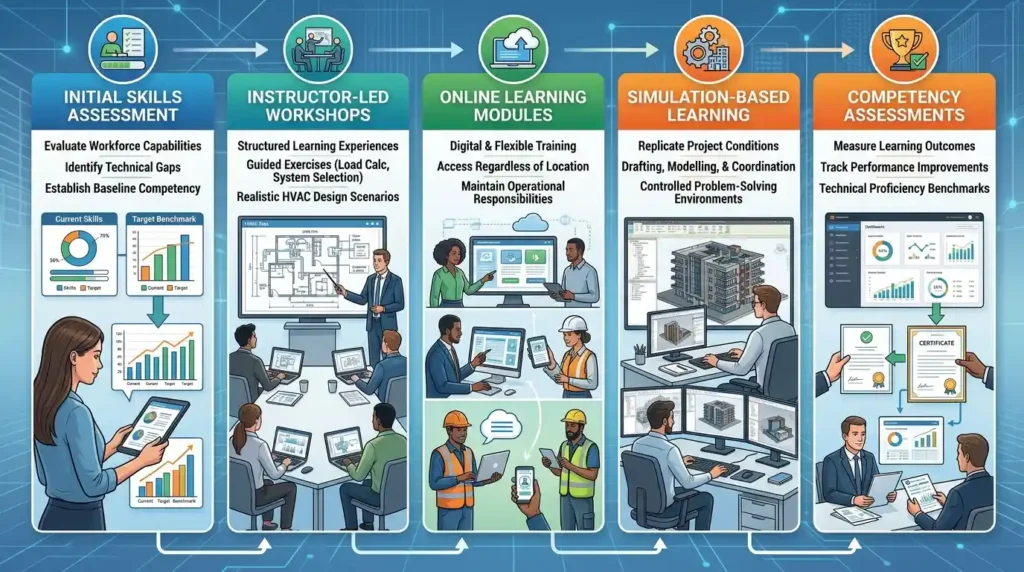
Training initiatives begin with a skills assessment.
Learning and development teams evaluate current workforce capabilities and identify technical gaps. These assessments establish baseline competency levels before programme implementation.
Common delivery formats include:
Instructor-Led Workshops
Workshops provide structured learning experiences.
Participants complete guided exercises using realistic HVAC design scenarios and engineering challenges.
Online Learning Modules
Digital modules support flexible workforce development.
Employees access training materials regardless of location while maintaining operational responsibilities.
Hybrid Learning Programmes
Hybrid programmes combine classroom instruction with self-paced learning.
This approach improves scalability while maintaining practical skill development.
Simulation-Based Learning
Engineering simulations replicate project conditions.
Participants practise drafting, modelling, coordination, and problem-solving activities within controlled learning environments.
Competency Assessments
Assessments measure learning outcomes.
Organisations track performance improvements using objective evaluation criteria and technical proficiency benchmarks.
When organisations begin evaluating software adaptation strategies and workforce readiness, resources such as:
How Does AutoCAD HVAC Training Address the Evolving Landscape of MEP Software? This provides a deeper examination of implementation approaches and evolving technical requirements.
For deeper insight, enrol in:
AutoCAD HVAC and Plumbing Design Training Course
What components are included in modern HVAC design training programmes?
Modern HVAC design training combines technical software skills, engineering principles, BIM methodologies, project coordination practices, documentation standards, quality control procedures, and performance measurement frameworks aligned with organisational objectives and industry requirements.
Effective programmes extend beyond software instruction.
Organisations require employees who understand how technology supports project delivery and business outcomes.
Core components include:
HVAC Design Fundamentals
Participants learn airflow calculations, load estimation concepts, equipment selection principles, and system layout methodologies.
These concepts establish technical understanding before software application.
Drafting and Documentation Standards
Consistency is essential for project quality.
Training covers drawing standards, annotation methods, plotting procedures, and documentation governance.
BIM Coordination Processes
Teams learn coordination workflows, clash detection procedures, and collaborative project management techniques.
Quality Assurance Frameworks
Quality assurance ensures design accuracy.
Participants learn review procedures, verification methods, and documentation control processes.
Project-Based Learning
Realistic projects connect theory with practical application.
Learners develop solutions aligned with workplace requirements and engineering standards.
What measurable outcomes do organisations achieve through HVAC software capability development?
Organisations achieve measurable improvements in productivity, design accuracy, coordination efficiency, project delivery speed, and workforce capability when structured HVAC software development programmes align with operational objectives and performance management frameworks.
Learning investments require measurable business outcomes.
Human resources and learning leaders increasingly evaluate technical training through performance indicators rather than attendance metrics.
Common KPIs include:
- Reduction in design revisions
- Faster project completion times
- Improved documentation accuracy
- Increased modelling efficiency
- Reduced coordination conflicts
- Higher employee competency scores
- Improved project quality metrics
Engineering organisations often measure productivity before and after training interventions.
Baseline assessments provide objective comparisons that support return-on-investment evaluation.
Performance data also informs future workforce planning decisions.
Which industries benefit most from AutoCAD and BIM capability development?
Industries with complex facilities, infrastructure assets, and multidisciplinary engineering requirements benefit most from AutoCAD and BIM capability development. These sectors require accurate design information, coordinated project delivery, regulatory compliance, and efficient asset management practices.
Several industries maintain strong demand for HVAC design expertise.
Healthcare
Hospitals require highly coordinated mechanical systems.
Design accuracy directly affects operational reliability and regulatory compliance.
Manufacturing
Production facilities depend on specialised HVAC systems that support environmental control and operational efficiency.
Commercial Real Estate
Office developments, retail centres, and mixed-use projects rely on coordinated MEP design processes.
Education
Universities and schools frequently undertake renovation and expansion projects requiring integration between existing and new building systems.
Government Infrastructure
Public sector projects increasingly mandate BIM-based delivery standards while maintaining historical CAD documentation requirements.
What misconceptions exist about the future of AutoCAD in HVAC design?
A common misconception is that BIM completely replaces AutoCAD. In practice, organisations continue using both technologies because project requirements, legacy assets, client expectations, and operational workflows demand multiple design and documentation capabilities simultaneously.
Many organisations assume AutoCAD has become obsolete.
Industry practice demonstrates otherwise.
The reality is that engineering environments rarely transition from one technology to another instantly. Digital transformation occurs through phased implementation strategies.
Another misconception is that software training alone improves performance.
Business results depend on process improvement, project governance, competency assessment, and workplace application.
Some decision-makers also assume BIM eliminates drafting skills.
Effective BIM professionals require a strong understanding of design documentation principles, engineering standards, and technical communication practices.
The future of HVAC design is not defined by AutoCAD versus Revit. It is defined by workforce capability across integrated digital engineering environments.
How should organisations prepare for the future of HVAC design technology?
Organisations should develop blended capability strategies that combine AutoCAD expertise, BIM knowledge, Revit proficiency, project coordination skills, and continuous learning frameworks. This approach supports workforce adaptability, operational efficiency, and long-term digital transformation objectives.
Successful organisations focus on capability development rather than software replacement.
Learning strategies begin with skills audits that identify workforce strengths and gaps.
Training roadmaps establish progression pathways from drafting competencies to advanced BIM collaboration skills.
Managers align learning objectives with operational goals and performance indicators.
Discover More from Our Guide Library:
How Does AutoCAD HVAC Training Support Career Entry Into Oil Gas and Power Sectors?
How Are AutoCAD HVAC Drawings Printed and Plotted for Issue?
Regular assessments measure knowledge retention and workplace application.
The future HVAC workforce requires versatility. Engineers, designers, and project teams must understand how AutoCAD, BIM, and Revit function together within evolving project delivery ecosystems. Organisations that build these integrated capabilities create stronger foundations for efficiency, collaboration, and long-term performance improvement.
Frequently Asked Questions
Who should attend an AutoCAD HVAC and Plumbing Design Training Course?
This course is suitable for HVAC engineers, mechanical designers, MEP professionals, CAD technicians, and project engineers. Imperial Corporate Training Institute structures the training to support both new learners and experienced professionals seeking to improve technical design skills.
What skills are covered in AutoCAD HVAC and Plumbing Design training?
AutoCAD HVAC and Plumbing Design training typically covers HVAC layout design, plumbing system drafting, equipment scheduling, ductwork design, piping plans, and construction documentation. Participants also learn drawing standards and design coordination techniques used in MEP projects.
Why is AutoCAD important for HVAC and plumbing design projects?
AutoCAD remains a widely used tool for creating accurate HVAC and plumbing drawings in commercial, industrial, and residential projects. The AutoCAD HVAC and Plumbing Design Training Course helps professionals develop drafting skills that support project planning, design accuracy, and documentation quality.
How does AutoCAD HVAC and Plumbing Design training support MEP projects?
AutoCAD HVAC and Plumbing Design training helps teams produce consistent technical drawings, improve design coordination, and maintain project documentation standards. Imperial Corporate Training Institute incorporates practical design exercises that reflect real-world MEP engineering requirements.