

The Mechanical, Electrical, and Plumbing (MEP) industry has experienced significant digital transformation over the last decade. Design teams now operate within interconnected software environments that combine drafting, modelling, coordination, simulation, and facility management functions. As Building Information Modelling (BIM) adoption continues to increase across commercial, industrial, and infrastructure projects, professionals often question whether AutoCAD HVAC skills remain relevant.
The answer lies in understanding how AutoCAD HVAC training has evolved alongside modern MEP workflows. Before evaluating current training approaches, it is useful to understand the broader industry discussion surrounding software evolution through this article on:
What Is the Future of AutoCAD in HVAC Design With BIM and Revit Growing? The conversation is no longer about replacing one platform with another. It focuses on how professionals build software competencies that support project delivery across multiple digital environments.
Why Does AutoCAD HVAC Training Remain Relevant in Modern MEP Software Environments?
AutoCAD HVAC training remains relevant because MEP projects still require precise drafting, system documentation, design coordination, and construction deliverables. Modern training integrates traditional CAD principles with BIM-aware workflows, helping professionals operate effectively across evolving software ecosystems without losing essential technical foundations.
MEP software has expanded beyond two-dimensional drafting. Today’s projects involve clash detection, digital twins, model coordination, energy analysis, and lifecycle asset management. Despite these developments, construction documentation remains a critical project requirement.
AutoCAD continues to serve as a foundational platform for HVAC design documentation. Mechanical layouts, duct routing, equipment schedules, annotation standards, and construction drawings frequently originate within AutoCAD-based workflows.
Training programmes that focus exclusively on drafting commands no longer satisfy industry expectations. Organisations seek professionals who understand how AutoCAD outputs connect to wider project delivery systems.
This shift has transformed HVAC training from software instruction into workflow education. Learners now develop an understanding of design standards, interoperability, coordination requirements, and information exchange processes.
For employers, this broader capability reduces onboarding time and improves project consistency across multidisciplinary teams.
The Continuing Role of CAD in BIM-Centred Projects
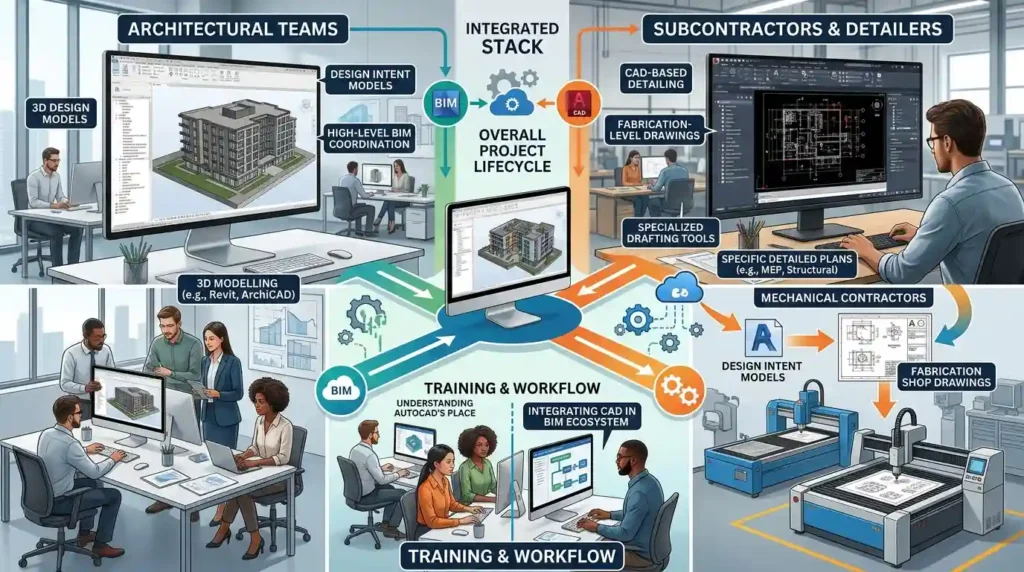
Many organisations operate hybrid environments where AutoCAD and BIM platforms coexist.
Architectural teams may use BIM software extensively, while subcontractors maintain CAD-based detailing processes. Mechanical contractors often receive design intent models but produce fabrication-level drawings using specialised drafting tools.
Training therefore focuses on ensuring professionals understand where AutoCAD fits within the overall project lifecycle.
Rather than competing with BIM systems, AutoCAD increasingly functions as part of an integrated technology stack.
How Has AutoCAD HVAC Training Adapted to BIM-Driven Workflows?
Modern AutoCAD HVAC training incorporates BIM awareness, data coordination principles, model-based collaboration, and interoperability concepts. Training focuses on preparing learners to contribute within digital project environments were information exchange and multidisciplinary coordination influence project success.
BIM has fundamentally changed project communication.
Design decisions are now shared across multiple disciplines through coordinated digital environments. HVAC professionals must understand how mechanical systems interact with architectural, structural, and electrical components.
As a result, training programmes have expanded beyond drafting exercises.
Learners study:
- BIM terminology
- Model coordination concepts
- Information management practices
- Design validation workflows
- Documentation standards
- Cross-platform collaboration processes
The objective is not to transform AutoCAD into BIM software. Instead, it is to prepare professionals for projects where both technologies operate simultaneously.
This training approach addresses a common workforce challenge. Many employees possess strong drafting skills but lack exposure to integrated project delivery methods.
HR teams increasingly prioritise candidates who understand collaborative digital environments because these competencies support faster project execution and fewer coordination errors.
Understanding Interoperability
Interoperability refers to the ability of different software platforms to exchange and utilise project information effectively.
In MEP environments, interoperability affects:
- Drawing exchange
- Model coordination
- Asset information transfer
- Construction documentation
- Facility management records
Training programmes now introduce these concepts early to ensure learners understand the practical implications of software integration.
What Skills Differentiate Traditional HVAC Drafting from Modern HVAC Design Training?
Modern HVAC design training combines drafting accuracy with coordination, documentation management, standards compliance, workflow integration, and digital collaboration skills. These competencies reflect the operational requirements of contemporary MEP projects rather than isolated software proficiency.
Traditional drafting education focused primarily on producing drawings.
Modern project environments demand a wider range of competencies.
Professionals must understand:
- Mechanical system representation
- Design communication
- Project documentation
- Revision control
- Cross-disciplinary coordination
- Information management
The difference becomes particularly visible during large commercial developments.
A drafter working in isolation produces drawings.
A modern HVAC professional contributes to a coordinated information ecosystem where every design modification influences multiple stakeholders.
The workforce implications are substantial.
Companies increasingly evaluate candidates based on workflow understanding rather than software command knowledge alone.
Emerging Competencies in MEP Teams
Current hiring trends frequently prioritise:
- Digital collaboration skills
- BIM awareness
- Documentation accuracy
- Standards compliance
- Coordination experience
- Design communication capabilities
AutoCAD HVAC training increasingly addresses these areas because they directly influence project outcomes.
How Does AutoCAD HVAC Training Support BIM Transition Strategies?
AutoCAD HVAC training supports BIM transition by establishing strong design documentation skills, improving system understanding, and preparing learners for progressive adoption of model-based workflows. Structured learning pathways reduce skill gaps during organisational digital transformation initiatives.
Many organisations face a practical challenge when implementing BIM.
Existing teams possess extensive AutoCAD experience but limited exposure to model-based workflows.
Replacing established expertise is rarely cost-effective.
Instead, companies focus on upskilling existing personnel.
This approach creates a transition pathway where professionals retain drafting expertise while developing BIM-related competencies.
A useful evaluation point occurs when organisations examine training strategies that specifically prepare professionals for future BIM adoption, such as:
How Does Imperial Prepare HVAC Trainees for BIM Transition After Their AutoCAD Course?
This stage represents the shift from software learning toward implementation planning.
Training becomes a strategic workforce development tool rather than a technical exercise.
Organisational Benefits of Structured Transition Training
Businesses that follow phased learning approaches often achieve:
- Faster technology adoption
- Reduced productivity disruption
- Better workforce retention
- Improved project consistency
- Lower training-related risk
These outcomes directly support long-term digital transformation objectives.
Which Learning Approaches Produce Better Results for HVAC Professionals?
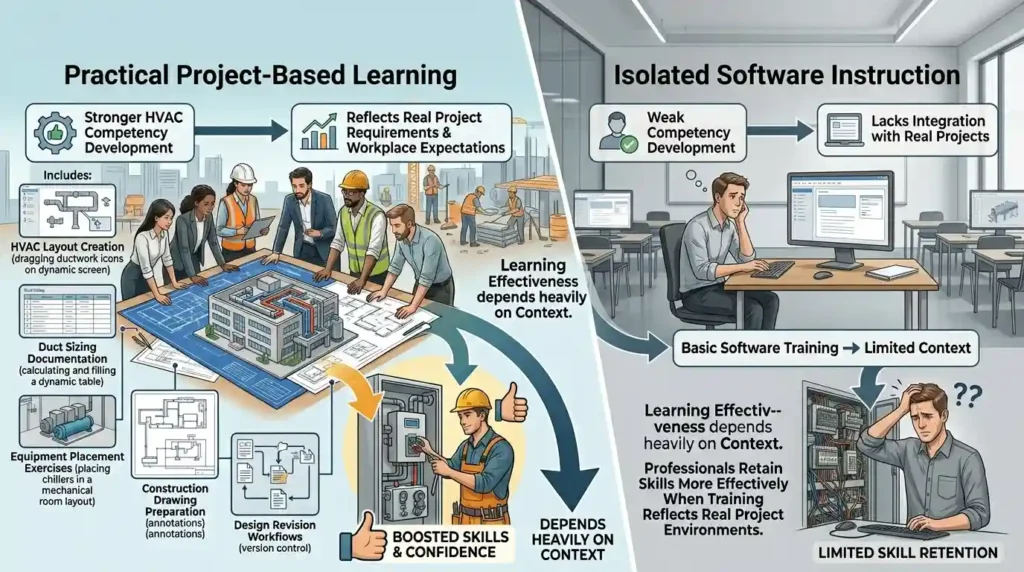
Practical project-based learning produces stronger HVAC competency development than isolated software instruction. Training that combines design tasks, documentation exercises, coordination scenarios, and workflow applications better reflects real project requirements and workplace expectations.
Learning effectiveness depends heavily on context.
Professionals retain skills more effectively when training reflects real project environments.
Project-based learning allows participants to apply technical concepts through practical scenarios.
Examples include:
- HVAC layout creation
- Duct sizing documentation
- Equipment placement exercises
- Construction drawing preparation
- Design revision workflows
These activities strengthen technical understanding while reinforcing project execution skills.
Comparison of Learning Approaches
| Learning Approach | Primary Focus | Workplace Readiness |
|---|---|---|
| Software Command Training | Tool operation | Moderate |
| Classroom Theory | Conceptual understanding | Moderate |
| Project-Based Learning | Real project application | High |
| Workflow Simulation | Team coordination | High |
| Integrated MEP Exercises | Cross-disciplinary collaboration | Very High |
The strongest outcomes typically occur when technical instruction is combined with practical application.
This reflects how HVAC professionals operate within actual project environments.
How Does the AutoCAD HVAC and Plumbing Design Training Course Align with Industry Requirements?
The AutoCAD HVAC and Plumbing Design Training Course aligns with industry requirements by combining technical drafting competencies, HVAC system documentation practices, design standards, and workflow awareness that reflect current MEP project delivery expectations.
The AutoCAD HVAC and Plumbing Design Training Course addresses both technical and operational requirements within the MEP sector.
Modern employers expect professionals to understand more than software functionality.
They require competency in:
- Mechanical system layouts
- Plumbing documentation
- Construction standards
- Drawing production
- Project coordination
- Technical communication
Training programmes aligned with these requirements create stronger connections between learning outcomes and workplace performance.
This alignment is particularly important for HR departments evaluating training investments.
Learning programmes generate measurable value when acquired skills transfer directly into project execution activities.
Measuring Training Effectiveness
Organisations commonly evaluate training through:
- Drawing accuracy rates
- Documentation quality
- Project delivery speed
- Coordination efficiency
- Design revision reduction
- Employee productivity improvements
These indicators provide practical measures of workforce development success.
What Should Organisations Evaluate When Selecting HVAC Training Solutions?
Organisations should evaluate training solutions based on workflow relevance, industry alignment, practical application, interoperability awareness, assessment methods, and measurable performance outcomes rather than software coverage alone.
Training selection has become increasingly strategic.
Businesses invest in workforce capability development to support operational performance, project delivery quality, and technology adoption initiatives.
As a result, decision-makers examine multiple evaluation criteria.
Decision Framework for Training Evaluation
| Evaluation Area | Key Question |
| Technical Coverage | Does training reflect current HVAC design practices? |
| Workflow Integration | Does it address real project environments? |
| BIM Awareness | Does it support digital collaboration requirements? |
| Practical Application | Are learners completing realistic project tasks? |
| Assessment Quality | Are competencies measured effectively? |
| Business Impact | Can outcomes be linked to workplace performance? |
This framework helps HR teams and technical managers assess whether training programmes support broader organisational objectives.
Selecting training based solely on software features often produces limited workforce development outcomes.
Evaluating workflow relevance generates stronger long-term value.
How Will MEP Software Evolution Continue Influencing HVAC Training?
MEP software evolution continues to increase demand for integrated skills that combine drafting, coordination, digital collaboration, information management, and project delivery expertise. Training programmes increasingly focus on adaptability rather than platform-specific knowledge alone.
Technology adoption within construction and engineering continues to accelerate.
Digital coordination platforms, cloud-based collaboration systems, asset management technologies, and BIM environments are becoming standard components of project delivery.
This trend changes workforce requirements.
Employers seek professionals capable of adapting across software ecosystems rather than relying on a single platform.
AutoCAD HVAC training addresses this reality by strengthening foundational design and documentation competencies while introducing the workflow principles that underpin modern MEP operations.
Discover More from Our Guide Library:
How Does AutoCAD HVAC Design Training Open Doors Into Industrial Engineering Sectors?
How Does AutoCAD HVAC Training Cover Plotting Layout and Drawing Output Setup?
The future of HVAC capability development therefore centres on transferable skills.
Professionals who understand design logic, project documentation, coordination processes, and digital collaboration frameworks remain valuable regardless of how individual software platforms evolve.
For organisations, this creates a practical training objective: develop adaptable professionals who can contribute effectively within increasingly integrated MEP environments while maintaining the technical precision required for successful project delivery.
Frequently Asked Questions
Who should attend an AutoCAD HVAC and Plumbing Design Training Course?
This course is suitable for mechanical engineers, HVAC technicians, MEP professionals, CAD operators, and engineering graduates. The AutoCAD HVAC and Plumbing Design Training Course helps learners develop technical drawing and design documentation skills for building services projects.
How does AutoCAD HVAC training support MEP design projects?
AutoCAD HVAC training helps professionals create accurate HVAC and plumbing drawings, coordinate building services layouts, and prepare construction-ready documentation. Imperial Corporate Training Institute includes industry-relevant design practices aligned with MEP project requirements.
Is AutoCAD still relevant for HVAC and plumbing design?
Yes, AutoCAD remains widely used for HVAC and plumbing drafting, detailed design documentation, and construction drawings. The AutoCAD HVAC and Plumbing Design Training Course develops essential CAD skills that support both traditional and BIM-based project environments.
What skills can learners gain from an AutoCAD HVAC and Plumbing Design Training Course?
Learners gain skills in HVAC drafting, plumbing system design, technical drawing standards, layout preparation, and MEP documentation. Imperial Corporate Training Institute helps participants understand design workflows commonly used in engineering and construction projects.