
Organisations face increasing pressure to improve efficiency, reduce waste, accelerate delivery, and maintain quality standards. Businesses across industries such as IT, healthcare, finance, manufacturing, telecommunications, and logistics rely on structured improvement frameworks to achieve these goals. Two of the most widely adopted approaches are Lean Six Sigma and Agile methodologies.
Although both frameworks focus on improving performance and delivering value, they address different business challenges and operate through different principles. Understanding the distinction between Lean Six Sigma and Agile helps HR managers, Learning and Development (L&D) professionals, business owners, and operational leaders select appropriate capability-building strategies and workforce development programmes.
Lean Six Sigma vs Agile Methodologies
Lean Six Sigma focuses on process efficiency, waste reduction, and quality improvement through data-driven analysis. Agile focuses on adaptability, collaboration, and rapid delivery through iterative work cycles. Organisations use Lean Six Sigma to optimise processes and Agile to increase responsiveness to changing business requirements.
The distinction begins with the primary objective of each methodology.
Lean Six Sigma combines Lean principles and Six Sigma statistical techniques. Lean concentrates on eliminating activities that do not add value. Six Sigma focuses on reducing process variation and defects. Together, they create a structured framework for continuous improvement.
Agile originated in software development but expanded into project management, product development, and business operations. Agile prioritises flexibility, customer feedback, incremental delivery, and continuous adaptation.
Lean Six Sigma asks:
- How can this process become more efficient?
- Where does waste occur?
- What causes defects?
- How can variation be reduced?
Agile asks:
- How can teams deliver value faster?
- How can customer feedback be incorporated quickly?
- How can priorities adapt to changing requirements?
- How can collaboration improve outcomes?
The difference reflects two complementary business needs: operational excellence and organisational agility.
How Does Lean Six Sigma Work in Corporate Environments?
Lean Six Sigma operates through structured improvement projects that identify inefficiencies, analyse root causes, implement solutions, and measure performance gains. Organisations use defined methodologies, statistical tools, and performance metrics to improve quality, productivity, and operational consistency.
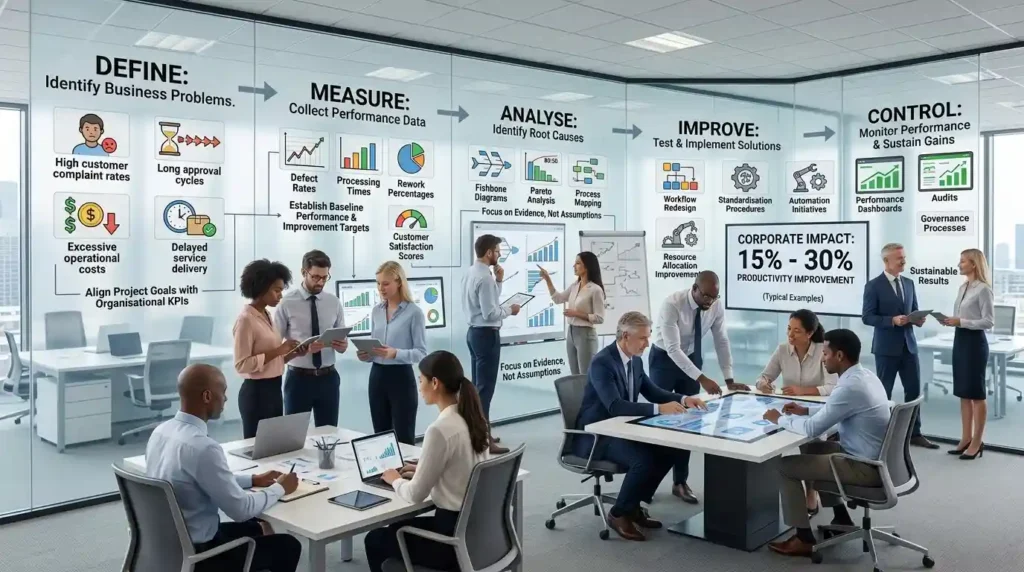
Lean Six Sigma projects follow the DMAIC framework:
Define
Teams identify a business problem.
Examples include:
- High customer complaint rates
- Long approval cycles
- Excessive operational costs
- Delayed service delivery
Project goals align with organisational KPIs.
Measure
Teams collect performance data.
Measurements often include:
- Defect rates
- Processing times
- Rework percentages
- Customer satisfaction scores
Baseline performance establishes improvement targets.
Analyse
Root causes are identified using analytical tools.
Examples include:
- Fishbone diagrams
- Pareto analysis
- Process mapping
- Statistical analysis
The focus remains on evidence rather than assumptions.
Improve
Solutions are tested and implemented.
Examples include:
- Workflow redesign
- Standardisation procedures
- Automation initiatives
- Resource allocation improvements
Control
Monitoring systems ensure improvements remain sustainable.
Performance dashboards, audits, and governance processes support long-term results.
Many organisations report productivity improvements between 15% and 30% after successful process improvement initiatives supported by Lean Six Sigma principles.
How Does Agile Work in Corporate Environments?
Agile works through short delivery cycles, cross-functional collaboration, continuous feedback, and incremental improvements. Teams focus on delivering usable outcomes in regular intervals while adapting priorities based on stakeholder needs and changing business conditions.
Agile breaks large projects into smaller deliverables.
Work is organised into iterations known as sprints.
A typical sprint lasts between 1 and 4 weeks.
During each sprint, teams:
- Define priorities
- Complete agreed tasks
- Review results
- Gather feedback
- Adjust future plans
Common Agile frameworks include:
Scrum
Scrum uses structured roles and sprint-based delivery cycles.
Roles include:
- Product Owner
- Scrum Master
- Development Team
Kanban
Kanban focuses on workflow visualisation and work-in-progress management.
Teams use boards to monitor task movement from initiation to completion.
Scaled Agile Framework (SAFe)
Large enterprises use SAFe to coordinate Agile practices across multiple departments and business units.
Agile implementation often improves project visibility, stakeholder engagement, and delivery speed.
What Business Problems Does Each Methodology Solve?
Lean Six Sigma addresses inefficiency, waste, defects, and inconsistent performance. Agile addresses slow delivery, changing requirements, communication barriers, and limited responsiveness. Organisations select methodologies based on the specific operational challenges they face.
Businesses often encounter distinct performance obstacles.
Lean Six Sigma addresses problems such as:
- Excessive operational costs
- Process bottlenecks
- Compliance failures
- Quality inconsistencies
- High rework rates
Agile addresses challenges such as:
- Frequent requirement changes
- Delayed product launches
- Customer feedback delays
- Siloed departments
- Limited innovation speed
A manufacturing company reducing production defects benefits from Lean Six Sigma.
A software development team responding to rapidly changing customer requirements benefits from Agile.
The methodology should match the nature of the challenge.
What Skills Are Required for Lean Six Sigma and Agile Implementation?
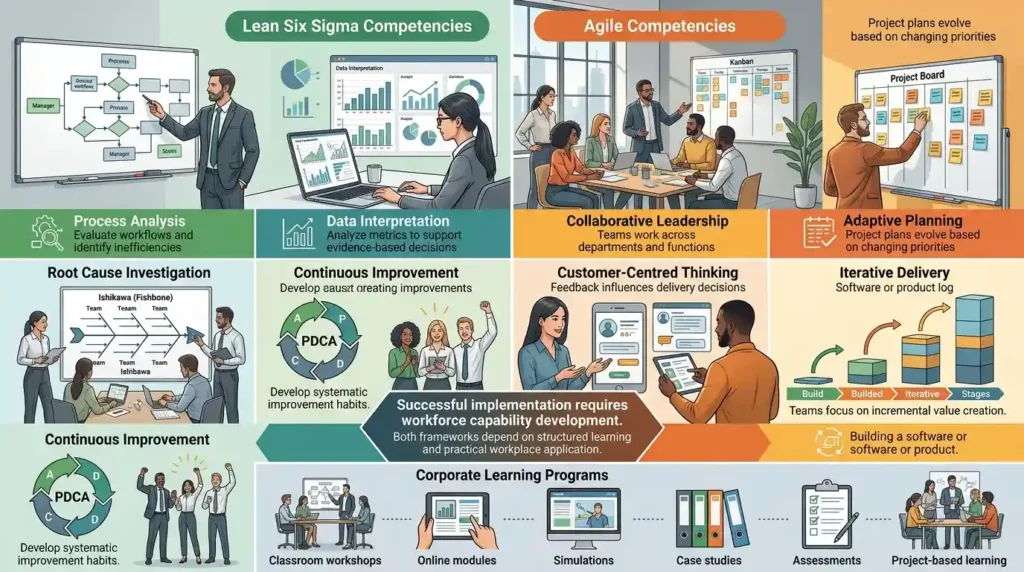
Lean Six Sigma requires analytical thinking, process management, statistical analysis, and performance measurement skills. Agile requires collaboration, stakeholder management, adaptive planning, communication, and iterative delivery skills. Both frameworks depend on structured learning and practical workplace application.
Successful implementation requires workforce capability development.
Lean Six Sigma competencies include:
Process Analysis
Employees learn to evaluate workflows and identify inefficiencies.
Data Interpretation
Teams analyse metrics to support evidence-based decisions.
Root Cause Investigation
Professionals identify underlying causes rather than symptoms.
Continuous Improvement
Employees develop systematic improvement habits.
Agile competencies include:
Collaborative Leadership
Teams work across departments and functions.
Adaptive Planning
Project plans evolve based on changing priorities.
Customer-Centred Thinking
Feedback influences delivery decisions.
Iterative Delivery
Teams focus on incremental value creation.
Corporate learning programmes frequently combine classroom workshops, online modules, simulations, case studies, assessments, and project-based learning activities to build these competencies.
What Components Are Included in Organisational Training for These Methodologies?
Organisational training includes frameworks, tools, implementation techniques, performance measurement systems, practical exercises, and real-world business scenarios. Effective programmes connect learning outcomes directly to operational objectives and measurable performance indicators.
Training initiatives typically address several core components.
Framework Knowledge
Participants learn methodology principles, terminology, and governance structures.
Practical Tools
Lean Six Sigma tools include:
- Value Stream Mapping
- Control Charts
- Pareto Analysis
- Failure Mode and Effects Analysis (FMEA)
Agile tools include:
- Sprint Planning
- Product Backlogs
- User Stories
- Kanban Boards
Simulation-Based Learning
Participants apply concepts to realistic business situations.
Assessment and Evaluation
Knowledge assessments verify competency development.
Workplace Application
Employees implement learned techniques within actual organisational projects.
Blended learning models often combine instructor-led sessions with self-paced digital learning to improve knowledge retention and practical application.
Can Lean Six Sigma and Agile Be Used Together?
Lean Six Sigma and Agile complement one another when organisations require both operational efficiency and rapid adaptability. Integrated approaches combine process optimisation with iterative delivery to improve performance across complex business environments.
Modern organisations increasingly integrate both methodologies.
Agile accelerates execution.
Lean Six Sigma improves process quality.
Combined implementation supports:
- Faster project delivery
- Reduced operational waste
- Improved customer satisfaction
- Higher process consistency
- Better cross-functional collaboration
Organisations exploring integrated improvement strategies often seek deeper understanding of how advanced improvement frameworks combine operational excellence with adaptive delivery models.
Readers interested in implementation approaches can explore:
How Does Master Black Belt Training Address the Intersection of Lean and Agile?
Get more information, enrol in:
Lean Six Sigma Master Black Belt Certification Training Course
This represents the stage where awareness shifts towards evaluating structured capability development solutions.
What Benefits Do Organisations Gain from Lean Six Sigma and Agile Adoption?
Organisations achieve measurable improvements in efficiency, quality, delivery speed, customer satisfaction, and workforce effectiveness. Success depends on aligning methodology selection with strategic objectives, operational requirements, and organisational culture.
Key organisational outcomes include:
Improved Productivity
Streamlined workflows reduce unnecessary activities.
Enhanced Quality
Defect reduction improves service and product consistency.
Faster Delivery
Agile practices accelerate project completion timelines.
Stronger Decision-Making
Data-driven analysis improves management decisions.
Better Employee Engagement
Clear processes and collaborative environments support workforce participation.
Increased Customer Satisfaction
Improved responsiveness and quality contribute to stronger customer experiences.
Performance indicators frequently monitored include:
- Cycle time reduction
- Defect reduction percentage
- Customer satisfaction scores
- Employee engagement metrics
- Cost savings
- Revenue growth support
These metrics provide evidence of organisational impact.
What Common Misconceptions Prevent Successful Implementation?
Many organisations incorrectly view Lean Six Sigma and Agile as competing methodologies, technology solutions, or short-term initiatives. Effective implementation requires cultural alignment, leadership commitment, capability development, and ongoing performance measurement.
Several misconceptions reduce effectiveness.
Misconception 1: Agile Eliminates Structure
Agile includes defined frameworks, governance processes, and accountability mechanisms.
Misconception 2: Lean Six Sigma Is Only for Manufacturing
Lean Six Sigma is widely applied in healthcare, banking, insurance, logistics, government, and professional services.
Misconception 3: Training Alone Creates Results
Training builds capability.
Workplace application creates measurable outcomes.
Misconception 4: One Methodology Fits Every Situation
Different business challenges require different approaches.
Misconception 5: Improvement Projects End After Implementation
Continuous monitoring and refinement sustain performance gains.
Organisations that establish governance systems, leadership support, and performance measurement frameworks achieve stronger long-term results than organisations that treat improvement initiatives as isolated projects.
How Do Organisations Choose Between Lean Six Sigma and Agile?
Organisations choose Lean Six Sigma when the priority is process improvement and quality enhancement. They choose Agile when the priority is speed, adaptability, and continuous delivery. Many enterprises combine both approaches to address diverse operational requirements.
Selection depends on strategic objectives.
Discover More from Our Guide Library:
How Is Lean Six Sigma Used to Improve Customer Satisfaction Scores?
What Are Common Lean Six Sigma Project Failure Modes and How Are They Avoided?
Lean Six Sigma is appropriate when organisations seek:
- Cost reduction
- Quality improvement
- Compliance enhancement
- Process standardisation
Agile is appropriate when organisations seek:
- Faster innovation
- Rapid delivery cycles
- Customer-driven development
- Greater organisational flexibility
Large enterprises frequently apply Lean Six Sigma in operational functions while using Agile in product development, technology, and innovation teams.
The most effective workforce development strategies align methodology selection with business goals, organisational maturity, performance metrics, and long-term capability requirements
Frequently Asked Questions
Who should take Lean Six Sigma Master Black Belt training?
This training is designed for senior professionals, process managers, and quality leaders responsible for operational excellence and organisational improvement. It is commonly used in industries like manufacturing, healthcare, IT, and finance to develop advanced Lean Six Sigma leadership capability.
What skills are developed in Master Black Belt certification training?
The course develops expertise in advanced statistical analysis, DMAIC leadership, process optimisation, and change management. Learners also gain skills in mentoring Green and Black Belts and driving data-based decision-making across business functions.
How does Lean Six Sigma Master Black Belt training improve business performance?
It improves business performance by reducing process inefficiencies, lowering operational costs, and increasing quality consistency. Organisations using structured Lean Six Sigma frameworks report improved productivity, better compliance, and stronger customer satisfaction outcomes.
What is the difference between Lean Six Sigma Black Belt and Master Black Belt?
A Black Belt focuses on executing Lean Six Sigma projects, while a Master Black Belt focuses on strategy, governance, and organisational deployment of improvement systems. Imperial Corporate Training Institute positions Master Black Belts as enterprise-level leaders driving continuous improvement culture.