

A reflected ceiling plan is a technical drawing showing ceiling elements, lighting, HVAC diffusers, sprinklers, and services as viewed from above. It aligns architectural design with mechanical systems to ensure spatial coordination, installation accuracy, and efficient building service integration outcomes.
A reflected ceiling plan (RCP) functions as a coordination layer between architectural intent and building services engineering. It defines how ceiling-mounted systems occupy shared spatial zones above finished ceiling level.
In corporate construction projects, RCPs are used to visualise ceiling infrastructure before installation begins. This reduces spatial conflicts between HVAC ductwork, lighting grids, fire protection systems, and structural beams.
Industries like commercial real estate, healthcare facilities, data centres, and hospitality rely on RCPs to ensure ceiling systems do not interfere with operational performance or safety compliance.
RCPs are integrated into BIM and CAD environments, where HVAC engineers, architects, and electrical designers collaborate using layered drawings. This coordination ensures that ceiling space is used efficiently without rework or installation delays.
How does HVAC design integrate with reflected ceiling plans in corporate projects?
HVAC design integrates with reflected ceiling plans through coordinated routing of ducts, diffusers, and mechanical systems within ceiling spaces. It prevents clashes with structural and electrical services, improves installation sequencing, and ensures compliance with spatial and performance requirements standards alignment.
HVAC integration with RCPs operates through spatial planning of air distribution systems inside ceiling voids. Engineers position ducts, return air grilles, and diffusers based on ceiling geometry and service constraints.
In corporate environments, coordination meetings between MEP disciplines ensure that HVAC layouts align with lighting layouts and sprinkler grids. This prevents site-level conflicts that increase project cost and delay schedules.
The process reduces rework rates by 25–40% in large-scale commercial projects when coordination is executed during design stages rather than construction stages.
It also improves energy efficiency performance because air distribution paths remain unobstructed, ensuring consistent airflow and compliance with ASHRAE-based ventilation standards used in international projects.
How does AutoCAD-based training teach coordination between HVAC layouts and RCPs?
AutoCAD-based training teaches coordination by simulating real project drawings where HVAC layouts are overlaid on reflected ceiling plans. Learners practise clash detection, layer management, annotation standards, and sequencing workflows to ensure accurate, buildable coordination in the execution readiness of commercial construction projects.

Training in AutoCAD for HVAC and RCP coordination focuses on replicating live project conditions. Trainees work on multi-layered drawings where architectural ceilings, HVAC systems, and electrical layouts exist in a single coordinated model.
Practical exercises include duct routing within confined ceiling spaces, diffuser placement alignment, and conflict resolution using layer isolation tools. These simulations replicate real MEP coordination challenges found in commercial construction environments.
Clash detection exercises improve accuracy by identifying spatial conflicts before construction begins. This reduces site errors and improves installation efficiency by up to 30% in project-based learning assessments.
Annotation standards training ensures consistency across teams, allowing engineers, drafters, and project managers to interpret drawings without ambiguity.
At the implementation stage, learners transition from basic drafting to coordination-based workflows. This includes managing X-references, maintaining layer discipline, and applying project naming conventions used in enterprise design environments.
At the point where organisations evaluate structured capability development in HVAC coordination, technical training becomes the primary decision factor.
At this stage, structured learning models such as:
How Does AutoCAD HVAC Training Teach Coordination with Reflected Ceiling Plans? Guide decision-makers in comparing training outcomes, delivery formats, and applied competency frameworks before selecting a programme.
For deeper insight, enrol in:
AutoCAD HVAC and Plumbing Design Training Course.
What are the key components of reflected ceiling plan coordination in HVAC workflows?
Key components include spatial zoning, duct routing logic, diffuser placement strategy, clash detection protocols, layer management systems, and BIM/CAD integration standards. These components ensure HVAC systems align with architectural ceilings while maintaining airflow efficiency, safety compliance, and installation accuracy across project environments.
Spatial zoning defines how ceiling areas are divided between mechanical, electrical, and architectural elements. HVAC engineers allocate zones for supply air, return air, and exhaust systems.
Duct routing logic determines airflow paths based on shortest feasible routes while avoiding structural interference. This reduces material waste and improves system efficiency.
Diffuser placement strategy ensures even air distribution across occupied zones in commercial buildings like offices, hospitals, and retail centres.
Clash detection protocols identify conflicts between HVAC components and other building services before construction begins, reducing rework costs.
Layer management systems in AutoCAD allow separation of architectural, mechanical, and electrical components for clear visual coordination and improved project control.
BIM integration ensures that RCPs and HVAC models remain synchronised across multidisciplinary teams during design and construction phases.
How do organisations implement reflected ceiling plan coordination training in teams?
Organisations implement RCP coordination training through structured learning pathways, including workshops, CAD simulation modules, project-based assessments, and hybrid learning formats. Teams are trained to align HVAC drafting standards, reduce design conflicts, and improve cross-disciplinary coordination efficiency across engineering departments.
Corporate training implementation begins with skill gap analysis across HVAC design teams. This identifies deficiencies in CAD proficiency, spatial coordination, and MEP integration understanding.
Training delivery uses blended formats. Workshops provide instructor-led demonstrations, online modules deliver theoretical frameworks, and simulation labs replicate real project environments.
Project-based assessments are used to measure competency. Teams are assigned full-scale RCP coordination tasks that include HVAC duct layout, ceiling grid alignment, and clash resolution exercises.
Organisations integrate training outputs into KPIs such as design accuracy rate, coordination cycle time, and reduction in revision requests during project execution.
Structured learning improves cross-functional communication between architects, engineers, and project managers, resulting in smoother project delivery workflows.
What KPIs measure effectiveness of HVAC and RCP coordination training?
KPIs include design error reduction rate, clash detection resolution time, project rework percentage, drafting productivity per engineer, and coordination cycle efficiency. These metrics quantify training impact on operational performance, cost savings, and project delivery speed across engineering and construction teams.
Design error reduction rate measures the decrease in drafting mistakes after training implementation. High-performing teams achieve 20–35% reduction in drawing revisions.
Clash detection resolution time tracks how quickly teams identify and resolve spatial conflicts within CAD models. Faster resolution improves project scheduling accuracy.
Rework percentage measures how often drawings require redesign after stakeholder review. Effective training reduces rework by up to 40% in coordinated projects.
Drafting productivity per engineer evaluates output volume and accuracy in CAD-based environments, reflecting improved technical proficiency.
Coordination cycle efficiency measures time taken from initial design to final approved coordinated drawings. Training reduces this cycle by improving standardisation and workflow discipline.
What are common problems in reflected ceiling plan and HVAC design alignment?
Common problems include spatial clashes between systems, inconsistent CAD layering, inaccurate duct sizing, poor coordination between disciplines, and lack of standardised drafting procedures. These issues increase project cost, delay construction schedules, and reduce overall design quality in engineering workflows.
Spatial clashes occur when HVAC ducts intersect with lighting fixtures or structural beams due to incomplete coordination during design stages.
Inconsistent CAD layering leads to confusion in identifying mechanical and architectural elements, increasing the risk of drafting errors.
Inaccurate duct sizing results from incorrect load calculations or misaligned design assumptions, affecting airflow performance and system efficiency.
Poor interdisciplinary coordination between HVAC, electrical, and architectural teams leads to duplicated work and misaligned project deliverables.
Lack of standardised drafting procedures creates variation in drawing quality across teams, reducing consistency in large-scale projects.
These problems are typically resolved through structured CAD training, workflow standardisation, and integrated BIM coordination practices.
What industries use reflected ceiling plan coordination skills in HVAC engineering?
Industries include commercial construction, healthcare infrastructure, data centres, hospitality developments, and industrial facilities. These sectors require precise HVAC and ceiling coordination to maintain operational efficiency, safety compliance, environmental control, and infrastructure reliability across complex building systems and engineering environments.
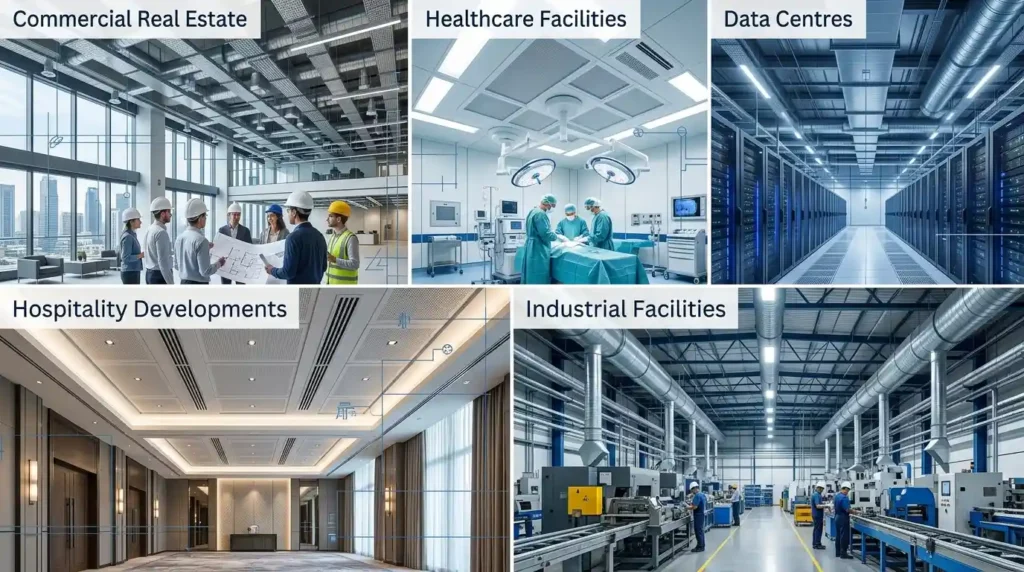
Commercial real estate projects use RCP coordination for office towers, shopping centres, and mixed-use developments where ceiling systems are densely integrated.
Healthcare facilities require precise HVAC coordination to maintain air quality control, infection prevention systems, and regulated ventilation zones in operating theatres and patient wards.
Data centres depend on controlled airflow distribution systems to manage heat loads generated by server infrastructure.
Hospitality developments such as hotels require coordinated ceiling designs for aesthetic integration and climate control across guest rooms and public areas.
Industrial facilities use RCP coordination to manage ventilation systems, exhaust routing, and temperature control in manufacturing environments.
How does structured training improve project delivery timelines and cost efficiency?
Structured training improves delivery timelines by standardising CAD workflows, reducing design conflicts, and increasing coordination efficiency. It reduces project cost through lower rework rates, faster approval cycles, and improved cross-disciplinary communication in HVAC and construction engineering environments.
Standardised workflows eliminate variation in drawing practices, ensuring consistent output across engineering teams working on shared projects.
Reduced design conflicts decrease time spent on revisions, allowing projects to move from design to execution faster.
Discover More from Our Guide Library:
How Are Ventilation System Drawings Created for Commercial Spaces in AutoCAD?
Why Is AutoCAD HVAC Proficiency a Job Requirement for Most MEP Firms Today?
Improved coordination efficiency shortens approval cycles between architects, engineers, and project stakeholders.
Cost efficiency increases due to reduced material waste, fewer site modifications, and lower rework requirements during construction phases.
Organisations implementing structured HVAC and RCP training report measurable improvements in project delivery speed, typically ranging from 15–30% faster completion rates depending on project scale and complexity.
How does AutoCAD HVAC training improve reflected ceiling plan coordination skills?
The AutoCAD HVAC and Plumbing Design Training Course develops skills in aligning HVAC ductwork with reflected ceiling plans to avoid spatial clashes. It teaches coordination with lighting grids, sprinkler systems, and structural elements using AutoCAD workflows.
Who should take the AutoCAD HVAC and Plumbing Design Training Course?
This course is designed for HVAC engineers, CAD technicians, mechanical designers, and construction professionals involved in building services design. Imperial Corporate Training Institute structures it for teams working in construction, facilities management, and MEP consultancy roles.
What software skills are developed in AutoCAD HVAC and Plumbing training?
Learners gain advanced AutoCAD skills including 2D HVAC drafting, plumbing schematics, X-reference management, and layer control. The training also focuses on producing coordinated MEP drawings used in real-world engineering and construction documentation.
How is AutoCAD HVAC training used in real construction projects?
The AutoCAD HVAC and Plumbing Design Training Course applies to commercial projects where HVAC layouts must align with architectural reflected ceiling plans. It is widely used in industries like commercial buildings, healthcare facilities, and industrial infrastructure design.