

AutoCAD HVAC proficiency is the ability to create, interpret, modify, and coordinate heating, ventilation, and air conditioning drawings within Mechanical, Electrical, and Plumbing (MEP) projects using industry-standard drafting workflows, technical standards, and collaboration processes used in commercial construction environments.
AutoCAD HVAC proficiency combines technical drafting skills with engineering coordination. It includes HVAC layout planning, duct routing, equipment placement, airflow calculations, plumbing integration, and documentation management. MEP firms use these competencies to deliver construction-ready designs that comply with project specifications, local regulations, and operational performance targets.
Modern MEP firms operate in industries like healthcare, manufacturing, commercial real estate, data centres, and hospitality. These sectors require detailed HVAC systems that support temperature control, indoor air quality, energy efficiency, and occupant safety. AutoCAD enables engineering teams to visualise these systems before physical installation begins.
Employers treat AutoCAD HVAC expertise as a core operational skill because design accuracy directly affects project costs, installation timelines, and facility performance. A drawing error in duct sizing or equipment coordination increases material waste, rework hours, and contractor disputes. Firms measure these impacts through KPIs such as project completion rates, drawing revision frequency, clash detection counts, and installation efficiency.
The demand for AutoCAD HVAC proficiency also reflects workforce transformation in construction and engineering. MEP projects now involve multidisciplinary collaboration between architects, civil engineers, electrical designers, and facility managers. Teams require standardised drawing environments that support coordination across departments and external contractors.
An AutoCAD HVAC and Plumbing Design Training Course addresses these workplace demands by developing practical drafting capability, system coordination knowledge, and project documentation skills aligned with live industry workflows.
Why Do MEP Firms Prioritise AutoCAD HVAC Skills During Recruitment?
MEP firms prioritise AutoCAD HVAC skills because projects depend on precise technical drawings, coordinated system layouts, and rapid design revisions that reduce delays, improve installation accuracy, and support compliance with engineering standards across multi-disciplinary construction environments.

Recruitment teams evaluate AutoCAD HVAC competency as a productivity indicator. A candidate with operational drafting knowledge contributes to project delivery faster than someone requiring extensive technical onboarding. Firms calculate onboarding efficiency using metrics such as training duration, supervision hours, and drawing revision rates during the first 90 days of employment.
Construction schedules have become shorter. Commercial projects frequently operate under 6-month to 18-month delivery timelines. Engineering departments need employees who understand HVAC drafting conventions, layer management, annotation standards, and mechanical coordination processes from the first project assignment.
AutoCAD HVAC proficiency also supports standardisation across distributed teams. Large MEP firms manage multiple projects simultaneously across different cities and countries. Consistent drawing structures enable teams to exchange files, maintain revision control, and coordinate engineering updates without workflow disruption.
Recruiters increasingly assess software competency alongside engineering fundamentals. Technical interviews often include:
HVAC Drafting Assessments
Candidates complete live drafting tasks such as duct layout creation, diffuser placement, equipment scheduling, or plumbing coordination.
Drawing Interpretation Exercises
Applicants review MEP drawings to identify clashes, sizing errors, or airflow distribution problems.
Project Coordination Scenarios
Candidates explain how HVAC systems integrate with electrical layouts, plumbing systems, and architectural constraints.
These evaluations measure operational readiness rather than theoretical knowledge alone.
How Does AutoCAD HVAC Training Work in Corporate Learning Environments?
AutoCAD HVAC training works through structured technical learning modules that combine software instruction, engineering concepts, project simulations, assessments, and collaborative design exercises aligned with real construction and facility management workflows.
Corporate learning departments implement AutoCAD HVAC training through blended delivery formats. These formats include instructor-led workshops, virtual classrooms, self-paced modules, and project-based assessments. Organisations select delivery models based on workforce size, operational schedules, and technical objectives.
Training programmes generally follow five implementation stages.
Technical Skill Assessment
Training begins with baseline evaluation. Organisations identify employee skill gaps in drafting accuracy, HVAC system knowledge, layer management, and design coordination.
L&D teams measure current capability using:
- Drawing accuracy tests
- Software navigation exercises
- HVAC terminology assessments
- Project simulation tasks
- Productivity benchmarks
This assessment establishes measurable learning objectives.
Software and Workflow Instruction
Participants learn core AutoCAD HVAC functions used in MEP environments. Topics include:
- HVAC drafting standards
- Duct and piping layouts
- Equipment placement
- Mechanical symbols
- Layer management
- Annotation systems
- Sheet setup and plotting
- File coordination procedures
Training uses real project examples instead of isolated software demonstrations. This approach improves knowledge transfer into workplace operations.
Project-Based Simulations
Simulation-based learning strengthens practical application. Employees complete exercises that replicate commercial projects such as office buildings, hospitals, warehouses, and retail centres.
Teams work on:
- Air distribution layouts
- Ventilation routing
- Chilled water systems
- Plumbing coordination
- Equipment schedules
- Mechanical room planning
Simulation environments improve technical decision-making and reduce design inconsistency.
Collaborative Coordination Exercises
Modern MEP workflows depend on cross-functional collaboration. Training therefore includes coordination exercises between HVAC, plumbing, and electrical disciplines.
Participants learn:
- Clash identification
- Revision management
- Design communication
- File-sharing protocols
- Coordination meeting workflows
These competencies improve operational efficiency in live projects.
Performance Evaluation and Reporting
Training outcomes are measured using operational KPIs. Organisations track:
- Drawing completion speed
- Error reduction percentages
- Rework frequency
- Coordination issue counts
- Project delivery timelines
- Compliance accuracy
These metrics help L&D departments evaluate training ROI and workforce readiness.
What Skills and Technical Components Are Included in AutoCAD HVAC Training?
AutoCAD HVAC training includes mechanical drafting, HVAC system design fundamentals, plumbing coordination, airflow planning, documentation management, project collaboration, and technical compliance skills required for commercial engineering and construction projects.
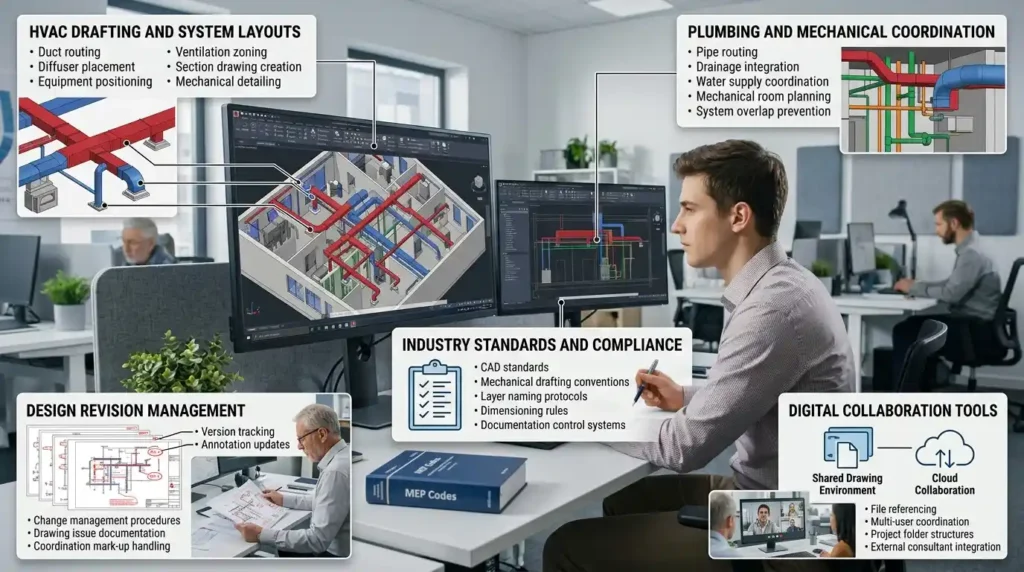
The training combines software operation with engineering application. Technical capability alone does not meet workplace requirements. Employees must also understand how HVAC systems function within commercial facilities.
HVAC Drafting and System Layouts
Participants learn how to produce accurate HVAC drawings for construction documentation.
Key tasks include:
- Duct routing
- Diffuser placement
- Equipment positioning
- Ventilation zoning
- Section drawing creation
- Mechanical detailing
Training focuses on precision and readability because construction teams depend on clear installation drawings.
Plumbing and Mechanical Coordination
HVAC systems interact closely with plumbing infrastructure. Training therefore covers coordinated MEP workflows.
Participants learn:
- Pipe routing
- Drainage integration
- Water supply coordination
- Mechanical room planning
- System overlap prevention
This reduces installation conflicts during project execution.
Industry Standards and Compliance
Commercial projects require compliance with engineering codes and organisational standards.
Training covers:
- CAD standards
- Mechanical drafting conventions
- Layer naming protocols
- Dimensioning rules
- Documentation control systems
Standardisation improves coordination across engineering teams and contractors.
Design Revision Management
MEP projects involve continuous design updates. Employees therefore need revision control capability.
Training includes:
- Version tracking
- Annotation updates
- Change management procedures
- Drawing issue documentation
- Coordination mark-up handling
These processes reduce communication breakdowns between departments.
Digital Collaboration Tools
Many organisations integrate AutoCAD into wider digital workflows. Teams use shared servers, cloud collaboration systems, and BIM coordination platforms.
Training introduces collaborative practices such as:
- Shared drawing environments
- File referencing
- Multi-user coordination
- Project folder structures
- External consultant integration
These skills improve operational continuity across distributed project teams.
How Does AutoCAD HVAC Proficiency Improve Organisational Performance?
AutoCAD HVAC proficiency improves organisational performance by increasing drafting accuracy, reducing engineering rework, accelerating project delivery, strengthening multidisciplinary coordination, and supporting measurable operational efficiency across design and construction teams.
MEP firms evaluate technical training based on business impact. AutoCAD HVAC capability influences operational performance across multiple departments.
Engineering productivity increases when employees produce standardised drawings efficiently. Teams spend less time correcting layouts, updating annotations, or resolving coordination conflicts. Organisations often track productivity gains through drawing turnaround times and project milestone completion rates.
Design accuracy also improves construction efficiency. Contractors install systems faster when drawings contain precise measurements, clear annotations, and coordinated layouts. Reduced rework lowers labour costs and material waste.
Organisations implementing structured technical training programmes report improvements in:
- Project delivery consistency
- Internal coordination efficiency
- Drawing approval timelines
- Client revision cycles
- Quality assurance compliance
Employee retention also improves in technical departments that support structured professional development. Skilled employees remain engaged when organisations invest in industry-relevant learning pathways linked to operational performance.
Training additionally strengthens succession planning. Senior HVAC designers and project managers frequently emerge from technically skilled drafting teams. Organisations therefore use AutoCAD HVAC training as part of broader workforce development strategies.
Which Industries Depend Most on AutoCAD HVAC Expertise?
Industries that depend most on AutoCAD HVAC expertise include healthcare, commercial construction, manufacturing, hospitality, education, retail, logistics, and data centre operations because these environments require complex climate control and coordinated MEP infrastructure systems.
Different industries apply HVAC systems differently based on operational requirements.
Healthcare Facilities
Hospitals and laboratories require specialised ventilation systems for infection control, air filtration, and temperature regulation. HVAC drawings must support strict compliance standards and equipment coordination.
Commercial Buildings
Office towers, shopping centres, and mixed-use developments require large-scale HVAC distribution systems integrated with architectural layouts and energy management objectives.
Manufacturing Plants
Industrial facilities depend on ventilation systems for heat extraction, equipment cooling, and worker safety. AutoCAD HVAC teams coordinate these systems with production infrastructure.
Data Centres
Data centres require precision cooling systems that maintain server performance and operational continuity. HVAC layouts directly affect energy consumption and equipment reliability.
Hospitality and Retail
Hotels, restaurants, and retail centres require efficient airflow distribution that supports occupant comfort and operational efficiency across multiple zones.
These industries prioritise AutoCAD HVAC proficiency because operational performance depends on coordinated environmental control systems.
What Common Problems Reduce the Effectiveness of AutoCAD HVAC Training?
Common problems reducing AutoCAD HVAC training effectiveness include generic content, lack of project simulation, weak performance measurement, outdated workflows, disconnected learning objectives, and insufficient alignment between training activities and operational engineering requirements.
Many organisations implement technical training without operational alignment. Generic software instruction often fails because employees do not learn how drafting processes function within actual MEP projects.
Training programmes become ineffective when they focus only on interface navigation instead of workflow execution. Employees need contextual understanding of HVAC coordination, documentation standards, and project communication.
Another common issue involves outdated training content. Construction technologies, drafting standards, and coordination processes evolve continuously. Programmes using obsolete workflows create skill gaps rather than reducing them.
L&D teams also struggle when training outcomes are not measurable. Organisations need performance metrics linked to operational objectives such as:
- Reduction in drawing errors
- Faster design completion
- Improved coordination accuracy
- Reduced contractor revisions
- Lower rework costs
Without these metrics, training effectiveness remains unclear.
A further misconception is that AutoCAD HVAC expertise develops through software exposure alone. Operational proficiency requires structured practice, case-based learning, assessments, and project simulations reflecting real engineering conditions.
When organisations evaluate implementation strategies and workforce readiness, understanding how structured technical education improves employability becomes essential. This transition from awareness to capability assessment aligns naturally with discussions explored in the article about:
How Does AutoCAD HVAC Training Make Graduates More Competitive in the Job Market?
How Do Organisations Measure the ROI of AutoCAD HVAC Training?
Organisations measure the ROI of AutoCAD HVAC training through productivity metrics, error reduction rates, project delivery improvements, employee retention data, coordination efficiency, and operational cost savings linked to engineering performance outcomes.
Training ROI evaluation requires measurable operational indicators rather than attendance records alone.
Engineering managers track drafting efficiency using project completion data. Faster drawing production enables firms to handle larger project volumes without increasing staffing levels.
Quality assurance teams measure design accuracy through:
- Drawing rejection rates
- Clash detection reports
- Revision frequency
- Installation correction requests
- Compliance review outcomes
Finance departments analyse operational savings generated by reduced rework and improved coordination efficiency.
Discover More from Our Guide Library:
How Do MEP Draughtsmen Use AutoCAD Blocks and Attributes Efficiently?
What Is a P&ID and How Is It Different from an HVAC Layout Drawing?
HR and L&D departments additionally monitor workforce development metrics such as:
- Internal promotion rates
- Technical certification completion
- Employee retention percentages
- Skills assessment improvements
- Cross-functional capability development
These measurements connect technical learning directly to organisational performance.
Structured AutoCAD HVAC training supports long-term workforce transformation because it combines software proficiency, engineering coordination, collaborative workflows, and measurable operational impact within modern MEP environments.
Why is AutoCAD HVAC training important for MEP engineers?
AutoCAD HVAC training is important because MEP engineers must produce accurate mechanical drawings for building systems. It improves design coordination between HVAC, plumbing, and electrical disciplines, reducing errors and rework during construction. It also supports faster project delivery and compliance with industry drafting standards.
Who should take an AutoCAD HVAC and Plumbing Design Training Course?
This course is suitable for mechanical engineers, MEP designers, CAD technicians, and fresh graduates entering the construction and engineering sector. It is also relevant for professionals working in industries like construction, facilities management, and building services design. The training builds job-ready skills for HVAC drafting roles.
What career benefits come from AutoCAD HVAC and Plumbing training?
AutoCAD HVAC training improves employability by developing technical drafting and MEP coordination skills required in construction projects. It helps professionals work on real HVAC system designs, improving productivity and accuracy in engineering teams. It also supports career growth in MEP design, CAD drafting, and building services engineering roles.