
AutoCAD HVAC training develops the ability to design ventilation layouts that support airflow efficiency, occupant comfort, fire safety compliance, and coordinated building services. In large commercial buildings, ventilation drawings directly influence energy performance, installation sequencing, maintenance access, and multidisciplinary coordination between engineering teams.
Ventilation systems in commercial buildings operate at a different scale from residential projects. A residential layout normally includes short duct runs, limited zoning, and basic airflow calculations. Commercial buildings require multi-floor coordination, pressure balancing, smoke control integration, and detailed routing across constrained ceiling spaces.
Training programmes focused on commercial ventilation drafting therefore concentrate on system logic rather than simple software operation. Learners study how airflow moves through office towers, shopping centres, hospitals, educational facilities, and industrial complexes.
The learning process begins with drafting fundamentals and progresses into large-scale coordination workflows. Professionals evaluating training quality often compare whether programmes teach isolated drawing commands or complete project delivery methods.
Understanding how commercial ventilation drawings are created before entering advanced HVAC drafting training helps learners connect airflow theory with CAD execution.
A foundational explanation appears in:
How Are Ventilation System Drawings Created for Commercial Spaces in AutoCAD?”, which explains the relationship between duct routing, airflow planning, and layered drafting standards.
Large commercial projects also require alignment with operational business outcomes. Poor ventilation layouts increase installation conflicts, raise material waste, and delay commissioning schedules. Organisations therefore assess HVAC training programmes based on measurable workplace impact rather than software familiarity alone.
How does AutoCAD HVAC training teach commercial ventilation zoning?
Commercial HVAC drafting training teaches ventilation zoning by linking airflow demand to occupancy type, floor usage, pressure relationships, and thermal load distribution. Trainees learn how different building zones require independent airflow strategies, duct branches, and equipment coordination for operational efficiency.
Ventilation zoning defines how conditioned air moves through distinct operational areas. In a commercial building, conference rooms, server spaces, retail units, kitchens, and corridors all require different airflow conditions.
Training programmes that cover commercial projects explain how zoning affects:
- Supply air distribution
- Return air positioning
- Exhaust system integration
- Static pressure balancing
- Equipment sizing relationships
- Air-change rate calculations
The drafting process starts with interpreting architectural plans. Learners identify occupancy density, ceiling limitations, shaft positions, and mechanical room locations before creating duct routes.
This stage separates technical drafting education from command-based software tutorials. Effective training focuses on engineering interpretation as much as CAD execution.
For HR departments evaluating technical training outcomes, zoning competence provides measurable value. Employees who understand airflow segmentation reduce coordination revisions during live projects. Design teams complete layouts faster because zoning decisions occur early rather than during clash resolution.
Commercial ventilation training also introduces layered drawing structures. Separate layers manage supply ducts, return ducts, exhaust systems, dampers, grilles, annotations, and equipment references. Standardised layer organisation improves multidisciplinary collaboration between HVAC, electrical, plumbing, and structural teams.
What ventilation layout skills are included in commercial HVAC drafting programmes?
Commercial HVAC drafting programmes cover duct routing, diffuser placement, airflow balancing principles, reflected ceiling coordination, section detailing, annotation standards, and clash-aware ventilation modelling. These skills support real construction documentation rather than conceptual diagrams or isolated drafting exercises.
Large commercial ventilation projects depend on drawing precision. Training therefore includes both drafting accuracy and system coordination logic.
Typical ventilation layout skills include:
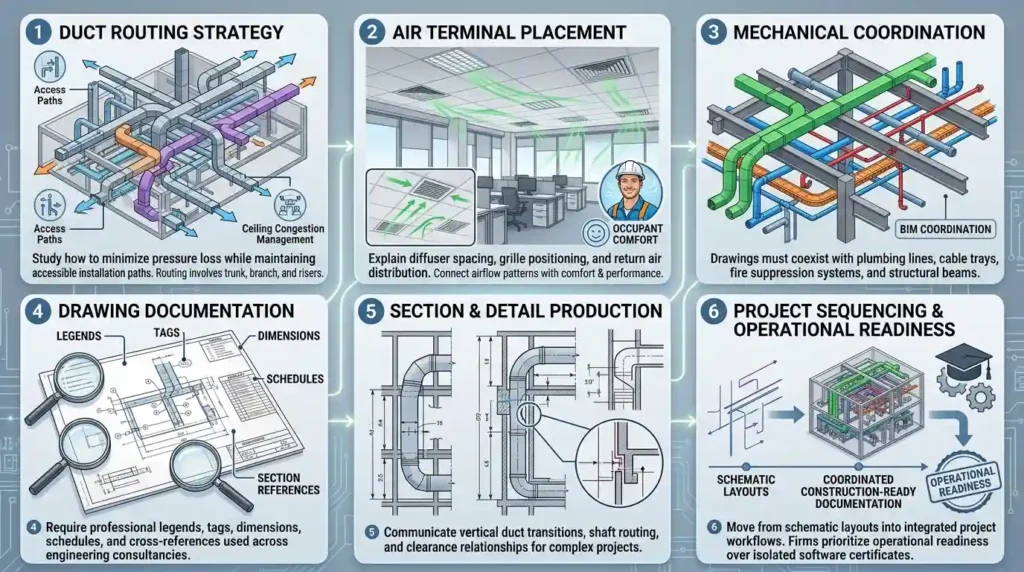
Duct routing strategy
Learners study how to minimise pressure loss while maintaining accessible installation paths. Routing exercises involve trunk ducts, branch ducts, risers, and ceiling congestion management.
Air terminal placement
Training explains diffuser spacing, grille positioning, and return air distribution. Learners connect airflow patterns with occupant comfort and ventilation performance.
Mechanical coordination
Commercial buildings contain overlapping building services. HVAC drawings must coexist with plumbing lines, cable trays, fire suppression systems, and structural beams.
Drawing documentation
Professional ventilation drawings require legends, tags, dimensions, schedules, and section references. Training programmes teach standardised documentation structures used across engineering consultancies.
Section and detail production
Large projects rely on sectional views to communicate vertical duct transitions, shaft routing, and clearance relationships.
A strong commercial drafting curriculum also includes project sequencing. Learners move from schematic layouts into coordinated construction-ready documentation.
This progression matters because employers increasingly assess operational readiness instead of software certificates alone. According to workforce development reports from construction and engineering sectors, firms prioritise employees who understand integrated project workflows rather than isolated drafting commands.
The AutoCAD HVAC and Plumbing Design Training Course becomes relevant at this stage because integrated ventilation layouts require simultaneous coordination with plumbing systems, ceiling services, and equipment positioning rather than standalone HVAC drafting.
How does training address airflow efficiency in ventilation layouts?
AutoCAD HVAC training addresses airflow efficiency by teaching duct sizing relationships, pressure-loss awareness, balanced air distribution, and routing optimisation. Efficient ventilation layouts reduce energy consumption, support occupant comfort, and improve long-term operational performance in commercial buildings.
Commercial ventilation systems operate continuously across large floor areas. Small drafting inefficiencies create substantial operational consequences.
For example:
- Excessive duct bends increase static pressure
- Poor diffuser positioning creates airflow imbalance
- Oversized duct routes waste ceiling space
- Inadequate return air planning reduces comfort consistency
Training programmes therefore connect CAD drafting decisions with mechanical performance outcomes.
Learners study airflow principles alongside layout production. This integration improves understanding of why certain routing strategies outperform others.
Some programmes also introduce simplified pressure concepts during drafting exercises:
Q=A×V
This airflow relationship helps trainees understand how duct area and air velocity influence ventilation performance.
Commercial projects increasingly prioritise energy efficiency because HVAC systems account for a large proportion of building energy usage. According to industry energy studies, HVAC operations commonly represent 35–45% of total commercial building energy consumption.
Training that incorporates airflow efficiency therefore supports broader organisational sustainability goals.
From a workforce planning perspective, companies benefit when drafting teams understand operational consequences. Efficient layouts reduce redesign cycles during commissioning and improve coordination between consultants and contractors.
How do commercial HVAC training programmes compare practical projects with theoretical instruction?
Effective commercial HVAC training combines theoretical airflow principles with project-based drafting exercises. Practical projects improve spatial coordination skills, drawing interpretation, and real-world documentation accuracy, while theory establishes the engineering logic behind ventilation system design decisions.
Many learners compare programmes based on software access or course duration. Organisations evaluating workforce capability focus on something different: application readiness.
The distinction between theoretical and project-based training becomes important in ventilation drafting because commercial layouts involve multidimensional coordination challenges.
| Training Focus | Theoretical Instruction | Project-Based Instruction |
|---|---|---|
| Airflow concepts | Explains ventilation principles | Applies airflow logic to layouts |
| Duct sizing understanding | Covers calculations and standards | Integrates sizing into routing |
| Coordination awareness | Introduces building systems | Resolves real ceiling conflicts |
| Documentation standards | Explains drawing conventions | Produces complete construction sheets |
| Workplace readiness | Builds conceptual knowledge | Develops operational drafting ability |
Commercial ventilation projects demand decision-making under spatial constraints. Learners improve faster when programmes include:
- Multi-floor building exercises
- Reflected ceiling plan coordination
- Mechanical room drafting
- Section development
- Clash-aware layouts
- Equipment scheduling
Employers increasingly favour training models that simulate project workflows because these programmes reduce onboarding time.
Decision-stage evaluation often begins once learners examine whether a programme includes actual commercial ventilation projects instead of isolated drafting tasks.
That comparison naturally aligns with:
“Does Imperial’s HVAC Programme Include Commercial Ventilation Drawing Projects?”, because implementation-focused learners start evaluating practical project exposure at this point.
How does ventilation layout training support multidisciplinary coordination?
Ventilation layout training supports multidisciplinary coordination by teaching shared drawing standards, layered documentation systems, spatial planning methods, and clash-reduction workflows. Large commercial projects require HVAC teams to coordinate continuously with structural, electrical, plumbing, and fire protection disciplines.
Commercial construction projects operate through interconnected documentation systems. HVAC drawings cannot exist independently.
Training programmes therefore include coordination-focused drafting strategies such as:
Layer management
Separate CAD layers organise mechanical systems for visibility and revision control.
Ceiling space allocation
Learners understand how ducts interact with lighting systems, cable trays, and sprinkler lines.
Vertical coordination
Commercial projects rely on shafts and risers connecting multiple floors. Training explains how vertical routing affects equipment placement and maintenance accessibility.
Annotation consistency
Coordinated projects require uniform symbols, tags, abbreviations, and schedules.
These skills influence project delivery efficiency directly. Coordination failures commonly create installation delays during construction phases.
From a business perspective, multidisciplinary competence improves collaboration between departments and external consultants. HR teams evaluating technical upskilling programmes often prioritise communication-oriented technical training because project coordination failures increase rework costs substantially.
Modern commercial projects also rely on digital collaboration environments. Even when AutoCAD remains the primary drafting platform, ventilation teams work within integrated documentation ecosystems involving BIM coordination, cloud-based review systems, and revision tracking processes.
What standards and compliance topics are included in ventilation drafting training?
Ventilation drafting training includes building code interpretation, airflow compliance requirements, fire damper positioning, smoke extraction principles, and documentation standards used in commercial engineering environments. Compliance awareness improves drawing accuracy and reduces approval-stage revisions during project delivery.
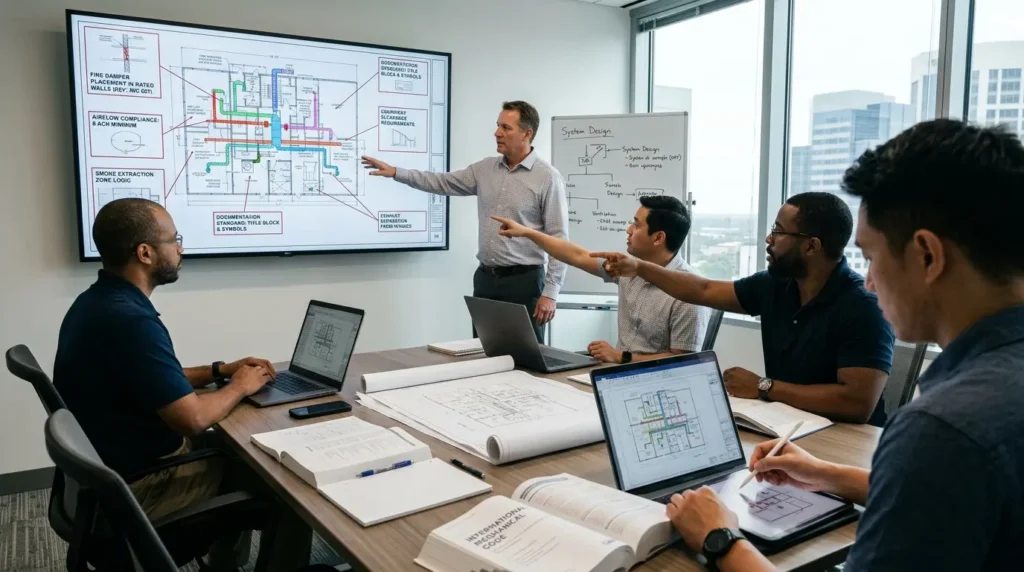
Commercial ventilation systems must comply with multiple technical standards.
Training programmes typically introduce:
- Ventilation rate requirements
- Fire safety routing rules
- Equipment clearance standards
- Exhaust separation principles
- Accessibility requirements
- Mechanical documentation conventions
The goal is not to replace engineering licensing. Instead, training helps drafters understand why layouts follow certain structural and safety rules.
This distinction matters because compliance-related drafting errors delay approvals and increase redesign workloads.
For example, fire-rated duct penetrations require specific detailing methods. Smoke extraction systems need dedicated routing logic. Kitchen exhaust layouts involve different operational considerations from office ventilation systems.
Training programmes that incorporate compliance interpretation create stronger workplace readiness because learners understand the operational purpose behind drafting standards.
Commercial organisations also evaluate training based on risk reduction. Staff who understand compliance fundamentals contribute to smoother coordination with consultants, authorities, and contractors.
How do organisations evaluate the effectiveness of HVAC ventilation training?
Organisations evaluate HVAC ventilation training through project accuracy, drafting speed, coordination quality, revision reduction, and operational readiness. Effective programmes improve technical consistency while supporting faster project delivery and stronger collaboration between engineering and construction teams.
Training evaluation increasingly depends on measurable performance indicators rather than attendance completion.
Common evaluation metrics include:
| Evaluation Area | Business Impact |
|---|---|
| Drawing accuracy | Reduces redesign time |
| Coordination quality | Minimises installation conflicts |
| Drafting productivity | Accelerates project timelines |
| Documentation consistency | Improves consultant collaboration |
| Technical interpretation | Strengthens decision-making |
| Revision frequency | Reduces operational inefficiency |
Commercial HVAC environments operate under strict deadlines. Organisations therefore prioritise training outcomes that improve project execution speed without reducing technical quality.
Many companies also compare learning delivery models:
Classroom-led training
Provides instructor guidance and structured feedback.
Project simulation training
Improves applied drafting competence through workflow replication.
Hybrid technical training
Combines theory, digital assignments, and collaborative exercises.
Workplace-integrated learning
Links active projects with supervised drafting development.
The most effective approach depends on workforce experience levels and operational requirements. Junior drafters usually benefit from structured technical guidance. Experienced teams often require advanced coordination-focused project simulations instead.
Training effectiveness also depends on curriculum alignment with commercial project realities. Programmes focused only on commands or interface navigation produce limited operational value because large commercial ventilation projects require analytical coordination skills.
How does commercial ventilation training prepare learners for real project environments?
Commercial ventilation training prepares learners for real project environments by replicating construction documentation workflows, coordination procedures, revision management systems, and multidisciplinary collaboration structures used in engineering and contracting organisations.
Commercial HVAC projects involve continuous iteration. Drawings evolve through consultant reviews, architectural changes, and coordination updates.
Training programmes that reflect this environment improve transition into professional practice.
Learners gain exposure to:
- Design revision workflows
- Layer standardisation
- Plotting procedures
- Sheet organisation
- Construction annotation systems
- Interdisciplinary communication structures
This operational preparation becomes increasingly important because engineering firms face skill gaps in project-ready drafting talent.
Industry workforce studies consistently show that technical proficiency alone no longer satisfies employer expectations. Companies expect drafters to understand coordination logic, documentation consistency, and project sequencing.
Discover More from Our Guide Library:
How Does AutoCAD HVAC Training Make Graduates More Competitive in the Job Market?
How Are Blocks Attributes and Dynamic Components Taught in AutoCAD HVAC Training?
Ventilation layout training therefore functions as both a technical education process and a workplace readiness framework.
The strongest programmes align CAD instruction with measurable project outcomes:
- Faster drafting turnaround
- Reduced coordination conflicts
- Improved drawing readability
- Better installation sequencing
- Enhanced communication across technical teams
These outcomes matter directly to organisations managing commercial construction schedules, operational budgets, and long-term building performance.
Is AutoCAD HVAC training suitable for commercial building projects?
Yes, the AutoCAD HVAC and Plumbing Design Training Course focuses on commercial HVAC drafting workflows, including ventilation layouts, duct sizing concepts, and multi-service coordination. Learners study how HVAC drawings integrate with plumbing, electrical, and structural systems in large buildings.
How does AutoCAD HVAC training improve workplace drafting skills?
The AutoCAD HVAC and Plumbing Design Training Course helps learners improve technical drawing accuracy, layer management, airflow layout planning, and construction documentation skills. These drafting competencies support faster project coordination and reduced design revisions in commercial projects.
Does the AutoCAD HVAC and Plumbing Design Training Course include ventilation layout training?
Yes, Imperial Corporate Training Institute includes ventilation layout drafting as part of the AutoCAD HVAC and Plumbing Design Training Course. Learners study supply and return air layouts, diffuser placement, duct routing, and reflected ceiling coordination for commercial spaces.
Who should attend an AutoCAD HVAC and Plumbing Design Training Course?
The AutoCAD HVAC and Plumbing Design Training Course is suitable for HVAC technicians, mechanical engineers, CAD operators, project coordinators, and facilities professionals. It also supports organisations addressing technical skill gaps in commercial building services drafting and design coordination.