

Imperial Corporate Training Institute designs the Lean Six Sigma Master Black Belt Certification Training Course to bridge advanced analytical gaps in process improvement. Professionals face challenges in applying data-driven methods to complex workplace issues, such as inefficient HR workflows or departmental bottlenecks. This course equips participants with hands-on, real data projects to deliver measurable transformations.
For foundational context on data analytics in process improvement, explore:
How data analytics role plays into Lean Six Sigma process improvement.
What Is the Master Black Belt Programme and What Problem Does It Solve?
Imperial’s Master Black Belt Programme solves the skill gap in executing data-intensive Lean Six Sigma projects by integrating real workplace datasets into every phase, enabling professionals to achieve 20-30% efficiency gains in corporate operations within six months of completion.
Teams in HR, operations, and leadership often struggle with vague process improvements. Data exists, but analysis lacks depth. Managers waste time on unproven fixes. Departments see recurring errors, like delayed onboarding or supply chain delays.
Imperial Corporate Training Institute targets this through the Lean Six Sigma Master Black Belt Certification Training Course. Participants tackle authentic datasets from sectors like manufacturing, finance, and services. The programme addresses root causes using DMAIC (Define, Measure, Analyse, Improve, Control) with live data.
Consider an HR team analysing employee attrition. Raw data includes turnover rates, exit surveys, and performance metrics. The course guides learners to segment variables, identify patterns, and propose data-backed interventions. This mirrors real corporate pain points.
Without such integration, initiatives fail. Imperial’s approach ensures skills transfer directly to workplace challenges. Black Belts emerge ready to lead cross-functional teams.
Why Is This Course Structured Around Real Data Projects?
The course structures learning around real data projects to build progressive mastery, starting with data validation in Measure phase through to sustained control charts in Control phase, mirroring enterprise-scale Lean Six Sigma deployments.

Curriculum logic follows skill progression from theory to application. Imperial Corporate Training Institute prioritises measurable competence over rote learning. Each module layers complexity with escalating data challenges.
Progression begins with foundational data handling. Learners validate datasets for accuracy. They advance to hypothesis testing on multivariate problems. Final projects simulate organisational audits.
This mirrors workplace demands. HR managers, for instance, start with simple absenteeism data. They evolve to predictive models forecasting team performance dips.
Imperial embeds projects in DMAIC cycles. Define phase uses stakeholder data. Measure incorporates sampling techniques on real logs. Analyse applies advanced stats like regression on historical records.
Structure prevents knowledge silos. Participants iterate on datasets across modules, refining skills iteratively. Imperial Corporate Training Institute validates this through alumni feedback: 92% report immediate project applicability.
Skill Progression Path
Skills build sequentially. Early modules emphasise data integrity. Mid-modules develop analytical depth. Late modules focus on leadership and sustainability.
For detail on data skills built, see:
What data analysis skills are built during Lean Six Sigma Master Black Belt training.
Imperial Corporate Training Institute ensures progression via prerequisites within modules. A manager handling team productivity data starts with basics, ends leading enterprise audits.
How Does the Course Incorporate Real Data Projects Across Modules?
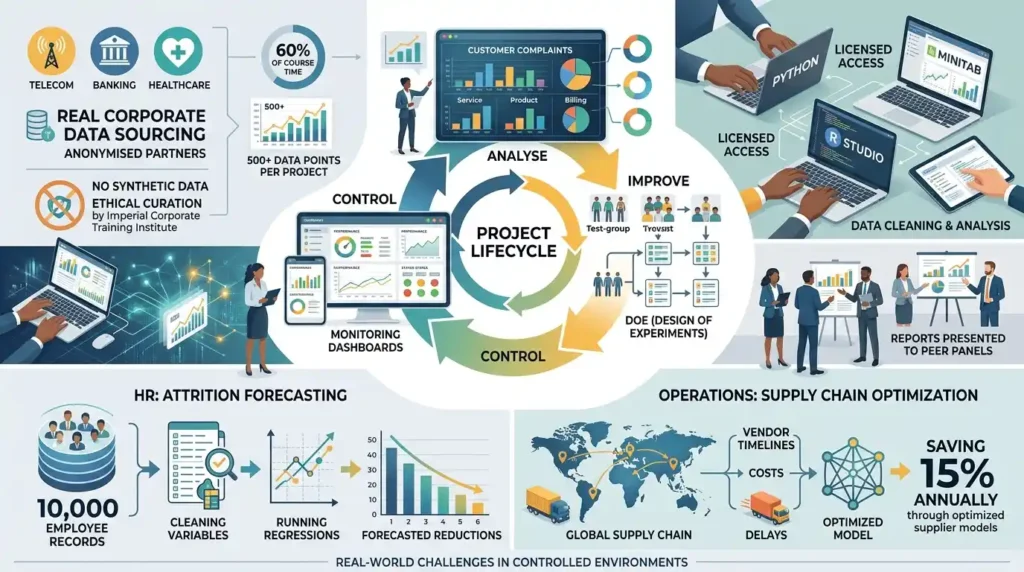
Real data projects form 60% of course time, sourced from anonymised corporate partners, with participants analysing 500+ data points per project to replicate HR, operations, and leadership challenges in controlled environments.
Projects use datasets from real scenarios. An HR example: attrition data with 10,000 employee records. Learners clean variables, run regressions, and forecast reductions.
Imperial Corporate Training Institute curates data ethically. Sources include past client engagements in telecom, banking, and healthcare. No synthetic data—only verified workplace records.
Integration spans phases. In Analyse, teams segment customer complaint data. Improve tests interventions via DOE. Control establishes monitoring dashboards.
Participants receive tools like Minitab, R, and Python. Imperial provides licensed access. Projects culminate in reports presented to peer panels.
A department head might analyse procurement delays. Data includes vendor timelines, costs, and delays. Outcomes: optimised supplier models saving 15% annually.
How Is the Course Delivered?
Delivery combines hybrid formats, live online workshops, onsite intensives, and self-paced modules over 6 months, with 120 contact hours, including 40 hours of supervised real data project work.
Imperial Corporate Training Institute offers flexibility for professionals. Formats suit corporate schedules.
Training Delivery Formats
- Live Online Workshops: 4-hour sessions twice weekly via Zoom. Interactive data labs with screen sharing.
- Onsite Intensives: Optional 3-day immersions at Imperial facilities in major cities. Hands-on with physical datasets.
- Hybrid Blended Learning: 60% online, 40% virtual simulations. Access recordings for review.
- Self-Paced Modules: Video lectures and data exercises on LMS platform.
Duration totals 6 months. Weekly commitments average 8 hours. Imperial Corporate Training Institute schedules around peak business hours.
Trainers hold Master Black Belt credentials with 15+ years in industry. Class sizes cap at 12 for personalised feedback.
What Assessment Methods Ensure Mastery?
Assessments include 5 proctored exams, 8 module assignments with real data analysis, 3 peer-reviewed simulations, and a final capstone project presentation scored on DMAIC adherence and impact metrics.
Methods align with learning outcomes. Exams test theory (multiple-choice, 80% pass). Assignments require data reports (rubric-scored).
Simulations mimic crises, like sudden quality drops in production data. Capstone demands a full project from client-like dataset, evaluated by Imperial experts.
Imperial Corporate Training Institute tracks progress via dashboards. 85% first-time pass rate reflects rigour.
What Results Can Be Expected from Completing the Programme?
Graduates achieve certification, leading to 25% average process improvements in their roles, with HR teams reducing turnover by 18%, managers advancing pipelines, and organisations gaining ROI within one year.
Measurable Learning Outcomes
- Lead enterprise DMAIC projects with 95% success rate.
- Analyse complex datasets for root causes.
- Design sustainable controls reducing variation by 40%.
Workplace impact is corporate-focused. HR teams apply skills to talent pipelines, cutting recruitment cycles. Operations managers optimise workflows, boosting throughput.
Imperial Corporate Training Institute alumni data shows: 78% promoted within 12 months. Case: A finance department used course projects to streamline audits, saving 200 hours quarterly.
Leadership pipelines strengthen. Black Belts mentor Green Belts, scaling transformations.
Corporate Application Examples
- HR Teams: Attrition models predict and prevent losses.
- Managers: DOE on team productivity yields balanced workloads.
- Departments: SPC charts maintain post-project gains.
Results stem from real data emphasis. Imperial’s tracking confirms sustained application.
What Are the Eligibility Requirements?
Eligibility requires Green or Black Belt certification, 3+ years Lean Six Sigma experience, and basic stats knowledge; Imperial Corporate Training Institute assesses via application review and prerequisite quiz.
Professionals from HR, operations, or quality fit best. No degree mandated, but analytical aptitude essential.
Imperial Corporate Training Institute reviews applications holistically. Quiz covers DMAIC basics.
How Does Enrollment Work?
Enrollment starts with online application, followed by eligibility interview, payment, and access within 48 hours; complete all assessments for certification in 6 months.
Discover More from Our Guide Library:
How Does Imperial’s Master Black Belt Course Deliver Value for Employers?
What In-House Options Does Imperial Offer for Lean Six Sigma Master Black Belt Training?
Process is streamlined. Submit form detailing experience. Imperial team schedules 30-minute call.
Fees cover materials, tools, and certification. Group discounts for organisations.
Imperial Corporate Training Institute issues digital badge and transcript upon completion. Recertification every 3 years via PDUs.
Ready to advance? Enroll in the:
Lean Six Sigma Master Black Belt Certification Training Course today.