
Lean and Agile have become two dominant operating systems for modern organisations. Lean focuses on waste elimination and process efficiency. Agile focuses on adaptability, iteration, and fast feedback cycles. When businesses scale, these two systems no longer operate in isolation. They intersect in delivery models, transformation programmes, and enterprise performance frameworks.
At the consideration stage, decision-makers are no longer asking what Lean or Agile is. They are evaluating how both systems can be integrated into one coherent improvement strategy that works across departments, supply chains, and digital transformation initiatives.
Early-stage understanding of these methodologies is often developed through foundational analysis of their differences and applications.
A useful starting point for that comparison is this guide on:
What Is the Difference Between Lean Six Sigma and Agile Methodologies? This explains how each system evolved and where its operational boundaries begin to overlap. This foundation is necessary before assessing advanced integration through leadership-level training.
Why does Lean and Agile intersection matter in enterprise transformation programmes?
Lean and Agile intersect because organisations now require both efficiency and adaptability within the same operating environment. Lean eliminates waste and standardises processes, while Agile ensures rapid iteration and responsiveness. Their intersection creates a hybrid performance system that supports continuous improvement, faster delivery cycles, and measurable operational efficiency at scale across business functions.
In enterprise transformation programmes, Lean alone struggles with dynamic environments such as software delivery, product innovation, and customer-driven change. Agile alone struggles with large-scale process optimisation and operational standardisation. The intersection solves this gap.
Organisations that integrate both systems report up to 30–50% faster cycle times in cross-functional delivery teams. This improvement is not achieved by replacing one system with another but by aligning their principles under a unified governance structure.
This is where advanced training becomes relevant. Explore:
Does Imperial’s MBB Course Cover Lean-Agile Hybrid Approaches? The Lean Six Sigma Master Black Belt Certification Training Course framework is designed to help professionals understand how Lean governance structures and Agile delivery models coexist within enterprise improvement ecosystems.
The intersection is no longer theoretical. It is embedded in digital transformation programmes, ERP optimisation, and product lifecycle management systems. HR leaders and operational managers now evaluate whether their internal capability can manage both systems simultaneously without conflict in KPIs or execution models.
How does Master Black Belt training integrate Lean and Agile thinking at strategic level?

Master Black Belt training integrates Lean and Agile thinking by developing system-level leadership capability that aligns process optimisation with adaptive delivery models. It teaches advanced statistical control, value stream governance, and Agile portfolio management to ensure both efficiency and responsiveness operate under a unified performance architecture.
At this level, Lean Six Sigma Master Black Belt Certification Training Course design shifts from tool application to enterprise orchestration. The focus is no longer individual projects but organisational systems.
A Master Black Belt operates as a transformation architect. They define how Lean value streams connect with Agile delivery teams. They also design governance models that prevent conflict between long-term process stability and short-term iteration cycles.
Lean contributes structured methodologies such as DMAIC (Define, Measure, Analyse, Improve, Control). Agile contributes iterative frameworks such as Scrum and Kanban. The Master Black Belt ensures both operate within compatible performance boundaries.
For example, in a financial services organisation, Lean may standardise onboarding processes while Agile teams iterate digital onboarding experiences. Without integration, these systems clash. With Master Black Belt oversight, they function as a single improvement ecosystem.
The strategic value lies in alignment. Organisations reduce duplication of improvement efforts by up to 40% when Lean and Agile are governed under a unified leadership structure.
What organisational problems does Lean-Agile misalignment create without Master Black Belt governance?
Lean-Agile misalignment creates duplicated efforts, conflicting KPIs, and fragmented improvement initiatives. Without Master Black Belt governance, Lean teams optimise for efficiency while Agile teams optimise for speed, resulting in operational friction, inconsistent performance measurement, and reduced return on transformation investments across enterprise-level programmes.
The most common issue is KPI conflict. Lean programmes measure efficiency, cost reduction, and defect elimination. Agile programmes measure velocity, iteration speed, and customer responsiveness. Without integration, teams optimise in opposite directions.
Another challenge is governance fragmentation. Lean initiatives are often managed through operational excellence teams. Agile initiatives are managed through product or IT delivery teams. This separation creates silos in decision-making.
A third issue is resource inefficiency. Organisations often run parallel improvement programmes addressing the same process from different angles. This leads to duplication of workshops, analytics, and reporting systems.
Master Black Belt governance solves this by introducing unified measurement systems. Instead of separate Lean and Agile KPIs, organisations adopt balanced scorecards that include cycle time, quality, customer value, and adaptability indices.
This alignment reduces transformation waste. In large enterprises, misalignment can consume up to 20–25% of transformation budgets without producing measurable ROI.
How does Master Black Belt training build hybrid Lean-Agile capability in professionals?
Master Black Belt training builds hybrid Lean-Agile capability by combining advanced statistical analysis, enterprise process design, and Agile delivery governance into a single leadership framework. Professionals learn to translate operational inefficiencies into iterative improvement cycles without losing structural process control or long-term optimisation discipline.
Capability development occurs across three layers: technical, strategic, and organisational.
At the technical level, professionals master advanced Lean Six Sigma tools such as regression analysis, hypothesis testing, and process capability studies. These tools ensure decisions are data-driven rather than assumption-based.
At the strategic level, Agile portfolio management is introduced. This includes backlog prioritisation at enterprise scale, cross-team dependency management, and iterative value delivery mapping.
At the organisational level, Master Black Belts act as change agents. They design transformation roadmaps that integrate Lean efficiency goals with Agile delivery cycles.
For example, in manufacturing environments adopting Industry 4.0, Lean ensures machine efficiency and defect reduction, while Agile supports rapid software updates in IoT systems. Master Black Belt professionals connect both streams into a unified optimisation model.
This hybrid capability is increasingly demanded in HR workforce planning. Organisations are not only hiring Lean experts or Agile coaches separately but seeking professionals who can bridge both domains.
What role does leadership play in managing Lean and Agile convergence?
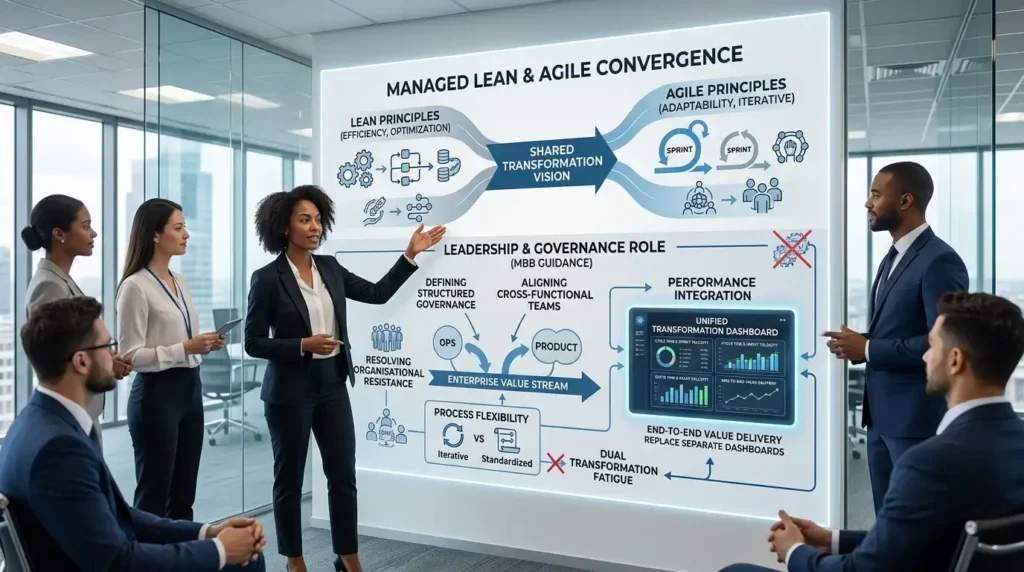
Leadership in Lean-Agile convergence ensures that both methodologies operate under a shared transformation vision. Master Black Belt leaders define governance structures, align cross-functional teams, and ensure that Lean efficiency and Agile adaptability contribute to the same organisational objectives without conflict or duplication.
Leadership is the control layer of convergence. Without it, Lean and Agile operate as competing systems.
Master Black Belt professionals provide this leadership through structured governance frameworks. They define which processes require standardisation and which require iterative flexibility.
They also manage organisational resistance. Teams often prefer one methodology over another depending on function. Operations teams prefer Lean. Product teams prefer Agile. Leadership resolves this by aligning both under enterprise value streams.
Another leadership function is performance integration. Instead of separate reporting dashboards, Master Black Belts design unified transformation dashboards that track end-to-end value delivery.
In large-scale digital transformation programmes, this leadership role becomes critical. Without it, organisations experience what is known as “dual transformation fatigue”, where Lean and Agile initiatives compete for attention and funding.
How do organisations measure success in Lean-Agile integrated environments?
Success in Lean-Agile integrated environments is measured through combined performance indicators such as end-to-end cycle time reduction, process quality improvement, customer value delivery speed, and adaptability index. Master Black Belt governance ensures these metrics are aligned across both efficiency and agility dimensions for consistent organisational reporting.
Traditional Lean metrics focus on defect rates, process efficiency, and cost savings. Agile metrics focus on velocity, sprint completion, and iteration frequency.
Integrated environments require hybrid KPIs. These include:
- Cycle time reduction across full value streams
- Percentage of automated process improvements
- Customer satisfaction score improvements linked to delivery speed
- Change adoption rate across teams
Master Black Belt professionals design measurement systems that connect operational data with strategic outcomes. This ensures that improvements in one system do not negatively impact the other.
For example, increasing Agile velocity without quality control leads to rework. Similarly, increasing Lean standardisation without flexibility slows innovation. Balanced metrics prevent these distortions.
Organisations using integrated KPI systems report up to 25% improvement in transformation ROI compared to isolated Lean or Agile implementations.
Why is Master Black Belt training considered the highest integration point for Lean and Agile frameworks?
Master Black Belt training is considered the highest integration point because it operates at enterprise governance level, combining statistical process control, Lean optimisation principles, and Agile delivery frameworks into a unified leadership system that aligns transformation strategy with measurable organisational performance outcomes.
Lower-level certifications focus on tools and team-level execution. Master Black Belt training focuses on system architecture.
This level of training prepares professionals to manage multiple transformation streams simultaneously. It includes Lean value stream design, Agile scaling frameworks, and enterprise risk management integration.
It also introduces advanced decision-making models. These models evaluate when to apply Lean standardisation and when to apply Agile iteration based on process variability, customer demand volatility, and operational risk.
The integration point is critical in sectors such as healthcare, banking, and large-scale manufacturing where both predictability and flexibility are required simultaneously.
Without Master Black Belt capability, organisations often oscillate between Lean-heavy and Agile-heavy approaches, creating instability in transformation outcomes.
Where does Lean-Agile Master Black Belt capability create the highest business impact?
Lean-Agile Master Black Belt capability creates the highest impact in large-scale transformation environments where operational efficiency and rapid innovation must coexist. It is most effective in digital transformation, supply chain optimisation, and enterprise product development where cross-functional alignment directly influences financial and customer outcomes.
In digital transformation programmes, Master Black Belts ensure that system upgrades follow both Lean efficiency principles and Agile iteration cycles.
In supply chain environments, Lean reduces waste while Agile ensures responsiveness to demand fluctuations.
Discover More from Our Guide Library:
How Does Master Black Belt Training Connect Lean Six Sigma to Customer Experience Metrics?
How Does Master Black Belt Training Teach Risk Mitigation in Improvement Projects?
In product development, Agile drives innovation cycles while Lean ensures production efficiency and cost control.
This dual impact creates measurable business value. Organisations report reduced time-to-market, improved operational efficiency, and higher customer retention when Lean and Agile are integrated under Master Black Belt governance.
The role is not operational. It is structural. It defines how transformation itself is designed, executed, and measured.
Frequently Asked Questions
How does Master Black Belt training differ from Black Belt certification?
Master Black Belt training focuses on organisational strategy, governance, and coaching multiple project teams, while Black Belt certification focuses on leading individual improvement projects. The Lean Six Sigma Master Black Belt Certification Training Course at Imperial Corporate Training Institute develops enterprise-wide leadership capability.
Can Lean Six Sigma Master Black Belt training support Agile transformation?
Yes, Master Black Belt training supports Agile transformation by integrating Lean efficiency with Agile delivery frameworks. It helps professionals align iterative development with structured process improvement, improving adaptability and performance across enterprise systems.
Who should take the Lean Six Sigma Master Black Belt Certification Training Course?
This course is designed for senior managers, process excellence leaders, and transformation professionals responsible for large-scale improvement initiatives. Imperial Corporate Training Institute recommends it for professionals managing Lean, Six Sigma, or Agile-driven organisational change.
What are the career benefits of becoming a Lean Six Sigma Master Black Belt?
A Master Black Belt certification enhances leadership credibility in process improvement and transformation roles. It opens opportunities in operations excellence, strategy consulting, and enterprise Agile-Lean integration across global organisations.