

Organisations across the building services sector are moving from isolated 2D drafting environments towards integrated Building Information Modelling (BIM) workflows. This transition creates a skills gap for HVAC professionals who have strong AutoCAD drafting capabilities but limited experience working within collaborative digital construction environments. The challenge is not replacing AutoCAD. The challenge is understanding how AutoCAD-based HVAC documentation connects with BIM processes, Revit coordination, and multidisciplinary project delivery.
Professionals evaluating training pathways often begin by understanding the wider direction of the industry. The article on:
The future of AutoCAD in HVAC design with BIM and Revit growing explains the market context behind this transition and why both skill sets remain relevant for engineering teams.
The AutoCAD HVAC and Plumbing Design Training Course delivered by Imperial Corporate Training Institute addresses this challenge through a structured learning pathway. Rather than treating AutoCAD and BIM as separate disciplines, the programme demonstrates how detailed HVAC and plumbing documentation developed in AutoCAD can support coordinated BIM project environments. The course focuses on practical engineering workflows, documentation standards, coordination requirements, and transition strategies used across commercial, industrial, and infrastructure projects.
What problem does this course solve for professionals preparing for BIM environments?
This course closes the gap between traditional AutoCAD drafting skills and modern BIM-based project coordination by teaching participants how HVAC and plumbing documentation integrates into multidisciplinary workflows, supports project collaboration, improves design accuracy, and aligns with current engineering delivery requirements.
Many organisations continue to rely on AutoCAD for mechanical documentation, schematic development, shop drawings, and detailed construction deliverables. At the same time, clients increasingly expect BIM-ready coordination processes and integrated project information.
This creates a common workplace challenge. Engineers may be proficient in drafting ductwork, piping layouts, and mechanical schematics, yet struggle when project teams require BIM coordination, digital collaboration, or Revit-based integration.
Imperial Corporate Training Institute structures this programme around that specific challenge. Participants learn how engineering drawings contribute to broader project ecosystems rather than functioning as isolated design documents.
The course develops practical competencies in HVAC drafting, plumbing design, documentation management, MEP coordination, design review procedures, and BIM integration principles. This combination supports professionals who need to maintain AutoCAD expertise while preparing for evolving project delivery methods.
For employers, the challenge extends beyond software proficiency. Teams must produce drawings that support coordination meetings, construction sequencing, quality reviews, and multidisciplinary collaboration. The programme addresses these organisational requirements through project-based learning and corporate engineering scenarios.
Why is the curriculum structured around progressive skill development?
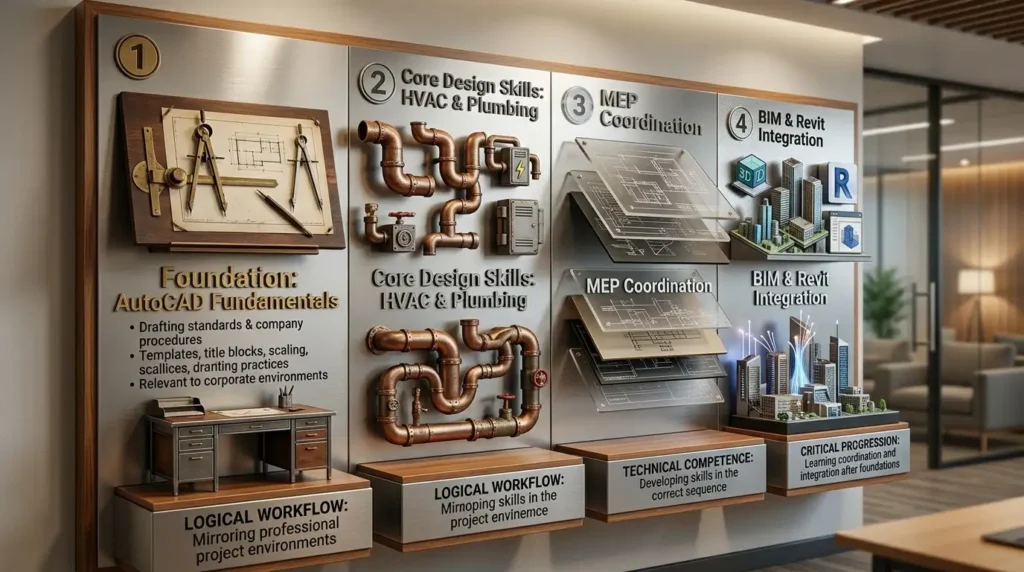
The curriculum follows a logical engineering workflow that moves from drafting fundamentals to advanced coordination, documentation, quality assurance, and BIM integration, allowing participants to develop technical competence in the same sequence used within professional project environments.
Learning progression is critical in technical training. Professionals cannot effectively coordinate BIM workflows without first understanding drafting standards, documentation requirements, and system design principles.
Imperial Corporate Training Institute begins with AutoCAD fundamentals relevant to corporate engineering environments. Participants establish a strong foundation in templates, title blocks, scaling practices, and CAD standards.
Foundation in Corporate Design Workflows
The first module focuses on how engineering organisations manage drawing production. Participants learn document structures, company standards, and drafting procedures used in professional projects.
These capabilities form the basis for all later activities involving HVAC systems, plumbing layouts, and multidisciplinary coordination.
Development of HVAC and Plumbing Design Skills
The next stages focus on HVAC drafting and plumbing design methodologies.
Participants learn:
- Duct routing principles
- Airflow distribution layouts
- Equipment placement techniques
- Plumbing riser development
- Pipe sizing approaches
- Drainage system planning
- Mechanical drafting conventions
Each topic builds practical understanding of how building services systems are documented and communicated.
Progression to MEP Coordination
Once drafting competencies are established, participants move into advanced AutoCAD functionality.
This includes:
- External references (Xrefs)
- Layer management strategies
- Annotation standards
- Data extraction processes
- Space management procedures
- Coordination techniques
These skills mirror real-world project requirements where multiple engineering disciplines contribute to the same development.
Transition Towards BIM Integration
The curriculum culminates with BIM and Revit integration concepts.
Participants learn how AutoCAD-generated information contributes to BIM environments, creating a bridge between traditional drafting workflows and modern digital project delivery methods.
What will participants learn throughout the programme?
Participants learn advanced HVAC drafting, plumbing design, MEP coordination, documentation management, quality assurance procedures, BIM integration principles, and project execution methods that support professional engineering responsibilities across commercial, industrial, and infrastructure developments.
The programme is designed around measurable technical outcomes rather than software navigation alone.
HVAC Design Competencies
Participants develop the ability to create detailed HVAC system documentation suitable for professional engineering projects.
Skills include:
- Ductwork design layouts
- Airflow routing strategies
- Diffuser placement planning
- Mechanical equipment coordination
- HVAC schematic preparation
- Design documentation standards
The training also introduces HVAC load calculation concepts and system optimisation methodologies used during project development.
Plumbing Design Competencies
The plumbing modules focus on creating accurate and coordinated water supply and drainage systems.
Participants learn:
- Hot and cold water system design
- Drainage planning techniques
- Pipe sizing methods
- Fixture coordination
- Plumbing riser development
- Material scheduling procedures
These competencies support both design and documentation responsibilities.
Documentation and Standards Management
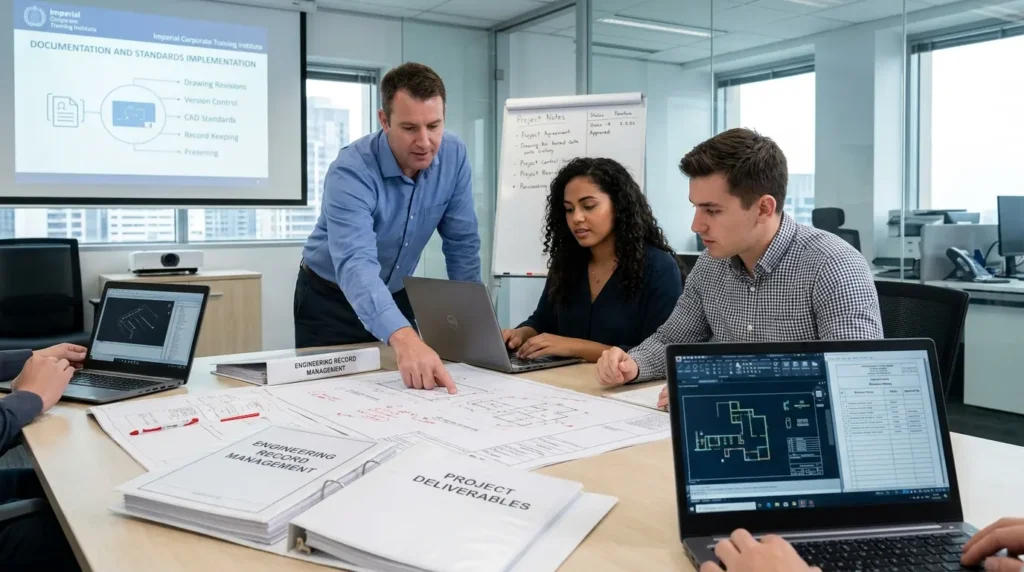
Engineering projects require more than technical layouts.
Professionals must produce documentation that satisfies client requirements, regulatory expectations, and internal quality standards.
Imperial Corporate Training Institute incorporates:
- Drawing revision management
- Version control procedures
- Documentation protocols
- CAD standard implementation
- Engineering record management
- Deliverable preparation methods
These skills contribute directly to workplace productivity and project consistency.
BIM Transition Skills
One of the programme’s distinguishing features is its focus on BIM readiness.
Participants learn:
- BIM workflow fundamentals
- AutoCAD and Revit coordination principles
- Data exchange concepts
- Integrated project environments
- Multidisciplinary collaboration methods
- 2D-to-3D transition strategies
These competencies help professionals understand where AutoCAD fits within modern project ecosystems.
How does the course prepare trainees specifically for BIM and Revit coordination?
The programme prepares participants for BIM environments by teaching coordination processes, data integration concepts, multidisciplinary collaboration methods, documentation standards, and workflow strategies that connect AutoCAD-generated engineering information with BIM and Revit-based project delivery systems.
Many professionals assume BIM transition requires abandoning AutoCAD expertise.
In practice, most organisations operate hybrid workflows where both technologies coexist.
Imperial Corporate Training Institute addresses this reality through Module 9, which focuses specifically on BIM and Revit integration.
Understanding the Relationship Between AutoCAD and BIM
Participants learn that BIM is not simply a software package.
It is a project delivery methodology built around information management, collaboration, and coordinated design processes.
The course explains how AutoCAD documentation supports these objectives through structured engineering data and accurate technical drawings.
Data Coordination Principles
Participants explore how information developed in AutoCAD can support BIM workflows.
Topics include:
- Data consistency
- Documentation accuracy
- Model coordination principles
- Information exchange processes
- Project collaboration standards
These capabilities become increasingly valuable on large-scale developments.
Supporting Multidisciplinary Collaboration
BIM projects require collaboration between mechanical, electrical, plumbing, structural, and architectural teams.
The programme teaches participants how mechanical documentation supports coordinated project execution.
Professionals learn how design decisions affect other disciplines and how coordination processes reduce clashes and rework.
Those evaluating training options may also benefit from reviewing:
How AutoCAD HVAC training addresses the evolving landscape of MEP software, which examines broader software evaluation considerations and industry requirements.
How is the training delivered and assessed?
The course combines instructor-led learning, practical exercises, project simulations, technical assignments, and design reviews to ensure participants demonstrate measurable competency development across HVAC drafting, plumbing documentation, coordination workflows, and BIM preparation activities.
Technical skills are best developed through application rather than theory alone.
Imperial Corporate Training Institute therefore structures delivery around practical engagement.
Workshop-Based Learning
Participants work through realistic engineering scenarios.
Activities include:
- Drafting exercises
- Design development tasks
- Layout creation projects
- Documentation preparation assignments
- Coordination activities
These exercises reinforce technical concepts through direct application.
Project Simulation Activities
The final stages of training involve comprehensive project simulation.
Participants develop complete HVAC and plumbing layouts while managing documentation requirements, coordination standards, and quality expectations.
This mirrors responsibilities encountered within engineering consultancies and construction organisations.
Quality Review Procedures
Assessment includes design review activities.
Participants learn to:
- Identify drafting inconsistencies
- Evaluate design accuracy
- Review documentation completeness
- Verify compliance requirements
- Resolve coordination issues
These competencies support workplace performance after course completion.
Performance Measurement
Learning outcomes are assessed through:
- Practical assignments
- Technical exercises
- Documentation reviews
- Project simulations
- Workflow evaluations
This approach provides evidence of skill acquisition rather than relying solely on theoretical testing.
What workplace results can organisations and professionals expect?
Participants gain measurable improvements in drafting accuracy, coordination capability, documentation quality, project workflow efficiency, and BIM readiness, enabling stronger contributions to engineering teams, construction projects, and multidisciplinary design environments.
Training outcomes should translate into workplace performance improvements.
Imperial Corporate Training Institute aligns course objectives with practical organisational requirements.
Improved Engineering Documentation
Participants produce more consistent and accurate engineering drawings.
This supports:
- Reduced documentation errors
- Improved project communication
- Better coordination outcomes
- Enhanced deliverable quality
Accurate documentation reduces downstream project risks.
Stronger Team Collaboration
Professionals develop a clearer understanding of multidisciplinary project environments.
This enables more effective collaboration between:
- HVAC engineers
- Plumbing designers
- MEP coordinators
- Project managers
- Construction teams
- Facility management departments
Collaboration skills become increasingly important as BIM adoption expands.
Enhanced Project Efficiency
The programme introduces workflow management techniques that support project delivery.
Participants learn structured approaches to:
- Drawing production
- Revision management
- Coordination processes
- Documentation control
- Quality assurance
These capabilities contribute to improved organisational efficiency.
Support for Workforce Development
From an HR and organisational perspective, the programme contributes to technical capability development.
Engineering managers can use the course to support:
- Professional development plans
- Technical upskilling initiatives
- Digital transformation programmes
- Workforce readiness strategies
- Design team capability enhancement
This makes the programme relevant not only for individual professionals but also for organisations investing in workforce transformation.
How does enrolment work and who should apply?
The programme is designed for engineering and construction professionals seeking advanced HVAC and plumbing design capabilities while preparing for BIM-oriented project environments, with a structured pathway from technical drafting expertise to integrated coordination competence.
The course is suitable for professionals involved in mechanical services design, documentation, and project coordination.
Recommended Participants
Typical participants include:
- Mechanical design engineers
- HVAC professionals
- MEP engineers
- AutoCAD technicians
- Design coordinators
- Construction consultants
- Facility management professionals
- Engineering graduates
Each participant benefits from structured progression through drafting, coordination, documentation, and BIM preparation topics.
Entry Considerations
A background in engineering, construction, mechanical services, or technical drafting is beneficial.
The programme is particularly valuable for professionals who already use AutoCAD and wish to strengthen their role within increasingly collaborative project environments.
Discover More from Our Guide Library:
How Does Imperial’s HVAC Programme Help Engineers Transition to Industrial Projects?
Does Imperial’s HVAC Programme Teach Professional Drawing Plotting Techniques?
Completion Path
Participants move through ten integrated modules covering:
- Corporate drafting workflows
- HVAC design
- Plumbing systems
- MEP coordination
- Design optimisation
- Documentation management
- Quality assurance
- BIM integration
- Project execution
The sequence ensures technical development aligns with professional engineering practices.
For professionals and organisations evaluating structured pathways towards BIM readiness after AutoCAD training, Imperial Corporate Training Institute provides a curriculum that connects drafting expertise with modern project coordination requirements through the:
AutoCAD HVAC and Plumbing Design Training Course and allows participants to apply for course access.