

Imperial Corporate Training Institute’s AutoCAD HVAC and Plumbing Design Training Course is a structured technical programme designed to bridge the gap between basic drafting knowledge and corporate-level mechanical design execution. It solves the industry skill gap where learners understand AutoCAD tools but cannot translate them into HVAC, plumbing, and MEP deliverables aligned with real project standards.
In many engineering environments, AutoCAD users can draw but cannot design within system constraints such as airflow, pipe routing, load calculations, or coordination requirements. This creates delays in project delivery and reduces design accuracy across departments. The course addresses this by building a structured pathway from drafting fundamentals to full HVAC and plumbing system design capability.
Early-stage conceptual understanding of career progression in drafting roles is supported through foundational industry context described in this resource:
What are the career steps from an AutoCAD Draughtsman to a Senior MEP Designer? This helps learners understand where HVAC design skills fit within long-term engineering career development.
Imperial Corporate Training Institute positions this programme as a structured roadmap rather than a standalone software course. It connects drafting skills with engineering decision-making, system logic, and documentation standards used in corporate construction environments.
Why is the course structured as a progressive HVAC and plumbing design roadmap instead of a tool-based AutoCAD training programme?
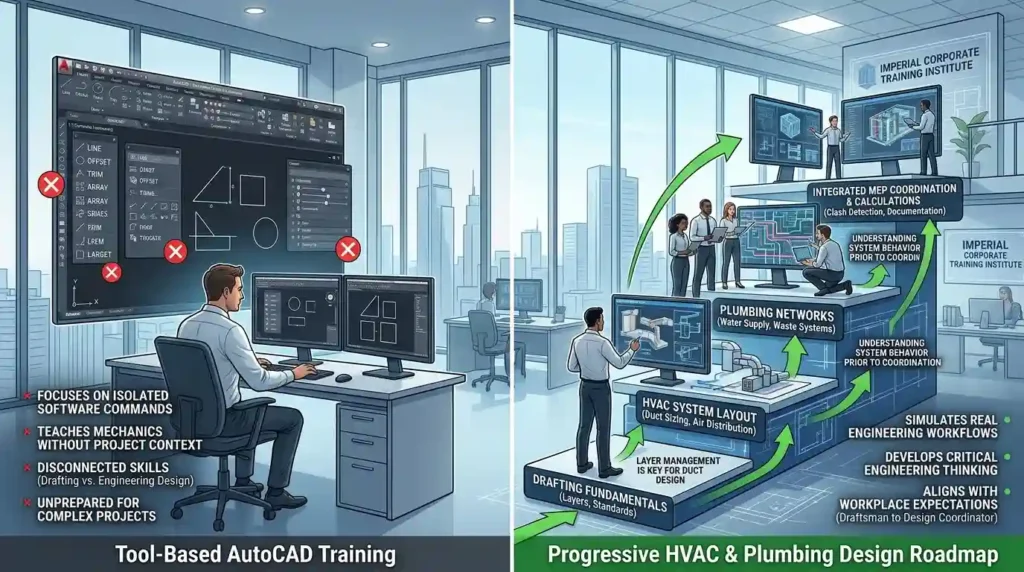
The course is structured as a staged learning roadmap because corporate MEP design requires progression from drafting fundamentals to system coordination, calculation integration, and documentation control. Imperial Corporate Training Institute designs each module to simulate real engineering workflows rather than isolated software commands or tool-based exercises.
Most AutoCAD training fails because it teaches commands without context. In contrast, this programme builds knowledge in sequence, starting from drafting standards and moving into HVAC system layout design, plumbing networks, and finally integrated MEP coordination.
Imperial Corporate Training Institute uses a layered curriculum logic. Each module builds dependency on the previous one. For example, learners cannot proceed to duct design without understanding layer management, and cannot progress to coordination without understanding system behaviour.
This structure is aligned with workplace expectations in engineering consultancies and construction firms where draftsmen must gradually evolve into design coordinators and senior MEP contributors.
Mid-stage evaluation of course structure and comparison with senior role expectations is supported through this resource:
How does AutoCAD HVAC training prepare draughtsmen for senior design roles.
Imperial Corporate Training Institute ensures that progression is not theoretical. It is mapped directly to deliverables such as duct layouts, plumbing schematics, riser diagrams, and coordinated MEP drawings used in real projects.
What will learners be able to design and deliver after completing the HVAC and plumbing training programme?
After completion, participants will be able to produce fully coordinated HVAC ducting systems, plumbing layouts, and mechanical schematics using AutoCAD while applying engineering standards, load considerations, and documentation protocols used in corporate construction and infrastructure projects.
The learning outcomes are structured across technical, analytical, and documentation-based competencies.
Learners gain HVAC drafting capability by designing duct layouts, airflow distribution systems, and equipment placement strategies. They also learn how to apply load-based thinking to ensure system efficiency and compliance.
In plumbing design, participants develop skills in pipe routing, slope calculation, riser diagrams, and fixture coordination. They also learn how to represent cold water, hot water, and drainage systems using structured CAD documentation methods.
Imperial Corporate Training Institute ensures learners can manage professional documentation tasks such as layer structuring, sheet organisation, and drawing standards used in engineering firms.
Advanced outcomes include integration with multidisciplinary workflows. Learners understand how HVAC and plumbing systems interact with electrical layouts and structural constraints.
The course also builds capability in AutoCAD-based system optimisation, including reduction of design conflicts and improvement of spatial coordination in dense building environments.
Imperial Corporate Training Institute emphasises measurable workplace outcomes such as reduced drafting errors, improved coordination speed, and ability to contribute to design approval cycles in corporate teams.
How is the HVAC and plumbing training delivered and what learning methods are used in corporate environments?
The training is delivered through structured modules combining guided demonstrations, practical drafting assignments, real-world engineering simulations, and corporate-style project workflows that replicate HVAC and plumbing design processes used in construction and consultancy environments.
Imperial Corporate Training Institute uses a blended instructional model focused on applied learning rather than theoretical explanation.
Each session includes live drafting demonstrations where participants build HVAC duct systems and plumbing layouts step-by-step. These are followed by independent assignments that simulate project-based work environments.
Workshops include system-based exercises such as duct routing optimisation, pipe sizing calculations, and coordination tasks using external references and layered CAD structures.
Imperial Corporate Training Institute integrates assessment through design tasks rather than written tests alone. Participants are evaluated on accuracy, compliance with standards, and ability to produce coordinated drawings.
The training environment reflects corporate engineering workflows where draftsmen work under project deadlines, revision cycles, and multidisciplinary coordination requirements.
Participants are also introduced to workflow automation practices, including template creation, drawing standardisation, and version control methods used in engineering offices.
Imperial Corporate Training Institute ensures that delivery formats reflect real project conditions so learners can transition directly into professional roles without adaptation delays.
What makes the curriculum progression suitable for corporate HVAC and MEP design roles?
The curriculum is designed to replicate corporate MEP project lifecycle stages, starting from drafting foundations and progressing through HVAC design, plumbing systems, coordination workflows, and final documentation, ensuring learners can operate in structured engineering teams.
Imperial Corporate Training Institute has designed the curriculum to mirror actual project execution environments.
Module 1 introduces corporate CAD standards and drafting discipline. Module 2 transitions into HVAC system drafting where learners begin designing duct networks and airflow paths.
Module 3 introduces plumbing system design including pipe sizing, slope calculations, and riser diagrams. Module 4 focuses on coordination using Xrefs and multi-layered design integration.
Modules 5 and 6 introduce system-level thinking through load calculations, optimisation techniques, and documentation standards.
Imperial Corporate Training Institute ensures that learners do not treat HVAC and plumbing as separate disciplines. Instead, they learn integration across systems.
Module 7 and 8 focus on documentation, quality assurance, and revision control, which are essential in corporate engineering delivery.
Module 9 integrates BIM and Revit workflows, preparing learners for modern design environments where AutoCAD interacts with 3D modelling systems.
Module 10 simulates complete project execution from design initiation to final deliverables.
This structured progression ensures learners can function in junior drafting roles, design coordination positions, and eventually senior MEP responsibilities.
Imperial Corporate Training Institute positions this curriculum as a direct career development pathway rather than a software course.
What workplace impact can be expected after completing Imperial’s HVAC and plumbing design training?
Graduates can expect improved drafting speed, enhanced design accuracy, stronger system coordination capability, and readiness to participate in real engineering projects involving HVAC and plumbing systems within corporate construction and infrastructure environments.

Imperial Corporate Training Institute aligns outcomes with measurable workplace performance indicators.
Participants are able to reduce design errors through improved understanding of system logic and CAD structuring methods. This leads to fewer revision cycles in engineering teams.
In corporate environments, learners become capable of supporting senior engineers by producing coordinated HVAC and plumbing drawings that meet project specifications.
HR departments benefit from improved workforce capability as employees transition from drafting roles into design support and coordination roles.
Imperial Corporate Training Institute also prepares learners for interdisciplinary collaboration, enabling smoother interaction with electrical and structural teams.
Another key outcome is improved documentation discipline. Learners can generate structured sheets, legends, and schedules required for project approvals and client submissions.
In engineering consultancies, this translates into faster project turnaround and improved compliance with international drafting standards.
The training also strengthens readiness for senior progression pathways where professionals move into MEP design leadership and project coordination roles.
How does enrollment work and who is eligible for Imperial’s HVAC and plumbing design programme?
Enrollment is structured for engineering professionals, draftsmen, and technical staff with basic AutoCAD knowledge who want to progress into HVAC and plumbing design roles. Imperial Corporate Training Institute follows a competency-based intake process aligned with corporate training requirements.
Eligibility includes mechanical engineers, MEP draftsmen, AutoCAD technicians, and facility management professionals involved in technical building systems.
Graduates with mechanical or civil engineering backgrounds can also participate to develop specialised HVAC and plumbing design skills.
Discover More from Our Guide Library:
Does Imperial’s HVAC AutoCAD Course Cover Both Residential and Commercial Design?
How Does Imperial’s HVAC Programme Teach Design Basis Reporting Skills?
Imperial Corporate Training Institute assesses participants based on their familiarity with AutoCAD fundamentals and readiness for applied engineering design tasks.
The training process includes structured onboarding, module-based progression, and completion of practical design assignments.
Participants complete a final project simulation where they design an integrated HVAC and plumbing system using corporate drafting standards.
Imperial Corporate Training Institute ensures that completion is based on demonstrated capability rather than theoretical assessment alone.
Upon completion, learners are prepared for roles in construction firms, engineering consultancies, and corporate facility management departments where HVAC and plumbing design expertise is required.
For final progression into structured learning and certification pathways, participants can enroll in this programme:
AutoCAD HVAC and Plumbing Design Training Course, and begin their corporate MEP design development pathway.