

Engineering coordination failures between HVAC teams and architectural departments often lead to ceiling clashes, incomplete reflected ceiling plans, delayed approvals, and construction-stage rework. The AutoCAD HVAC and Plumbing Design Training Course by Imperial Corporate Training Institute is structured to address these coordination gaps through applied drafting, MEP collaboration, and corporate-level design workflows.
In commercial construction environments, HVAC engineers are expected to coordinate with architects, electrical teams, BIM specialists, and project managers before installation begins. Mechanical layouts must align with reflected ceiling plans, structural limitations, access panels, lighting systems, and fire safety components. Engineers who lack multidisciplinary coordination skills often produce technically correct drawings that fail during project execution.
Understanding how HVAC systems interact with ceiling planning is a foundational requirement before progressing into advanced coordination workflows. Engineers evaluating this programme often begin by reviewing educational material such as:
What Is a Reflected Ceiling Plan and How Does HVAC Design Fit into It? to understand the architectural context behind HVAC integration.
The AutoCAD HVAC and Plumbing Design Training Course by Imperial Corporate Training Institute is designed for decision-stage learners who need measurable drafting and coordination capabilities applicable to real engineering projects. The programme focuses on technical competency, workflow accuracy, and collaboration standards used across corporate construction and infrastructure sectors.
What Problem Does This Programme Solve for HVAC Engineers?
This programme resolves the operational gap between standalone HVAC drafting and multidisciplinary project coordination. It prepares engineers to integrate mechanical systems with architectural layouts, reflected ceiling plans, plumbing systems, and corporate documentation standards required in commercial and industrial construction environments.
Many engineers can produce HVAC layouts independently but struggle when coordinating with architects during project development. Ceiling congestion is one of the most common technical issues in commercial buildings. HVAC ductwork competes for space with lighting fixtures, sprinkler systems, cable trays, ceiling grids, and structural components.
In real project environments, HVAC coordination failures create several operational problems:
- Incorrect diffuser placement relative to ceiling grids
- Duct routing conflicts with beams and lighting systems
- Inconsistent ceiling elevations across departments
- Poor equipment accessibility for maintenance
- Delays in drawing approval cycles
- Increased construction-stage revisions
The AutoCAD HVAC and Plumbing Design Training Course by Imperial Corporate Training Institute addresses these challenges through structured coordination training rather than isolated software instruction.
Participants learn how reflected ceiling plans influence diffuser locations, air distribution strategies, access requirements, and service integration. The course also explains how engineers interpret architectural intent before finalising HVAC layouts.
The programme bridges design communication gaps between departments. Engineers learn how to read architectural documentation accurately, apply drafting standards consistently, and produce coordinated mechanical layouts suitable for tender submissions and construction execution.
Corporate engineering teams benefit from reduced rework because trained professionals understand multidisciplinary workflow requirements from the beginning of the design process.
Why Is the Course Structured Around Coordination and Workflow Progression?
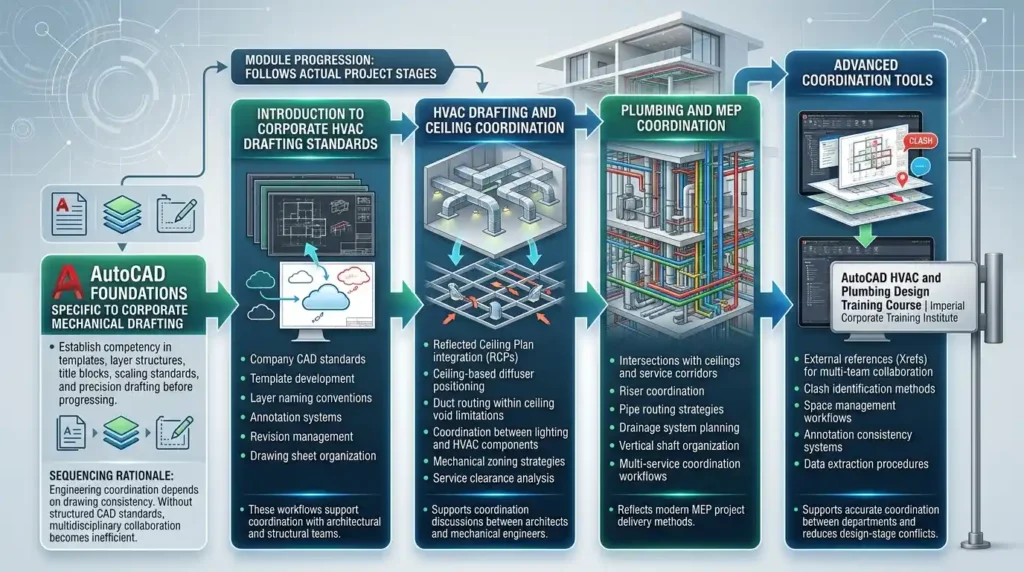
The curriculum follows a progressive engineering workflow that moves from drafting fundamentals to multidisciplinary coordination, design optimisation, documentation control, and project simulation. This structure reflects how HVAC and plumbing systems are developed within real corporate engineering environments.
The programme begins with AutoCAD foundations specific to corporate mechanical drafting. Participants establish competency in templates, layer structures, title blocks, scaling standards, and precision drafting before progressing into HVAC coordination tasks.
This sequencing is important because engineering coordination depends on drawing consistency. Without structured CAD standards, multidisciplinary collaboration becomes inefficient.
Module progression within the programme follows actual project stages:
Introduction to Corporate HVAC Drafting Standards
Participants learn how engineering organisations structure mechanical drawings for consistency and collaboration. Training includes:
- Company CAD standards
- Template development
- Layer naming conventions
- Annotation systems
- Revision management
- Drawing sheet organisation
These workflows support coordination with architectural and structural teams.
HVAC Drafting and Ceiling Coordination
The HVAC drafting section focuses heavily on reflected ceiling plan integration. Engineers learn how diffuser placement, airflow routing, and duct sizing interact with architectural ceiling layouts.
Participants practise:
- Ceiling-based diffuser positioning
- Duct routing within ceiling void limitations
- Coordination between lighting and HVAC components
- Mechanical zoning strategies
- Service clearance analysis
This phase of training directly supports coordination discussions between architects and mechanical engineers.
Plumbing and MEP Coordination
The programme expands coordination beyond HVAC systems. Engineers learn how plumbing layouts intersect with ceiling spaces and service corridors.
Training includes:
- Riser coordination
- Pipe routing strategies
- Drainage system planning
- Vertical shaft organisation
- Multi-service coordination workflows
This multidisciplinary structure reflects modern MEP project delivery methods.
Advanced Coordination Tools
The AutoCAD HVAC and Plumbing Design Training Course by Imperial Corporate Training Institute introduces advanced coordination techniques using Xrefs, layer management systems, and design review processes.
Participants work with:
- External references for multi-team collaboration
- Clash identification methods
- Space management workflows
- Annotation consistency systems
- Data extraction procedures
These tools support accurate coordination between departments and reduce design-stage conflicts.
Engineers evaluating the programme structure often compare its coordination-focused approach with broader HVAC drafting education such as:
How Does AutoCAD HVAC Training Teach Coordination With Reflected Ceiling Plans? to assess curriculum depth and workflow relevance.
What Will Participants Learn About HVAC and Architectural Coordination?
Participants learn how to coordinate HVAC systems within architectural constraints using AutoCAD-based drafting, reflected ceiling plan interpretation, MEP collaboration techniques, clash management procedures, and documentation standards aligned with commercial engineering project requirements.
The programme focuses on measurable engineering competencies rather than software familiarity alone. Learning outcomes are tied directly to workplace performance.
Participants develop the ability to:
Interpret Architectural Documentation
Engineers learn how to analyse reflected ceiling plans and architectural drawings before beginning HVAC layouts.
Training covers:
- Ceiling grid interpretation
- Section analysis
- Ceiling elevation review
- Architectural coordination requirements
- Service access planning
This supports effective communication with architects and design consultants.
Develop Coordinated HVAC Layouts
Participants produce HVAC designs that align with building architecture and ceiling constraints.
Key skills include:
- Duct routing optimisation
- Air distribution planning
- Diffuser coordination
- Mechanical equipment placement
- Ceiling void utilisation
Training exercises simulate commercial office buildings, infrastructure projects, and industrial environments.
Apply MEP Coordination Principles
The AutoCAD HVAC and Plumbing Design Training Course by Imperial Corporate Training Institute trains participants to coordinate HVAC systems with plumbing and electrical services.
This includes:
- Shared service corridors
- Vertical shaft coordination
- Pipe and duct separation standards
- Access clearance analysis
- Service sequencing
Participants learn how multidisciplinary coordination reduces site conflicts during installation.
Integrate AutoCAD With BIM Workflows
Modern engineering environments increasingly combine AutoCAD and BIM systems. The programme introduces participants to BIM coordination concepts and Revit integration processes.
Training includes:
- Data linking procedures
- BIM coordination logic
- Transition workflows from 2D to 3D environments
- Integrated documentation methods
This prepares engineers for hybrid design environments used across large-scale projects.
Produce Corporate-Level Documentation
Documentation quality affects project approvals, procurement processes, and construction implementation.
Participants learn:
- Tender drawing preparation
- Equipment scheduling
- Bill of materials development
- Revision tracking
- As-built documentation procedures
These outputs reflect real engineering deliverables expected in corporate construction sectors.
How Is the Programme Delivered and Assessed?
The programme combines instructor-led workshops, practical drafting assignments, technical simulations, coordination exercises, and project-based assessments to ensure participants can apply HVAC coordination skills within real engineering and architectural project environments.
The AutoCAD HVAC and Plumbing Design Training Course by Imperial Corporate Training Institute is structured for corporate professionals who require practical learning outcomes rather than theoretical exposure.
Training delivery formats may include:
- Classroom workshops
- Online instructor-led sessions
- Hybrid learning structures
- Corporate onsite training
- Practical drafting laboratories
This flexibility supports engineering teams working across different project schedules and organisational structures.
Practical Workshop Structure
Workshops focus on application-based learning. Participants work directly on mechanical drafting exercises using project-style documentation.
Training activities include:
- HVAC drafting exercises
- Ceiling coordination simulations
- Layer management tasks
- Documentation development
- Clash management scenarios
Participants receive technical guidance during drafting workflows rather than passive demonstrations.
Assignment-Based Skill Validation
Each module includes structured assignments aligned with workplace tasks.
Examples include:
- Creating coordinated HVAC layouts
- Developing duct routing systems
- Producing plumbing schematics
- Organising drawing sheets
- Applying drafting standards
Assignments evaluate technical accuracy and workflow consistency.
Simulation-Based Learning
The programme includes project simulations reflecting commercial engineering environments.
Participants manage:
- Timeline-based drafting tasks
- Multi-department coordination workflows
- Revision procedures
- Client submission standards
- Quality assurance reviews
Simulation training improves readiness for real project delivery conditions.
Design Review and Quality Assurance
Participants learn internal review processes commonly used within engineering organisations.
This includes:
- Design auditing
- Error identification
- Compliance verification
- Documentation checking
- Revision control systems
The AutoCAD HVAC and Plumbing Design Training Course by Imperial Corporate Training Institute places strong emphasis on quality assurance because design inaccuracies directly affect project execution and construction costs.
What Results Can Organisations and Engineers Expect After Completion?
Participants completing the programme can expect measurable improvements in HVAC drafting accuracy, multidisciplinary coordination capability, project documentation quality, and technical communication effectiveness within commercial engineering and construction environments.

Engineering organisations increasingly require professionals who can contribute to integrated project delivery rather than isolated drafting functions.
The programme supports several measurable workplace outcomes.
Improved Coordination Accuracy
Engineers develop stronger coordination capabilities across architectural and MEP disciplines.
This reduces:
- Ceiling clashes
- Design inconsistencies
- Revision cycles
- Construction-stage conflicts
- Documentation errors
Better coordination improves project efficiency and supports smoother approval processes.
Faster Project Delivery
Structured drafting workflows improve production speed without reducing technical quality.
Participants learn:
- Layer automation methods
- Standardised documentation systems
- Workflow organisation strategies
- Efficient revision management
These processes support faster drawing development within corporate environments.
Stronger Team Collaboration
The AutoCAD HVAC and Plumbing Design Training Course by Imperial Corporate Training Institute improves collaboration between engineering departments and architectural teams.
Participants gain practical understanding of:
- Design communication procedures
- Cross-disciplinary coordination logic
- Shared documentation structures
- Technical review workflows
This strengthens coordination during design meetings and project approvals.
Enhanced Technical Documentation
Many engineering organisations struggle with inconsistent documentation quality across teams.
Participants learn how to produce:
- Coordinated construction drawings
- Standardised layouts
- Accurate schedules
- Structured revision records
- Professional submission packages
Improved documentation quality supports procurement, construction, and facility management activities.
Workforce Development for Corporate Engineering Teams
HR departments and engineering managers often require structured technical upskilling programmes for internal workforce development.
The programme supports:
- Technical standardisation
- Design workflow alignment
- Team capability improvement
- Graduate engineer development
- Corporate engineering competency frameworks
This makes the course relevant for organisational learning initiatives as well as individual technical progression.
How Does Enrollment Work and Who Should Apply?
Enrollment is structured for engineering professionals, technical graduates, MEP specialists, and corporate teams seeking applied HVAC and plumbing coordination skills using AutoCAD within commercial, industrial, and infrastructure project environments.
The AutoCAD HVAC and Plumbing Design Training Course by Imperial Corporate Training Institute is intended for professionals involved in mechanical system design, technical drafting, and multidisciplinary project coordination.
Suitable participants include:
- Mechanical design engineers
- HVAC engineers
- MEP coordinators
- AutoCAD technicians
- Plumbing design specialists
- Project engineers
- Facility management professionals
- Engineering graduates
The programme is particularly relevant for professionals transitioning from isolated drafting roles into broader project coordination responsibilities.
Discover More from Our Guide Library:
Does Imperial’s HVAC Programme Include Commercial Ventilation Drawing Projects?
How Does Imperial’s HVAC Course Help Graduates Meet MEP Firm Hiring Requirements?
Entry Expectations
Participants are expected to have:
- Basic engineering knowledge
- Familiarity with technical drawings
- Interest in HVAC or plumbing system design
- Understanding of construction workflows
Prior exposure to AutoCAD is beneficial but workflow training is integrated progressively throughout the programme.
Completion Path
Participants progress through:
- Drafting fundamentals
- HVAC system layouts
- Plumbing coordination
- Advanced AutoCAD workflows
- BIM integration concepts
- Quality assurance procedures
- Final project simulation
Successful completion demonstrates practical capability in HVAC and plumbing coordination workflows aligned with corporate engineering standards.
For professionals and organisations evaluating structured HVAC coordination training with applied engineering workflows, technical drafting standards, and multidisciplinary project integration.