

Commercial ventilation drawings define airflow distribution, duct routing, equipment placement, pressure balancing, and compliance requirements. They improve coordination between engineering, construction, and facility management teams while reducing installation errors, project delays, and operational inefficiencies in large-scale buildings.
Ventilation system drawings are technical documents used to design airflow systems for commercial environments such as hospitals, shopping centres, hotels, airports, data centres, and office towers. These drawings show how conditioned air moves through a building and how air quality standards are maintained across different operational zones.
In corporate construction environments, ventilation drawings support collaboration between HVAC engineers, architects, structural consultants, electrical contractors, and project managers. Each department relies on precise drawing data to avoid spatial conflicts and installation delays during construction phases.
AutoCAD provides a digital drafting environment where engineers create two-dimensional and three-dimensional HVAC layouts. The software allows technical teams to define duct dimensions, airflow directions, grille positions, riser systems, and equipment schedules with measurable precision.
Large commercial projects involve thousands of square metres of conditioned space. Manual drafting processes increase coordination errors and reduce project visibility. AutoCAD standardises the drawing process and improves documentation consistency across multiple teams and project phases.
Organisations use structured HVAC drafting workflows because ventilation systems directly affect operational performance metrics such as indoor air quality, energy consumption, occupant comfort, and maintenance efficiency. Poorly designed ventilation systems increase operational costs and reduce equipment lifespan.
Training teams in structured drafting practices improves project delivery accuracy. In industries like healthcare, finance, manufacturing, and retail, technical drawing accuracy affects regulatory compliance, safety standards, and operational continuity.
How does AutoCAD support ventilation system design in commercial environments?
AutoCAD supports ventilation design through layered drafting tools, scalable layouts, airflow calculations, duct routing systems, annotation standards, and multidisciplinary coordination. It enables engineering teams to produce accurate technical drawings aligned with commercial building specifications and compliance frameworks.
Commercial HVAC drafting begins with architectural floor plans imported into AutoCAD. Engineers use these layouts as the foundation for ventilation system planning. The process starts with analysing building dimensions, occupancy density, equipment loads, and airflow requirements.
HVAC engineers create separate drawing layers for supply ducts, return ducts, exhaust systems, dampers, diffusers, and mechanical equipment. Layer management improves project organisation and allows teams to isolate technical elements during design reviews.
AutoCAD drafting workflows typically follow these stages:
Site and architectural analysis
Engineers evaluate room functions, ceiling heights, occupancy levels, and zoning requirements. Buildings such as hospitals and laboratories require pressure-controlled ventilation systems, while retail facilities focus on balanced airflow and customer comfort.
Load calculation and airflow planning
Teams calculate heating and cooling loads using HVAC engineering formulas. Airflow rates are measured in cubic feet per minute (CFM) or litres per second (L/s). These calculations determine duct sizes, fan capacities, and air distribution layouts.
Duct routing and equipment placement
Drafting teams create duct pathways that avoid clashes with plumbing, electrical systems, and structural components. Equipment such as air handling units (AHUs), chillers, exhaust fans, and fire dampers are positioned according to operational efficiency and maintenance accessibility.
Annotation and technical documentation
Engineers label airflow directions, duct dimensions, insulation specifications, and equipment schedules. Standardised annotation improves communication between construction teams and facility managers.
Quality review and compliance checks
Design managers review drawings against local building regulations, ASHRAE standards, and project specifications. Quality control processes reduce rework during installation phases.
Corporate training programmes often simulate these workflows through project-based learning exercises. Technical teams learn drafting standards using commercial building case studies instead of isolated software demonstrations.
What skills are required to create ventilation drawings in AutoCAD?
Ventilation drafting requires technical drawing skills, HVAC system knowledge, spatial coordination, airflow analysis, software proficiency, and compliance understanding. Organisations prioritise these skills because commercial construction projects depend on accurate engineering documentation and multidisciplinary collaboration.
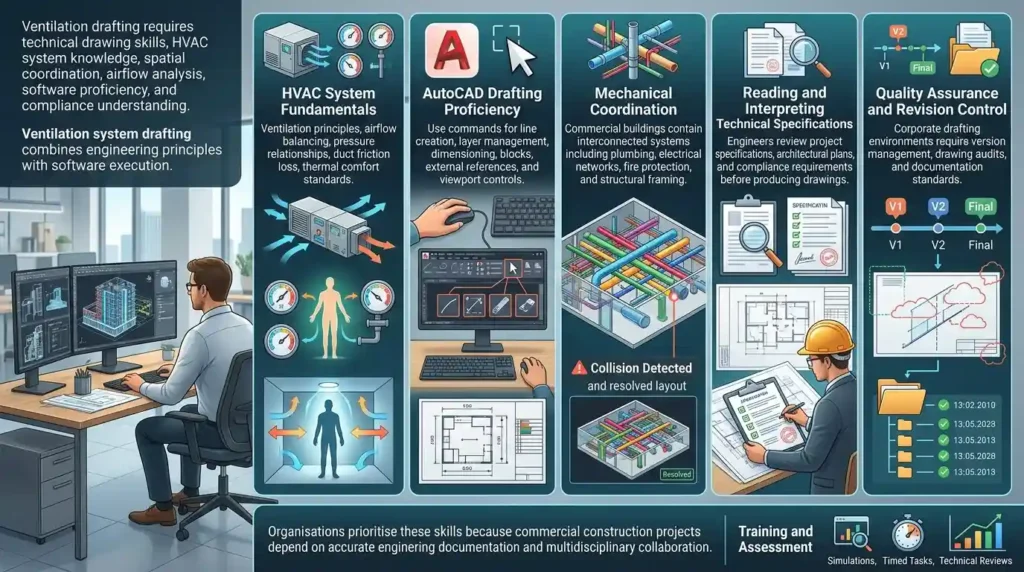
Ventilation system drafting combines engineering principles with software execution. Technical employees require both HVAC knowledge and CAD operational skills to produce accurate commercial drawings.
Core drafting competencies include:
HVAC system fundamentals
Employees learn ventilation principles such as airflow balancing, pressure relationships, duct friction loss, and thermal comfort standards. Understanding HVAC terminology improves communication between engineering and operations teams.
AutoCAD drafting proficiency
Technical staff use commands for line creation, layer management, dimensioning, blocks, external references, and viewport controls. Productivity improves when employees standardise drafting workflows across departments.
Mechanical coordination
Commercial buildings contain interconnected systems including plumbing, electrical networks, fire protection, and structural framing. HVAC teams must coordinate duct layouts without creating installation conflicts.
Reading and interpreting technical specifications
Engineers review project specifications, architectural plans, and compliance requirements before producing drawings. Misinterpretation increases project delays and construction modifications.
Quality assurance and revision control
Corporate drafting environments require version management, drawing audits, and documentation standards. Revision errors create coordination issues during procurement and installation stages.
Training departments often assess these competencies through simulations, timed drafting tasks, and technical reviews. Structured assessments provide measurable performance indicators for workforce development programmes.
How are ventilation drawings implemented in corporate construction projects?
Commercial organisations implement ventilation drawings through collaborative project workflows involving engineering teams, contractors, procurement departments, and facility managers. Structured implementation improves installation accuracy, project scheduling, compliance tracking, and operational performance after construction completion.
Ventilation drawings move through several operational stages before physical installation begins. Large organisations integrate drafting workflows into broader project management systems to improve coordination efficiency.
The implementation process includes:
Design coordination meetings
Engineering departments review HVAC layouts alongside architectural and electrical systems. Clash detection reduces construction delays and change orders during installation phases.
Procurement planning
Ventilation drawings define equipment specifications, duct dimensions, and material quantities. Procurement teams use these documents to source components and manage supplier timelines.
Installation execution
Mechanical contractors interpret AutoCAD drawings during site installation. Accurate documentation reduces duct misalignment, equipment relocation, and airflow balancing issues.
Inspection and commissioning
Commissioning teams compare installed systems against design drawings. Airflow testing and balancing procedures verify operational performance before building occupancy.
Facilities management integration
Final as-built drawings support long-term maintenance planning. Facility managers use HVAC documentation to schedule inspections, repairs, and energy optimisation initiatives.
Corporate training programmes often include implementation-focused modules because technical teams require operational context beyond drafting commands alone.
This transition from foundational drafting knowledge to practical execution becomes especially important when organisations evaluate specialised training pathways. A deeper explanation of implementation-based learning appears in the article on:
How ventilation layouts are taught within large commercial HVAC projects through structured AutoCAD workflows.
Enrol in:
AutoCAD HVAC and Plumbing Design Training Course.
What components are included in commercial ventilation drawings?
Commercial ventilation drawings include duct layouts, airflow routes, equipment schedules, diffuser placements, exhaust systems, pressure zones, insulation details, and compliance annotations. These components ensure coordinated construction execution and long-term operational reliability within complex commercial environments.
Ventilation drawings contain interconnected technical elements that define how air moves throughout a building. Each component serves operational and regulatory purposes.
Duct layouts
Duct layouts show airflow pathways between air handling units and occupied spaces. Engineers define duct dimensions, routing directions, and connection points based on airflow calculations.
Air handling equipment
Drawings specify HVAC equipment such as AHUs, fan coil units, chillers, exhaust fans, smoke extract systems, and rooftop units. Equipment schedules include capacities, airflow ratings, and installation details.
Diffusers and grilles
Supply and return air terminals control airflow distribution inside occupied zones. Placement affects indoor comfort, pressure balancing, and ventilation efficiency.
Exhaust and smoke management systems
Commercial kitchens, laboratories, and underground parking facilities require dedicated exhaust systems. Smoke extraction systems support fire safety compliance during emergencies.
Mechanical symbols and annotations
AutoCAD drawings use standardised symbols for dampers, diffusers, filters, and equipment connections. Consistent notation improves coordination between multidisciplinary teams.
Compliance and safety references
Ventilation drawings include references to fire dampers, access clearances, insulation specifications, and airflow requirements aligned with local building codes and international standards.
Organisations standardise these drawing components to improve project consistency across multiple locations and operational facilities.
How do organisations deliver AutoCAD HVAC training to technical teams?
Organisations deliver AutoCAD HVAC training through workshops, hybrid learning models, simulations, project-based assignments, and technical assessments. Structured delivery improves employee competency, drafting accuracy, project coordination, and operational efficiency across engineering and construction departments.
Corporate technical training focuses on measurable workplace outcomes instead of theoretical software exposure. Organisations align HVAC drafting programmes with project requirements and operational objectives.
Training delivery models include:
Instructor-led workshops
Engineering teams participate in classroom-based drafting exercises focused on commercial project scenarios. Workshops typically range from 20 to 60 training hours depending on technical complexity.
Online technical modules
Digital learning platforms provide flexible access to AutoCAD tutorials, HVAC drafting exercises, and recorded demonstrations. Online modules support geographically distributed teams.
Hybrid learning environments
Many organisations combine online instruction with practical workshops. Hybrid delivery improves scheduling flexibility while maintaining technical supervision during complex drafting exercises.
Case-based learning
Employees analyse commercial building projects such as hospitals, hotels, and manufacturing facilities. Real-world examples improve technical problem-solving capabilities.
Simulation-driven exercises
Technical simulations replicate coordination challenges involving HVAC, plumbing, and electrical systems. Simulation-based learning improves spatial awareness and interdisciplinary collaboration.
Performance assessments
Training departments evaluate drafting speed, accuracy, annotation standards, and coordination efficiency. KPI-based assessments provide measurable workforce development outcomes.
Corporate learning programmes increasingly focus on operational application because software proficiency alone does not improve project delivery performance.
What business benefits result from accurate ventilation system drafting?
Accurate ventilation drafting improves project coordination, reduces construction rework, supports compliance management, lowers operational costs, and enhances facility performance. Organisations use structured drafting processes to improve efficiency, reduce project risk, and strengthen engineering productivity across commercial developments.

Commercial HVAC systems directly affect operational continuity and energy efficiency. Poor drafting quality increases installation conflicts, maintenance costs, and occupant complaints.
Key organisational benefits include:
Reduced project delays
Accurate coordination drawings reduce clashes between HVAC, plumbing, and electrical systems. Fewer conflicts decrease construction stoppages and redesign requirements.
Improved cost control
Precise material specifications improve procurement planning and reduce waste during installation. Commercial projects with coordinated HVAC drawings experience lower rework costs.
Enhanced energy performance
Well-designed ventilation systems improve airflow efficiency and temperature control. Energy-efficient HVAC operations reduce long-term utility expenses for commercial facilities.
Better compliance management
Structured drawings support compliance with fire safety regulations, ventilation standards, and occupational health requirements. Compliance failures increase legal and operational risks.
Stronger facility maintenance
As-built ventilation documentation improves maintenance scheduling and equipment troubleshooting. Facility teams identify system components faster using accurate drawing records.
Increased workforce productivity
Technical employees with standardised drafting skills complete projects more efficiently. Consistent workflows improve collaboration across engineering and construction departments.
Training programmes focused on measurable drafting outcomes support organisational objectives such as operational efficiency, cost reduction, and infrastructure reliability.
What common problems affect ventilation drawing projects in organisations?
Ventilation drawing projects fail when teams use inconsistent drafting standards, inadequate HVAC knowledge, poor coordination processes, or generic software training. These issues increase rework, reduce installation accuracy, and weaken operational performance across commercial construction projects.
Many organisations invest in software access without developing structured technical competencies. This creates workflow inconsistencies and coordination failures during project execution.
Common operational problems include:
Generic software-only training
Employees learn AutoCAD commands without understanding HVAC engineering principles. Software familiarity alone does not produce accurate commercial ventilation layouts.
Poor interdisciplinary coordination
HVAC teams sometimes draft systems without reviewing structural or electrical layouts. Coordination failures create installation conflicts and redesign costs.
Lack of standardisation
Different departments often use inconsistent layer naming, annotation styles, and documentation methods. Inconsistent standards reduce project clarity and increase revision errors.
Limited practical application
Training programmes focused only on theory fail to prepare teams for commercial project environments. Employees require practical exposure to real building layouts and engineering scenarios.
Weak revision management
Large commercial projects involve multiple drawing revisions. Poor version control increases communication breakdowns between engineering, procurement, and installation teams.
Inadequate performance measurement
Some organisations fail to track drafting accuracy, project turnaround time, or coordination efficiency. Without measurable KPIs, workforce development outcomes remain unclear.
Discover More from Our Guide Library:
Why Is AutoCAD HVAC Proficiency a Job Requirement for Most MEP Firms Today?
How Do MEP Draughtsmen Use AutoCAD Blocks and Attributes Efficiently?
High-performing organisations address these issues through structured technical learning frameworks that combine HVAC engineering concepts, drafting standards, and operational implementation practices.
What is included in the AutoCAD HVAC and Plumbing Design Training Course?
The AutoCAD HVAC and Plumbing Design Training Course covers HVAC drafting, plumbing layouts, ducting systems, piping design, and technical drawing standards. Imperial Corporate Training Institute also includes practical AutoCAD workflows used in commercial and industrial building projects.
Who should attend an AutoCAD HVAC and Plumbing Design Training Course?
This course is suitable for mechanical engineers, HVAC technicians, CAD operators, project engineers, and facility management professionals. Imperial Corporate Training Institute structures the training for both entry-level learners and experienced technical staff working on building services projects.
How does AutoCAD help in HVAC and plumbing system design?
AutoCAD improves the accuracy of HVAC and plumbing drawings by supporting detailed layouts, layer management, equipment placement, and system coordination. The AutoCAD HVAC and Plumbing Design Training Course teaches how technical teams create compliant and organised commercial building drawings.
What skills are developed in an AutoCAD HVAC and Plumbing Design Training Course?
Learners develop skills in HVAC drafting, plumbing system design, duct sizing, piping layouts, schematic interpretation, and drawing coordination. Imperial Corporate Training Institute also focuses on practical project documentation and industry-standard CAD practices.