

Hot water and heating system design in AutoCAD drawings is the process of creating technical layouts, pipe routing plans, heating load calculations, equipment schedules, and construction documentation using computer-aided design software for commercial, industrial, and residential buildings.
Hot water and heating systems support temperature control, occupant comfort, and energy efficiency in buildings such as hospitals, hotels, office towers, manufacturing plants, and educational facilities. In corporate construction environments, these systems form part of the broader HVAC infrastructure. AutoCAD allows engineering and drafting teams to convert heating concepts into standardised technical documentation used for construction, maintenance, compliance, and facility management.
The design process includes creating detailed drawings for boilers, radiators, underfloor heating systems, pumps, expansion tanks, valves, and insulated pipe networks. AutoCAD supports precision drafting with layers, dimensions, symbols, annotations, and coordinated layouts. This standardisation reduces design conflicts between mechanical, electrical, and plumbing departments.
In workforce development programmes, heating system drafting training addresses technical skill gaps in engineering teams, maintenance departments, and construction firms. Organisations use structured learning frameworks to improve drawing accuracy, reduce project delays, and increase coordination between multidisciplinary teams.
Industries like healthcare, oil and gas, commercial real estate, and manufacturing rely on accurate heating system documentation because design errors increase operational costs, energy waste, and construction rework. A poorly documented heating network causes commissioning delays and compliance issues during inspections.
How do organisations create heating system drawings in AutoCAD step by step?
Organisations create heating system drawings through a structured workflow that includes site analysis, heating load calculations, equipment selection, pipe routing, drafting standards, system coordination, and documentation review before project approval and construction execution.
Engineering teams begin with architectural background drawings. These include floor plans, elevations, reflected ceiling plans, and service coordination layouts. Mechanical designers analyse room sizes, occupancy levels, insulation specifications, and environmental conditions before creating heating layouts.
How is heating load analysis performed?
Heating load analysis calculates the amount of heat required to maintain indoor temperature standards across building zones, departments, and operational areas using thermal performance data and occupancy requirements.

Heating load calculations define radiator sizing, boiler capacity, pipe diameter, and circulation requirements. Designers calculate thermal losses through walls, windows, roofs, and ventilation systems. Commercial projects often divide buildings into heating zones for operational control and energy efficiency.
For example, hospitals require separate heating controls for operating theatres, patient wards, laboratories, and administration offices. Manufacturing plants use different heating outputs for warehouse areas, production halls, and control rooms.
AutoCAD drawings integrate these calculations into annotated layouts, schedules, and mechanical legends. Engineering teams document system capacities to support procurement, installation, and maintenance planning.
How are heating pipes routed in AutoCAD layouts?
Heating pipe routing defines the physical path of supply and returns lines while maintaining installation efficiency, pressure balance, accessibility, and coordination with electrical and structural systems.
Pipe routing follows building constraints and mechanical engineering standards. Designers use AutoCAD layers to separate hot water supply lines, return lines, drainage systems, insulation details, and valve assemblies.
Mechanical teams position pipes to minimise heat loss and reduce pressure drop. Routing also avoids clashes with electrical conduits, structural beams, and ventilation ductwork. Coordination drawings reduce construction conflicts and improve installation speed.
Corporate construction projects often use colour-coded drafting standards. For example:
- Red layers represent hot water supply pipes
- Blue layers represent return systems
- Green layers identify valves and balancing equipment
- Grey layers show insulation boundaries
These standards improve communication between engineering contractors, site supervisors, and maintenance teams.
How are heating components documented?
Heating components are documented through schedules, symbols, dimensions, annotations, and equipment tags that standardise installation requirements across engineering and construction teams.
Heating drawings contain detailed component schedules for:
- Boilers
- Pumps
- Heat exchangers
- Radiators
- Expansion vessels
- Thermostatic valves
- Underfloor heating manifolds
Each component receives identification tags linked to specifications and procurement records. AutoCAD documentation ensures consistency across project phases, including design approval, construction, commissioning, and maintenance operations.
This structured documentation approach supports compliance with engineering standards and operational KPIs such as installation accuracy, maintenance response time, and energy performance monitoring.
What tools and technical skills are required for heating system design drafting?
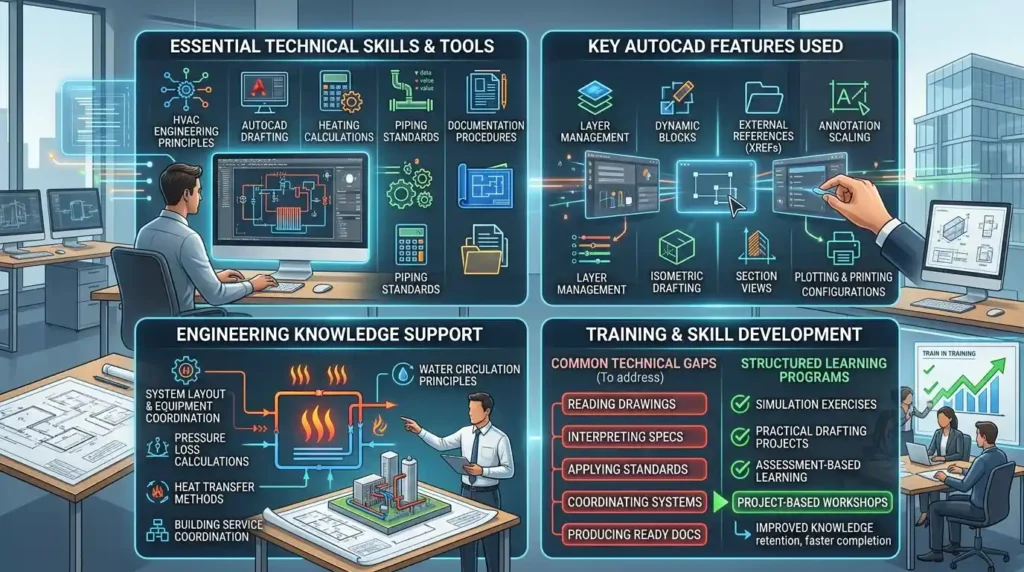
Heating system drafting requires technical knowledge of HVAC engineering principles, AutoCAD drafting tools, heating calculations, piping standards, and documentation procedures used in commercial building projects.
Technical drafting teams use AutoCAD features such as:
- Layer management
- Dynamic blocks
- External references
- Annotation scaling
- Isometric drafting
- Section views
- Plotting and printing configurations
Engineering knowledge supports proper system layout and equipment coordination. Drafting professionals understand pressure loss calculations, water circulation principles, heat transfer methods, and building service coordination requirements.
Training departments often identify technical gaps in:
- Reading engineering drawings
- Interpreting HVAC specifications
- Applying drafting standards
- Coordinating multidisciplinary systems
- Producing construction-ready documentation
Structured learning programmes address these gaps through simulation exercises, practical drafting projects, and assessment-based learning methodologies.
Many organisations integrate project-based workshops into technical training because practical drafting exercises improve knowledge retention and drawing accuracy. Teams trained using real project simulations complete documentation tasks faster and produce fewer coordination errors.
How does AutoCAD HVAC training support heating circuit design knowledge?
AutoCAD HVAC training develops heating circuit design skills through practical exercises involving pipe layouts, equipment positioning, flow direction planning, zoning systems, and mechanical documentation standards used in commercial projects.
Heating circuits control how hot water moves through buildings. Training programmes teach participants to design supply and return loops, calculate flow paths, position balancing valves, and organise zoning systems for operational efficiency.
Corporate learning frameworks use structured modules that progress from basic drafting principles to advanced mechanical coordination. Training delivery formats include:
- Instructor-led workshops
- Online technical modules
- Hybrid classroom learning
- CAD laboratory simulations
- Project-based assignments
- Technical assessments
Learning outcomes focus on measurable workplace improvements. Organisations track KPIs such as:
- Reduction in drawing revisions
- Faster project delivery times
- Improved compliance accuracy
- Lower coordination conflicts
- Increased drafting productivity
When organisations evaluate implementation methods and documentation practices, readers often transition from general awareness to technical execution research.
This is the point where detailed guidance on heating circuit layouts becomes relevant through:
How Does AutoCAD HVAC Training Cover Heating Circuit Design and Documentation? It is related to heating circuit drafting and AutoCAD documentation workflows.
Enrol in:
AutoCAD HVAC and Plumbing Design Training Course.
What are the key components included in heating system AutoCAD drawings?
Heating system AutoCAD drawings include layout plans, pipe sizing details, equipment schedules, control diagrams, sectional views, insulation specifications, and coordination annotations required for construction and facility operations.
Each drawing package serves operational and engineering functions throughout the building lifecycle. Mechanical consultants, contractors, procurement teams, and facility managers rely on consistent documentation standards.
Layout drawings
Layout drawings define the physical placement of heating equipment, pipelines, valves, and connection points across building floors and service zones.
These drawings show the routing structure for heating distribution systems. Teams use scaled plans to coordinate installation with structural and electrical departments.
Schematic diagrams
Schematic diagrams explain system operation by showing equipment relationships, flow directions, and control sequences without focusing on physical installation dimensions.
Schematics support troubleshooting and commissioning activities. Maintenance teams use these diagrams to understand operational logic and isolation procedures.
Equipment schedules
Equipment schedules provide technical specifications, capacities, model references, and operational data for heating system components.
Schedules improve procurement accuracy and support asset management systems. Facilities departments often integrate this information into digital maintenance platforms.
Detail drawings
Detail drawings show installation methods, mounting configurations, insulation requirements, and valve assembly arrangements for field execution teams.
Construction teams use detail drawings to maintain installation quality and compliance consistency across projects.
What business benefits do organisations gain from accurate heating system drafting?
Accurate heating system drafting improves project coordination, reduces construction errors, increases energy efficiency, supports compliance, and lowers operational costs across building lifecycle management processes.
Poor drafting quality increases project delays and rework expenses. Mechanical coordination conflicts create installation disruptions that affect project schedules and contractor productivity.
Accurate AutoCAD documentation improves:
- Construction sequencing
- Procurement planning
- Facility maintenance
- System commissioning
- Energy management
- Compliance inspections
Commercial organisations track drafting performance through operational KPIs such as:
- Percentage reduction in RFIs (Requests for Information)
- Reduction in site clashes
- Faster approval turnaround times
- Improved installation accuracy
- Lower maintenance response times
For example, coordinated mechanical drawings reduce installation conflicts between HVAC ducts and heating pipes. This decreases labour downtime and material waste during construction phases.
Energy efficiency also improves through accurate balancing and zoning documentation. Buildings with properly designed heating systems consume less energy and maintain stable thermal performance across operational departments.
Which industries use heating system AutoCAD drawings most extensively?
Industries with complex infrastructure requirements use heating system AutoCAD drawings extensively to support operational continuity, energy control, compliance standards, and facility management objectives.
Healthcare facilities require highly detailed heating documentation because temperature control affects patient safety and laboratory operations. Hospitals use centralised hot water systems with zoning strategies for surgical units, recovery wards, and diagnostic departments.
Manufacturing plants use heating systems to maintain production stability and equipment protection. Industrial facilities often integrate process heating with environmental temperature control systems.
Hospitality businesses like hotels and resorts depend on reliable heating distribution to support guest comfort and operational continuity. Large hospitality properties use central boiler systems connected to extensive piping networks.
Educational institutions, commercial offices, data centres, and government facilities also require coordinated heating documentation for operational efficiency and regulatory compliance.
In these sectors, technical drafting teams work closely with project managers, facility engineers, and procurement departments. Collaborative workflows improve coordination and reduce project fragmentation.
What common problems affect heating system drafting projects?
Heating system drafting projects face problems such as inconsistent documentation standards, insufficient technical training, design coordination conflicts, outdated workflows, and inaccurate heating calculations that reduce project efficiency and increase operational risks.
One common issue involves disconnected workflows between engineering departments. Mechanical teams often create layouts without full coordination with structural or electrical systems. This produces construction clashes during installation phases.
Another issue involves inconsistent drafting standards. Different teams use different layer structures, symbols, annotation scales, and naming conventions. This reduces drawing readability and delays approvals.
Technical skill shortages also affect drafting quality. Many organisations report competency gaps in:
- Heating load calculations
- Pipe sizing principles
- AutoCAD standards
- Mechanical coordination
- Documentation accuracy
Generic training programmes fail because they focus on software navigation without connecting drafting tasks to operational engineering requirements.
Effective workforce development programmes use practical simulations, case-based learning, and project assessments linked to real construction workflows. Teams learn how heating documentation affects procurement, commissioning, maintenance, and operational performance.
Some organisations also underestimate the importance of documentation review processes. Drawings require structured quality checks before approval. Review procedures verify dimensions, flow directions, pipe sizing, equipment references, and compliance standards.
Without quality assurance frameworks, drafting errors move into construction phases where correction costs increase significantly.
How do organisations measure the impact of heating system design training?
Organisations measure heating system design training impact through productivity metrics, drafting accuracy rates, project coordination performance, compliance outcomes, and operational efficiency improvements linked to workforce capability development.
Learning and development departments use measurable KPIs to evaluate technical training effectiveness. These include:
- Reduction in drawing revision cycles
- Faster drafting completion times
- Increased first-pass approval rates
- Reduced site coordination conflicts
- Improved compliance audit scores
Engineering managers also assess operational performance after training implementation. Teams producing coordinated AutoCAD drawings complete projects with fewer delays and lower rework costs.
Discover More from Our Guide Library:
What Are Common HVAC AutoCAD Drawing Errors That Junior Engineers Make?
How Does AutoCAD HVAC Handle Chiller Plant and Cooling Tower System Design?
Assessment methodologies include:
- Practical CAD simulations
- Technical drawing reviews
- Scenario-based exercises
- Performance benchmarking
- Project coordination evaluations
Hybrid learning models support scalable workforce development across multiple locations. Organisations combine online learning modules with instructor-led workshops and practical drafting labs.
This approach improves knowledge standardisation across departments and project teams. Consistent drafting practices strengthen collaboration, documentation quality, and long-term facility management performance.
What does the AutoCAD HVAC and Plumbing Design Training Course cover?
The AutoCAD HVAC and Plumbing Design Training Course at Imperial Corporate Training Institute covers HVAC layouts, plumbing system drafting, pipe routing, duct design, equipment scheduling, and technical documentation. The course also explains industry-standard AutoCAD workflows used in commercial and industrial building projects.
Who should attend an AutoCAD HVAC and Plumbing Design Training Course?
This training course is suitable for HVAC engineers, mechanical draughtsmen, MEP professionals, site supervisors, and technical design teams. Imperial Corporate Training Institute structures the course for both entry-level learners and experienced professionals working in construction and facility management sectors.
How does AutoCAD HVAC training improve workplace performance?
AutoCAD HVAC training improves drafting accuracy, project coordination, and documentation quality in engineering environments. Organisations use structured CAD training to reduce design errors, improve drawing standardisation, and support faster project delivery across construction and maintenance teams.
What software skills are developed in an AutoCAD HVAC and Plumbing Design Training Course?
Participants develop practical skills in AutoCAD layer management, HVAC drafting, plumbing layouts, schematic diagrams, annotation standards, and equipment detailing. Imperial Corporate Training Institute also includes real-world drawing exercises to improve technical documentation and system coordination skills.