

AutoCAD HVAC design training develops the technical and operational skills required to create heating, ventilation, and air conditioning system drawings for commercial and industrial buildings. Organisations use this training to improve design accuracy, reduce project delays, standardise workflows, and strengthen multidisciplinary collaboration between MEP engineering teams.
AutoCAD HVAC design training focuses on the practical application of computer-aided drafting within mechanical, electrical, and plumbing (MEP) projects. It teaches engineers how to produce HVAC layouts, ducting systems, airflow calculations, equipment schedules, plumbing coordination drawings, and construction-ready documentation using digital drafting software.
In corporate environments, MEP engineers work on large-scale projects such as hospitals, airports, manufacturing facilities, residential towers, data centres, and retail complexes. These projects involve strict timelines, compliance requirements, and coordination across multiple departments. Training ensures engineering teams follow standardised drafting methods and technical specifications.
The training also supports workforce development objectives. Companies use structured technical learning to address skill gaps in building services engineering, improve project execution, and reduce design inconsistencies. Engineering firms measure training outcomes through KPIs such as drawing accuracy rates, revision reduction percentages, project turnaround time, and coordination efficiency.
AutoCAD HVAC training aligns with practical workplace demands. Instead of focusing only on software commands, modern programmes integrate real project simulations, HVAC system design standards, and interdisciplinary coordination processes.
Why are organisations increasing investment in AutoCAD HVAC training for MEP engineers?
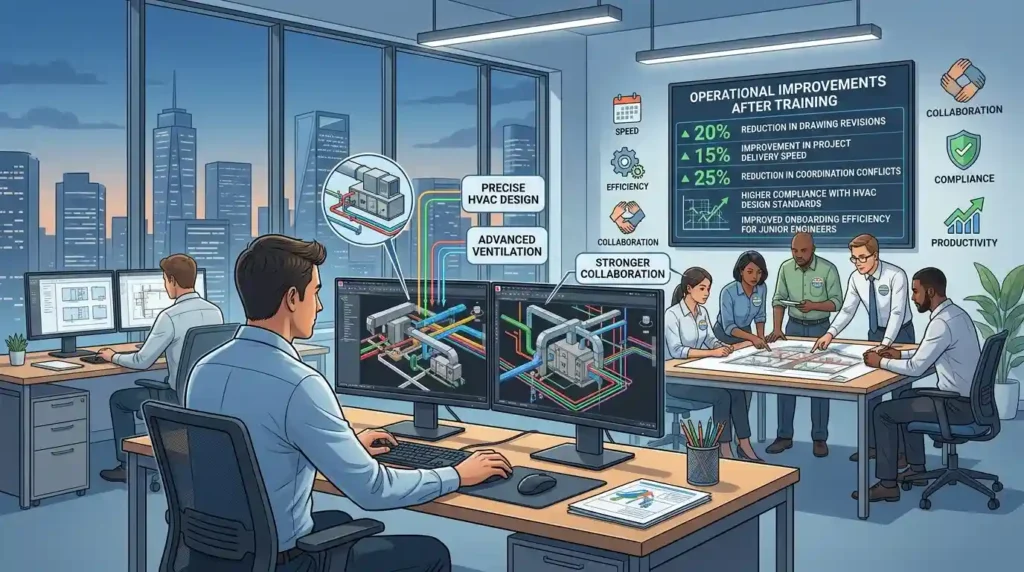
Organisations are increasing investment in AutoCAD HVAC training because modern construction projects require faster drafting cycles, accurate coordination models, and reduced design conflicts. Trained MEP engineers improve project delivery efficiency, minimise rework, support regulatory compliance, and strengthen collaboration between mechanical, electrical, and architectural departments.
Construction and infrastructure projects have become more technically complex. Commercial developments now include advanced ventilation systems, energy-efficient cooling technologies, and integrated smart building systems. These changes increase the demand for engineers who can produce precise HVAC and plumbing drawings.
Many engineering firms face operational issues caused by inconsistent drafting standards. Common problems include overlapping systems, inaccurate duct sizing, incorrect airflow calculations, and coordination clashes between disciplines. These issues increase project costs and delay construction schedules.
Training helps organisations standardise engineering workflows. Standardisation improves communication between teams working on structural, electrical, mechanical, and plumbing systems. It also reduces dependency on senior engineers for routine drafting tasks.
Workforce capability development has become a strategic priority in industries like construction, oil and gas, healthcare infrastructure, manufacturing, and facilities management. Companies use technical training programmes to build internal expertise instead of relying entirely on outsourced drafting resources.
Corporate learning departments also track measurable operational improvements after technical training implementation. Organisations commonly report:
- 20% reduction in drawing revisions
- 15% improvement in project delivery speed
- 25% reduction in coordination conflicts
- Higher compliance with HVAC design standards
- Improved onboarding efficiency for junior engineers
These outcomes support long-term workforce productivity and project quality objectives.
How does AutoCAD HVAC design training work within professional development programmes?
AutoCAD HVAC design training works through structured learning pathways that combine technical instruction, simulation-based practice, assessments, and workplace application. Organisations deliver training through workshops, online modules, hybrid learning, and project-based assignments aligned with operational engineering requirements.
Corporate training programmes follow a staged implementation structure. The process starts with skill assessment and competency mapping. Training teams identify existing knowledge gaps in drafting accuracy, HVAC system design understanding, software proficiency, and coordination workflows.
Training needs assessment
Engineering managers evaluate current team performance using operational metrics such as:
- Design error frequency
- Time required for drafting completion
- Coordination issue reports
- Project documentation quality
- Compliance audit findings
This assessment creates role-specific learning objectives for junior engineers, design coordinators, project engineers, and senior MEP specialists.
Technical instruction phase
The instructional phase introduces core HVAC drafting principles and software functionality. Participants learn:
- HVAC system layout development
- Duct routing strategies
- Pipe sizing and plumbing integration
- Equipment placement standards
- Layer management and annotation methods
- Air distribution planning
- Construction documentation preparation
Training programmes usually run between 20 and 60 hours depending on complexity and participant experience levels.
Applied simulation exercises
Case-based learning forms a major part of technical workforce development. Engineers work on simulated commercial projects such as office buildings, hotels, factories, and healthcare facilities.
Simulation exercises improve problem-solving skills because participants resolve real engineering coordination challenges instead of completing isolated software tasks.
Assessment and competency validation
Professional development programmes include technical assessments to validate competency improvements. Organisations use:
- Practical drafting tests
- Timed project assignments
- Peer review evaluations
- Technical compliance assessments
- Workflow efficiency measurements
These evaluations help companies measure training ROI and workforce readiness.
What technical components are included in AutoCAD HVAC and plumbing design training?
AutoCAD HVAC and plumbing design training includes drafting standards, HVAC system design principles, airflow management, ducting layouts, plumbing coordination, construction documentation, and multidisciplinary project integration. These components support operational consistency and technical accuracy across engineering teams.

Technical training programmes combine software skills with applied engineering knowledge. This integrated approach ensures engineers understand both system functionality and drafting execution.
HVAC drafting fundamentals
Training begins with drafting structure and workflow management. Engineers learn:
- Drawing templates
- Layer organisation
- Annotation standards
- Scale management
- Symbol libraries
- Sheet setup procedures
These elements improve documentation consistency across projects.
HVAC system design concepts
Engineers study mechanical system principles including:
- Air conditioning distribution
- Ventilation system planning
- Load calculation basics
- Airflow balancing
- Equipment selection standards
- Duct sizing methodology
This knowledge improves coordination between design intent and drafting execution.
Plumbing coordination skills
Modern MEP projects require integration between HVAC and plumbing systems. Training includes:
- Water supply routing
- Drainage layouts
- Pipe coordination techniques
- Mechanical room planning
- Service clearance management
Coordination training reduces construction-stage clashes between systems.
Construction documentation workflows
MEP engineers produce technical documents used by contractors, consultants, and project managers. Training covers:
- Shop drawings
- As-built documentation
- Equipment schedules
- Material specifications
- Coordination drawings
- Revision tracking
Documentation accuracy improves communication across project stakeholders.
Digital collaboration practices
Corporate engineering teams increasingly use collaborative project environments. Training includes workflow integration with:
- BIM coordination systems
- Cloud-based document sharing
- Interdisciplinary review processes
- Version control procedures
These practices improve operational transparency and project alignment.
What business challenges does AutoCAD HVAC training solve for organisations?
AutoCAD HVAC training solves business challenges related to design inconsistency, project delays, coordination conflicts, skill shortages, and operational inefficiencies. Structured technical training improves workflow reliability, supports compliance standards, and increases engineering team productivity across complex construction environments.
Many organisations experience project disruptions caused by inconsistent drafting practices. Different engineers often use varying standards, naming conventions, and documentation methods. This inconsistency slows project reviews and increases revision cycles.
Training establishes standard operating procedures across engineering departments. Standardisation improves quality control and simplifies project auditing processes.
Reducing project rework
Construction rework creates significant operational costs. Poorly coordinated HVAC and plumbing drawings frequently cause installation conflicts during construction phases.
Training reduces errors by improving:
- Spatial coordination accuracy
- Drafting consistency
- Technical documentation quality
- Interdisciplinary communication
Reduced rework improves project profitability and resource utilisation.
Addressing engineering skill shortages
The construction sector continues to face shortages of technically skilled MEP professionals. Organisations use workforce development programmes to accelerate competency building among junior engineers.
Structured learning pathways reduce onboarding time and increase workforce scalability.
Improving compliance performance
Commercial buildings must comply with local building regulations, ventilation standards, and safety requirements. Training improves awareness of drafting compliance procedures and engineering documentation standards.
Compliance-focused learning reduces approval delays and audit failures.
How do different industries use AutoCAD HVAC-trained MEP engineers?
Industries use AutoCAD HVAC-trained MEP engineers to design, coordinate, and manage building services systems across commercial, industrial, healthcare, infrastructure, and residential projects. Sector-specific technical requirements increase the need for specialised drafting and coordination capabilities.
Different industries apply HVAC drafting differently based on operational demands and regulatory requirements.
Healthcare facilities
Hospitals and laboratories require controlled airflow systems, pressure-sensitive environments, and strict ventilation standards. Engineers design specialised HVAC layouts for infection control and air quality management.
Manufacturing facilities
Factories use HVAC systems for temperature regulation, equipment cooling, and environmental safety. MEP teams coordinate large-scale ducting systems with industrial production layouts.
Commercial real estate
Office towers, shopping centres, and hotels require energy-efficient climate control systems integrated with architectural and electrical designs.
Data centres
Data centres rely on precise cooling infrastructure to maintain server performance. HVAC design teams create high-capacity airflow systems with redundancy planning and thermal management strategies.
Residential developments
High-rise residential projects require coordinated plumbing and HVAC systems that maximise space efficiency while meeting construction schedules.
Each sector requires engineers to understand operational priorities alongside drafting execution.
How do organisations measure the effectiveness of AutoCAD HVAC training?
Organisations measure AutoCAD HVAC training effectiveness through KPIs related to drafting accuracy, project completion speed, coordination efficiency, compliance performance, and employee productivity. Performance measurement helps learning departments evaluate operational impact and workforce capability improvements.
Training effectiveness measurement forms part of strategic workforce planning. Companies use both technical and business performance indicators.
Technical performance KPIs
Engineering departments track:
- Drawing revision frequency
- Design approval turnaround time
- Coordination clash reduction
- Documentation error rates
- Drafting productivity per engineer
These metrics provide direct visibility into operational improvements.
Workforce development KPIs
HR and L&D teams evaluate:
- Skill assessment scores
- Training completion rates
- Internal promotion readiness
- Employee retention levels
- Time-to-productivity for new engineers
Technical learning programmes contribute to workforce stability and capability development.
Financial performance indicators
Organisations also measure commercial outcomes such as:
- Reduced project rework costs
- Faster project delivery
- Improved resource allocation
- Lower outsourcing dependency
- Increased project profitability
These indicators help leadership teams justify continued investment in technical learning programmes.
When organisations begin evaluating specialised technical credentials and workforce progression frameworks, readers often shift from awareness into solution assessment.
This is the ideal point to reference content that discusses the broader professional impact of certification pathways, such as:
What Is the Long-Term Career Value of AutoCAD HVAC Certification for MEP Engineers? within a section explaining long-term engineering capability development.
Enrol in:
AutoCAD HVAC and Plumbing Design Training Course.
What misconceptions reduce the effectiveness of AutoCAD HVAC training programmes?
Common misconceptions reduce training effectiveness when organisations treat AutoCAD HVAC learning as software-only instruction, ignore workflow integration, or fail to measure operational outcomes. Effective programmes combine technical application, engineering principles, and business performance objectives.
One common misconception is that software knowledge alone improves engineering performance. Technical productivity depends on understanding HVAC systems, coordination requirements, and documentation standards alongside drafting tools.
Another issue involves generic training delivery. Organisations often implement identical programmes across different engineering roles without considering operational responsibilities.
Junior engineers, project coordinators, and senior MEP designers require different learning objectives and assessment methods.
Lack of practical application
Training programmes lose effectiveness when participants do not work on realistic engineering scenarios. Case-based learning improves retention because engineers apply technical concepts to operational challenges.
Simulation-driven learning produces stronger workforce outcomes than lecture-only delivery models.
Missing post-training implementation
Many organisations fail to reinforce learning after programme completion. Effective workforce development includes:
- Project-based application
- Mentoring support
- Workflow integration reviews
- Ongoing competency assessments
- Technical performance monitoring
Continuous reinforcement improves long-term capability retention.
Failure to align training with business outcomes
Technical learning programmes should support measurable operational goals. Companies achieve stronger ROI when training aligns with productivity improvement, quality control, and project efficiency targets.
Why does AutoCAD HVAC training support long-term workforce transformation?
AutoCAD HVAC training supports long-term workforce transformation by building scalable technical capability, improving interdisciplinary collaboration, standardising engineering workflows, and preparing organisations for increasingly digital construction environments. Consistent technical learning strengthens operational resilience and supports sustainable engineering performance.
Modern engineering environments depend on digital coordination and precise technical execution. Organisations require MEP teams capable of working within integrated project delivery models and data-driven construction systems.
Technical workforce transformation involves more than software adoption. It includes:
- Standardised engineering processes
- Continuous competency development
- Cross-functional collaboration
- Digital documentation management
- Performance-based learning systems
AutoCAD HVAC training contributes directly to these organisational priorities.
Discover More from Our Guide Library:
How Is AutoCAD Used to Design Ductwork Layouts in Commercial Buildings?
What Are the Most Common HVAC Design Mistakes That AutoCAD Training Can Prevent?
Engineering firms increasingly integrate training into long-term workforce planning strategies. Structured learning pathways help companies develop internal expertise, reduce external dependency, and strengthen succession planning for technical leadership roles.
As construction technologies continue evolving, organisations that maintain continuous technical development programmes achieve stronger project consistency, operational efficiency, and workforce adaptability.
What is included in the AutoCAD HVAC and Plumbing Design Training Course?
The AutoCAD HVAC and Plumbing Design Training Course covers HVAC drafting, duct layout design, plumbing system drawings, equipment scheduling, and MEP coordination workflows. Imperial Corporate Training Institute structures the training around practical engineering applications used in commercial and industrial projects.
Who should attend an AutoCAD HVAC and Plumbing Design Training Course?
The AutoCAD HVAC and Plumbing Design Training Course is suitable for MEP engineers, mechanical engineers, CAD technicians, project coordinators, and building services professionals. It also supports organisations developing technical drafting skills within engineering and construction teams.
Why is AutoCAD HVAC training important for MEP engineers?
AutoCAD HVAC training helps MEP engineers produce accurate HVAC and plumbing drawings, reduce coordination errors, and improve project documentation quality. Imperial Corporate Training Institute focuses on practical workflows that support engineering efficiency and multidisciplinary collaboration.
How does AutoCAD HVAC and plumbing training improve project performance?
The AutoCAD HVAC and Plumbing Design Training Course improves project performance by reducing drafting errors, improving design coordination, and supporting faster documentation processes. Engineering teams use these skills to manage HVAC layouts, plumbing systems, and construction drawings more efficiently.