

HVAC knowledge helps organisations control comfort, energy use, and building reliability. Engineers who understand system components design safer workplaces, reduce downtime, and support compliance. In corporate training, this capability improves facility performance, budget control, and cross-team coordination across projects and operations.
In workplace settings, HVAC is not just a technical subject. It is a business function tied to productivity, occupant comfort, asset life, and operating cost. When air handling fails, teams experience heat stress, poor air quality, noise complaints, and interrupted operations. When systems are understood properly, organisations manage buildings with fewer faults and better energy discipline.
For HR managers and L&D professionals, HVAC knowledge sits within technical upskilling and facilities capability building. For business owners and department heads, it supports decision-making on maintenance, refurbishment, and capital planning. For team leaders, it creates stronger coordination between engineering, procurement, and operations teams.
An effective training programme defines HVAC components in workplace terms. It connects technical knowledge with measurable outcomes such as reduced maintenance calls, lower energy waste, faster fault isolation, and better compliance performance. That link is what turns a technical topic into a workforce development priority.
What is an HVAC system in a workplace context?
An HVAC system is the building infrastructure that heats, cools, ventilates, and controls indoor air quality. In corporate environments, it keeps workspaces usable, supports equipment performance, and helps organisations meet comfort, safety, and energy targets across offices, plants, hospitals, and commercial sites.
HVAC stands for heating, ventilation, and air conditioning. In an engineering and facilities context, it is the coordinated set of equipment and controls that manages indoor environmental conditions. The system does not operate as one single unit. It consists of interdependent components that move air, remove heat, regulate humidity, and maintain pressure balance.
Corporate training treats HVAC as a system, not as isolated equipment. That distinction matters. A chiller does not deliver value alone. A fan coil unit, duct system, sensor network, and control sequence determine whether the building performs as intended. This systems view helps teams avoid narrow troubleshooting and weak design decisions.
In business terms, HVAC affects productivity and operating cost. A poorly balanced system raises energy consumption, increases occupant complaints, and shortens equipment life. A well-understood system supports stable working conditions and predictable maintenance planning. That is why basic HVAC literacy belongs in technical training for engineers, facility teams, and project staff.
How do the basic components work together?
The main HVAC components work as one cycle: heat is generated or removed, air is moved, conditioned air is distributed, and controls regulate performance. Engineers need to understand this sequence because system failures usually happen at component interfaces, not only within one part.
The core components are the heating source, cooling equipment, ventilation system, air distribution network, and control devices. Each part has a defined role. The heating section raises temperature. The cooling section removes heat and moisture. Ventilation introduces fresh air and removes stale air. Distribution moves conditioned air through ducts or piping. Controls adjust operation based on demand.
A practical example helps. In a commercial office, the air handling unit draws in outdoor air, mixes it with return air, filters it, and conditions it. Ductwork then delivers the air to occupied zones. Thermostats and sensors signal the system to increase or reduce output. If any link in that chain fails, the entire workplace experience changes.
This is the same logic used in corporate learning design. Training starts with the system map, then breaks each component into functions, dependencies, and failure points. That approach improves fault diagnosis and design confidence. It also helps employees understand how changes in one area affect energy, comfort, and maintenance workload in another.
What are the key HVAC components engineers must know?
Engineers must know the heating unit, cooling unit, ventilation path, air handling unit, ductwork, filters, dampers, pumps, fans, thermostats, sensors, and control system. These components define capacity, airflow, indoor air quality, and operating efficiency in commercial buildings.
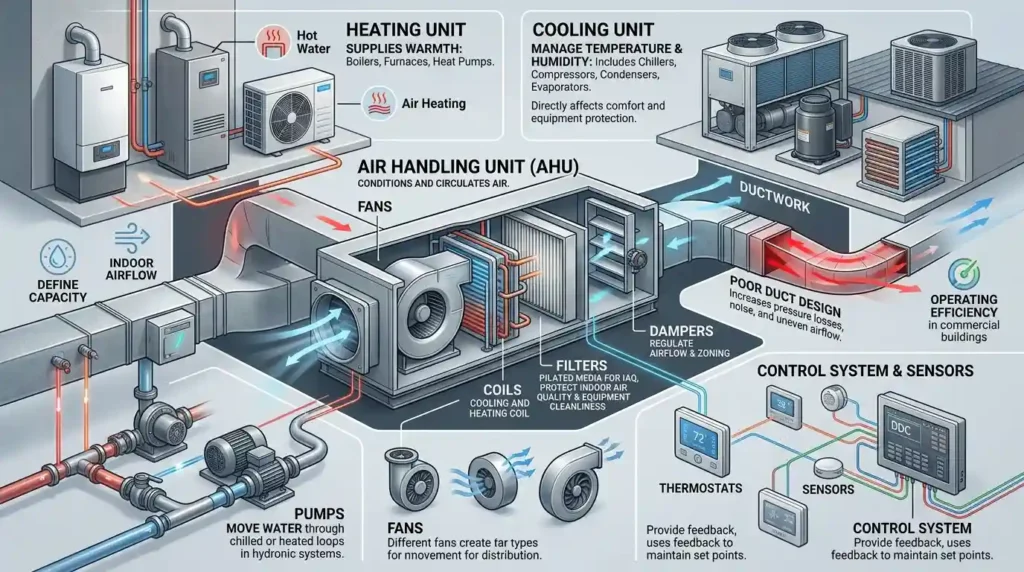
The heating component supplies warmth through boilers, furnaces, or heat pumps. The cooling component usually includes chillers, compressors, condensers, and evaporators. These systems manage temperature and humidity, which directly affects comfort and equipment protection.
The air handling unit is a central element in many buildings. It conditions and circulates air. It usually contains fans, coils, filters, and dampers. Ductwork carries air to different zones. Poor duct design increases pressure losses, noise, and uneven airflow.
Filters protect indoor air quality and equipment cleanliness. Dampers regulate airflow and zoning. Pumps move water through chilled or heated loops in hydronic systems. Fans create the air movement needed for distribution. Thermostats and sensors provide feedback, and the control system uses that feedback to maintain set points.
How do controls and sensors fit into training?
Controls and sensors are the decision layer of HVAC. Engineers use them to manage temperature, humidity, airflow, and energy consumption. In training, this section builds diagnostic thinking because most performance issues come from incorrect set points, poor calibration, or sequence errors.
A training programme should cover the practical meaning of sensor data. Learners need to understand temperature sensors, humidity sensors, pressure sensors, and occupancy signals. They also need to understand how controllers respond to those inputs. That knowledge supports maintenance teams, commissioning teams, and design teams.
Why do ductwork and piping matter?
Ductwork and piping are the delivery networks. Ducts move air. Pipes move water or refrigerant, depending on system type. Their sizing, routing, and insulation affect pressure, energy loss, noise, and system balance. In corporate facilities, these details determine whether the design performs in practice or only on paper.
How is HVAC training delivered in organisations?
HVAC training is delivered through workshops, online modules, simulations, case studies, and supervised assessments. Effective programmes combine theory with practical tasks, so engineers, technicians, and project staff apply component knowledge to real building scenarios and workplace decisions.
Corporate training follows a structured sequence. It starts with a skills-gap analysis. The organisation identifies where staff lack knowledge, such as duct sizing, component identification, load calculation, control logic, or maintenance planning. Training objectives are then aligned with site needs, job roles, and performance expectations.
Delivery formats differ by organisation size and complexity. Workshops suit hands-on learning and team alignment. Online modules support standardised knowledge across multiple sites. Hybrid learning combines both and works well for distributed teams in industries like IT, healthcare, finance, manufacturing, and construction. Simulations and case-based exercises strengthen application because learners work through realistic faults and design decisions.
Assessment completes the process. Organisations use quizzes, technical tasks, design reviews, and scenario analysis to check competence. A strong programme ends with measurable outputs such as improved commissioning accuracy, reduced rework, and faster diagnosis of faults. That is how training moves from attendance to capability.
What does a practical training workflow look like?
A practical HVAC training workflow includes diagnosis, component theory, system mapping, design tasks, simulated problem-solving, and assessment. This sequence builds competence step by step and gives organisations a clear method for proving skill transfer into job performance.
The first stage is baseline assessment. Trainers identify the current level of understanding and the most common workplace gaps. This prevents generic instruction and keeps the programme relevant to the actual job.
The second stage is core theory. Learners study how each HVAC component functions and how it connects to the rest of the system. The third stage is application. Participants analyse drawings, interpret layouts, and review operating scenarios. The fourth stage is simulation. They respond to faults, load changes, or design constraints in a controlled environment.
The final stage is evaluation. Organisations track performance before and after training. They compare error rates, job completion time, first-time fix rates, and project rework. This gives leaders evidence of return on learning investment. It also creates a repeatable model for future technical training.
What business outcomes does HVAC training produce?
HVAC training improves engineering accuracy, maintenance efficiency, energy control, and workplace reliability. For organisations, the main outcomes are lower operating costs, fewer service disruptions, better compliance, stronger teamwork, and improved asset performance over time.
The most visible outcome is better problem-solving. Engineers who understand basic components diagnose faults faster. They identify whether a problem sits in airflow, controls, refrigerant, filtration, or distribution. That reduces wasted labour and prevents repeated call-outs.
Energy performance improves when staff understand load management, zoning, and system balance. Many buildings waste energy because equipment runs against poor settings or mismatched demand. Training gives teams the technical judgement to correct these issues and monitor performance consistently.
There is also a management outcome. Trained staff communicate more clearly with contractors, consultants, and internal stakeholders. This improves coordination in capital projects and maintenance planning. It also supports leadership pipelines because technical staff gain broader decision-making capability.
Common KPIs include maintenance response time, first-time resolution rate, energy use intensity, downtime hours, rework percentage, and occupant complaint volume. These indicators connect learning to business performance in a direct way. That connection matters for HR and L&D because it justifies technical training through measurable results.
Where do organisations use this knowledge most?
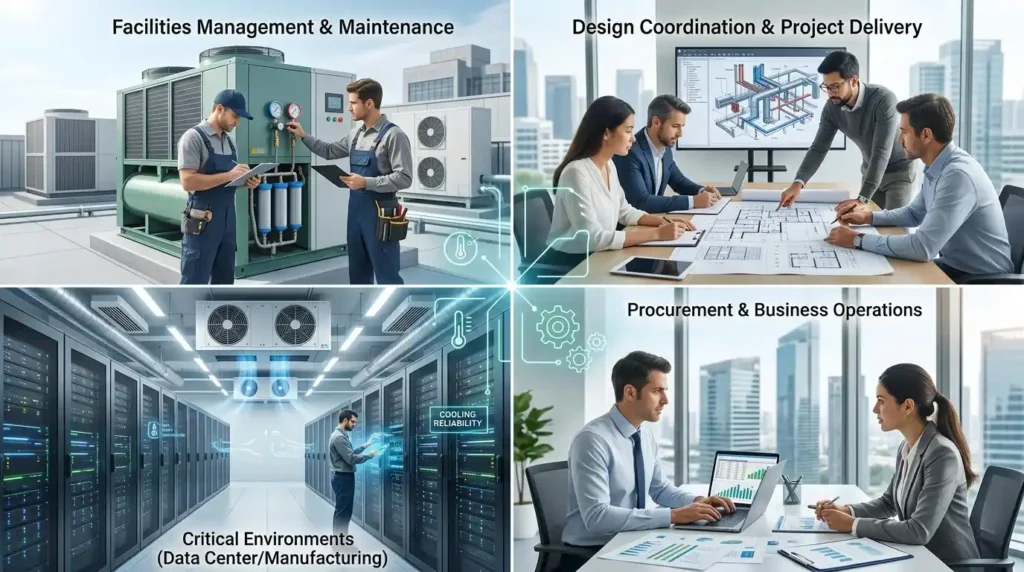
Organisations use HVAC knowledge in facilities management, project delivery, maintenance planning, procurement, and design coordination. It is relevant in offices, hospitals, hotels, manufacturing plants, data centres, and commercial real estate where indoor environmental control affects operations and service quality.
Facilities teams use HVAC knowledge to maintain comfort and reduce breakdowns. Engineering teams use it to design and commission systems correctly. Procurement teams use it to compare specifications and avoid mismatched equipment. Project managers use it to sequence installations and reduce interface errors. Operations teams use it to keep buildings stable during peak demand.
Different industries apply the knowledge differently. In healthcare, air quality and pressure control are critical. In manufacturing, temperature stability and process ventilation matter. In data centres, cooling reliability protects equipment uptime. In hospitality, comfort directly affects service quality. In office environments, air distribution and thermal consistency affect productivity.
This is why HVAC training belongs in broader workforce planning. It supports technical depth and cross-functional understanding. Teams work better when they know what each component does, what failure looks like, and what actions restore performance.
What problems happen when training is weak?
Weak HVAC training creates generic knowledge, poor design judgement, slow fault diagnosis, and low return on learning investment. Organisations then face repeated errors, higher energy costs, weak coordination, and training that does not translate into workplace performance.
The most common misconception is that reading equipment manuals equals competence. It does not. Manuals list specifications, but they do not teach system thinking, troubleshooting, or workplace application. Another mistake is delivering theory without drawings, site examples, or assessment. That produces recognition, not skill.
Discover More from Our Guide Library:
How Does AutoCAD Improve Accuracy in HVAC System Design and Layout?
What Is AutoCAD and Why Is It Essential for HVAC and Plumbing Engineers?
A second problem is training without business metrics. If leaders do not define outcomes, they cannot measure improvement. A programme without baseline and post-training data becomes a one-time event instead of a performance intervention. That weakens support from senior decision-makers.
A third issue is over-standardised training. Generic content ignores site type, climate, load conditions, and role responsibilities. A programme for a facilities technician differs from one for a design engineer or project coordinator. Strong corporate training adapts the same HVAC fundamentals to the learner’s job context.
Where should organisations place the next-step learning link?
The best placement is after the section on training delivery, when readers move from understanding HVAC basics to evaluating structured learning options.
If you are building this blog page, insert the link in the section on how organisations deliver HVAC training. Use naturally descriptive anchor text, such as “a structured AutoCAD-based approach to duct sizing and layout”, and point it to:
How Does AutoCAD HVAC Training Teach Duct Sizing and System Layout? That placement fits the reader’s decision path because they are already asking how training moves from theory into practical design work.
For more insight enrol:
AutoCAD HVAC and Plumbing Design Training Course.
The placement works because it connects the broad concept of HVAC systems to the specific capability of layout and sizing. It also matches the corporate learning journey: awareness first, then evaluation, then implementation.
What is included in an AutoCAD HVAC and Plumbing Design Training Course?
An AutoCAD HVAC and Plumbing Design Training Course covers drawing creation for ducting, piping, layouts, symbols, dimensions, and technical annotations. At Imperial Corporate Training Institute, the focus is on practical CAD skills used in HVAC and plumbing design workflows.
Who should take AutoCAD HVAC and Plumbing Design Training?
This training suits HVAC engineers, plumbing designers, drafters, MEP professionals, and technical staff involved in building services design. It also supports learners who need AutoCAD drafting skills for mechanical and plumbing project work.
How does AutoCAD help in HVAC and plumbing design?
AutoCAD helps engineers create accurate 2D technical drawings for duct routes, pipe networks, equipment placement, and service coordination. It improves design clarity, reduces drafting errors, and supports communication between project teams.
Is AutoCAD HVAC and Plumbing Design Training useful for beginners?
Yes, beginner learners can use this training to build foundational drafting skills for HVAC and plumbing systems. The course usually starts with basic AutoCAD tools before moving into system layouts and industry-specific drawing standards.