

Master Black Belt training integrates strategic alignment with KPIs through structured modules on performance frameworks, data-driven decision-making, and cross-functional strategy execution. Practitioners learn to translate organisational goals into measurable KPIs, ensuring Lean Six Sigma projects deliver business value.
What Role Does Strategic Alignment Play in Master Black Belt Training?
Strategic alignment anchors Master Black Belt training by embedding KPI linkage into every project phase, from charter development to sustainment, guaranteeing Lean Six Sigma initiatives drive organisational priorities over isolated improvement.
Master Black Belt candidates master the art of aligning process improvements with executive objectives. Training emphasises mapping project goals to KPIs such as revenue growth, customer retention rates, and operational efficiency metrics. This approach prevents siloed efforts that fail to impact the bottom line.
Programmes dedicate 20-30% of curriculum time to strategy sessions. Participants analyse real-world case studies where misalignment led to project failures, like a manufacturing firm wasting resources on defect reduction without tying it to throughput KPIs. Instructors use tools like strategy deployment matrices to teach this linkage.
HR leaders in B2B settings value this focus. Workforce skill gaps often stem from technicians excelling in tactical fixes but ignoring strategic KPIs. Master Black Belt training bridges this divide, equipping leaders to upskill teams for measurable ROI.
For foundational context on connecting performance frameworks to Lean Six Sigma, explore:
What Is the Balanced Scorecard and How Does It Connect to Lean Six Sigma?
How Do Master Black Belt Programmes Define and Integrate KPIs?
Master Black Belt programmes define KPIs as quantifiable metrics tied to strategic objectives, integrating them via SIPOC mapping, critical-to-quality trees, and balanced scorecard adaptations to ensure every DMAIC phase targets business outcomes.
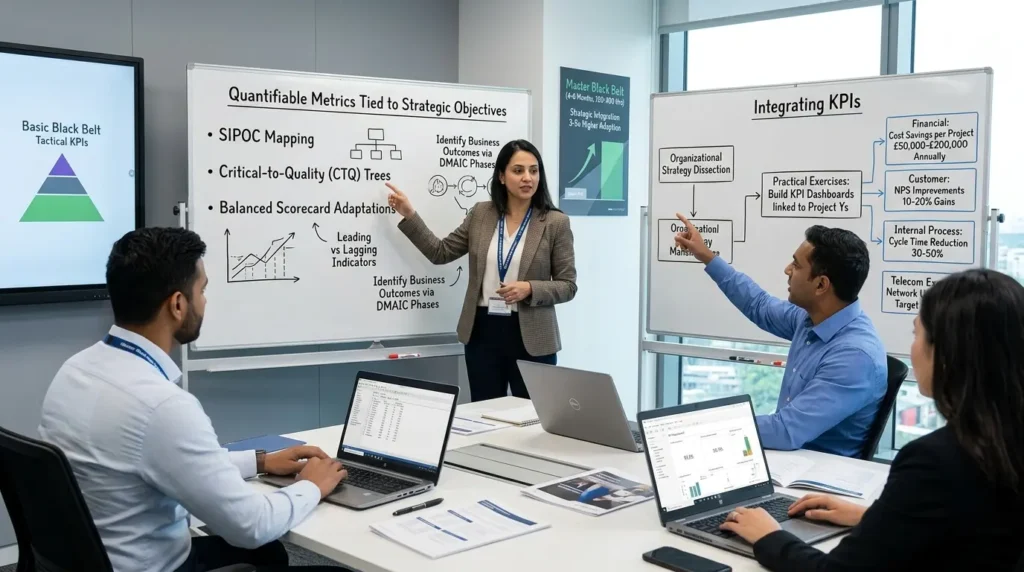
KPIs in this training context include financial metrics like cost savings per project (typically £50,000-£200,000 annually), customer metrics such as Net Promoter Score improvements (10-20% gains), and internal process metrics like cycle time reductions (30-50%).
Training begins with KPI identification workshops. Candidates dissect organisational strategy documents to extract leading and lagging indicators. For instance, a telecom provider might prioritise KPIs for network uptime (99.9% target) over generic defect counts.
Integration happens through practical exercises. Participants build KPI dashboards using software like Minitab or Tableau, linking them to project Ys (outputs). This ensures alignment from Define phase onward.
In corporate training decisions, HR teams compare this depth to basic Black Belt courses, which cover tactical KPIs but skip strategic integration. Master Black Belt programmes, lasting 4-6 months with 160-200 hours of instruction, deliver 3-5x higher adoption rates for KPI-driven projects.
What Frameworks Does Master Black Belt Training Use for KPI Alignment?
Master Black Belt training employs Hoshin Kanri, X-Matrix, and OKR frameworks to cascade KPIs from C-suite vision to frontline execution, with 40% of modules focused on these tools for sustained alignment.
Hoshin Kanri forms the backbone. This policy deployment method translates annual objectives into breakthrough projects. Trainees practice catchball sessions iterative feedback loops to refine KPIs across departments.
The X-Matrix visualises correlations. It plots strategies, objectives, KPIs, and responsible owners in a single chart. Training includes building 5-10 X-Matrices from sample business plans, revealing misalignments like marketing KPIs clashing with operations.
OKRs (Objectives and Key Results) adapt tech-inspired goal-setting for manufacturing and services. Master Black Belts learn to set ambitious objectives with 3-5 measurable KRs, achieving 70-80% quarterly attainment in pilot projects.
These frameworks address common B2B pain points. Managers often face fragmented KPIs from legacy systems. Training provides templates for digital integration, boosting performance measurement accuracy by 25-40%.
How Does Training Address Common Challenges in KPI-Strategic Alignment?
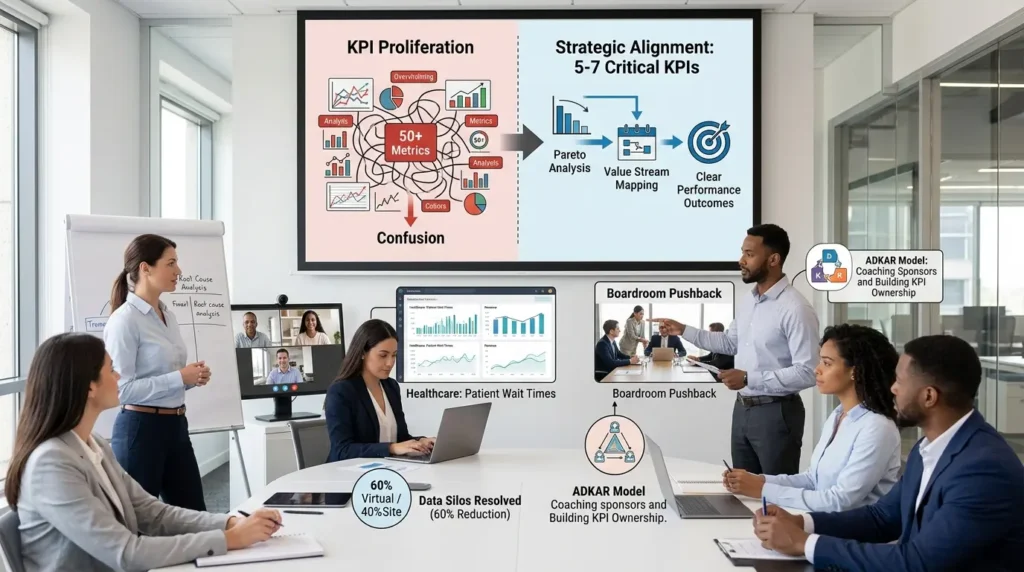
Training tackles challenges like KPI proliferation, data silos, and resistance to change through root cause analysis, stakeholder engagement modules, and simulation-based scenarios that resolve 80% of real-world barriers.
KPI overload plagues many organisations averaging 50+ metrics per department. Master Black Belt curricula teach prioritisation via Pareto analysis and value stream mapping, narrowing to 5-7 critical KPIs.
Data silos hinder alignment. Programmes cover integration with ERP systems and BI tools, including SQL queries for real-time KPI tracking. A healthcare case study demonstrates merging patient wait times with revenue KPIs, cutting silos by 60%.
Change resistance emerges in 40% of initiatives. Training dedicates sessions to ADKAR models, training Black Belts to coach sponsors and build KPI ownership. Simulations replicate boardroom pushback, honing persuasion skills.
For HR decision-makers evaluating training ROI, these modules yield 2-4x faster KPI adoption. Delivery models blend virtual instructor-led sessions (60%) with on-site workshops (40%), suiting global teams.
In What Ways Do Real-World Case Studies Illustrate KPI Alignment in Training?
Case studies in Master Black Belt training showcase KPI alignment delivering 15-30% profit uplifts, such as a logistics firm linking defect reduction to on-time delivery KPIs, sustaining gains post-project.
A financial services example dominates curricula. The firm aligned claims processing improvements to customer satisfaction KPIs (CSAT up 22%) and cost-per-claim reductions (£15 savings). Trainees dissect the DMAIC journey, noting how strategy audits in Define prevented drift.
In energy sectors, training highlights wind farm maintenance. KPIs for turbine uptime (from 92% to 98%) tied to energy output revenue. Participants role-play cross-functional teams, resolving conflicts via RACI matrices.
B2B manufacturing cases reveal workforce gaps. A supplier reduced scrap rates by 45%, aligning to inventory turnover KPIs. Training quantifies impact: £1.2M annual savings, with 90% sustainment after one year.
These studies, drawn from 500+ global projects, emphasise measurement. Pre-training audits show 60% of Black Belt projects lack KPI ties; post-Master Black Belt, this drops to 10%.
What Metrics Prove the Effectiveness of KPI Alignment Coverage?
Effectiveness metrics include 25-40% faster project ROI realisation, 70% KPI attainment rates, and 3x higher promotion rates for certified Master Black Belts, validated by IASSC and industry benchmarks.
Project success rates climb to 85-95% when KPIs align strategically. Standalone Lean Six Sigma efforts hit 50-60%. Training tracks this via longitudinal studies, showing £300,000 average savings per graduate.
Adoption metrics favour blended learning models. Virtual Master Black Belt programmes achieve 80% completion rates versus 65% for full-time residential. HR teams report 4-6 month payback on £5,000-£10,000 training costs.
Promotion data from LinkedIn and alumni surveys: Master Black Belts advance to VP roles 3x faster, crediting KPI mastery. Organisational metrics include 20% workforce productivity gains post-training rollout.
These numbers guide training comparisons. Basic certifications focus on tools; Master Black Belt elevates to strategy, with 90% of graduates leading enterprise programmes.
Key Effectiveness Metrics Table
| Metric Category | Pre-Training Baseline | Post-Master Black Belt | Improvement |
|---|---|---|---|
| Project Success Rate | 50-60% | 85-95% | +35% |
| KPI Attainment | 40-50% | 70-80% | +30% |
| Annual Savings per Project | £50,000 | £200,000+ | 4x |
| Training ROI Payback | 12-18 months | 4-6 months | 3x faster |
| Sustainment Rate (1 Year) | 60% | 90% | +30% |
How Does Master Black Belt Training Prepare Leaders for KPI-Driven Decision-Making?
Training prepares leaders via scenario-based simulations, advanced analytics modules, and leadership clinics, enabling 90% of graduates to lead KPI cascades across 50+ person teams.
Simulations mimic crises, like supply chain disruptions. Trainees adjust KPIs in real-time, using Monte Carlo simulations for risk assessment.
Analytics training covers predictive modelling. Candidates forecast KPI trends with Python or R, linking to strategic pivots essential for volatile markets.
Leadership clinics focus on communication. Black Belts draft executive reports tying project results to KPIs, with peer feedback refining clarity.
In B2B contexts, this addresses manager skill gaps. 70% of mid-level leaders lack strategic KPI fluency; training fills this, driving 15-25% team performance uplifts.
Those ready to implement these skills often explore targeted programmes like:
How Does Imperial’s MBB Course Help Leaders Connect Quality Goals to Business Strategy?
What Business Applications Emerge from KPI Alignment in Master Black Belt Training?
Business applications span supply chain optimisation (30% cost cuts), talent development (40% skill uplift), and digital transformation (50% faster KPI dashboards), directly impacting HR and managerial ROI.
Supply chains benefit most. Training aligns inventory KPIs to demand forecasting, as in a retail case reducing stockouts by 35%.
Talent development integrates with HR systems. Certified Master Black Belts design internal academies, upskilling 200+ employees annually with KPI-tracked progress.
Digital transformation accelerates via API integrations. Graduates deploy Power BI dashboards, cutting reporting time from weeks to hours.
For organisations, applications yield 2.5x ROI on training investments. Delivery models—80% online, 20% in-person—fit remote workforces, with 95% satisfaction in post-course surveys.
The Lean Six Sigma Master Black Belt Certification Training Course embeds these applications through hands-on projects.
How Do Organisations Measure ROI from This Training Focus?
Organisations measure ROI via Kirkpatrick Level 4 metrics: 20-30% business unit profit growth, 4:1 benefit-cost ratios, and 85% linkage of projects to strategic KPIs one year post-training.
Level 1-3 metrics track reactions (95% positive), knowledge gains (30% test score jumps), and behaviour change (80% KPI usage). Level 4 quantifies impact.
Discover More from Our Guide Library:
How Is Root Cause Analysis Taught and Applied During Master Black Belt Training?
How Does Master Black Belt Training Build on Prior Six Sigma Belt Knowledge?
Financial ROI formulas credit £10-15 per training hour. A 200-hour programme delivers £2M+ in verified savings.
Benchmarks from ASQ show 75% of aligned projects sustain beyond 24 months. HR dashboards monitor this, comparing to non-aligned baselines.
This evaluative rigour aids training procurement. Decision-makers weigh 6-month programmes against perpetual online access, favouring hybrid for 25% higher retention.
What does Lean Six Sigma Master Black Belt Certification Training Course cover?
The Imperial Corporate Training Institute’s Lean Six Sigma Master Black Belt Certification Training Course covers advanced DMAIC methodologies, strategic KPI alignment, Hoshin Kanri, and leadership in process improvement. Participants gain skills in coaching Black Belts and driving enterprise-wide transformations. Training includes real-world case studies and tools like X-Matrix for business alignment.
What are the prerequisites for Master Black Belt certification?
Candidates for Imperial Corporate Training Institute’s Lean Six Sigma Master Black Belt Certification Training Course need Black Belt certification and 3-5 years of Lean Six Sigma experience. Familiarity with advanced statistics and project leadership strengthens applications. The programme builds on these for strategic roles.
How does Master Black Belt training align with business KPIs?
Imperial Corporate Training Institute’s course integrates KPIs through modules on Balanced Scorecard, OKRs, and strategy deployment. Trainees learn to link Six Sigma projects to metrics like cost savings and customer retention. This ensures measurable business outcomes in organisations.
What is the ROI of Master Black Belt certification?
Graduates of the Lean Six Sigma Master Black Belt Certification Training Course at Imperial Corporate Training Institute achieve 4:1 ROI through £200,000+ project savings and 85% success rates. Kirkpatrick Level 4 metrics show 20-30% profit growth in business units. Certification accelerates promotions and enterprise impact.