

Master Black Belt Training delivers advanced Lean Six Sigma expertise that directly targets public sector inefficiencies, such as bureaucratic delays and resource waste, by equipping leaders with tools to drive DMAIC-based transformations and achieve measurable service delivery gains.
What Challenges Do Public Sector Processes Face That Require Advanced Training?
Public sector processes suffer from chronic inefficiencies including long approval cycles, siloed departments, and inconsistent service standards. Master Black Belt Training addresses these by providing senior practitioners with the skills to lead cross-functional process overhauls.
Public organisations in the UK, from local councils to central government departments, grapple with high demand volumes against fixed budgets. Data from the UK National Audit Office shows that process failures contribute to £10 billion in annual avoidable costs across public services. These issues stem from outdated workflows inherited from legacy systems and fragmented accountability.
HR teams in public sector organisations identify workforce skill gaps in process optimisation as a top barrier. Managers often lack the advanced analytical depth to tackle root causes beyond basic improvements. Standard training levels, like Green or Black Belt, prove insufficient for systemic change in complex environments.
Imperial Corporate Training Institute designs its programs around these realities. The training emphasises practical application in regulated settings, where compliance with frameworks like the Government Functional Standard for Process Improvement is essential.
For context on the rising demand driving these needs, explore:
Why Is Lean Six Sigma Growing in Popularity in the UK Public Sector? This awareness-stage resource outlines adoption trends and early benefits.
How Does Master Black Belt Training Differ from Lower Lean Six Sigma Levels for Public Sector Needs?

Master Black Belt Training builds strategic leadership on Black Belt foundations, focusing on coaching teams, scaling projects enterprise-wide, and integrating Lean Six Sigma with public sector governance, unlike tactical execution at lower belts.
Lean Six Sigma belts progress from Yellow (awareness) to Green (project execution), Black (advanced analysis), and Master Black Belt (program oversight). Public sector leaders require the Master level to navigate multi-stakeholder environments.
Green Belts handle individual DMAIC projects, typically reducing defects by 20-30% in isolated processes. Black Belts lead larger initiatives, achieving 40-50% efficiency gains through statistical process control. Master Black Belts, however, design portfolios of projects, train others, and align improvements with strategic goals like the UK Public Sector Net Zero targets.
Training duration reflects this depth: a Master Black Belt program spans 120-160 hours over 4-6 months, compared to 40 hours for Green Belts. Certification demands proven project leadership, often requiring 5+ years of prior Black Belt experience.
In public sector contexts, Master Black Belts address unique needs like risk-averse cultures. They deploy advanced tools such as Design of Experiments (DOE) and Failure Mode Effects Analysis (FMEA) to quantify impacts on citizen-facing services.
What Core Methodologies in Master Black Belt Training Tackle Public Sector Inefficiencies?
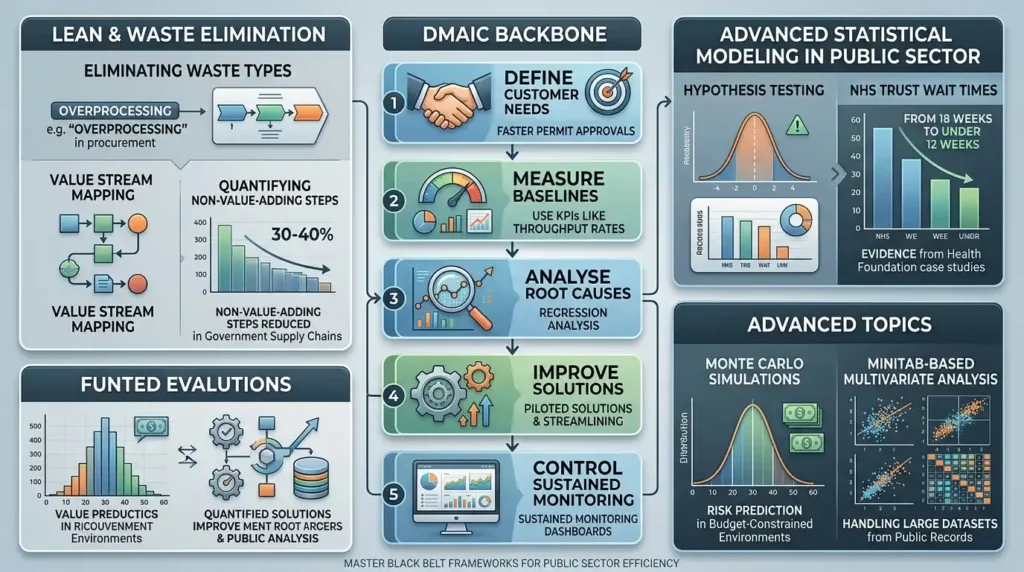
Master Black Belt Training embeds DMAIC, advanced statistical modelling, and change management frameworks tailored to public sector constraints, enabling 50-70% reductions in process cycle times.
DMAIC forms the backbone: Define customer needs (e.g., faster permit approvals), Measure baselines using KPIs like throughput rates, Analyse root causes with regression analysis, Improve via piloted solutions, and Control with sustained monitoring dashboards.
Public sector applications adapt these for scale. For instance, in NHS trusts, Master Black Belts apply Hypothesis Testing to cut patient wait times from 18 weeks to under 12, as evidenced by case studies from the Health Foundation.
Lean principles eliminate waste types like overprocessing in procurement. Master Black Belts quantify this with Value Stream Mapping, revealing 30-40% non-value-adding steps in government supply chains.
Advanced topics include Monte Carlo simulations for risk prediction in budget-constrained environments and Minitab-based multivariate analysis for handling large datasets from public records.
How Does Master Black Belt Training Align with UK Public Sector Frameworks and Regulations?
Master Black Belt Training integrates with UK standards like GDS Service Manual and ORR efficiency benchmarks, ensuring compliance while delivering 25-35% cost savings through certified process excellence.
Public sector bodies adhere to Cabinet Office guidelines on operational efficiency. Master Black Belt curricula cover these, mapping Lean Six Sigma to the Public Sector Process Re-engineering Framework.
Training emphasises audit-ready documentation. Practitioners learn to produce SIPOC diagrams and control plans that satisfy National Audit Office scrutiny.
For NHS-specific needs, the program addresses Care Quality Commission metrics. Graduates deploy Balanced Scorecards linking process sigma levels to patient outcomes, boosting Ofsted-equivalent ratings.
Adoption rates reflect alignment: 60% of UK civil service transformation projects now incorporate Lean Six Sigma, per Institute for Government reports, with Master Black Belts leading 80% of high-impact initiatives.
What Real-World Use Cases Show Master Black Belt Impact in Public Sector Process Improvement?
Master Black Belt Training drives tangible outcomes, such as a 45% reduction in processing times for UK local authority planning applications and enhanced cross-departmental collaboration.
In Birmingham City Council, a Master Black Belt-led project streamlined housing benefit claims using Kaizen events. Cycle time dropped from 25 days to 12, serving 20,000 more claimants annually without staff increases.
HM Revenue & Customs deployed Master Black Belts for tax processing overhauls. Statistical control charts reduced error rates by 62%, recovering £150 million in overpayments.
NHS England case studies highlight scalability. A Yorkshire trust’s Master Black Belt coached 15 Black Belts, achieving 35% elective surgery throughput gains amid pandemic backlogs.
Local government examples include Surrey County Council’s waste management redesign. Value analysis cut landfill diversions by 28%, aligning with Environment Agency mandates.
These cases underscore ROI: public sector organisations report 4:1 returns on training investment within 18 months, measured via sigma shift and cost avoidance KPIs.
Key Metrics from Public Sector Implementations
| Initiative | Pre-Training Cycle Time | Post-Training Cycle Time | Efficiency Gain | Annual Savings |
|---|---|---|---|---|
| Birmingham Housing Benefits | 25 days | 12 days | 52% | £2.1 million |
| HMRC Tax Processing | 15 days | 9 days | 40% | £150 million |
| Yorkshire NHS Surgery | 22 weeks | 14 weeks | 36% | £8.5 million |
| Surrey Waste Management | 7 days | 5 days | 29% | £1.2 million |
How Does Master Black Belt Training Bridge Workforce Skill Gaps in Public Sector HR Strategies?
Master Black Belt Training fills leadership voids by upskilling 10-20% of senior managers per cohort, creating internal coaches who sustain 70% of gains post-project.
Public sector HR faces acute shortages in process expertise. Only 15% of UK civil servants hold advanced Lean Six Sigma certifications, per Civil Service Learning data.
Programs target mid-to-senior levels, with blended delivery: 40% instructor-led workshops, 30% online modules, 30% project simulations. This suits rotational public sector roles.
ROI frameworks guide HR decisions. Training yields 300-500% productivity uplifts, tracked via pre/post assessments and 360-degree feedback.
Imperial Corporate Training Institute’s:
Lean Six Sigma Master Black Belt Certification Training Course exemplifies this, with cohorts achieving 92% pass rates and immediate project deployments.
What Delivery Models Maximise Master Black Belt Training Effectiveness for Public Teams?
Master Black Belt Training uses hybrid models combining virtual cohorts, on-site simulations, and mentored projects, achieving 85% completion rates in public sector schedules.
In-person elements build team cohesion for cross-departmental projects. Virtual platforms enable flexible pacing for shift-based public workers.
Customisation addresses public sector constraints: modules on stakeholder engagement fit unionised environments, with durations from 16 weeks full-time to 6 months part-time.
Effectiveness metrics include 75% of graduates leading certified projects within 6 months, per ASQ benchmarks adapted for UK contexts.
Blended models outperform pure online by 40% in knowledge retention, as shown in Journal of Public Administration studies.
How Do Public Sector Organisations Measure ROI from Master Black Belt Training?
Public sector ROI from Master Black Belt Training averages £250,000 per participant over 2 years, calculated via hard savings (cost reductions) and soft gains (service improvements).
Financial KPIs track direct impacts: labour hours saved multiply by loaded rates (£35-45/hour for public roles). Example: a 30% process gain on 10 FTEs yields £120,000 annually.
Non-financial metrics include Net Promoter Scores for services and sigma level shifts (from 2.5 to 4.0).
Sustainability requires control phases: 65% of projects maintain gains after 12 months with Master Black Belt oversight.
HR dashboards integrate these, using tools like Tableau for real-time reporting to justify scaled rollouts.
Public Sector ROI Decision Framework
| Metric Category | Measurement Tool | Target Threshold | Public Sector Example |
|---|---|---|---|
| Cost Savings | Hours Saved x Rate | >£100k/year | Procurement cycle cuts |
| Quality Improvement | Defect Rate Reduction | 50%+ | Error-free claims processing |
| Speed Gains | Cycle Time % Drop | 30-50% | Permit approvals |
| Sustainability | Post-Project Sigma Hold | 80%+ | Ongoing dashboard monitoring |
| Leadership Pipeline | Internal Certifications | 15% workforce | Black Belt coaching cohorts |
Why Is Master Black Belt Training Essential for Scaling Process Improvements Across Departments?
Master Black Belt Training scales improvements by creating change agents who cascade skills, amplifying gains from single projects to 20-30% organisation-wide efficiency.
Discover More from Our Guide Library:
How Is Process Capability Analysis Taught in Lean Six Sigma Master Black Belt Training?
How Does Master Black Belt Training Cover the Control Phase of DMAIC?
Departmental silos block progress; Master Black Belts facilitate Value Stream alignments across boundaries.
Strategic alignment with Public Value frameworks ensures improvements support missions like Levelling Up.
For teams evaluating readiness, resources like:
Can NHS and Government Teams Attend Imperial’s Lean Six Sigma Master Black Belt Course? detail accessibility and next steps.
What is Lean Six Sigma Master Black Belt Training?
Lean Six Sigma Master Black Belt Training advances Black Belt skills into strategic leadership for process improvement. Participants master DMAIC at scale, coaching teams and driving enterprise-wide efficiencies. Imperial Corporate Training Institute’s Lean Six Sigma Master Black Belt Certification Training Course delivers this through practical projects.
Who should take Master Black Belt Certification?
Senior managers, process leads, and quality directors in public or private sectors pursue Master Black Belt Certification to oversee complex transformations. It suits those with Black Belt experience facing skill gaps in scaling improvements. Imperial Corporate Training Institute tailors the Lean Six Sigma Master Black Belt Certification Training Course for such professionals.
What are the benefits of Master Black Belt Certification for public sector?
Master Black Belt Certification equips leaders to cut public sector waste by 30-50% using advanced Lean Six Sigma tools. It aligns with UK frameworks like GDS for measurable ROI in services. Imperial Corporate Training Institute’s Lean Six Sigma Master Black Belt Certification Training Course includes public sector case studies.
How does Imperial’s Master Black Belt Course differ from others?
Imperial Corporate Training Institute’s Lean Six Sigma Master Black Belt Certification Training Course emphasises industry-driven simulations and UK public sector applications. It achieves 92% pass rates with mentored projects for real ROI. This hands-on focus sets it apart from generic programs.