

Imperial Corporate Training Institute delivers the Lean Six Sigma Master Black Belt Certification Training Course to equip senior leaders with tools for enterprise-wide quality transformation. Companies face persistent challenges in embedding a quality-first culture, where inefficiencies persist despite initial Lean Six Sigma efforts. This course addresses that gap by training Master Black Belts to lead sustainable change.
Teams often struggle with fragmented process improvements that fail to scale. HR departments report inconsistent skill application across departments, leading to stalled productivity gains.
For deeper insights into how Lean Six Sigma initiates cultural shifts, explore:
How Does Lean Six Sigma Drive Cultural Change in an Organisation?
What problem does this course solve?
Imperial Corporate Training Institute’s Lean Six Sigma Master Black Belt Certification Training Course solves the challenge of scaling quality improvements from projects to enterprise culture, enabling senior leaders to mentor teams and align processes with business goals across manufacturing and services.
Organisations implement Lean Six Sigma at lower belts but lack strategic oversight. Quality culture erodes without sustained governance. Senior managers witness repeated waste in operations, such as excess inventory in supply chains or delays in service delivery.
HR teams in manufacturing firms note that Green Belts complete projects but fail to influence department-wide habits. This course targets that void. Participants gain skills to deploy frameworks that embed data-driven decisions organisation-wide.
Consider a global manufacturing company. Initial Black Belt projects reduced defects by 20%, yet overall quality metrics plateaued. Master Black Belts trained by Imperial Corporate Training Institute mapped value streams across sites, cutting enterprise costs by 15%.
The course defines the skill gap precisely: leaders need advanced tools for multivariate analysis and change leadership. It bridges this by focusing on corporate application, ensuring transformations stick.
Why choose this course structure?
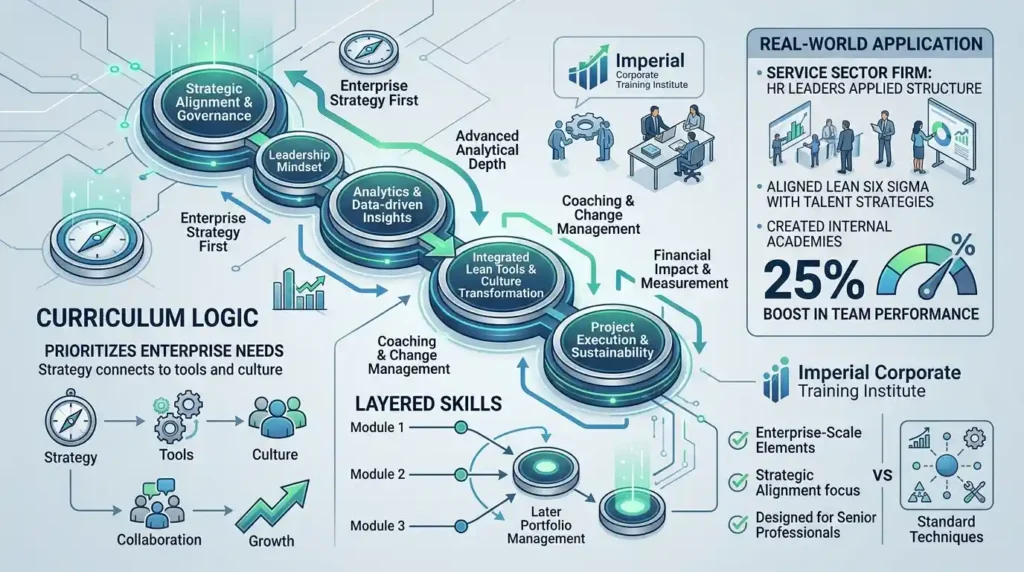
This course follows a logical progression from strategic alignment to capstone execution, building skills module by module to mirror real enterprise deployments at Imperial Corporate Training Institute.
Curriculum logic prioritises enterprise needs over isolated techniques. It starts with governance, advances to analytics, then integrates Lean tools, and ends with sustainability. This sequence matches how companies transform: strategy first, then tools, culture, and measurement.
Imperial Corporate Training Institute designed progression for senior professionals. Early modules build leadership mindset. Mid-modules deliver analytical depth. Later ones focus on coaching and financial impact.
Each module layers skills. For example, Module 1 on strategic deployment informs Module 6’s project portfolio management. This prevents common pitfalls like misaligned initiatives.
In a service sector firm, HR leaders applied this structure. They aligned Lean Six Sigma with talent strategies post-training, creating internal academies that boosted team performance by 25%.
The structure suits decision-makers evaluating options. It compares to standard Black Belt training by adding enterprise-scale elements.
For details on leadership in quality culture, see:
How Does Master Black Belt Training Teach Leaders to Build a Quality-First Culture?
What will participants learn?
Participants master 10 modules covering strategic deployment, advanced analytics, Lean transformation, change leadership, process reengineering, project management, coaching, control systems, financial impact, and capstone projects through Imperial Corporate Training Institute’s structured curriculum.
Module 1: Strategic Role of the Master Black Belt
Participants learn enterprise-wide deployment. They study alignment with corporate strategy and governance structures. Skills include building leadership mindsets for process excellence.
Module 2: Advanced Analytical and Statistical Tools
Training covers multivariate analysis and regression models. Design of Experiments (DOE) applies to corporate projects. Tools like Minitab and JMP enable capability studies and control charts.
Module 3: Enterprise-Level Lean Transformation
Value stream mapping spans end-to-end processes. Lean tools integrate across manufacturing and services. Participants calculate ROI and apply waste elimination frameworks.
Module 4: Change Leadership and Organisational Culture
Skills focus on performance-driven cultures. Managing resistance in cross-functional teams is key. Strategies align Lean Six Sigma with HR initiatives.
A department manager in a supply chain team used these to reduce cycle times by 30%. Communication tactics shifted team behaviours permanently.
Module 5: Business Process Reengineering and Innovation
Agile processes emerge from reengineering. Lean Six Sigma combines with digital tools and AI. Innovation pipelines drive ongoing improvements.
Module 6: Project Portfolio Management
Project selection balances short- and long-term goals. Financial justifications support executive reporting.
Module 7: Coaching, Mentoring, and Capability Building
Coaching Black Belts ensures project success. Training methodologies build internal academies and leadership pipelines.
HR teams in tech firms coached 50 Green Belts, scaling improvements across 10 departments.
Module 8: Advanced Control and Sustainability Systems
Dashboards track KPIs. Audits and maturity assessments maintain momentum.
Module 9: Financial Impact and Corporate Value Creation
Linkages to shareholder value include cost-benefit analysis. Alignment with KPIs quantifies gains.
Module 10: Capstone Project and Certification Evaluation
Real-world projects undergo defence. Imperial Corporate Training Institute assesses documentation for certification.
Skill progression ensures measurable gains: from analysis (Modules 2-3) to leadership (Modules 4,7) and sustainability (Modules 8-10).
How is the course delivered?
Imperial Corporate Training Institute delivers the course in flexible formats including onsite workshops, online sessions, and hybrid models, spanning 4-6 months with 120+ hours of structured training, simulations, and assessments.
Delivery suits corporate schedules. Onsite workshops occur at client facilities for teams. Online platforms enable global access with live instructors.
Hybrid combines virtual modules with in-person capstones. Duration totals 120 hours: 80 for modules, 40 for projects.
Methods include lectures, case studies, and simulations. Participants analyse real datasets in Minitab.
Assessments feature quizzes per module, assignments on DOE, and team simulations for change management. Capstone requires project defence before executives.
A manufacturing executive joined hybrid delivery. Workshops simulated factory waste elimination, directly applicable to their plant.
Imperial Corporate Training Institute customises for groups: HR cohorts focus on talent integration; operations on ROI.
What results can be expected?
Participants achieve certification, with companies reporting 20-40% cost reductions, 30% productivity gains, and sustained quality cultures through Imperial Corporate Training Institute’s proven outcomes.
Learning outcomes centre on measurable skills. Graduates mentor teams, reducing project failure rates by 50%.
Workplace impact spans roles. Senior operations managers deploy governance, cutting enterprise defects.
In one case, a quality leader in services applied Module 9 tools. Financial analysis justified £2M in savings, aligning with KPIs.
HR teams build pipelines: trained Master Black Belts coach 20+ belts yearly, transforming departments.
Leadership gains include data-driven decisions. Predictive analytics from Module 2 forecasts process capability.
Corporate results include ROI tracking. Firms measure maturity via Module 8 audits, achieving Level 4 in 12 months.
Proof comes from alumni: a supply chain director scaled Lean across sites, boosting on-time delivery to 98%.
Team performance rises as cultures shift. Managers report fewer errors; departments sustain gains post-training.
How much does the course cost?
Pricing for Imperial Corporate Training Institute’s Lean Six Sigma Master Black Belt Certification Training Course starts at £4,500 per participant for standard delivery, scaling to £12,000+ for custom onsite group programmes, inclusive of materials and certification.
Costs reflect format and scale. Individual online access costs £4,500. Corporate onsite for 10+ participants averages £8,000 per head.
This covers modules, tools licence (Minitab), assessments, and certification. No hidden fees.
Group discounts apply: 15% for 5-10, 25% for 20+. Customisation adds for industry-specific cases.
Value ties to outcomes: £4,500 investment yields £100K+ savings per graduate via projects.
Compare to peers: Imperial Corporate Training Institute’s structure delivers higher ROI through enterprise focus.
How does enrollment work?
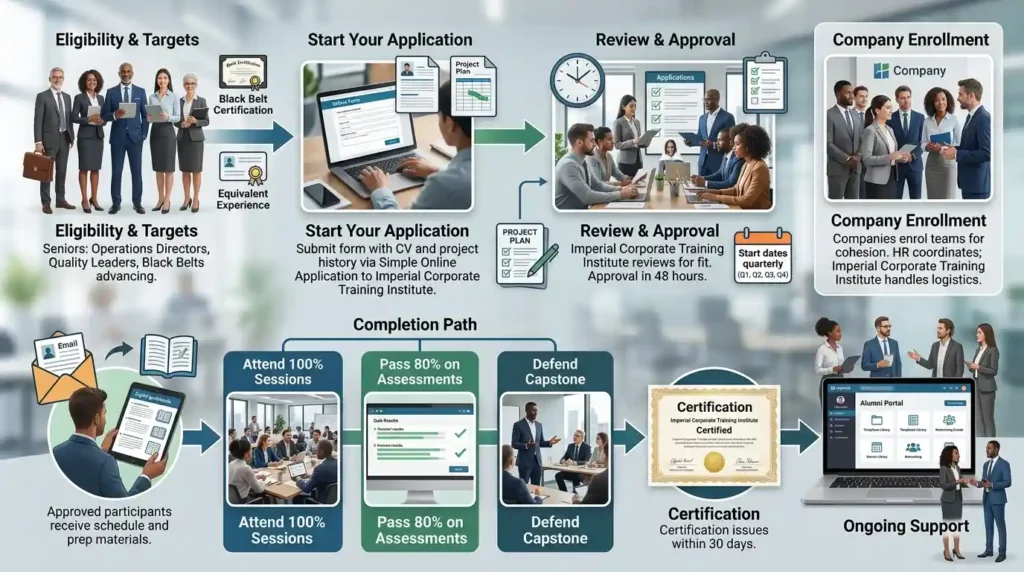
Enrollment requires a Black Belt certification or equivalent experience, followed by a simple online application to Imperial Corporate Training Institute, with approval in 48 hours and start dates quarterly.
Eligibility targets seniors: operations directors, quality leaders, Black Belts advancing.
Process starts here: submit form with CV and project history.
Imperial Corporate Training Institute reviews for fit. Approved participants receive schedule and prep materials.
Completion path: attend 100% sessions, pass 80% on assessments, defend capstone. Certification issues within 30 days.
Discover More from Our Guide Library:
Does Imperial’s Master Black Belt Course Include a Live Project Charter Exercise?
How Does Imperial’s Programme Use Value Stream Mapping in Real Case Studies?
Ongoing support includes alumni portal for templates and networking.
Companies enrol teams for cohesion. HR coordinates: Imperial Corporate Training Institute handles logistics.
Ready to transform your quality culture? Enrol in this programme today.