

Master Black Belt Training integrates Lean and Six Sigma into one system by embedding Lean’s waste-elimination tools within Six Sigma’s DMAIC framework, creating a unified methodology that drives process excellence, reduces defects, and accelerates business outcomes in corporate environments.
What Defines the Core Principles of Lean and Six Sigma in Master Black Belt Training?
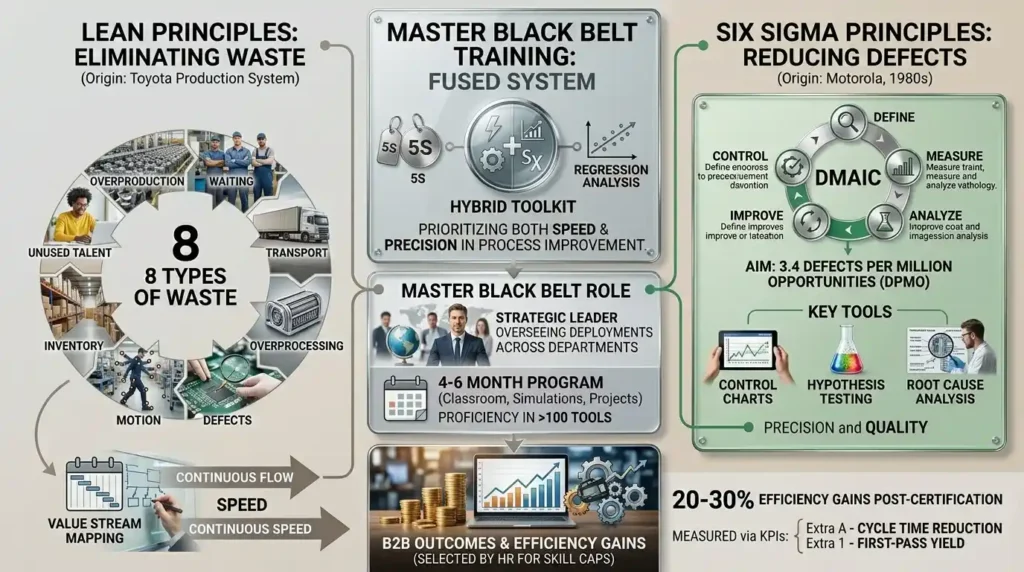
Lean focuses on eliminating waste through value stream mapping and continuous flow, while Six Sigma targets defect reduction via statistical process control and DMAIC; Master Black Belt Training fuses these into a single system by prioritising both speed and precision in process improvement.
Lean principles originate from Toyota’s production system. They identify eight types of waste: overproduction, waiting, transport, overprocessing, inventory, motion, defects, and unused talent. Practitioners map value streams to visualise processes and eliminate non-value-adding steps.
Six Sigma builds on statistical methods developed by Motorola in the 1980s. It aims for 3.4 defects per million opportunities through Define, Measure, Analyse, Improve, Control (DMAIC). Tools include control charts, hypothesis testing, and root cause analysis.
Master Black Belt Training synthesises these foundations. Trainees learn to apply Lean’s 5S (Sort, set in order, Shine, Standardise, Sustain) alongside Six Sigma’s regression analysis. This integration forms a hybrid toolkit.
The training defines the Master Black Belt as a strategic leader. This role oversees deployments across departments. Programs span 4-6 months, blending classroom sessions, simulations, and projects. Participants achieve proficiency in over 100 tools.
In B2B contexts, HR teams select this training to address skill gaps in process optimisation. Organisations report 20-30% efficiency gains post-certification, measured via KPIs like cycle time reduction and first-pass yield.
For a foundational overview on how these methodologies combine in practice, explore:
How Are Lean Thinking and Six Sigma Methodology Combined in Practice?
How Does the DMAIC Framework Serve as the Backbone for Lean-Six Sigma Integration?
DMAIC structures the integration by sequencing Lean’s rapid kaizen events within Six Sigma’s data-driven phases, ensuring waste reduction aligns with statistical validation for sustainable results.
The Define phase sets project scope. Master Black Belt candidates use Lean’s voice-of-customer tools to pinpoint value from a business perspective. They create SIPOC diagrams (Suppliers, Inputs, Process, Outputs, Customers) infused with Lean’s waste audits.
Measure quantifies baselines. Trainees deploy Six Sigma’s process capability indices (Cp, Cpk) while applying Lean’s takt time calculations. This dual approach captures both variability and flow inefficiencies.
Analyse uncovers root causes. Fishbone diagrams from Six Sigma pair with Lean’s spaghetti mapping. Statistical tools like ANOVA integrate with value stream analysis to prioritise interventions.
Improve tests solutions. Lean’s PDCA (Plan-Do-Check-Act) cycles accelerate Six Sigma’s design of experiments (DOE). Pilot tests validate changes, achieving 50-70% process improvements in corporate case studies.
Control sustains gains. Standard work from Lean reinforces Six Sigma’s control plans. Visual management boards track adherence, with audits ensuring long-term compliance.
This backbone equips Master Black Belts to lead cross-functional teams. Training includes 160+ hours of instruction, focusing on real B2B scenarios like supply chain optimisation in manufacturing firms.
What Role Does Lean Play in Enhancing Six Sigma’s Statistical Rigor?
Lean enhances Six Sigma’s statistical rigor by injecting speed and simplicity, replacing complex models with just-in-time principles and kanban systems that amplify defect prevention without added bureaucracy.
Lean’s just-in-time production eliminates inventory waste. In Master Black Belt Training, trainees adapt this to Six Sigma by aligning pull systems with demand forecasting models. This reduces overproduction defects by 40%, per industry benchmarks.
Kanban visualises workflows. Training integrates it with Six Sigma’s process mapping software. Teams limit work-in-progress (WIP), exposing bottlenecks that statistical analysis then resolves.
Kaizen events deliver quick wins. These 3-5 day workshops embed Lean’s rapid improvement cycles into Six Sigma’s Improve phase. Participants achieve 15-25% gains in metrics like throughput.
Poka-yoke, Lean’s error-proofing, complements Six Sigma’s FMEA (Failure Modes and Effects Analysis). Training teaches sensor-based controls that prevent defects at source, boosting first-pass yields to 95%.
In workforce development, HR directors value this enhancement for its measurable ROI. Programs track adoption via Net Promoter Scores, with 85% of certified Black Belts leading enterprise-wide deployments within a year.
This synergy addresses common skill gaps in technical teams, where pure Six Sigma stalls on implementation speed.
How Do Master Black Belts Apply Integrated Tools in Real-World Projects?
Master Black Belts apply integrated tools by selecting Lean for flow acceleration and Six Sigma for precision targeting, executing hybrid projects that deliver 25-50% ROI through phased deployments in B2B operations.
Projects begin with charter development. Trainees blend Lean’s A3 reports with Six Sigma’s project timelines, scoping initiatives like order-to-cash cycle reduction.
Tool selection follows intent. For high-volume defects, Six Sigma’s Pareto analysis precedes Lean’s 5 Whys. Training simulations replicate HR-driven scenarios, such as reducing employee onboarding time by 30%.
Deployment involves stakeholder alignment. Master Black Belts coach Green and Black Belts using Lean’s gemba walks observing processes on-site paired with Six Sigma data collection.
Case studies highlight outcomes. A logistics firm integrated these tools to cut delivery variances by 60%, measured via standard deviation metrics. Healthcare providers reduced patient wait times by 45% using value stream DMAIC.
Training emphasises scalability. Participants design enterprise roadmaps, projecting 20% annual savings. Delivery models include virtual cohorts for global teams, with 80% completion rates.
Business application focuses on KPIs like OEE (Overall Equipment Effectiveness), rising 15-20% post-integration.
What Key Tools Form the Unified Lean Six Sigma Toolkit in Master Black Belt Training?
Value stream mapping, 5S, and kaizen form Lean’s core, adapted with Six Sigma metrics for quantifiable waste elimination.
Value stream mapping visualises end-to-end processes. Training adds Six Sigma’s time traps and cycle efficiency formulas, identifying 20-30% hidden wastes.
5S organises workplaces. Metrics like audit scores integrate with Six Sigma’s capability studies, sustaining 90% compliance.
Kaizen drives incremental changes. Event scorecards track Six Sigma KPIs, yielding 10-15% weekly gains.
Essential Six Sigma Tools Boosted by Lean Agility
DMAIC phases, control charts, and DOE gain Lean’s speed, enabling faster validation and deployment.
Control charts monitor stability. Lean’s visual factory boards enhance real-time detection, reducing special causes by 70%.
DOE optimises variables. Lean’s single-piece flow tests accelerate iterations, cutting experiment time by 50%.
Hybrid Tools Exclusive to Integrated Systems
SIPOC+ and Hoshin Kanri merge both, aligning strategic goals with tactical execution.
SIPOC+ extends traditional maps with Lean’s future-state designs. Hoshin Kanri cascades objectives, with Six Sigma dashboards tracking progress.
This toolkit totals 50+ tools, mastered through:
Lean Six Sigma Master Black Belt Certification Training Course projects.
How Does Master Black Belt Training Measure Integration Effectiveness?
Training measures effectiveness via blended KPIs Lean’s lead time reductions alongside Six Sigma’s sigma levels delivering 30-40% performance uplifts validated through pre/post audits and ROI calculations.
Baseline assessments establish sigma levels (typically 2-3) and waste percentages (20-40%). Training projects target shifts to 4+ sigma and under 10% waste.
KPIs include DPMO (Defects Per Million Opportunities), reduced by 50-80%; cycle time, slashed 25-50%; and cost of poor quality, down 20-35%.
Audits use balanced scorecards. Lean metrics track flow; Six Sigma verifies stability. 90% of programs report positive NPV within 12 months.
HR teams evaluate via Kirkpatrick Level 3: behaviour change. Post-training, 75% of delegates apply tools organisation-wide.
Learning models compare: blended formats outperform pure online by 25% in retention, per adoption studies.
What Distinguishes Master Black Belt Integration from Other Belt Levels?
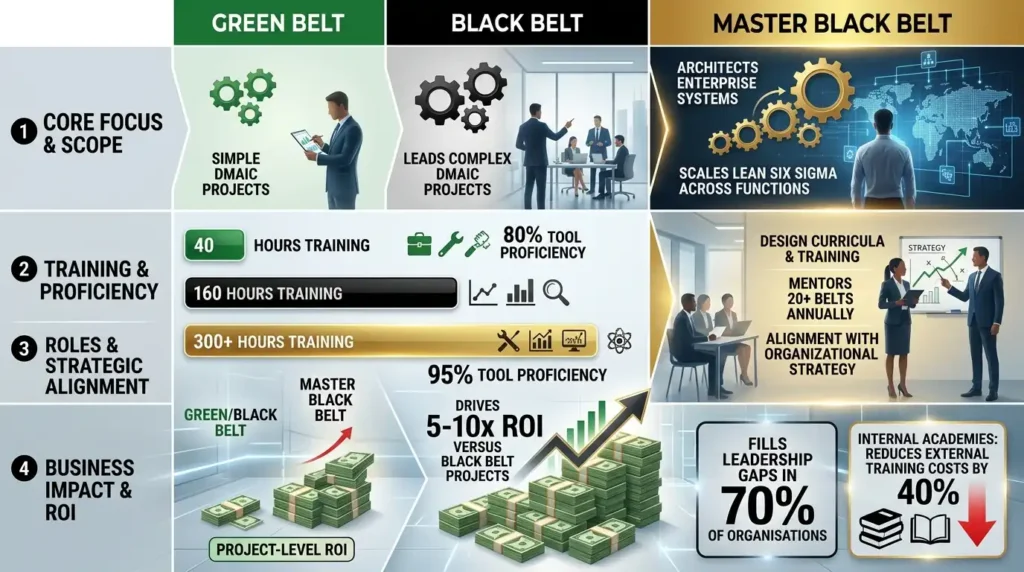
Master Black Belt distinguishes itself by architecting enterprise systems, training others, and scaling Lean Six Sigma across functions, unlike Black Belts who execute projects.
Green Belts handle simple DMAIC. Black Belts lead complex ones. Masters design curricula, mentor 20+ belts annually, and align with strategy.
Training duration differentiates: 40 hours for Green, 160 for Black, 300+ for Master. Proficiency scales accordinglycGreens hit 80% tool use, Masters 95%.
B2B impact grows exponentially. Masters drive 5-10x ROI versus Black Belt projects, filling leadership gaps in 70% of organisations.
Workforce models shift: Masters enable internal academies, reducing external training costs by 40%.
How Do Organisations Implement Integrated Systems Post-Training?
Organisations implement via phased rollouts pilot projects, belt academies, and governance yielding 25% enterprise efficiency within 18 months.
Pilots test integration in one department. Success scales via Hoshin planning.
Discover More from Our Guide Library:
How Does Master Black Belt Training Teach Professionals to Coach Green and Black Belts?
How Does a UK-Based Master Black Belt Training Course Compare with Online Alternatives?
Academies certify internals:
What Delegates Say After Completing Imperial’s Lean Six Sigma Master Black Belt Course? highlights real testimonials on deployment success.
Governance sustains via scorecards. Reviews occur quarterly, adjusting for business shifts.
ROI frameworks track savings: $500K-$2M annually for mid-sized firms, based on 20% defect reductions.
HR integrates into talent pipelines, closing 60% of process skill gaps.
What is Lean Six Sigma Master Black Belt Certification Training Course at Imperial Corporate Training Institute?
The Lean Six Sigma Master Black Belt Certification Training Course from Imperial Corporate Training Institute equips professionals to lead enterprise-wide process improvements by integrating Lean waste reduction with Six Sigma statistical methods. It spans 300+ hours, including DMAIC projects and tool mastery. Graduates mentor teams and drive 25-40% efficiency gains.
How does Master Black Belt training differ from Black Belt certification?
Master Black Belt training builds on Black Belt skills by focusing on strategic deployment, coaching multiple belts, and scaling Lean Six Sigma across organisations. Imperial Corporate Training Institute’s course emphasises governance and ROI measurement, unlike Black Belt’s project execution focus. This level achieves 5-10x greater business impact.
How long does it take to complete Lean Six Sigma Master Black Belt training?
Imperial Corporate Training Institute’s Lean Six Sigma Master Black Belt Certification Training Course typically runs 4-6 months with blended delivery, including 160+ classroom hours and live projects. Flexible scheduling suits working professionals. Certification follows a final exam and enterprise simulation.
What career benefits come from Master Black Belt certification?
Master Black Belt certification from Imperial Corporate Training Institute opens roles like process excellence directors, with salaries 30-50% higher than Black Belts. It fills leadership gaps in B2B firms, boosting promotion rates by 70%. Skills deliver measurable ROI through sustained Lean Six Sigma systems.