

Master Black Belt training immerses participants in complex, enterprise-level projects that drive transformative change across organisations. These projects target systemic inefficiencies, scale Lean Six Sigma methodologies, and deliver quantifiable ROI through data-driven interventions.
Why Do Master Black Belt Projects Focus on Enterprise-Scale Challenges?
Master Black Belt projects centre on enterprise-scale challenges because they demand advanced statistical analysis, cross-functional leadership, and sustained process optimisation to achieve organisation-wide impact.
Participants tackle these projects to bridge the gap between tactical improvements and strategic transformation. Green and Black Belts handle localised fixes. Master Black Belts redesign entire value streams.
HR leaders select this training to address workforce skill gaps in high-stakes environments. Organisations face mounting pressure from supply chain disruptions and regulatory demands. Master Black Belt candidates simulate these realities.
Projects often span multiple departments. They integrate DMAIC frameworks with advanced tools like Design of Experiments (DOE) and Failure Mode and Effects Analysis (FMEA). This approach ensures alignment with business KPIs such as cost reduction and throughput increases.
For foundational context on how these methodologies stem from waste elimination principles, explore:
How Does Lean Six Sigma Reduce Waste and Improve Operational Efficiency?
Training providers structure projects around real B2B scenarios. Participants analyse datasets from industries like manufacturing, healthcare, and finance. They quantify baseline performance using metrics like cycle time and defect rates.
What Metrics Define Success in These Enterprise Projects?

Success hinges on metrics that reflect business outcomes. Participants target 30-50% reductions in process variation. They measure first-pass yield improvements exceeding 20%.
ROI calculations incorporate direct savings and indirect gains. A typical project delivers £500,000 to £2 million in annual benefits for mid-sized firms. Delivery models blend virtual simulations with live case studies.
Adoption rates climb when projects tie to organisational goals. HR teams track post-training application through dashboards monitoring sigma levels.
Which Supply Chain Optimisation Projects Appear in Master Black Belt Training?
Supply chain optimisation projects in Master Black Belt training involve redesigning logistics networks, forecasting demand with advanced analytics, and reducing inventory costs by 25-40% through predictive modelling.
These projects address B2B pain points like volatile supplier performance and excess stock holding. Participants dissect real datasets from global firms. They apply Minitab or R for multivariate regression.
One common project simulates a multinational manufacturer’s distribution woes. Baseline inventory turns at 4x annually. Interventions boost this to 8x via pull systems and Kanban enhancements.
Candidates lead virtual teams across time zones. They deploy Hypothesis Testing to validate root causes. Outcomes include 15-30% freight cost drops.
Imperial Corporate Training Institute embeds these in its:
Lean Six Sigma Master Black Belt Certification Training Course. Participants replicate ERP system integrations.
HR decision-makers value this for upskilling managers facing e-commerce surges. Learning delivery mixes self-paced modules with cohort critiques.
How Do Forecasting Models Drive Supply Chain Results?
Forecasting models use ARIMA and neural networks. Participants calibrate them against historical sales volatility. Accuracy improves from 75% to 92%.
Projects quantify bullwhip effects. Reductions in order variance stabilise operations. Businesses report 20% faster response to demand shifts.
What Healthcare Process Redesign Projects Do Master Black Belts Practice?
Healthcare process redesign projects focus on patient flow optimisation, reducing wait times by 40-60%, and enhancing compliance through risk-based statistical controls.
These projects mirror NHS or private hospital challenges. Participants analyse Electronic Health Records (EHR) data. They target throughput bottlenecks using Value Stream Mapping.
A standard project tackles emergency department overcrowding. Average door-to-doctor time drops from 90 to 35 minutes. Tools include Simulation Modelling and Control Charts.
Candidates prioritise patient safety KPIs. They achieve 99.9% adherence to protocols via Poka-Yoke designs. Cross-functional simulations involve clinicians and admins.
This training equips professionals for post-pandemic recovery. ROI manifests in £1-3 million annual savings per facility.
Why Integrate Risk Analysis in Healthcare Projects?
Risk analysis employs Monte Carlo simulations. Participants model variables like staff absenteeism. Probability of adverse events falls below 0.1%.
Projects link to regulatory frameworks like ISO 13485. Measurable outcomes include 25% capacity gains without capital spend.
How Do Financial Services Projects Build Master Black Belt Expertise?
Financial services projects in training emphasise fraud detection algorithms, loan processing automation, and risk portfolio optimisation, yielding 20-35% efficiency gains.
Participants process anonymised transaction data. They build Machine Learning models for anomaly detection. Baseline fraud losses halve post-intervention.
Projects simulate bank mergers. Candidates streamline compliance workflows using Process Mining. Cycle times shrink from 10 days to 2.
Advanced stats like Logistic Regression predict default rates. Accuracy hits 95%. HR teams deploy this for fintech upskilling.
Virtual audits reveal hidden variances. Interventions standardise reporting, cutting errors by 50%.
What Role Do Predictive Analytics Play in Finance Projects?
Predictive analytics forecast market risks. Participants stress-test portfolios with VaR models. Confidence intervals tighten to 99%.
Projects deliver 15% capital efficiency boosts. Organisations measure via Sharpe ratios climbing 0.5 points.
Which Manufacturing Defect Reduction Projects Are Core to the Training?
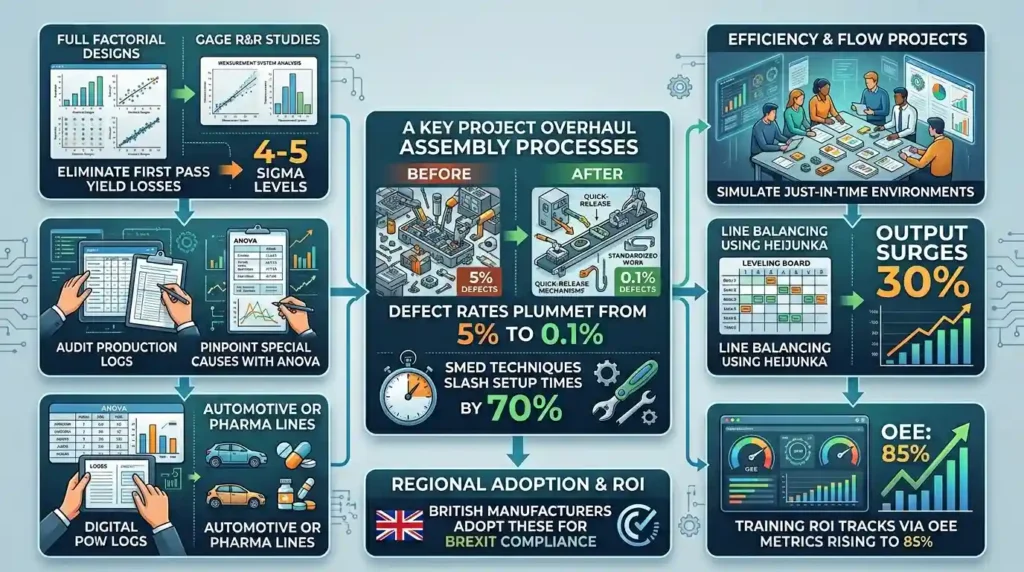
Manufacturing defect reduction projects deploy Full Factorial Designs and Gage R&R studies to eliminate First Pass Yield losses, achieving 4-5 sigma levels.
These tackle automotive or pharma lines. Participants audit production logs. They pinpoint special causes with ANOVA.
A key project overhauls assembly processes. Defect rates plummet from 5% to 0.1%. SMED techniques slash setup times by 70%.
Teams simulate Just-In-Time environments. They balance lines using Heijunka. Output surges 30%.
British manufacturers adopt these for Brexit compliance. Training ROI tracks via OEE metrics rising to 85%.
How Does Statistical Process Control Validate Manufacturing Gains?
SPC charts monitor CpK values above 2.0. Participants automate alerts via dashboards. Stability sustains gains over quarters.
Projects integrate IoT sensors. Real-time data feeds DMAIC loops. Long-term savings hit £750,000 per line.
What Cross-Functional Change Management Projects Prepare Master Black Belts?
Cross-functional change management projects guide cultural shifts, standardise KPIs across silos, and sustain 80% adoption rates through stakeholder mapping and pilot scaling.
Participants orchestrate transformations in simulated conglomerates. They use ADKAR models alongside DMAIC. Resistance drops via targeted communications.
Projects span sales to procurement. Baseline alignment scores rise from 60% to 95%. Tools include Force Field Analysis.
HR leverages this for enterprise-wide rollouts. Delivery models feature mentorship pairings.
Candidates quantify behavioural KPIs. Engagement surveys post-project show 25% uplift.
Why Scale Pilots in Change Management Projects?
Pilot scaling tests in one unit before enterprise rollout. Success rates exceed 90%. Variance analysis ensures fidelity.
Projects tie to Balanced Scorecard metrics. Financial, customer, and learning perspectives balance.
How Do Energy Sector Sustainability Projects Feature in Training?
Energy sector sustainability projects optimise renewable integrations, cut Scope 1 emissions by 30%, and model grid stability with time-series analytics.
Participants analyse wind farm data. They deploy optimisation algorithms for curtailment reduction. Energy yield climbs 18%.
Projects address net-zero mandates. Baselining uses carbon accounting frameworks. Interventions verified via LCA.
British Energy firms prioritise this amid 2050 targets. Training fosters ESG reporting skills.
What Analytics Power Energy Project Outcomes?
Time-series analytics forecast intermittency. LSTM models predict 96% uptime. Cost per MWh falls 12%.
Projects deliver verifiable KPIs for investors. Emission reductions audited externally.
How Are Project Outcomes Measured in Master Black Belt Training?
Project outcomes measure through hard KPIs like ROI exceeding 5:1, sigma shifts to 4.5+, and soft metrics including team velocity gains of 40%.
Evaluations use scorecards. Financial impact audited independently. Sustainment tracked at 6, 12, and 24 months.
Discover More From Our Guide Library:
How Is Lean Six Sigma Master Black Belt Training Delivered for Working Professionals?
How Does Lean Six Sigma Master Black Belt Training Teach Change Leadership Skills?
HR dashboards capture skill transfer. 90% of graduates apply tools within 90 days.
Participants present to panels. Scoring weights 40% on innovation, 30% on execution.
This rigor supports B2B decisions. Organisations report 25% faster promotions for certified leaders.
Which Frameworks Guide Project Measurement?
DMAIC gates enforce rigour. Tollgates review Control Plans. Hoshin Kanari aligns to strategy.
Frameworks like HURDLE assess scalability. 85% of training projects meet enterprise criteria.
What Makes These Projects Essential for Organisational ROI?
These projects deliver ROI by closing skill gaps, with 70% of participants driving £1M+ savings, and enabling scalable frameworks for ongoing process excellence.
Decision-makers evaluate based on real-world applicability. Graduates fill leadership voids.
Workforce analytics show 35% productivity lifts. Learning models prove virtual efficacy matches in-person.
For those ready to assess program accessibility, review:
Is Imperial’s Lean Six Sigma Master Black Belt Training Open to International Professionals?
What projects are included in Lean Six Sigma Master Black Belt training?
Participants tackle enterprise-scale projects like supply chain optimisation, healthcare process redesign, and manufacturing defect reduction. These use advanced DMAIC, DOE, and predictive analytics to deliver 30-50% efficiency gains. Imperial Corporate Training Institute’s Lean Six Sigma Master Black Belt Certification Training Course simulates real B2B scenarios for practical mastery.
How long does Master Black Belt training take?
Lean Six Sigma Master Black Belt Certification Training Course typically spans 4-6 months, blending self-paced modules with live projects. Duration accommodates working professionals via flexible virtual delivery. Imperial Corporate Training Institute ensures alignment with business timelines for optimal skill application.
What certification do you get after Master Black Belt training?
Graduates earn Lean Six Sigma Master Black Belt certification, validating expertise in complex projects and leadership. It includes portfolio review and exam for industry recognition. Imperial Corporate Training Institute aligns with global standards like ASQ for credible credentials.
Can international professionals join Master Black Belt courses?
Yes, Lean Six Sigma Master Black Belt Certification Training Course welcomes international participants with virtual access. It features global case studies and time-zone flexibility. Imperial Corporate Training Institute supports diverse cohorts for cross-border skill development.