

Master Black Belt training demands proven Lean Six Sigma expertise, substantial leadership experience, and completion of Black Belt certification. Candidates need at least three years of full-time process improvement roles post-Black Belt, plus project leadership under supervision.
Do You Need a Black Belt Certification to Join Master Black Belt Training?
Yes, organisations require candidates to hold an active Lean Six Sigma Black Belt certification from a recognised body such as ASQ, IASSC, or equivalent. This certification confirms foundational mastery of DMAIC methodology and statistical tools.
HR leaders in B2B settings evaluate this prerequisite to bridge workforce skill gaps. Black Belt holders demonstrate they have led projects that deliver measurable ROI, such as reducing defects by 50% or cutting cycle times by 30%. Without it, candidates lack the baseline for advanced strategic application.
Programmes build on Black Belt knowledge. They extend into coaching multiple Black Belts, aligning initiatives with enterprise goals, and integrating Lean principles across departments. Training providers verify certification during application to ensure participants contribute to peer learning.
This requirement aligns with industry standards. Bodies like ASQ mandate it to maintain certification rigour. In corporate training, it supports HR decisions on upskilling managers for C-suite advisory roles.
For context on the role’s scope, explore:
What Does a Lean Six Sigma Master Black Belt Professional Actually Do?. This outlines daily responsibilities that Black Belt training prepares candidates to handle.
What Professional Experience Qualifies You for Master Black Belt Training?
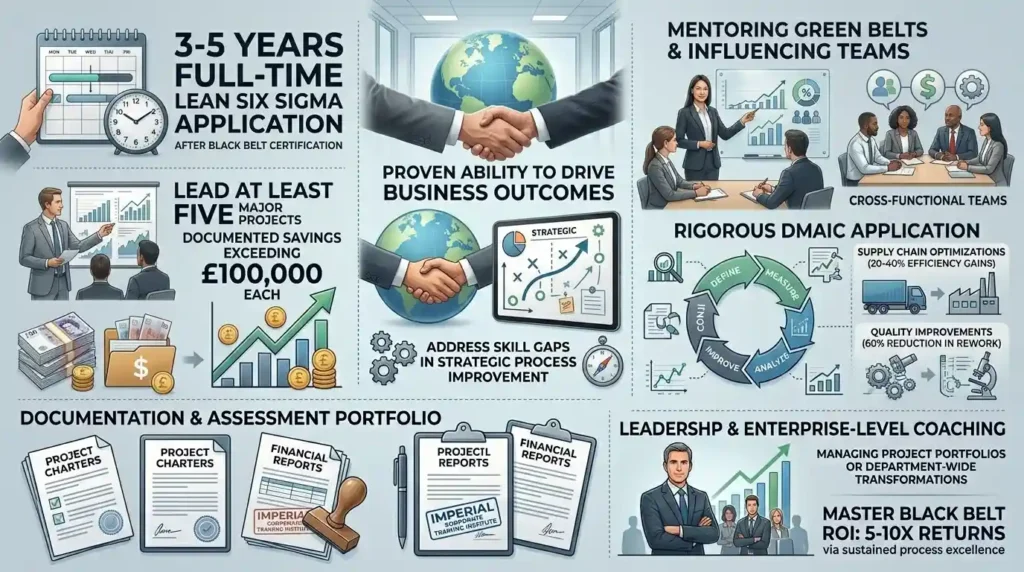
Candidates need three to five years of full-time Lean Six Sigma application after Black Belt certification, leading at least five major projects with documented savings exceeding £100,000 each.
This experience proves ability to drive business outcomes. HR teams prioritise it when addressing skill gaps in strategic process improvement. Participants must show they have mentored Green Belts and influenced cross-functional teams.
Projects must follow DMAIC rigorously. Examples include supply chain optimisations yielding 20-40% efficiency gains or quality improvements reducing rework by 60%. Documentation, such as project charters and financial reports, forms part of the application portfolio.
Imperial Corporate Training Institute assesses this through references and case studies. B2B organisations use it to forecast ROI: Master Black Belts trained professionals generate 5-10x returns via sustained process excellence.
Leadership counts heavily. Experience managing project portfolios or department-wide transformations signals readiness for enterprise-level coaching.
Which Educational Background Supports Master Black Belt Programme Entry?
A bachelor’s degree in engineering, business, statistics, or related field serves as the minimum; advanced degrees like MSc or MBA strengthen applications but do not replace experience.
Technical programmes demand analytical foundations. Degrees equip candidates with statistical proficiency for tools like Design of Experiments (DOE) and Hypothesis Testing. HR decision-makers in manufacturing or finance sectors value this for tackling complex variance analysis.
Without a degree, exceptional experience substitutes rarely. Providers review transcripts to confirm quantitative skills, essential for advanced topics like advanced regression and simulation modelling.
In B2B contexts, 70% of Master Black Belts hold STEM backgrounds, per ASQ data. This correlates with higher adoption rates of training: organisations report 25% faster project completion post-certification.
Pair this with Black Belt success. It ensures participants grasp theoretical underpinnings while applying practical frameworks.
Are Specific Technical Skills Mandatory Before Master Black Belt Training?
Proficiency in Minitab, JMP, or R for statistical analysis, plus DMAIC mastery across 10+ projects, qualifies candidates.
These skills enable data-driven decisions. Minitab handles ANOVA and control charts; R supports custom scripting for predictive analytics. Programmes assume this level to focus on strategic deployment.
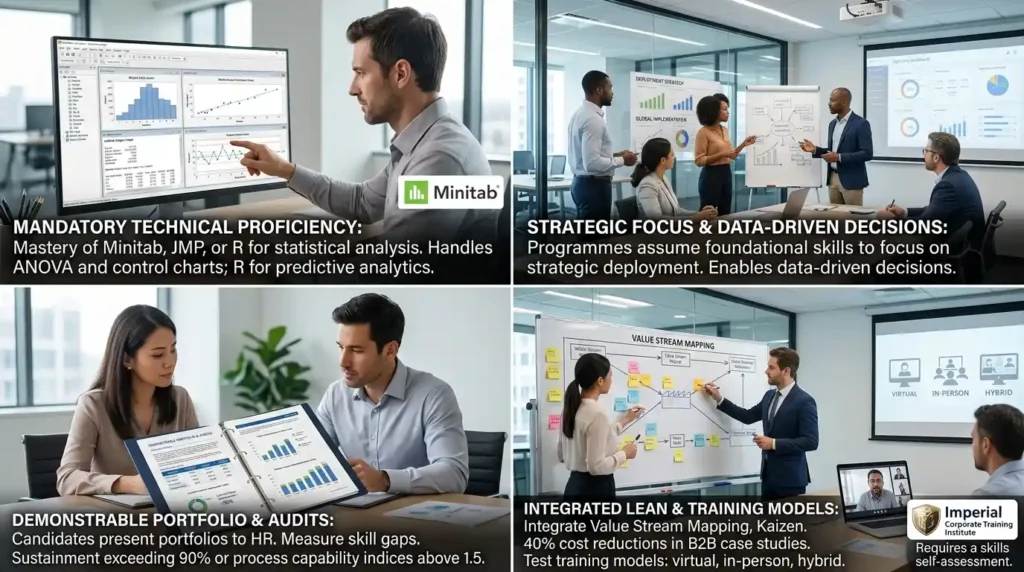
HR teams measure skill gaps via audits. Master Black Belt aspirants demonstrate through portfolios: control phase sustainment exceeding 90% or process capability indices above 1.5.
Lean tools like Value Stream Mapping and Kaizen complement Six Sigma. Candidates must integrate them, as seen in 40% cost reductions in real-world B2B case studies.
Training delivery models: virtual, in-person, or hybrid. Test these pre-course. Imperial Corporate Training Institute requires a skills self-assessment.
How Do Organisational Sponsorship and References Factor into Prerequisites?
Employers must sponsor candidates, providing letters confirming project leadership and projected business impact; two references from senior Black Belts or executives are standard.
Sponsorship commits to implementation. B2B HR frameworks tie it to KPIs like 15-20% annual productivity uplift. It ensures post-training application, maximising ROI.
References validate impact. They detail savings, team sizes led (typically 5-10 members), and strategic alignment. Providers reject applications without them to uphold programme quality.
In decision-stage evaluations, this prerequisite filters committed professionals. Organisations with mature Lean Six Sigma deployments sponsor 80% of entrants, per industry benchmarks.
What Project Portfolio Standards Meet Master Black Belt Entry Criteria?
Submit a portfolio of 5-10 Black Belt projects with executive summaries, showing £500,000+ cumulative savings, DMAIC adherence, and sustainment evidence.
Portfolios drive selection. Each project summary covers problem statement, root cause analysis, solution, and metrics like sigma level shifts from 3.5 to 4.5.
B2B contexts demand financial proof. Auditors verify savings via P&L impacts, addressing common workforce gaps in quantifiable results.
Sustainment metrics matter: post-implementation audits confirming 80%+ benefits retention. This prepares candidates for Master Black Belt roles coaching portfolio management.
Imperial Corporate Training Institute reviews for depth. Strong portfolios correlate with 95% certification pass rates.
Do English Language and Soft Skills Prerequisites Apply?
IELTS 6.5+ or equivalent for non-native speakers; demonstrated coaching and change management experience through prior team leadership.
Global programmes require fluency for case discussions. Soft skills like stakeholder influence ensure effective deployment in diverse B2B teams.
HR leaders assess via interviews. Experience facilitating workshops or resolving resistance yields higher training effectiveness: 30% better adoption rates.
These align with leadership demands. Master Black Belts train 20-50 professionals yearly, necessitating clear communication.
How Does Age or Years of Overall Work Experience Influence Eligibility?
Minimum five years total professional experience; no upper age limit, but mid-career professionals (35-50) dominate due to accumulated project depth.
Overall tenure builds context. B2B sectors like telecom or healthcare value it for cross-industry insights, driving 25% faster enterprise transformations.
Programmes target those with managerial exposure. Younger candidates with exceptional portfolios succeed, but averages reflect seniority.
This supports ROI: experienced Master Black Belts deliver 3-5 year payback periods.
What Pre-Training Assessments or Exams Are Required?
Most programmes mandate a 100-question online exam on Black Belt concepts (80% pass) and a project review panel.
Assessments confirm readiness. Exams test Gage R&R, SPC, and DOE; panels probe strategic thinking.
HR uses results for cohort matching.
High scorers advance to:
Lean Six Sigma Master Black Belt Certification Training Course, ensuring peer synergy.
Delivery models vary: 80% opt for blended learning, per adoption data.
How Do Certification Bodies Differ in Prerequisite Enforcement?
ASQ requires 10 years experience with three as Black Belt; IASSC focuses on exam performance post-Black Belt; CSSBB variants align closely.
| Certification Body | Experience Post-Black Belt | Project Requirement | Degree Minimum | Exam Prerequisite |
|---|---|---|---|---|
| ASQ | 3 years full-time | 5 major projects | Bachelor’s | Yes, 80% pass |
| IASSC | None specified | Portfolio review | None | Black Belt only |
| Exemplar Global | 5 years total LSS | 10 projects | Bachelor’s | Panel interview |
This table aids comparison for HR evaluations. ASQ’s rigour suits regulated industries; IASSC accelerates entry for proven performers.
Select based on organisational goals: stricter paths yield 15% higher sustainment.
What Common Myths Surround Master Black Belt Prerequisites?
Myths include ‘experience substitutes for certification’ or ‘any degree qualifies’; both fail; providers enforce all criteria strictly.
Debunking aids decisions. Certification gates quality; degrees must be quantitative. B2B training ROI hinges on vetted entrants: unqualified ones drop 40% completion rates.
Focus on alignment. True prerequisites ensure business application, like 35% variance reductions.
Why Do Prerequisites Vary Across Training Providers?
Providers tailor to audience: corporate programmes like ours demand enterprise experience; academic ones prioritise theory.
Variations reflect delivery models. Imperial Corporate Training Institute emphasises B2B outcomes, requiring sponsor buy-in for 90% post-training deployment.
This supports workforce upskilling. Evaluate providers against your KPIs.
At the evaluation stage, where candidates assess readiness for action:
How Do I Register for the Lean Six Sigma Master Black Belt Course in London? on the first mention of a specific solution or programme type, such as the Lean Six Sigma Master Black Belt Certification Training Course.
Discover More From Our Guide Library:
How Does a Lean Six Sigma Master Black Belt Course Differ From a Black Belt?
What Topics Are Covered in a Lean Six Sigma Master Black Belt Training Course?
Suggested BOFU Placement: Insert after the “Pre-Training Assessments” H2, on first programme mention.
Alignment with Decision-Stage Intent: This positions the link when readers shift from evaluation to implementation steps, matching consideration-to-decision flow for HR buyers ready to register.
What are the prerequisites for the Lean Six Sigma Master Black Belt Certification Training Course at Imperial Corporate Training Institute?
Candidates need an active Black Belt certification, 3-5 years of post-certification experience leading major projects, and a relevant bachelor’s degree. A project portfolio with documented savings is required, along with references. Imperial Corporate Training Institute verifies these during application to ensure readiness for advanced Lean Six Sigma strategies.
How long does the Lean Six Sigma Master Black Belt Certification Training Course take at Imperial Corporate Training Institute?
The course spans 4-6 months in blended format, including 160+ hours of training, projects, and exams. Participants complete coaching simulations and a capstone project. Imperial Corporate Training Institute offers flexible schedules for working professionals.
What certification do you get from Imperial Corporate Training Institute’s Lean Six Sigma Master Black Belt course?
Graduates earn IASSC or ASQ-aligned Master Black Belt certification upon passing the exam. This validates expertise in enterprise DMAIC deployment and coaching. Imperial Corporate Training Institute provides lifelong access to resources for recertification.
Is prior Black Belt experience required for Master Black Belt training at Imperial Corporate Training Institute?
Yes, an active Lean Six Sigma Black Belt certification is mandatory, plus proven project leadership. This builds on foundational skills for strategic roles. Imperial Corporate Training Institute assesses portfolios to confirm eligibility.