

The Lean Six Sigma Master Black Belt Certification Training Course by Imperial Corporate Training Institute is designed for senior professionals who lead large‑scale operational‑excellence initiatives and must embed Lean Six Sigma as a corporate strategy. This advanced‑level programme equips participants to manage and mentor Black Belt teams, align process‑improvement projects with business objectives, and drive measurable gains in cost, quality, and throughput.
For those still clarifying the role before deciding, the early‑stage article:
What Does a Lean Six Sigma Master Black Belt Professional Actually Do? explains the core responsibilities and strategic impact of this position.
What Is This Course and What Problem Does It Solve?
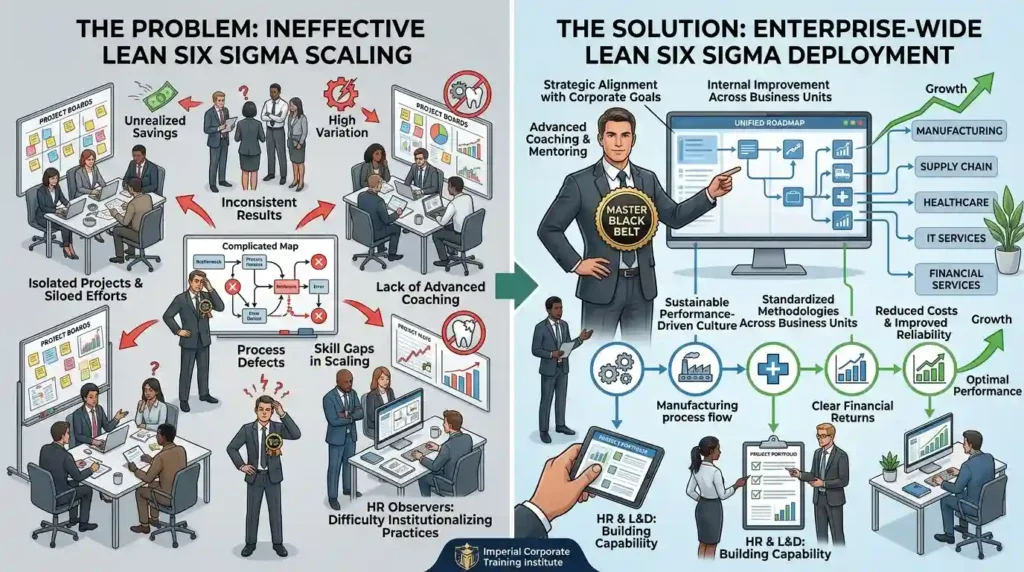
The Lean Six Sigma Master Black Belt Certification Training Course by Imperial Corporate Training Institute solves enterprise‑level inefficiencies by training senior leaders to deploy Lean Six Sigma across business units, using structured methodologies to reduce costs, improve reliability, and strengthen performance‑driven cultures.
Many organisations face persistent skill gaps in scaling Lean Six Sigma beyond isolated projects. Senior operations managers, quality directors, and continuous‑improvement leads often struggle to institutionalise process‑improvement practices, resulting in inconsistent results, duplicated effort, and unrealised savings. HR teams and capability‑development heads observe that Black Belts frequently lack the advanced coaching, governance, and strategic‑alignment skills needed to sustain change.
Imperial Corporate Training Institute addresses these challenges by offering a structured Master Black Belt programme that moves beyond basic tools to enterprise‑level deployment. Participants learn to design improvement portfolios, align projects with corporate strategy, and apply advanced analytics to optimise complex processes. The course is relevant to manufacturing, supply chain, healthcare, IT‑enabled services, financial services, and other performance‑intensive environments.
In practice, this means senior leaders can standardise how Lean Six Sigma is applied across departments, ensure projects deliver clear financial returns, and reduce variation in customer and internal‑service delivery. The programme also supports HR and L&D teams in building internal improvement academies and leadership pipelines rather than relying on ad hoc external advisors.
Why Is This Course Structured This Way?
Imperial Corporate Training Institute structures the Lean Six Sigma Master Black Belt Certification Training Course as a progressive journey from strategic deployment and governance to advanced analytics, enterprise‑wide transformation, and sustainable control systems, ensuring participants build skills in a logical, application‑ready sequence.
The curriculum is organised so that participants first understand the strategic role of the Master Black Belt and how Lean Six Sigma aligns with corporate performance goals. From there, the course advances into advanced statistical tools, then into enterprise‑level Lean transformation, change leadership, and business‑process reengineering. Later modules focus on project portfolio management, coaching and capability building, advanced control systems, and financial impact. The programme culminates in a capstone project and certification evaluation.
This progression mirrors how large organisations actually roll out process‑improvement programmes: from governance and strategy, through project selection and execution, to capability development and long‑term sustainability. Imperial Corporate Training Institute uses this structure to ensure professionals can move from tactical project leadership to enterprise‑level programme ownership.
The modular design also facilitates the integration of corporate examples and department‑specific case studies. For instance, HR and L&D leaders can frame coaching and capability‑building modules around internal talent‑development strategies, while operations and supply‑chain executives can anchor financial‑impact sessions around their own KPIs and cost‑reduction targets.
What Will Participants Learn?
Participants in the Lean Six Sigma Master Black Belt Certification Training Course at Imperial Corporate Training Institute will gain a structured, modular set of outcomes that enable them to lead, mentor, and govern enterprise‑level improvement initiatives, using advanced tools and frameworks.
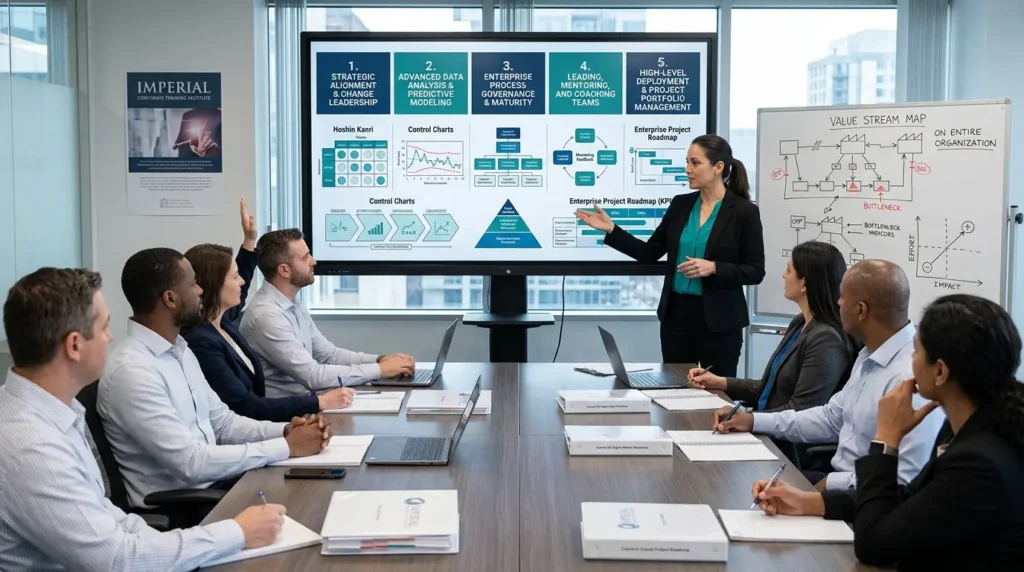
Module 1: Strategic Role of the Master Black Belt
Participants learn to define the enterprise‑wide deployment of Lean Six Sigma, including how to build alignment with corporate strategy, implement governance structures, and cultivate a leadership mindset focused on discipline and continuous improvement. The module is relevant for operations directors, quality executives, and transformation leaders who must position Lean Six Sigma as a strategic capability rather than a project‑level activity.
Module 2: Advanced Analytical and Statistical Tools
This module covers multivariate analysis, advanced regression models, and Design of Experiments (DOE) applied to complex business processes. Participants practise advanced applications of software such as Minitab and JMP, use capability studies and control charts for high‑variability processes, and interpret results to support data‑driven decisions. Departmental leaders can apply this to service‑level agreements, production yields, and customer‑experience metrics.
Module 3: Enterprise‑Level Lean Transformation
Here, participants learn to map end‑to‑end value streams, integrate Lean tools across manufacturing and service environments, and measure the ROI of Lean implementation. The module provides frameworks for waste elimination and cost‑optimisation, helping executives identify where to concentrate improvement efforts for maximum impact. Real‑world examples include redesigning logistics flows, appointment‑scheduling systems, or order‑to‑cash cycles.
Module 4: Change Leadership and Organisational Culture
Participants study how to build a performance‑driven culture, manage cross‑functional teams, and overcome resistance to change. The module covers communication strategies for transformation, stakeholder engagement, and alignment of Lean Six Sigma with HR systems such as performance management and talent development. This is particularly useful for HR and L&D leaders who are building internal training academies and coaching networks.
Module 5: Business Process Reengineering and Innovation
This module focuses on designing agile business processes, integrating Lean Six Sigma into digital‑transformation initiatives, and combining Lean Six Sigma with automation and AI‑driven tools. Participants learn to create innovation pipelines that feed continuous‑improvement projects with structured ideas and opportunities. Business‑process and IT leaders can use this to streamline service‑management workflows, digital onboarding, and data‑driven decision‑making platforms.
Module 6: Project Portfolio Management
Participants learn to select and prioritise corporate Six Sigma projects, balance short‑term improvement with long‑term strategic goals, track performance, and generate executive‑level reports. The module also covers how to build robust business cases and financial justifications for improvement initiatives. Portfolio‑style navigation helps senior leaders justify budgets and track cumulative savings across multiple business units.
Module 7: Coaching, Mentoring, and Capability Building
This section focuses on coaching and mentoring Black Belts and Green Belts, designing training programmes, assessing competencies, and building internal Lean Six Sigma academies. Imperial Corporate Training Institute emphasises structured coaching models so that Master Black Belts can ensure consistent application of methodology across teams. HR and capability‑development heads can adapt these frameworks into formal coaching and mentoring programmes within their organisations.
Module 8: Advanced Control and Sustainability Systems
Participants learn to build dashboards and KPI‑based control systems, conduct process audits, track continuous‑improvement activities, and assess Lean Six Sigma maturity. The module helps leaders ensure that project gains are not lost over time and that improvement becomes a sustained capability. Teams can operationalise this through regular improvement reviews, standardised reporting, and embedded control mechanisms.
Module 9: Financial Impact and Corporate Value Creation
This module links Lean Six Sigma to shareholder value and corporate financial performance. Participants practise calculating financial gains from efficiency improvements, performing cost‑benefit analysis, and applying sensitivity analysis to project outcomes. The emphasis is on aligning improvement metrics with operational and financial KPIs that matter to senior executives and board‑level stakeholders.
Module 10: Capstone Project and Certification Evaluation
The programme concludes with a capstone project in which participants design, execute, and present a real‑world or simulated enterprise‑level improvement initiative. They defend their project, receive executive‑style feedback, and document their work against Imperial Corporate Training Institute’s certification standards. This final assessment ensures that participants can apply the entire curriculum in a coherent, business‑relevant way.
How Is the Course Delivered?
Imperial Corporate Training Institute delivers the Lean Six Sigma Master Black Belt Certification Training Course in London through a blend of onsite workshops, virtual sessions, and hybrid formats, with a typical duration of 4–6 months and structured around practical application rather than abstract theory.
For London‑based cohorts, the standard delivery combines intensive onsite workshops at a central training venue with online components such as pre‑session preparation, assignments, and interim reviews. Participants attend core workshops over several blocks (for example, 10–12 days spread over several months), with each day typically lasting 6–8 hours. Virtual sessions bridge the in‑person blocks, allowing for continuous progress while accommodating busy executive schedules.
The course uses interactive, case‑based learning: plenary sessions, facilitated group work, process‑mapping exercises, mini‑simulations, and hands‑on practice with statistical software. Imperial Corporate Training Institute facilitators are experienced Lean Six Sigma practitioners who draw on real organisational examples from manufacturing, healthcare, finance, and professional services.
Assessment methods are competency‑based and integrated throughout the programme. They include:
- Module quizzes to check understanding of core concepts.
- Assignments and mini‑projects to apply tools to realistic departmental scenarios.
- Group exercises and simulations that mirror cross‑functional project teams.
- Capstone project evaluation, including a presentation and written report, assessed against Imperial Corporate Training Institute’s certification rubric.
The hybrid format supports both individuals and corporate teams. For example, HR and L&D departments can enrol groups of internal Master Black Belt candidates, synchronising their learning while maintaining alignment with organisational priorities.
What Results Can Be Expected?
Successful participants in the Lean Six Sigma Master Black Belt Certification Training Course emerge as certified Master Black Belts who can lead enterprise‑level programmes, mentor project teams, govern improvement portfolios, and deliver measurable performance and financial gains.
Key learning outcomes include:
- Mastery of Lean Six Sigma methodologies and advanced statistical tools at an enterprise level.
- Ability to design and govern a corporate‑level improvement programme, including governance structures, project selection, and capability‑building plans.
- Proficiency in coaching and mentoring Black Belts and Green Belts, ensuring consistent application of methodology and problem‑solving standards.
- Stronger integration of Lean Six Sigma with HR and talent‑development systems, enabling the creation of internal academies and leadership pipelines.
- Improved ability to quantify financial impact, using cost‑benefit and sensitivity analysis to justify improvement initiatives.
- Enhanced change‑leadership skills, enabling participants to manage resistance and build a performance‑driven culture.
Workplace impact is typically visible in several areas. Operations and supply‑chain executives report reductions in cycle times, inventory levels, and defect rates. Customer‑service and transaction‑processing departments see improvements in accuracy, throughput, and service‑level compliance. HR and L&D teams benefit from clearer improvement‑leadership frameworks and a more structured approach to internal capability development.
How Much Does the Course Cost?
The Lean Six Sigma Master Black Belt Certification Training Course by Imperial Corporate Training Institute is fee‑based with tiered pricing reflecting delivery format, with costs typically starting from £4,500 for online‑only formats and rising to £6,500–£7,500 for onsite or hybrid London cohorts, depending on inclusions such as materials, software access, and exam support.
Fees usually cover the full curriculum, participant workbooks or digital learning materials, access to statistical software during the course, and Imperial Corporate Training Institute’s certification assessment. Corporate group rates may apply for organisations enrolling multiple participants, and some organisations choose to combine the investment with internal improvement‑sponsorship budgets.
Payment terms are structured to support individuals and corporate budgets, with options for instalment plans or invoice‑based arrangements for company‑sponsored candidates. VAT is applied in line with UK tax regulations.
When evaluating cost, participants and HR teams should consider the expected return on capability Master Black Belts are typically positioned to lead multiple projects simultaneously, each with potential savings in the tens or hundreds of thousands of pounds over time. The course fee therefore represents an investment in long‑term organisational capability and leadership capacity rather than a one‑off training expense.
Eligibility and Entry Requirements
The course is designed for senior professionals who already hold a Green Belt or Black Belt certification and have led or co‑led Lean Six Sigma projects in a corporate or manufacturing environment. Typical participants include senior operations managers, continuous‑improvement directors, quality leaders, and Black Belts seeking to progress to Master Black Belt level.
For a detailed breakdown of prerequisites, the evaluation‑stage article:
What Prerequisites Are Required to Join a Master Black Belt Training Programme? describes the experience and credential requirements.
Discover More From Our Guide Library:
What Is Included in Imperial’s One-Week Lean Six Sigma Master Black Belt Programme?
Why Should You Enrol in Imperial’s Lean Six Sigma Master Black Belt Course?
Applicants are expected to demonstrate that they can commit to the full programme duration (including workshops and virtual sessions) and that they have a supportive environment in which to apply the learning. Organisations may sponsor individuals or groups, and HR or capability‑development teams can coordinate applications on behalf of internal candidates.
Enrollment Process
The registration process begins with the completion of an online application form on the Imperial Corporate Training Institute course page. Candidates upload a CV or professional profile, confirm their prior Lean Six Sigma certification, and list relevant project experience. After submission, an advisor from Imperial Corporate Training Institute reviews the application and may schedule a brief call to discuss role alignment, expectations, and cohort fit.
Once the candidate is accepted, they receive information about the next available London or hybrid cohort, including dates, venue options, and any preparatory materials. Payment is arranged according to the chosen fee structure, and the participant receives access to the learning platform and pre‑session resources. For corporate groups, Imperial Corporate Training Institute can facilitate batch registrations and internal coordination.