

A data-driven approach replaces subjective intuition and hierarchical guesswork with empirical metrics, statistical analysis, and verified behavioral indicators to guide strategic workforce development and operational choices.
Traditional decision making relies heavily on executive gut feeling, historical precedent, and anecdotal evidence. Leaders within organizations such as manufacturing plants, retail chains, and IT firms often approve training budgets or restructure teams based on personal experience rather than objective organizational needs. This legacy method creates significant blind spots. When human resources managers guess which competencies require improvement, up to 70 percent of corporate training investments fail to produce measurable behavioral change.
In contrast, a data-driven approach anchors every workplace intervention in hard metrics. Organizations collect continuous feedback loops from employee performance reviews, digital productivity trackers, and pre-training competency assessments. By analyzing these data points, decision-makers isolate exact skill gaps across departments. For example, instead of mandating a generic leadership workshop for all senior staff, an analytics-guided audit reveals that middle managers in the logistics division specifically lack data literacy and conflict resolution competencies. Target delivery then addresses this exact deficit.
This systematic shift alters how businesses view professional development. Training transforms from an arbitrary HR expense into a precision instrument. Organizations measure baseline employee capabilities, implement structured learning interventions, and track post-training performance metrics over a designated 90-day window. Leadership teams evaluate exact changes in project delivery speed, error rates, and cross-functional collaboration scores. Eliminating guesswork ensures that every capital allocation toward workforce upskilling generates verifiable operational returns.
How Does Implementation Function Within Corporate Structures and Learning Lifecycles?
Corporate implementation operates through a rigorous four-stage framework consisting of diagnostic baseline assessment, curriculum design, multi-modal delivery, and empirical post-training evaluation.
Deploying a data-driven capability framework requires structured execution across distinct operational phases. The process begins with a comprehensive organizational audit. Human resources professionals deploy validated psychological assessments, technical skill audits, and 360-degree feedback tools to map current workforce competencies against future business objectives. This diagnostic phase takes 14 to 21 days and establishes clear performance baselines for every participating employee.
Once the skills gap analysis concludes, instructional designers build targeted curricula aligned with strategic corporate goals. Organizations rarely rely on a single delivery channel. They deploy hybrid learning architectures combining synchronous live workshops, asynchronous digital modules, and peer-led coaching sessions. For instance, complex technical upskilling programs incorporate 30 percent self-paced digital learning and 70 percent practical simulation exercises. This blended methodology accommodates varying employee schedules while maintaining high cognitive engagement.
Implementation workflows proceed through strict governance protocols:
- Diagnostic Assessment: Execute baseline skill evaluations using quantitative diagnostic tests and management observation metrics.
- Curriculum Alignment: Design modular learning pathways tailored to specific departmental deficits identified in the audit phase.
- Blended Delivery: Execute training via interactive workshops, digital micro-learning modules, and experiential simulations over an 8-to-12 week cycle.
- Impact Measurement: Evaluate knowledge retention and behavioral application through post-training KPIs and productivity audits at 30, 60, and 90-day intervals.
During the execution phase, maintaining high standards of instructional integrity requires balancing theoretical frameworks with real-world application. Learners engage in case-based problem solving where they apply newly acquired strategic thinking models to simulated corporate crises. Instructors monitor progress continuously through embedded formative assessments. This iterative feedback loop allows facilitators to adjust pacing and remediate specific conceptual misunderstandings before summative evaluations occur.
What Key Components, Skills, and Frameworks Constitute a Data-Driven Training Ecosystem?
A robust data-driven training ecosystem integrates precise competency frameworks, experiential learning methodologies, analytical tracking software, and multi-format delivery mechanisms.
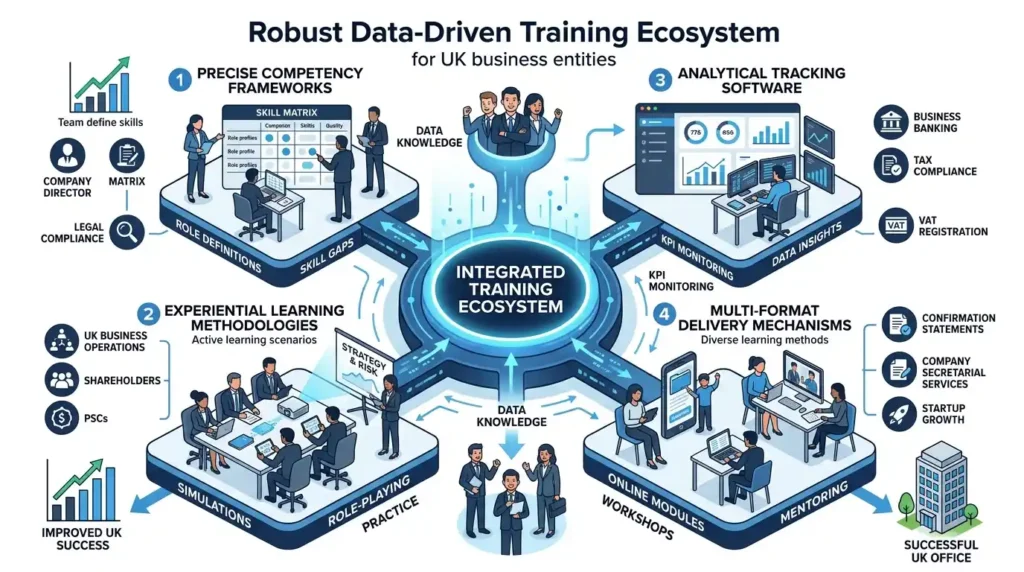
Building high-performing teams requires an interlocking set of structural components. At the foundational level, organizations utilize standardized competency frameworks that define exact behavioral and technical benchmarks for every job role. These frameworks categorize proficiencies into distinct tiers: foundational knowledge, operational application, strategic mastery, and innovative leadership.
The learning methodology must move beyond passive lecture formats to drive genuine cognitive retention. Effective corporate programs leverage active learning frameworks such as scenario-based simulations, role-playing exercises, and collaborative peer reviews. When training participants tackle complex business challenges modeled on actual company operations, skill transfer rates increase by up to 55 percent compared to traditional classroom instruction.
| Component Category | Primary Tools and Methodologies | Operational Function |
| Diagnostic Tools | 360-degree feedback, psychometric evaluations, technical audits | Identifies baseline skill deficiencies and measures individual readiness |
| Delivery Formats | Instructor-led workshops, LMS modules, hybrid coaching | Facilitates flexible knowledge acquisition across distributed workforces |
| Active Methodologies | Case studies, business simulations, experiential role-play | Translates abstract theory into practical workplace execution |
| Analytics Engines | Learning Management System (LMS) dashboards, HRIS data | Tracks completion rates, time-to-competency, and post-training KPIs |
Technological infrastructure powers this entire ecosystem. Enterprise Learning Management Systems track quantitative metrics such as course completion velocity, assessment scores, and engagement duration. When integrated with Human Resources Information Systems, these platforms allow L&D leaders to correlate specific training interventions with subsequent performance appraisals and promotion trajectories. Organizations operating in sectors like financial services, software engineering, and healthcare rely on these integrated dashboards to prove training efficacy to executive boards.
What Tangible Organizational Benefits and Measurable Outcomes Do Data-Driven Programs Produce?
Data-driven professional development generates quantifiable business value through accelerated time-to-competency, reduced employee turnover, enhanced leadership pipelines, and measurable productivity gains.
Modern enterprises operate under intense pressure to optimize operational expenditure while maximizing human capital output. Traditional, intuition-based training often results in wasted financial capital because courses do not align with actual job requirements. Conversely, a data-driven training model eliminates redundancy by focusing resources exclusively on verified performance gaps. Organizations implementing targeted upskilling initiatives report an average 24 percent increase in overall team productivity within six months of program completion.
Employee retention represents another critical operational metric directly influenced by structured professional development. High-performing professionals in competitive sectors such as biotechnology, management consulting, and telecommunications consistently cite career growth opportunities as a primary reason for tenure. When companies deploy transparent, data-backed skill development pathways, employee turnover decreases by up to 30 percent. Staff members perceive a direct investment in their professional longevity, which fosters organizational loyalty and deepens institutional engagement.
Furthermore, data-driven frameworks strengthen internal leadership pipelines. By tracking high-potential employees through objective performance metrics and leadership readiness assessments, organizations remove bias from promotion cycles. Decision-makers identify emerging leaders based on verified problem-solving capabilities and emotional intelligence indicators rather than tenure alone. This objective identification process ensures that newly appointed team leads possess the exact competencies required to manage complex, cross-functional organizational challenges.
How Do Specific Corporate Teams, Departments, and Industries Apply These Methodologies?
Corporate adoption spans diverse functional departments—including executive leadership, sales operations, and technical engineering—across industries such as healthcare, manufacturing, and professional services.
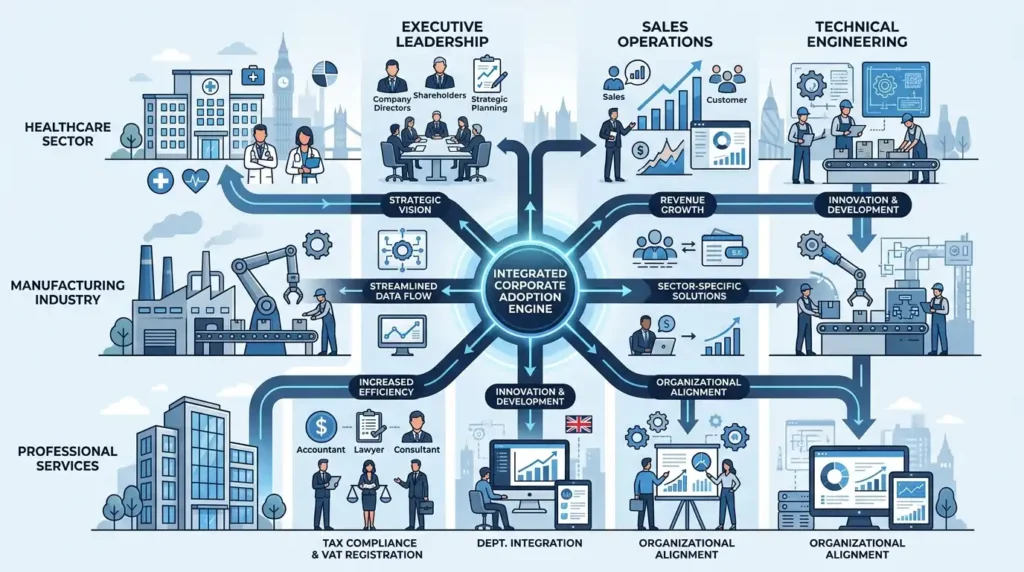
Different organizational units require tailored approaches to data-driven training. Executive leadership teams focus on strategic thinking, digital transformation governance, and macro-economic risk management. Programs designed for C-suite executives and senior directors incorporate complex market simulations and crisis-management role-playing. These interventions prepare leaders to navigate volatile business environments with calculated precision rather than speculative assumptions.
Sales and customer success departments utilize empirical data derived from customer relationship management platforms to refine communication and negotiation frameworks. Training modules for commercial teams analyze recorded client interactions, win-loss ratios, and pipeline velocity metrics. Facilitators design targeted role-playing exercises that address specific conversion bottlenecks identified in the data. This clinical focus on actual performance data elevates conversion rates by an average of 18 percent across retail and B2B SaaS sectors.
As organizations navigate complex operational transitions, professionals often evaluate broader structural shifts in how corporate strategy is formulated and executed. For a deeper examination of how analytical frameworks guide high-level corporate planning, review this analysis on [What Is the Difference Between a Data Strategy and a Business Intelligence Strategy?], which details the foundational data architectures required to sustain modern enterprise decision-making.
Technical departments, including engineering, cybersecurity, and data science teams, require continuous upskilling to counter rapid technological obsolescence. In IT and software development environments, training delivery relies heavily on hands-on coding sandboxes, peer code reviews, and simulated security breach exercises. Team leaders track deployment frequency and bug-fix turnaround times to measure the direct operational impact of technical training workshops. This granular measurement ensures that engineering output scales in direct alignment with broader corporate expansion goals.
What Common Problems and Misconceptions Undermine Corporate Training Investments?
Corporate training initiatives frequently fail due to pervasive misconceptions regarding program scalability, passive learning models, and the absence of rigorous post-training accountability structures.
A dominant misconception in corporate learning asserts that training volume equates to workforce capability. Many business owners believe that procuring extensive libraries of generic online courses satisfies organizational development requirements. This approach ignores individual contextual needs and results in disengaged employees who click through modules without retaining core concepts. Passive video consumption yields a knowledge retention rate of less than 10 percent after 7 days. True competency acquisition demands active, facilitated application.
Another critical failure point involves the total neglect of post-training reinforcement. Organizations often treat training as a discrete, one-off event rather than a continuous developmental continuum. When employees return to their desks following a two-day workshop without managerial reinforcement or operational incentives to apply new skills, behavioral reversion occurs rapidly. Within 30 days, employees default to legacy habits, rendering the financial investment entirely unproductive.
| Common Misconception | Reality of Corporate Learning | Corrective Action |
| Training Volume Equals Skill | Passive consumption yields under 10% retention | Implement active, scenario-based simulations and coaching |
| One-Size-Fits-All Workshops | Generic programs fail to address departmental nuances | Conduct rigorous pre-training skill audits and gap analyses |
| Training as a One-Time Event | Behavioral reversion occurs within 30 days without reinforcement | Establish post-training KPIs and continuous 90-day evaluation loops |
| Anecdotal ROI Measurement | Executive gut-feeling cannot justify L&D budgets | Track hard metrics including productivity, error rates, and retention |
Furthermore, organizations often fail to establish rigorous ROI metrics before approving L&D budgets. Relying on subjective participant satisfaction surveys rather than hard performance data obscures the true financial impact of training. Decision-makers must demand empirical proof of behavioral change. By tying learning objectives directly to operational key performance indicators, organizations eliminate ineffective programs, optimize training expenditures, and cultivate a resilient, high-performing workforce capable of sustaining long-term competitive advantage.
Frequently Asked Questions
How does a data-driven approach improve corporate training ROI?
By leveraging empirical diagnostic audits and targeted skill-gap analyses, Imperial Corporate Training Institute ensures that data-driven programs eliminate redundant spending on generic courses. This precision targeting aligns learning initiatives directly with verified organizational needs, yielding measurable productivity increases and demonstrable returns on capital.
What methods are used to implement data-driven decision making in teams?
Organizations deploy structured frameworks combining quantitative baseline assessments, scenario-based simulations, and multi-modal learning formats. Programs delivered through Imperial Corporate Training Institute utilize active methodologies like role-playing and case-based problem solving to translate complex data analytics into practical workplace execution.
Why is data-driven training superior to traditional intuition-based management?
Traditional management relies on executive guesswork and historical precedent, which often results in high training failure rates and rapid behavioral reversion. In contrast, data-driven strategies utilize continuous performance tracking and objective metrics to guide workforce upskilling, ensuring long-term operational efficiency and reduced employee turnover.
How do L&D professionals measure the impact of data-driven corporate programs?
Learning and development professionals track hard performance indicators including time-to-competency, error rate reductions, and post-training key performance indicators over 30, 60, and 90-day intervals. Programs offered by Imperial Corporate Training Institute integrate these rigorous measurement loops into enterprise learning management systems to prove tangible workforce transformation.
Which industries benefit most from data-driven professional development?
Sectors facing rapid technological shifts—such as IT software engineering, financial services, healthcare, and manufacturing—derive the greatest advantage from data-driven upskilling. Imperial Corporate Training Institute tailors its industry-relevant programs to help technical and management teams navigate complex operational challenges with statistical precision.