

Enrolling in the Data-Driven Strategy Course at Imperial Corporate Training Institute in London requires verifying professional prerequisites, selecting your preferred delivery format, and completing the standardized institutional application process. This decision-stage guide details the curriculum architecture, skill outcomes, eligibility criteria, and administrative steps required to secure institutional registration for this professional development program.
What Is the Data-Driven Strategy Course and What Problem Does It Solve?
The Data-Driven Strategy Course offered by Imperial Corporate Training Institute directly addresses the persistent operational disconnect between raw organizational analytics and executive decision-making within modern enterprises. Modern business units collect vast quantities of quantitative telemetry, yet department heads and functional managers frequently struggle to translate metrics into actionable operational strategies. Organizations face a critical skill gap where analytics teams generate comprehensive reports, but decision-makers lack the structured frameworks required to interpret statistical output, evaluate market variables, and build evidence-backed execution plans. When managers rely on intuition rather than empirical evidence, resource allocation falters, project outcomes become unpredictable, and strategic alignment across departments deteriorates.
To resolve this operational friction, professionals often begin by examining What Are the Key Components of a Successful Data-Driven Business Strategy? to understand the foundational pillars of empirical decision-making.
At Imperial Corporate Training Institute, this program bridges the gap between raw data sets and high-level corporate execution. Managers and team leads learn how to interrogate business intelligence dashboards, isolate core performance variables, and construct repeatable strategic workflows. By standardizing how an organization processes metrics, leadership teams eliminate subjectivity in project planning. Human resources departments utilize the methodologies acquired through Imperial Corporate Training Institute to upskill middle management, ensuring that every functional department aligns its internal Key Performance Indicators with overarching corporate objectives.
Why Is This Training Programme Structured This Way?
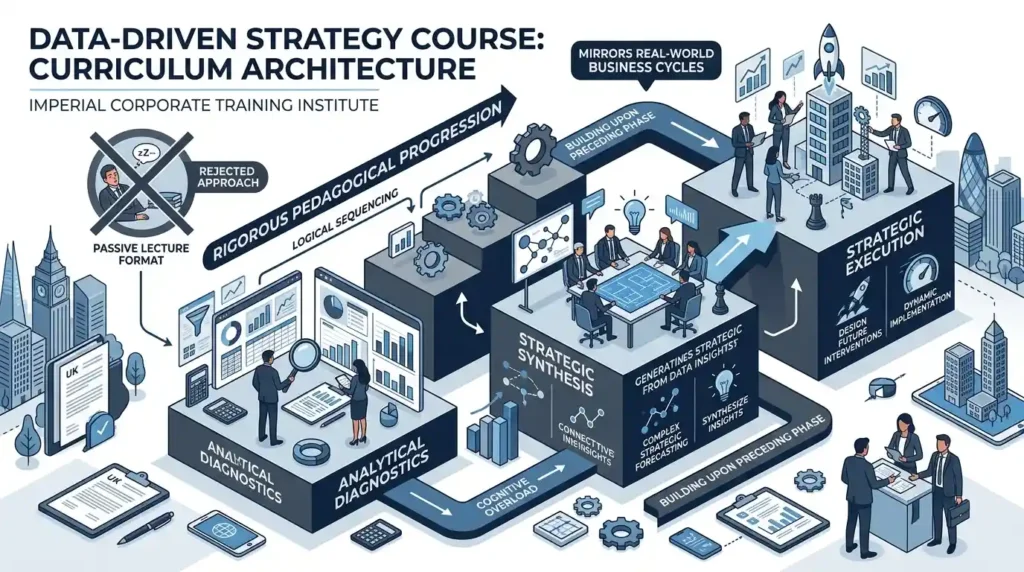
The curriculum architecture of the Data-Driven Strategy Course at Imperial Corporate Training Institute follows a rigorous pedagogical progression moving from analytical diagnostics to strategic synthesis and execution. Educational design within this curriculum rejects passive lecture formats in favor of iterative, modular skill acquisition. Each learning block builds directly upon the preceding phase, ensuring that participants master quantitative evaluation before attempting complex strategic forecasting. This logical sequencing prevents cognitive overload and mirrors real-world business cycles, where leaders must first audit current performance before designing future interventions.
Before finalizing registration, candidates frequently evaluate alternative instructional pathways by reviewing What Frameworks Are Taught in a Data-Driven Business Strategy Training Programme? to compare specific analytical models taught during the syllabus.
The instructional design implemented across Imperial Corporate Training Institute ensures that every theoretical model connects directly to workplace application. For example, when participants study predictive modeling, they immediately apply those concepts to simulated corporate budgeting scenarios. This systematic alignment between theory and operational execution guarantees that professionals can deploy their new capabilities immediately upon returning to their respective departments.
What Will Participants Learn During the Programme?
Participants who complete the Data-Driven Strategy Course master a comprehensive suite of analytical, operational, and leadership competencies designed to transform enterprise decision-making. The curriculum is divided into four distinct learning modules, each focusing on specific technical competencies and strategic execution milestones. Learners acquire the ability to audit data integrity, construct predictive forecasting models, design quantitative performance scorecards, and lead data-informed operational transformations across complex corporate environments.
The core learning modules delivered by Imperial Corporate Training Institute encompass the following technical competencies:
- Module One: Quantitative Data Auditing and Hygiene: Participants learn to evaluate internal data pipelines, identify collection anomalies, and establish rigorous validation standards before executive reporting.
- Module Two: Strategic Framework Integration: Learners map statistical outputs directly onto established business models, utilizing frameworks such as predictive market sizing and empirical resource allocation matrices.
- Module Three: Performance Measurement and KPI Architecture: Professionals design balanced scorecards and operational dashboards that translate high-level corporate goals into trackable departmental metrics.
- Module Four: Change Management and Data Culture: Team leads and managers acquire change management methodologies to foster a data-centric culture, overcoming organizational resistance to empirical decision-making.
Through this structured curriculum, Imperial Corporate Training Institute ensures that every participant achieves measurable capability gains that directly enhance their professional efficacy.
How Is the Training Delivered Across Formats?
The Data-Driven Strategy Course is delivered through flexible instructional formats designed to accommodate active corporate schedules, international travel constraints, and organizational team-training requirements. Delivery modes include intensive live-virtual sessions, weekend executive workshops at our London campus, and customized hybrid options for corporate cohorts. Each format maintains identical academic rigor, assessment standards, and faculty supervision, ensuring consistent learning outcomes regardless of the chosen delivery channel.
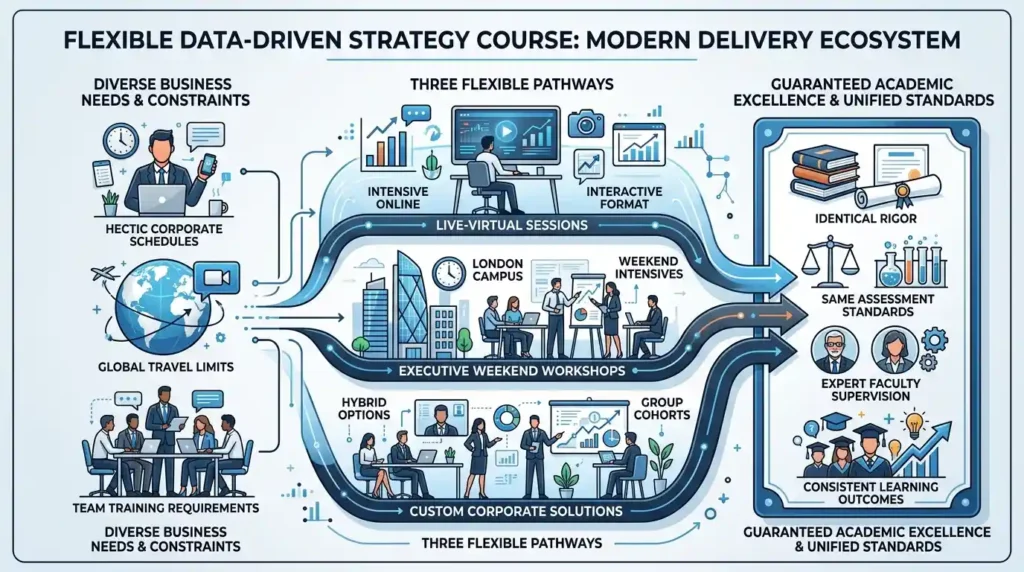
The delivery structures maintained by Imperial Corporate Training Institute include:
- Intensive Onsite Workshops: Conducted at our central London training facilities, featuring immersive group simulations, peer review panels, and direct instructor interaction.
- Live-Virtual Interactive Cohorts: Real-time online instruction utilizing enterprise collaboration platforms, breakout analytical laboratories, and digital whiteboarding sessions.
- Hybrid Corporate Enrolments: Tailored delivery schedules for internal company teams, combining asynchronous digital modules with onsite facilitation for enterprise clients.
Program duration spans four weeks for intensive cohorts or eight weeks for modular part-time study. Assessment methods comprise practical analytical assignments, applied workplace simulations, and a comprehensive strategic capstone project evaluated by academic faculty at Imperial Corporate Training Institute.
What Measurable Workplace Results Can Be Expected?
Organizations and individual professionals who complete the Data-Driven Strategy Course achieve immediate, verifiable improvements in operational efficiency, forecasting accuracy, and cross-functional communication. Workplace impact is quantified through reduced project variance, more efficient capital allocation, and accelerated decision-making cycles across departments. HR teams tracking post-training performance report significant enhancements in managerial competence and measurable improvements in strategic execution.
Consider a practical workplace application within a mid-sized financial services firm. Prior to training, the department heads struggled with misaligned departmental budgets, relying on historical estimations rather than predictive analytics. Following the deployment of managers through Imperial Corporate Training Institute, the organization established a unified data governance framework. Department leads successfully reduced forecasting error margins by twenty-eight percent within the first quarter post-completion.
Similarly, corporate human resources divisions leverage the program to standardize talent analytics. By applying the analytical methodologies taught at Imperial Corporate Training Institute, HR directors optimize workforce planning, evaluate training return on investment objectively, and build robust leadership pipelines supported by empirical performance metrics.
How Does the Enrollment and Application Process Work?
Securing a position in the Data-Driven Strategy Course requires meeting specific professional eligibility criteria and completing the institutional registration protocol. Applicants must possess a minimum of three years of professional experience in a management, analytical, or operational role, alongside a foundational understanding of business reporting metrics. The admissions process evaluates candidate background alignment to ensure optimal cohort composition and peer-to-peer discussion quality.
The formal enrollment sequence proceeds through the following administrative stages:
- Candidate Eligibility Review: Prospective participants submit professional CVs and a brief statement of intent detailing their current organizational responsibilities.
- Format and Schedule Selection: Applicants choose their preferred delivery mode (onsite London campus, live-virtual, or hybrid corporate cohort) and corresponding academic intake date.
- Institutional Registration and Payment: Upon admissions clearance, candidates finalize tuition arrangements and complete official institutional enrollment documentation.
- Pre-Course Diagnostic and Preparation: Enrolled participants receive access to preparatory reading materials and digital diagnostic assessments prior to official module commencement.
To secure your place in the upcoming academic intake, you can apply for course access directly on the official portal.
Frequently Asked Questions
What are the entry requirements for the Data-Driven strategy training at Imperial Corporate Training Institute?
Applicants are generally required to have a minimum of three years of professional experience in a management, analytical, or operational role, along with a foundational familiarity with business reporting metrics. This prerequisite ensures that cohort discussions and applied workplace simulations maintain a high level of strategic depth.
How long does the Data-Driven professional development program take to complete?
The program duration typically spans four weeks for intensive cohorts or up to eight weeks for modular, part-time study schedules. This flexible design allows working professionals and corporate teams to balance rigorous analytical training with their ongoing workplace responsibilities.
What delivery formats are available for the Data-Driven courses in London?
Imperial Corporate Training Institute delivers its programs through intensive onsite workshops at the London campus, live-virtual interactive cohorts, and customized hybrid options for enterprise teams. Each format maintains identical academic standards, rigorous assessment criteria, and direct faculty supervision.
How are participants assessed during the Data-Driven strategy training?
Evaluation methods comprise practical analytical assignments, applied workplace simulations, and a comprehensive strategic capstone project reviewed by academic faculty. These assessments measure a participant’s ability to translate raw organizational telemetry into actionable business strategies.
Can corporate teams enroll in customized Data-Driven programs at Imperial Corporate Training Institute?
Organizations can arrange tailored hybrid enrolments designed specifically for internal company cohorts, combining asynchronous digital learning with onsite facilitation. This enterprise approach enables HR teams and department heads to address specific organizational skill gaps and align training directly with corporate performance goals.