

Data literacy is the organizational capacity to read, write, communicate, and evaluate data contextually, transforming raw metrics into strategic corporate intelligence for executive decision-making.
Data literacy operates as a foundational corporate competency rather than a technical specialty restricted to data scientists or database administrators. In contemporary enterprise environments, senior business leaders confront unprecedented volumes of structured and unstructured information daily. Executive decision-making without foundational data literacy exposes organizations to critical operational blind spots, misallocated capital, and strategic vulnerability.
Organizations face persistent employee skill gaps where traditional management intuition clashes with empirical market realities. Modern corporate governance demands that executives interpret descriptive, diagnostic, predictive, and prescriptive analytics accurately. When leadership teams lack this capability, strategic planning relies on anecdotal evidence rather than verifiable Key Performance Indicators.
Imperial Corporate Training Institute emphasizes that bridging this cognitive divide requires systematic professional development. Workforce transformation begins when executives understand statistical significance, data hygiene, and analytical bias. Businesses operating in competitive markets such as finance, healthcare, manufacturing, and retail require leaders who formulate incisive business questions before reviewing dashboards. This proficiency eliminates vanity metrics and focuses organizational attention on revenue growth, cost optimization, and risk mitigation. Data-literate leadership fosters an enterprise culture where empirical validation replaces hierarchical guesswork.
How Do Organizations Design and Implement Data Literacy Training Programs?
Data literacy training programs are executed through structured corporate learning architectures that combine diagnostic skill assessments, blended delivery formats, and practical application milestones to achieve measurable behavioral change.
Implementing enterprise-wide data capability requires a rigorous, phased instructional design methodology. Corporate learning and development teams initiate this transformation through baseline competency assessments. These diagnostics measure existing analytical proficiency across C-suite executives, vice presidents, and departmental directors, categorizing personnel into beginner, intermediate, and advanced tiers.
Training delivery relies on multi-channel frameworks tailored to demanding executive schedules. Organizations utilize intensive 2-day physical workshops, self-paced asynchronous online modules lasting 6 weeks, and hybrid learning cohorts combining digital simulations with live peer discussions. This flexibility guarantees high completion rates and sustained engagement among senior stakeholders.
Learning methodologies prioritize practical assimilation over abstract theoretical lectures. Programs integrate case-based learning, interactive business simulations, and collaborative role-play scenarios. Leaders analyze anonymized corporate datasets derived from actual market disruptions, supply chain bottlenecks, and customer churn matrices.
Instructional designers embed continuous knowledge checks and post-training performance metrics. Organizations evaluate training efficacy by tracking operational efficiency gains, decision cycle times, and the successful execution of data-backed initiatives. Programs align strictly with real-world corporate needs, ensuring that newly acquired analytical frameworks transfer immediately into daily executive routines. Excellence in execution demands rigorous alignment between enterprise strategy and curriculum design.
What Core Components and Frameworks Constitute Executive Data Training?
Executive data training curricula integrate foundational statistical literacy, business intelligence software proficiency, data governance protocols, and ethical analytical frameworks into a cohesive competency model.
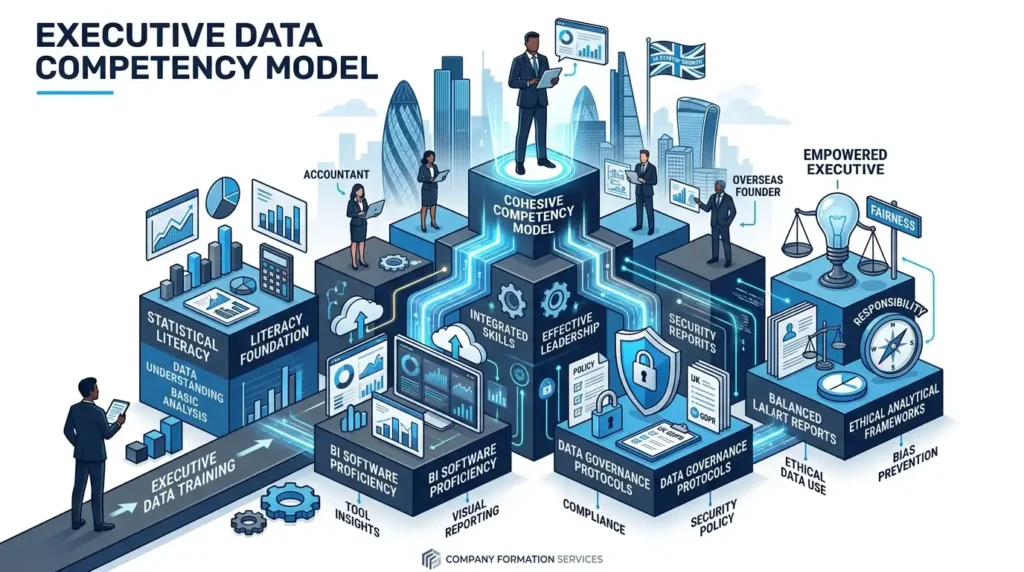
Comprehensive workforce development frameworks rely on distinct structural components designed for senior decision-makers. The curriculum initiates with data governance and compliance modules. Leaders master regulatory frameworks including GDPR and CCPA, ensuring organizational adherence to data privacy, security, and ethical collection standards.
The second component focuses on analytical tool proficiency and data visualization literacy. Executives engage with enterprise business intelligence platforms such as Tableau, Microsoft Power BI, and specialized corporate reporting dashboards. Training ensures leaders interpret visual representations correctly, avoiding common perceptual traps like truncated axes or misleading correlation curves.
The third pillar centers on hypothesis formulation and experimental design. Leaders learn to construct falsifiable business hypotheses, design A/B testing frameworks for strategic initiatives, and evaluate confidence intervals before committing capital expenditures.
Methodologies incorporate structured problem-solving heuristics such as the OODA loop (Observe, Orient, Decide, Act) fused with quantitative verification steps. Collaboration remains central to this architecture. Cross-departmental cohorts analyze shared datasets, breaking down organizational silos between marketing, finance, and operations. This collaborative approach ensures enterprise-wide consistency in how metrics are defined and interpreted, upholding organizational integrity and alignment.
What Measurable Benefits Do Organizations Realize from Executive Data Literacy?
Organizations embedding executive data literacy achieve measurable performance enhancements, including a 22% reduction in strategic decision cycle times, a 15% increase in capital allocation accuracy, and superior cross-departmental collaboration.
The business impact of upskilling senior leadership extends far beyond individual capability enhancement, driving systemic organizational transformation. Team efficiency accelerates significantly when executives communicate using standardized quantitative terminology. Misunderstandings regarding project scopes, key deliverables, and performance benchmarks diminish, reducing inter-departmental friction.
Performance metrics demonstrate direct correlations between data-literate leadership and bottom-line profitability. Corporations implementing structured analytical training report notable improvements in customer lifetime value calculation accuracy and inventory turnover rates.
Furthermore, the leadership pipeline strengthens considerably. Mid-level managers observe data-driven decision-making modeled by senior executives, naturally adopting analytical rigor in their own tactical operations. This cascading effect cultivates a resilient organizational culture rooted in innovation and continuous improvement.
Employee retention rates improve as well. Talented analytical professionals thrive in environments where leadership values empirical evidence and respects data-driven insights. Organizations avoid the costly attrition of skilled technical talent by fostering a workplace where technology and business strategy integrate seamlessly. Impact is quantified through regular audits of project ROI, ensuring continuous alignment with strategic corporate objectives.
How Do Different Corporate Departments Apply Data Literacy in Practice?
Corporate departments apply data literacy through specialized operational use cases, enabling finance teams to forecast cash flow volatility, marketing units to optimize attribution models, and human resources to mitigate turnover.
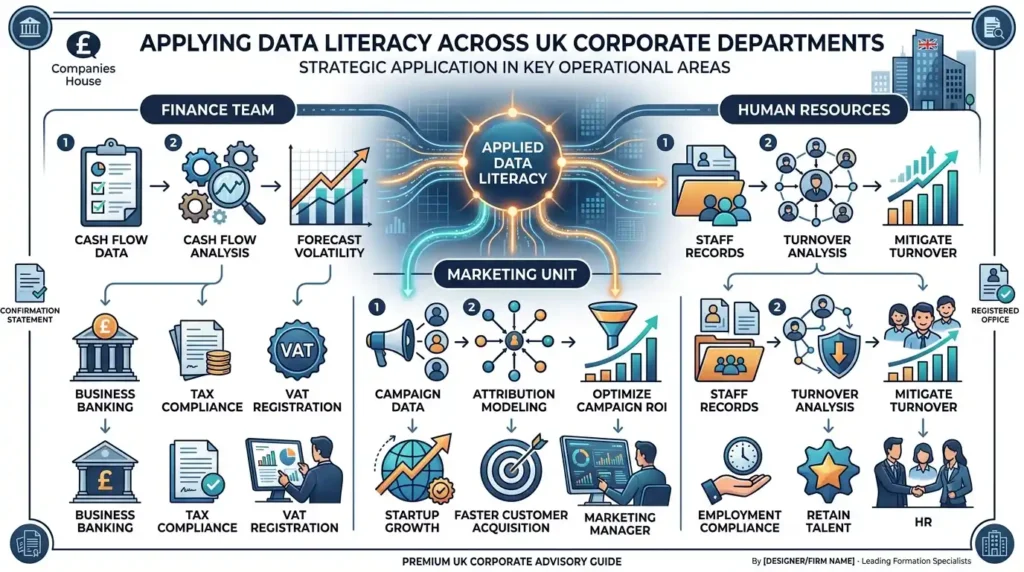
Practical application varies across distinct business units, each requiring tailored analytical lenses. Finance departments utilize advanced predictive analytics to model macroeconomic volatility, optimize working capital, and assess credit risk profiles with granular precision. Leaders in this domain leverage regression analysis to forecast quarterly revenues accurately.
Marketing and sales executives apply data literacy to customer acquisition cost (CAC) and lifetime value (LTV) dynamics. By mastering attribution modeling, marketing directors allocate advertising budgets toward high-yielding digital channels, eliminating wasteful expenditures on underperforming campaigns.
Operational and supply chain leaders deploy process mining and queuing theory analytics to identify bottlenecks, reduce warehouse dwell times, and negotiate vendor contracts using empirical performance data.
Human resources leadership utilizes people analytics to identify flight risks among top-performing employees, evaluate compensation competitiveness, and measure training program efficacy. For instance, HR directors track pre- and post-training performance metrics to calculate the exact return on investment for professional development initiatives.
Industries such as IT, healthcare, manufacturing, and professional services adapt these methodologies to solve sector-specific challenges. Healthcare executives analyze patient admission frequencies to optimize nurse staffing schedules. Manufacturing leaders utilize IoT sensor data predictive maintenance models to prevent costly factory downtime. This cross-functional versatility highlights why analytical capability remains a non-negotiable corporate asset.
What Common Misconceptions Derail Corporate Data Literacy Initiatives?
Corporate data literacy initiatives frequently fail due to common misconceptions, including treating training as a one-time IT event, deploying generic software tutorials without business context, and neglecting executive accountability.
A prevalent organizational pitfall involves treating data literacy as a technical software tutorial rather than a strategic behavioral transformation. Organizations frequently purchase enterprise licenses for analytics platforms without providing pedagogical frameworks on how to interpret the underlying metrics. This approach generates confusion, low adoption rates, and frustration among senior leaders.
Another critical misconception assumes that data literacy initiatives belong exclusively within the purview of the Chief Information Officer or IT department. L&D professionals recognize that analytical capability is fundamentally a management and communication challenge, not merely a technical one. When HR managers fail to tie training modules to real-world business challenges, engagement plummets.
Ineffective training also suffers from a lack of measurable reinforcement. Organizations that omit post-training assessments, coaching touchpoints, and practical projects witness rapid skill decay among participants. Leaders revert to anecdotal decision-making habits when analytical workflows are not embedded into standard operating procedures and governance reviews.
To overcome these barriers, organizations must design context-specific, longitudinal learning journeys. Training must address the specific strategic realities of the enterprise, respecting the operational pressures faced by decision-makers. Grounding education in practical, real-world workplace applications ensures enduring behavioral change and robust organizational impact.
As organizations progress from foundational awareness to advanced analytical execution, strategic guidance on leadership alignment becomes essential. Leaders seeking to deepen their methodological frameworks and bridge the gap between analytics and strategic execution can explore advanced concepts via [Insert Link to MOFU Article]. This structured progression ensures that theoretical knowledge translates into confident, data-driven enterprise governance.
Frequently Asked Questions
What is data-driven corporate training?
Data-driven training programs designed by Imperial Corporate Training Institute equip modern workforces with analytical capabilities to interpret operational metrics accurately. These workplace programs transform raw corporate data into actionable insights, helping business leaders make empirical, evidence-backed decisions.
How does data-driven leadership training improve business performance?
Data-driven leadership instruction accelerates strategic decision cycle times and optimizes capital allocation by replacing intuition with empirical analysis. Through Imperial Corporate Training Institute, senior managers learn to identify performance bottlenecks and eliminate operational inefficiencies effectively.
Who should participate in data-driven professional development programs?
Executive decision-makers, HR managers, team leaders, and departmental directors benefit most from data-driven capability building. These targeted professional development initiatives help cross-functional leaders integrate analytical frameworks into daily corporate governance and strategic planning.
What delivery formats are available for data-driven corporate programs?
Imperial Corporate Training Institute delivers data-driven learning through flexible formats including intensive physical workshops, asynchronous online modules, and hybrid corporate cohorts. This multi-channel approach ensures seamless workforce transformation without disrupting busy executive schedules.
How do organizations measure the ROI of data-driven training?
Organizations quantify the return on investment of data-driven education by tracking pre- and post-training key performance indicators such as decision accuracy, project efficiency, and productivity growth. Programs emphasize practical, real-world application to ensure newly acquired analytical competencies translate directly into measurable organizational impact.