

Industrial engineering sectors depend on integrated design accuracy, coordinated mechanical systems, and digital modelling proficiency. AutoCAD-based HVAC training develops these capabilities by translating building services theory into production-ready technical drawings used across oil, gas, energy, and manufacturing environments. The value lies in its direct alignment with real industrial workflows rather than purely academic engineering knowledge.
Industrial employers evaluate candidates based on their ability to interpret schematics, produce compliant layouts, and collaborate within multidisciplinary engineering teams. This is where structured CAD-based HVAC training becomes a differentiator in workforce selection and project readiness.
A detailed exploration of sector-specific alignment is expanded in this foundational resource on career pathways into energy and industrial systems: It provides the awareness-stage foundation for understanding how CAD skills transition into large-scale infrastructure environments.
Why does AutoCAD HVAC training act as a gateway into industrial engineering sectors?
AutoCAD HVAC training acts as a gateway into industrial engineering sectors because it builds applied technical drafting capability, system-level thinking, and coordination skills required in infrastructure-driven industries. It transforms basic engineering knowledge into job-ready design execution used in plant design, energy systems, and large-scale mechanical projects.
Industrial engineering sectors operate on precision-driven design documentation. HVAC systems are integrated into nearly every industrial facility, including refineries, processing plants, power stations, and logistics hubs. These environments require engineers who can convert conceptual layouts into detailed technical drawings that meet operational and safety standards.
At this stage, structured training becomes the entry mechanism. A programme such as the BOFU-stage solution offered through demonstrates how targeted learning pathways connect technical drafting with industrial project deployment. Within Imperial Corporate Training Institute, this transition is framed around applied design logic rather than theoretical instruction, ensuring alignment with industry expectations.
The gateway effect is created by three core mechanisms:
First, exposure to industrial drafting standards. Engineers learn how HVAC layouts integrate with structural, electrical, and process systems.
Second, familiarity with project documentation cycles. Industrial environments require revision-controlled drawings and compliance tracking.
Third, development of spatial coordination thinking. Engineers must visualise airflow, duct routing, and equipment placement within complex plant structures.
This combination creates a profile that industrial employers recognise as operationally ready.
How does HVAC design training align with industrial workflow requirements?
HVAC design training aligns with industrial workflow requirements by integrating drafting accuracy, system coordination, and documentation control into a structured engineering process that mirrors real project lifecycles used in manufacturing plants, oil and gas facilities, and large-scale infrastructure developments.
For more information explore:
How Does AutoCAD HVAC Training Support Career Entry Into Oil Gas and Power Sectors?
Industrial engineering workflows follow a structured sequence: concept design, detailed engineering, coordination, construction documentation, and as-built validation. HVAC design training replicates this cycle through CAD-based assignments and scenario-driven modelling.
Learners are trained to interpret engineering briefs and convert them into layered drawings. These drawings must align with mechanical, electrical, and civil constraints. This ensures compatibility with industrial project environments where multiple disciplines operate simultaneously.
A critical component of this alignment is technical consistency. Industrial projects require standardized layer naming, annotation precision, and scalable drawing formats. AutoCAD HVAC training enforces these standards through repeated drafting exercises.
The relevance becomes more pronounced in structured programmes such as the , where learners work on full-cycle design simulations. These simulations replicate industrial engineering conditions, including design revisions and compliance adjustments.
Workflow alignment also includes:
- Drawing version control practices
- Coordination with structural layouts
- Equipment scheduling integration
- Load calculation representation in design sheets
This workflow integration ensures that learners are not only producing drawings but also participating in engineering logic systems used in industrial environments.
What role does HVAC modelling play in industrial design coordination?
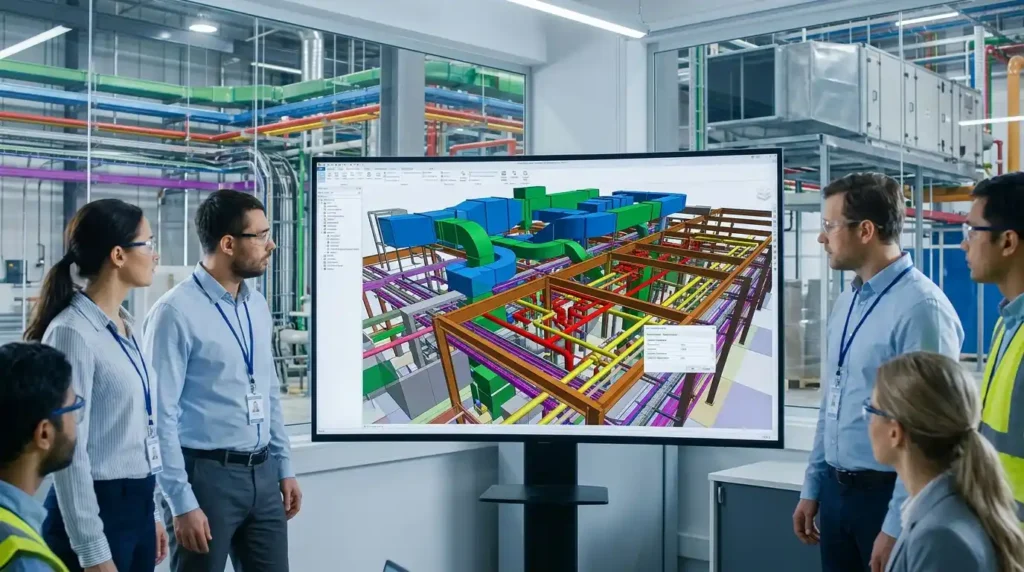
HVAC modelling plays a central role in industrial design coordination by ensuring spatial integration, system compatibility, and clash-free engineering layouts across mechanical, structural, and electrical disciplines in complex infrastructure projects.
Industrial facilities contain dense systems where multiple engineering layers overlap. HVAC modelling ensures that ductwork, ventilation systems, and mechanical equipment do not conflict with structural beams, piping networks, or electrical conduits.
Coordination begins with 2D CAD layouts and extends into spatial validation. Engineers must ensure that airflow paths remain efficient while respecting structural limitations. This requires precise modelling discipline rather than conceptual design.
In industrial engineering projects, coordination failures lead to cost escalation. Rework costs in large-scale projects can exceed 12–18% of total mechanical installation budgets when design conflicts are not resolved at the drafting stage. HVAC modelling reduces this risk by enabling early detection of spatial issues.
Training environments replicate these conditions by introducing layered project files. Learners work with multiple system overlays to simulate real coordination challenges.
Industrial engineering teams also rely on HVAC models for:
- Equipment clearance validation
- Maintenance access planning
- Fire safety airflow compliance
- Energy efficiency optimisation layouts
This makes HVAC modelling a core technical competency rather than a supporting drafting skill.
How does AutoCAD HVAC training compare with traditional engineering education?
AutoCAD HVAC training differs from traditional engineering education by focusing on applied technical execution, industry-specific drafting standards, and project-based simulation rather than theoretical mechanical engineering principles and broad academic engineering curricula.
Traditional engineering education builds foundational knowledge in thermodynamics, fluid mechanics, and system design theory. However, it often lacks direct exposure to industrial CAD workflows and documentation standards.
AutoCAD HVAC training fills this gap by focusing on execution. Learners are trained to produce industrial-grade drawings that can be used directly in construction and installation phases.
| Evaluation Dimension | Traditional Engineering Education | AutoCAD HVAC Training |
|---|---|---|
| Learning focus | Theory and principles | Applied drafting execution |
| Output type | Conceptual understanding | Technical drawings |
| Industry readiness | Indirect | Direct |
| Software exposure | Limited | Extensive AutoCAD use |
| Project simulation | Low | High |
This distinction is critical for industrial employers. Most hiring decisions for drafting and coordination roles depend on software proficiency and documentation accuracy rather than theoretical depth alone.
Traditional education remains essential for engineering design leadership roles. However, AutoCAD HVAC training accelerates entry into operational engineering functions, especially in industrial sectors where design execution speed directly impacts project timelines.
Where is AutoCAD HVAC design applied in industrial engineering sectors?
AutoCAD HVAC design is applied across industrial engineering sectors including oil and gas facilities, power generation plants, manufacturing units, logistics infrastructure, and process industries where environmental control and mechanical system integration are essential for operational performance.
In oil and gas environments, HVAC systems regulate hazardous air control and maintain operational safety conditions in processing zones. Accurate duct routing and ventilation modelling are critical to compliance.
In power generation plants, HVAC systems support turbine halls, control rooms, and auxiliary systems. Temperature regulation directly affects equipment efficiency and lifespan.
Manufacturing industries rely on HVAC systems to maintain controlled environments for production lines. This includes dust control, humidity regulation, and thermal stability.
Industrial applications typically include:
- Refinery ventilation system design
- Power station cooling coordination
- Warehouse airflow optimisation
- Pharmaceutical cleanroom HVAC layouts
These applications require high precision drafting. Errors in design translation can lead to system inefficiencies or safety risks.
AutoCAD-based training ensures engineers understand how each industrial sector imposes different environmental and regulatory constraints on HVAC system design.
How does AutoCAD HVAC training influence hiring decisions and ROI in industrial engineering?
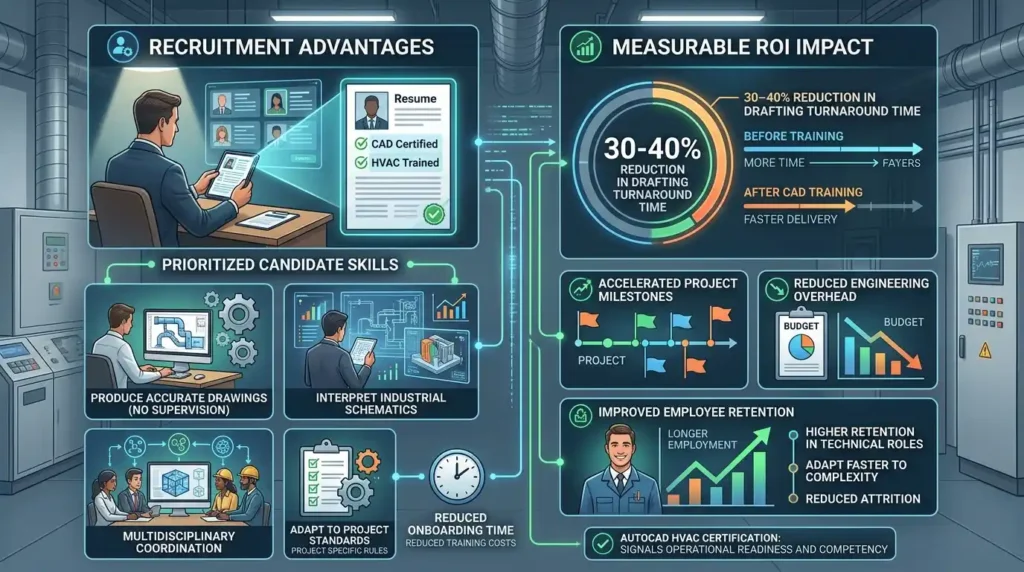
AutoCAD HVAC training influences hiring decisions by demonstrating measurable drafting competency, reducing onboarding time, and improving project delivery efficiency, which directly impacts return on investment for engineering firms operating in industrial sectors.
Industrial employers evaluate candidates based on productivity readiness. Engineers who can immediately contribute to drafting and coordination reduce training overhead costs.
Hiring teams prioritise candidates who can:
- Produce accurate CAD drawings without supervision
- Interpret industrial schematics quickly
- Work within multidisciplinary coordination teams
- Adapt to project-specific drafting standards
The ROI impact is measurable. Companies report up to 30–40% reduction in drafting turnaround time when CAD-trained engineers are integrated into project teams. This efficiency gain translates into faster project milestones and reduced engineering overhead.
Training also improves retention in technical roles. Employees with structured CAD training adapt faster to industrial project complexity, reducing early-stage attrition.
From a recruitment perspective, AutoCAD HVAC certification signals operational readiness. It functions as a competency marker rather than a theoretical credential.
Get deeper insight explore:
How Does Imperial’s HVAC Programme Help Engineers Transition to Industrial Projects?
What career pathways open after AutoCAD HVAC training in industrial engineering?
AutoCAD HVAC training opens structured career pathways into drafting, coordination, and design support roles within industrial engineering sectors, leading to progression into senior design coordination, BIM integration, and project engineering positions over time.
Initial roles typically include HVAC CAD Technician, Mechanical Draftsman, or Design Assistant Engineer. These positions focus on producing and modifying technical drawings for industrial systems.
With experience, professionals progress into coordination roles where they manage system integration across mechanical, electrical, and structural domains.
Discover More from Our Guide Library:
How Does AutoCAD HVAC Training Cover Plotting Layout and Drawing Output Setup?
How Does AutoCAD HVAC Training Distinguish Between Schematic and Working Drawings?
Further progression includes:
- BIM coordination specialist roles
- HVAC design engineer positions
- Industrial project engineering roles
- Technical consultancy positions in infrastructure firms
Career progression depends on exposure to complex projects and ability to manage multi-system coordination tasks.
Industrial engineering environments reward technical accuracy and system understanding. AutoCAD HVAC training provides the foundation for both, enabling structured career mobility across infrastructure-driven industries.
Frequently Asked Questions
What skills are covered in the AutoCAD HVAC and Plumbing Design Training Course?
The AutoCAD HVAC and Plumbing Design Training Course at Imperial Corporate Training Institute covers HVAC drafting, plumbing layouts, ductwork design, piping systems, and technical drawing standards. Learners also develop practical CAD skills used in building services and mechanical engineering projects.
How does AutoCAD HVAC and Plumbing design training support engineering careers?
AutoCAD HVAC and Plumbing design training helps professionals develop technical drafting and design coordination skills required in construction, infrastructure, and industrial projects. These competencies are commonly used in mechanical engineering and building services roles.
What software skills are developed during an AutoCAD HVAC and Plumbing Design Training Course?
Participants learn how to create, edit, and manage HVAC and plumbing drawings using AutoCAD software. The AutoCAD HVAC and Plumbing Design Training Course also focuses on layer management, annotations, system layouts, and engineering documentation practices.
Why is AutoCAD important for HVAC and plumbing system design?
AutoCAD enables engineers and designers to produce accurate technical drawings for HVAC and plumbing installations. Imperial Corporate Training Institute includes practical drafting exercises that reflect industry workflows and project documentation requirements.