

HVAC projects depend on accurate technical drawings to communicate design intent, installation requirements, and construction specifications. Sections and construction details play a critical role because they show information that standard floor plans cannot display. In corporate engineering environments, these drawing elements reduce installation errors, improve coordination between disciplines, and support compliance with project standards.
For organisations managing building services projects, the ability to create and interpret HVAC sections and details directly affects project delivery performance. Engineering teams, design consultants, facility management departments, and construction contractors use these drawings to improve communication, reduce rework, and maintain quality control throughout the project lifecycle. Understanding how AutoCAD handles sections and details is therefore an essential competency within workforce development programmes focused on technical design excellence.
Why are sections and details important in HVAC system drawings?
Sections and details reveal hidden building service information, improve design accuracy, support construction coordination, reduce installation errors, and provide technical clarity for engineers, contractors, and project stakeholders throughout the entire building development process.
HVAC floor plans show equipment locations and duct routing across a building level. They do not provide sufficient information about vertical clearances, ceiling spaces, equipment mounting requirements, or service coordination.
A section drawing represents a cut through a building or system. It displays components such as ductwork, chilled water pipes, cable trays, ceilings, structural beams, and mechanical equipment in their actual vertical positions.
Construction details provide enlarged views of specific elements. Examples include duct penetrations, equipment supports, diffuser installations, insulation assemblies, and pipe connection arrangements.
From a business perspective, these drawings reduce project uncertainty. Organisations use them to minimise design conflicts, improve installation productivity, and support quality assurance processes. Studies across construction projects show that design coordination issues account for significant percentages of project delays and rework costs. Detailed section drawings help eliminate many of these issues before construction begins.
What does AutoCAD use to create HVAC sections and details?
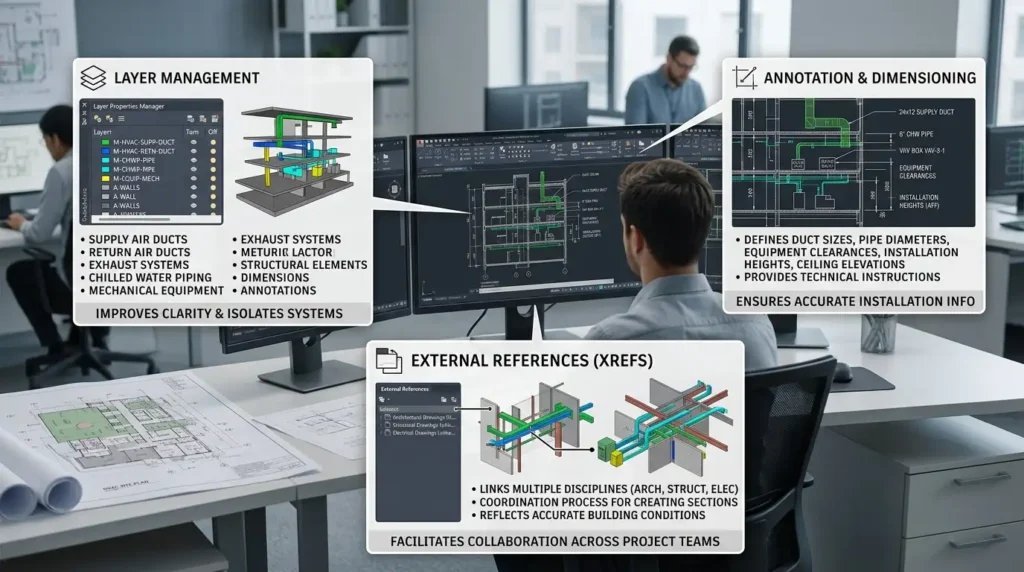
AutoCAD uses drawing geometry, layers, annotation tools, reference files, viewports, dimensioning systems, and drafting standards to produce precise HVAC sections and construction details that communicate technical information consistently across project teams.
AutoCAD provides a structured drafting environment where HVAC designers create both two-dimensional and three-dimensional representations of building services systems.
Layer Management
Layers organise HVAC components into categories.
Common layer groups include:
- Supply air ducts
- Return air ducts
- Exhaust systems
- Chilled water piping
- Mechanical equipment
- Structural elements
- Dimensions
- Annotations
Layer management improves drawing clarity and allows designers to isolate specific systems when producing section views.
Annotation and Dimensioning
Annotations provide technical instructions.
Dimensions define:
- Duct sizes
- Pipe diameters
- Equipment clearances
- Installation heights
- Ceiling elevations
These elements ensure that construction teams receive accurate installation information.
External References (Xrefs)
Large projects involve multiple disciplines.
Architectural, structural, electrical, and mechanical drawings are commonly linked through external references. This coordination process allows HVAC designers to create sections that accurately reflect building conditions.
How does the section creation process work in corporate design environments?
Corporate HVAC teams follow a structured workflow that includes model review, coordination checks, section identification, drafting, annotation, quality control, and document approval before construction documentation is released.
Engineering organisations typically implement standard operating procedures to ensure consistency across projects.
Step 1: Review Design Information
The design team evaluates:
- Architectural layouts
- Structural drawings
- Mechanical plans
- Equipment schedules
This review identifies areas requiring section views.
Step 2: Select Critical Locations
Sections are placed where additional information is necessary.
Examples include:
- Plant rooms
- Mechanical risers
- Equipment rooms
- Ceiling voids
- Service corridors
These locations often contain multiple building systems requiring coordination.
Step 3: Draft the Section
Designers create the cut view by projecting relevant building elements and HVAC components.
The section displays:
- Floor levels
- Ceiling heights
- Duct elevations
- Pipe routing
- Equipment positions
This information provides installation guidance.
Step 4: Add Construction Information
Dimensions, notes, symbols, and specifications are inserted.
These additions transform the section from a visual representation into a construction document.
Step 5: Conduct Quality Assurance
Many organisations implement drawing review procedures.
Reviewers check:
- Accuracy
- Compliance
- Coordination
- Completeness
This stage reduces errors before project release.
What construction details are commonly produced for HVAC systems?

HVAC construction details focus on installation methods, equipment interfaces, support systems, penetrations, insulation assemblies, and maintenance access requirements to ensure consistent construction quality and regulatory compliance.
Construction details address specific technical requirements.
Equipment Installation Details
These drawings illustrate:
- Air handling unit installations
- Fan mounting arrangements
- Chiller connections
- Pump assemblies
They clarify how equipment integrates with the building.
Ductwork Details
Duct details typically include:
- Joint configurations
- Hanger systems
- Fire damper installations
- Flexible connections
These drawings support standardised installation practices.
Pipework Details
Pipe details often show:
- Valve arrangements
- Expansion provisions
- Support spacing
- Insulation requirements
They help maintain consistency across projects.
Penetration Details
Building services frequently pass through walls and floors.
Penetration details define:
- Fire stopping requirements
- Sealing methods
- Structural clearances
- Compliance standards
These details support safety and regulatory objectives.
How are sections and details taught in professional HVAC training programmes?
Professional HVAC training programmes combine technical theory, practical drafting exercises, project simulations, assessments, and workplace-focused applications to develop competency in creating and interpreting sections and construction details.
Technical training addresses both software operation and engineering understanding.
Practical Workshops
Participants complete guided drafting exercises.
Typical activities include:
- Creating HVAC sections
- Developing detail drawings
- Annotating technical documents
- Applying industry standards
Hands-on learning improves skill retention.
Project-Based Learning
Training frequently incorporates realistic project scenarios.
Learners work with:
- Commercial buildings
- Hospitals
- Manufacturing facilities
- Educational institutions
These examples reflect actual workplace challenges.
Assessment Methods
Competency measurement often includes:
- Drawing assignments
- Technical reviews
- Practical tests
- Project submissions
Assessment ensures that learning outcomes align with workplace requirements.
Blended Learning Delivery
Corporate learning departments increasingly adopt blended formats.
Common delivery models include:
- Instructor-led workshops
- Virtual classrooms
- Self-paced online modules
- Practical laboratory sessions
This approach accommodates workforce scheduling requirements.
For organisations evaluating implementation approaches, readers often transition from understanding the concept to examining the practical learning process.
A detailed explanation can be provided through:
How Are Sections and Construction Details Produced in AutoCAD HVAC Training?
To get more insight, enrol in:
AutoCAD HVAC and Plumbing Design Training Course
What skills are required to produce accurate HVAC sections and details?
Effective HVAC documentation requires technical drafting skills, spatial awareness, engineering knowledge, coordination capability, standards compliance understanding, and quality control practices that support project delivery objectives.
Technical competence extends beyond software proficiency.
Spatial Interpretation
Designers must visualise three-dimensional building systems from two-dimensional drawings.
This capability improves coordination and reduces design conflicts.
Engineering Fundamentals
Professionals require knowledge of:
- Air distribution systems
- Hydronic systems
- Ventilation principles
- Equipment operation
Understanding system behaviour improves drawing accuracy.
Standards Application
Projects follow industry standards and organisational requirements.
Examples include:
- Drawing conventions
- Symbol libraries
- Layer standards
- Documentation protocols
Consistency improves communication across teams.
Quality Review Skills
Technical staff must identify:
- Missing dimensions
- Coordination conflicts
- Incorrect elevations
- Documentation gaps
These review capabilities contribute to project quality performance.
How do organisations implement HVAC drafting competency development?
Organisations implement HVAC drafting development through skills assessments, structured learning pathways, competency frameworks, practical projects, mentoring programmes, and performance measurement systems aligned with business objectives.
Workforce development begins with capability evaluation.
Skills Gap Analysis
Managers assess existing competencies against project requirements.
Typical assessment areas include:
- AutoCAD proficiency
- HVAC engineering knowledge
- Documentation standards
- Coordination capability
The results guide learning priorities.
Structured Learning Pathways
Many organisations establish progressive development stages.
These stages often include:
- Fundamental drafting skills
- HVAC documentation principles
- Section development techniques
- Construction detailing
- Project coordination
This structure supports consistent capability growth.
Mentoring and Knowledge Transfer
Experienced professionals guide less experienced team members.
Knowledge transfer improves workforce continuity and strengthens technical standards.
Performance Measurement
Learning effectiveness is measured through operational outcomes.
Common KPIs include:
- Drawing accuracy rates
- Design review findings
- Rework reduction
- Project delivery efficiency
- Documentation quality scores
These metrics connect training investment with business performance.
What business outcomes result from accurate HVAC sections and details?
Accurate HVAC sections and details improve project coordination, reduce construction rework, strengthen compliance, increase productivity, enhance stakeholder communication, and support predictable project delivery across complex engineering environments.
Technical documentation directly influences project success.
Reduced Rework
Construction rework consumes significant project resources.
Clear documentation reduces ambiguity and installation errors.
Improved Coordination
Sections reveal interactions between systems.
This visibility supports collaboration among:
- Mechanical teams
- Structural engineers
- Electrical designers
- Construction contractors
Better coordination improves project execution.
Enhanced Productivity
Well-prepared drawings reduce clarification requests.
Teams spend more time performing productive work and less time resolving documentation issues.
Stronger Compliance
Detailed documentation supports adherence to:
- Building regulations
- Safety requirements
- Client specifications
- Internal quality standards
Compliance contributes to organisational credibility and risk management.
Consistent Project Delivery
Standardised documentation practices improve predictability.
Organisations benefit through:
- Reduced project delays
- Improved resource utilisation
- Better stakeholder communication
- Higher documentation quality
These outcomes align with corporate objectives focused on operational excellence and measurable business impact.
What misconceptions affect HVAC section and detail development?
Many organisations incorrectly assume that floor plans provide sufficient information, software expertise alone guarantees quality, or generic training produces competency without practical application and performance measurement.
One common misconception is that section drawings are optional documentation.
In reality, complex projects depend on sections to communicate installation requirements effectively.
Discover More from Our Guide Library:
What Is the Role of the HVAC Designer in a Multi-Discipline Design Team?
How Are AutoCAD HVAC Drawings Issued and Revised During Construction Projects?
Another misconception is that software proficiency equals engineering competence. AutoCAD is a drafting platform. Successful documentation requires engineering understanding, coordination knowledge, and adherence to standards.
Some organisations also rely on generic training programmes that lack workplace relevance. Effective technical learning combines software skills, project-based practice, quality reviews, and measurable performance outcomes.
A final misconception involves training evaluation. Completion rates do not measure workforce capability. Organisations achieve stronger results when learning effectiveness is linked to operational KPIs such as drawing accuracy, reduced rework, and project efficiency.
Frequently Asked Questions
Who should attend an AutoCAD HVAC and Plumbing Design Training Course?
This course is suitable for HVAC engineers, mechanical designers, CAD technicians, project engineers, and building services professionals. Imperial Corporate Training Institute structures the training to support both beginners and experienced professionals involved in HVAC and plumbing design projects.
Why are AutoCAD skills important for HVAC and plumbing design?
AutoCAD enables professionals to produce precise HVAC and plumbing drawings, improve design coordination, and reduce construction errors. Accurate drafting supports compliance, project efficiency, and effective communication between engineering and construction teams.
How does AutoCAD help create HVAC and plumbing system drawings?
AutoCAD provides tools for drafting ductwork layouts, piping networks, equipment schedules, sections, and construction details. The AutoCAD HVAC and Plumbing Design Training Course teaches how to organise drawings, apply standards, and develop professional documentation.
What are the benefits of learning HVAC and plumbing design with AutoCAD?
Learning AutoCAD for HVAC and plumbing design improves technical drafting accuracy, design coordination, and project documentation quality. Imperial Corporate Training Institute focuses on practical workflows that reflect real-world engineering and building services requirements.