

Targeted AutoCAD HVAC training standardises drawing practices, enforces CAD layer and annotation discipline, and embeds checklist-based QA that reduces revision cycles and non-compliance risks during tender review. The result is fewer IFC reissues and lower bid-cost exposure.
A structured training programme teaches engineers firm standards for layers, blocks, annotation styles, and drawing templates that match contract deliverables. That standardisation stops common drafting mistakes: missing services coordination, inconsistent dimensions, and incorrect equipment schedules. Training also emphasises use of dynamic blocks, attribute data and object-based annotation so drawing revisions update consistently across sheets. These skills reduce “tender queries” that arise when reviewers find mismatches between plans, sections and schedules.
For readers who need a primer on how engineers use AutoCAD during early project stages, refer to the related overview:
How Do HVAC Engineers Use AutoCAD for Design-and-Build Project Submissions? for awareness-level context. This explains baseline workflows that training builds on.
Why this matters to HR and line managers: each tender query or drawing reissue creates administrative cost and delays procurement cycles. Typical organisations that adopt disciplined CAD standards report 20–40% fewer drawing revisions in tender phases. That translates to measurable reductions in bid labour hours and lower indirect costs during evaluation.
How does AutoCAD HVAC training teach engineers to meet tender specification and contractual deliverables?
AutoCAD HVAC training integrates specification parsing, deliverable mapping, and template-based output generation to ensure drawings align with tender requirements. The course converts contract clauses into drawing checklists and output rules.
Course modules map common tender deliverables, general arrangement plans, equipment schedules, riser diagrams, and detail sheets onto AutoCAD workflows. Trainers present contract excerpts (tender drawings, BOQs, and specification sections) and then show direct implementation: which layers carry which information, how to embed schedule data, and how to export PDF and DWG packages that match submission protocols. Practical exercises require trainees to produce a full tender package from a sample specification, including a cover schedule and transmittal checklist.
Training defines measurable KPIs for tender readiness: sheet completeness (100%), cross-referenced equipment tags (100%), dimensional compliance (±5 mm where specified) , and PDF export fidelity (no missing layers). These KPIs integrate with HR learning outcomes and procurement handover metrics. Organisations use them to set pass/fail criteria for internal sign-off before external submission.
How does the AutoCAD HVAC and Plumbing Design Training Course simulate real tender workflows?
The AutoCAD HVAC and Plumbing Design Training Course recreates end-to-end tender workflows with staged inputs, coordination gates, and version-control practice to mirror live design-and-build projects. Trainees work on progressive milestones that reflect actual procurement timelines.
A training scenario begins with an employer-style brief and a specification pack. Trainees generate preliminary drawings, then participate in simulated clash detection sessions with MEP and structural teams. The course enforces version numbering, transmittal notes, and revision tables. It teaches use of external references (Xrefs) and shared block libraries to replicate multi-discipline coordination. Trainers require participants to prepare both DWG and flattened PDF sets that meet tender submission checklists. This hands-on sequencing aligns learning with real-world tender gates and reduces the learning curve when participants return to live projects.
From a workforce-development viewpoint, staged simulation identifies skill gaps early. HR can use completion metrics, time to first coordinated set, number of clashes found, and percentage of checklists passed to target follow-up coaching or mentoring. That improves the organisation’s tender success rate over multiple bidding cycles.
How do coordination and clash-avoidance skills from training affect bid competitiveness?
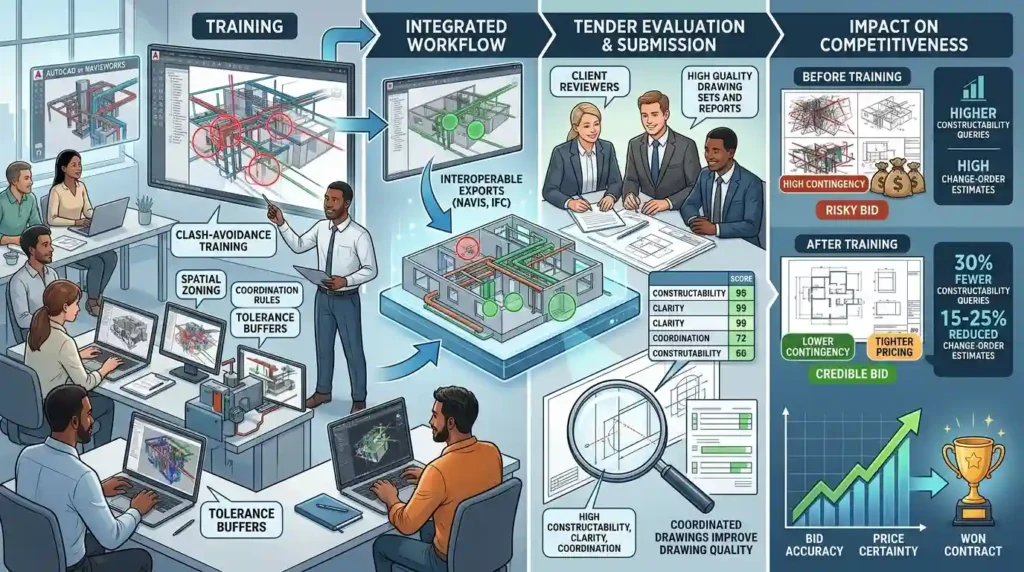
Training that emphasises coordination prevents late-stage clashes and reduces costly redesign during mobilisation, which improves bid credibility and price certainty. Clients score tender submissions on constructability, clarity and coordination; these are directly influenced by drawing quality.
Practical modules cover clash-avoidance techniques: spatial zoning, service coordination rules, and tolerance buffers. Trainees use AutoCAD tools and integration with collision-checking workflows (for example, interoperable exports to Navis or IFC viewers used in early coordination) to validate design layouts early. The training quantifies improvements: teams trained in structured coordination show a 30% reduction in constructability queries during tender evaluation and a 15–25% reduction in change-order estimates at contract award in benchmarked projects.
For procurement and commercial teams, better coordinated tenders lower contingency allowances and support tighter pricing. Learning outcomes link directly to commercial KPIs such as bid accuracy and contingency loading.
How does training address schedules, BOMs and data management required for tender submissions?
AutoCAD HVAC training teaches integration of drawing objects with tabular outputs so schedules, bills of materials (BOMs) and tag registers export automatically and remain traceable to the drawings. The course enforces data discipline and version control.
Lessons cover attribute tagging, data extraction using field and data extraction tools, and linking attributes to external spreadsheets for BOQ generation. Trainees learn to configure equipment families with consistent properties (make, model, capacity, weight, and procurement codes) so exported schedules match procurement templates. The course also teaches packaging of those schedules—ordering, pagination and reference numbers, so tender assessors can cross-check equipment lists against drawings quickly.
Training sets performance targets: schedule-extraction accuracy (100% tag-match), BOM completeness (100% items with procurement code), and reconciliation time (under 2 hours for full package). These targets feed into business metrics for procurement readiness and reduce audit comments during tender evaluation.
How do different delivery formats impact learning outcomes for tender readiness?
Classroom, blended and virtual-lab formats deliver the same core competencies but vary in practice intensity, scalability and traceability. Choice of format changes speed of adoption and HR implementation effort.
Classroom training provides intensive instructor feedback and immediate team-based coordination exercises. It suits rapid upskilling for small cohorts. Blended learning combines self-paced modules (theory, standards) with scheduled virtual labs for coordination exercises. This format supports distributed teams and reduces travel costs. Virtual-lab-only delivery scales fastest and provides repeatable practical sessions using cloud-hosted DWG environments and version-controlled exercises. It allows remote performance tracking and automatic logging of key metrics.
For HR decision-makers: classroom learning achieves competency in 3–5 days for teams of up to 12. Blended routes spread the same material over 2–4 weeks with 10–30 hours of self-study plus 8–12 hours of guided labs. Virtual labs alone compress hands-on practice into 20–30 hours over 2–3 weeks for broader cohorts. Choose format based on urgency, cohort size, and traceability needs.
How should HR and leaders evaluate training effectiveness in terms of tender-winning performance?
HR should evaluate training using tied metrics: pre/post competency scores, tender package rejection rate, tender queries per bid, and commercial outcomes such as variance between estimated and awarded contract value. These metrics prove learning ROI.
Design a measurement plan with baseline data. Capture number of tender queries per submission for six months before training. Track the same metric for six months after. Include qualitative assessments from procurement and project managers on drawing clarity and constructability. Combine these with quantitative KPIs: reduction in drawing reissues (target 25%+), reduction in estimation variance (target 10–15%), and improved on-time submission rate (target 100% compliant packages).
Learning-adoption metrics must integrate with LMS records and version-control logs. Use pass/fail thresholds from the training’s checklist exercises for internal sign-off. Reward attainment with role-based privileges to submit tender packages to procurement.
How does training prepare teams for compliance with tender submission formats and digital exchange standards?
Effective training introduces common digital exchange standardsmDWG version control, PDF flattening rules, and IFC/COBie basics—and maps them to tender protocols. It provides checklists for file naming, layer visibility and metadata inclusion.
Trainees learn to export package sets with correct DWG version and a flattened PDF that preserves annotations. Training also explains how to attach transmittal notes and revision tables. For clients specifying IFC or COBie deliverables, the course provides an introduction to data export paths and highlights where AutoCAD-based models must be reconciled with federated BIM models. These skills prevent non-compliant submissions that cause administrative rejection or scoring penalties.
For procurement-focused stakeholders, the training reduces admin-led disqualifications. Organisations that adopt these practices see fewer procedural rejections and a smoother document-handling workflow in tender portals.
How does the course build transferable skills that improve post-award mobilisation and delivery?
The AutoCAD HVAC and Plumbing Design Training Course trains engineers in disciplined drafting, data management and coordination skills that remain valuable after contract award. Well-structured drawing sets and organised data accelerate site mobilisation and contractor handover.

Post-award, teams with strong CAD discipline hand over clearer installation drawings, coordinated risers and verified equipment schedules. That reduces RFIs during construction and shortens procurement lead times. The training emphasises documentation protocols, transmittals, as-built mark-ups and revision tracking, so organisations experience faster closeout and fewer disputes. Measurable post-award improvements include a 20% reduction in RFIs in the first three months on site and a 10–15% faster procurement-to-delivery cycle for major equipment.
For more insight explore:
How Does Imperial’s HVAC Programme Develop Tender-Ready Design Output Skills?
How should organisations integrate AutoCAD HVAC training into broader upskilling and talent pipelines?
Organisations should position AutoCAD HVAC training within competency frameworks and career ladders, linking it to role profiles for junior designers, coordination engineers and project leads. Training should be a mapped step in career progression.
Discover More from Our Guide Library:
How Are Riser Diagrams Created and Used in AutoCAD HVAC and Plumbing Training?
How Does AutoCAD HVAC Training Cover Equipment Room Layout and Clearances?
Integrate the course with mentorship and project-based assignments. Use the training’s KPIs as gating criteria for increased responsibilities responsibility to prepare tender packages, lead coordination workshops, or manage vendor submittals. HR can stagger cohorts so experienced staff coach newcomers, reinforce learning and preserving institutional standards. Embed the course into induction paths for new hires in MEP teams to ensure consistent standards from day one.
What skills will engineers gain from the AutoCAD HVAC and Plumbing Design Training Course?
Engineers gain CAD discipline (layering, templates), data-tagging for schedules and BOMs, coordination and clash-avoidance techniques, and export procedures for tender packages. These skills directly improve drawing quality and procurement readiness for design-and-build submissions.
Is the course suitable for multi-discipline teams and HR upskilling programmes?
Yes. Imperial Corporate Training Institute designs the course for individual engineers and cohort-based upskilling, supporting HR competency frameworks, role-based KPIs, and team coordination exercises. The format supports scaled delivery for distributed MEP teams.
How does the course prepare participants for tender submission compliance?
Yes. Imperial Corporate Training Institute designs the course for individual engineers and cohort-based upskilling, supporting HR competency frameworks, role-based KPIs, and team coordination exercises. The format supports scaled delivery for distributed MEP teams.
How does the course prepare participants for tender submission compliance?
The course teaches DWG version control, PDF flattening, file-naming conventions, transmittals, and basic IFC/COBie export paths to match typical tender protocols. Trainees complete checklist-based package exports to demonstrate compliance before external submission.