

Mechanical rooms define the operational efficiency, maintainability, and compliance level of commercial buildings. HVAC systems fail early when equipment spacing, airflow access, pipe routing, and maintenance clearances are ignored during the design phase. AutoCAD HVAC training addresses these risks by teaching structured equipment room layout methods that align drafting accuracy with engineering coordination.
Modern training programmes focus on spatial planning, clash reduction, workflow sequencing, and service accessibility. Learners evaluate how chillers, pumps, AHUs, duct systems, drainage lines, and electrical pathways interact within limited architectural footprints. This creates practical competence instead of software-only familiarity.
Professionals comparing training approaches often begin by understanding how digital drafting supports spatial coordination.
Explore:
How Does AutoCAD Help With Space Planning for Mechanical Room Layout? explains how mechanical room planning evolves from basic drawing into coordinated engineering documentation. That awareness stage naturally leads to evaluating how training programmes apply those principles in real HVAC drafting environments.
Training evaluation becomes more important for HR departments and technical managers when organisations face coordination errors during MEP execution. Rework caused by improper equipment placement increases project cost, delays commissioning schedules, and affects long-term facility maintenance.
This is why many technical teams assess whether structured programmes such as:
Does Imperial’s HVAC Course Include Mechanical Room Layout Design Exercises? include practical room layout exercises rather than isolated drafting tutorials.
Why Is Equipment Room Layout Important in HVAC Training?
Equipment room layout determines whether HVAC systems remain maintainable, code-compliant, and operationally efficient throughout the building lifecycle. AutoCAD HVAC training teaches spatial coordination, service access planning, airflow management, and equipment sequencing so learners understand how layout decisions affect construction, maintenance, safety, and system performance.
Mechanical rooms contain interconnected HVAC components operating within constrained spaces. Training programmes therefore focus on how to position systems while maintaining accessibility for inspection, repair, and replacement activities.
A poorly designed equipment room creates several operational issues:
- Restricted maintenance access
- Unsafe working conditions
- Airflow inefficiencies
- Pipe and duct clashes
- Increased installation time
- Higher lifecycle costs
AutoCAD HVAC training introduces learners to clearance standards around major mechanical equipment. Engineers and technicians learn why chillers require service zones, why pumps need valve accessibility, and why air handling units require filter replacement clearance.
The training also explains spatial hierarchy inside equipment rooms. Large HVAC systems must follow logical sequencing based on operational relationships. For example:
- Chillers remain close to condenser water systems
- Pumps align with pipe routing efficiency
- AHUs require direct duct connectivity
- Drainage slopes affect equipment positioning
These principles connect engineering functionality with drafting precision.
Organisations increasingly evaluate training based on measurable workplace outcomes. Facilities teams require personnel who can interpret technical drawings accurately and coordinate installation requirements before construction begins. This reduces RFIs, redesign requests, and site conflicts.
How Does AutoCAD HVAC Training Teach Equipment Clearances?
AutoCAD HVAC training teaches equipment clearances through practical drafting exercises, manufacturer specification analysis, and real mechanical room simulations. Learners study operational spacing, maintenance access zones, airflow requirements, and code-based separation standards to create layouts that support installation efficiency and long-term system servicing.
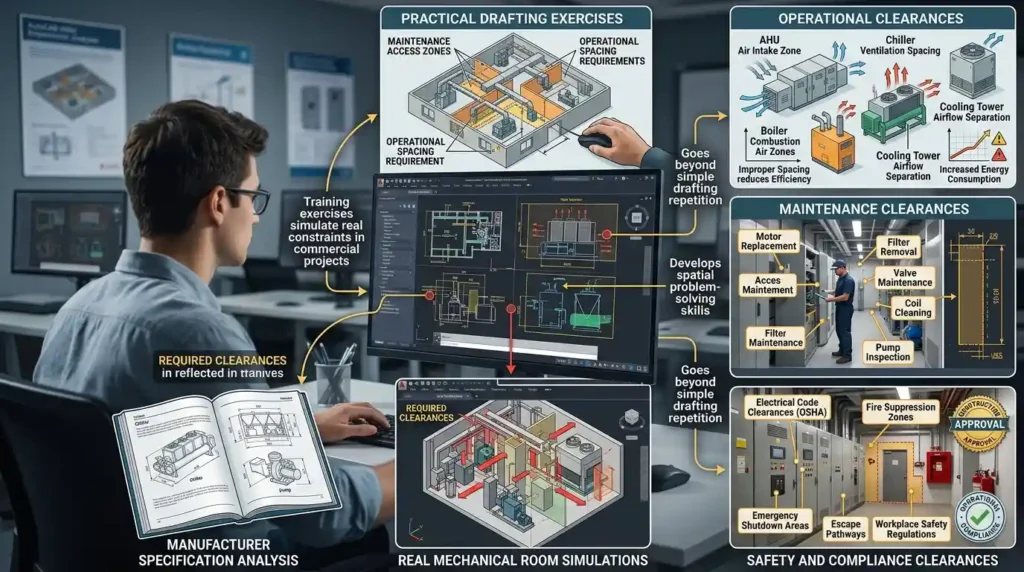
Clearances represent one of the most critical topics in HVAC room planning. Mechanical equipment cannot operate effectively when positioned without sufficient access zones.
Training programmes normally cover three major clearance categories:
Operational Clearances
Operational clearance refers to the minimum space required for equipment performance. HVAC units require airflow circulation, heat rejection space, and vibration control separation.
Examples include:
- AHU intake clearance
- Chiller ventilation spacing
- Boiler combustion air zones
- Cooling tower airflow separation
Learners study how improper spacing reduces equipment efficiency and increases energy consumption.
Maintenance Clearances
Maintenance clearance focuses on technician access. Equipment requires sufficient room for servicing activities such as:
- Motor replacement
- Filter removal
- Valve maintenance
- Coil cleaning
- Pump inspection
Training exercises often include interpreting manufacturer manuals to determine required service dimensions.
Safety and Compliance Clearances
Building regulations and engineering standards influence room layout design. HVAC training introduces learners to clearance standards connected to:
- Fire safety
- Electrical access
- Emergency shutdown areas
- Escape pathways
- Workplace safety regulations
These requirements directly affect construction approval and operational compliance.
AutoCAD exercises simulate real constraints found in commercial projects. Learners position HVAC systems within limited room dimensions while maintaining accessibility standards. This develops spatial problem-solving skills rather than simple drafting repetition.
What Types of Mechanical Equipment Are Included in Layout Exercises?
AutoCAD HVAC training includes practical layout exercises involving chillers, pumps, boilers, air handling units, duct systems, piping networks, and ventilation equipment. These exercises help learners understand spatial coordination, system interaction, maintenance planning, and equipment sequencing within real commercial mechanical room environments.
Mechanical room layouts involve multiple interconnected systems. Effective training therefore combines drafting skills with equipment familiarity.
Typical layout exercises include:
Chillers and Cooling Systems
Learners position chillers based on:
- Pipe routing efficiency
- Maintenance access
- Structural loading
- Ventilation needs
- Noise control considerations
Training often explains how chilled water systems interact with pumps and air distribution networks.
Pump Room Coordination
Pump layouts require careful spacing because maintenance access directly affects operational continuity.
Training covers:
- Pump alignment
- Valve accessibility
- Pipe support coordination
- Drainage planning
- Vibration isolation spacing
These exercises improve practical engineering understanding.
Air Handling Units (AHUs)
AHUs create spatial challenges because of duct connections and filter access requirements.
Learners practise:
- Supply and return duct coordination
- Access panel spacing
- Ceiling clearance management
- Maintenance zone allocation
This develops coordination awareness between HVAC and architectural systems.
Boiler and Ventilation Systems
Heating systems introduce combustion safety considerations. Training explains:
- Flue routing
- Ventilation pathways
- Safety clearance requirements
- Pipe expansion spacing
These exercises help learners understand compliance-based design thinking.
How Do Training Programmes Compare Practical Layout Learning Methods?
Training programmes differ in how they balance software instruction, engineering theory, and project-based exercises. Strong AutoCAD HVAC training integrates live drafting tasks, equipment coordination challenges, and clearance analysis instead of relying only on interface tutorials or isolated command demonstrations.
Many organisations compare HVAC training providers based on practical application depth rather than course duration alone.
The table below outlines common training approaches.
| Training Approach | Primary Focus | Workplace Relevance | Skill Development Outcome |
|---|---|---|---|
| Software-only instruction | AutoCAD commands | Limited | Basic drafting familiarity |
| Engineering theory-heavy training | HVAC concepts | Moderate | Technical understanding |
| Project-based HVAC drafting | Real layout coordination | High | Applied workplace competence |
| Simulation-based coordination training | Clash and clearance management | Very High | Multi-system coordination skills |
Software-only training teaches drawing tools but often excludes real coordination scenarios. Learners understand commands without learning why layout decisions matter operationally.
Project-based training produces stronger workplace readiness because learners solve realistic coordination problems.
HR teams evaluating training effectiveness increasingly prioritise measurable drafting capability. Technical employees must contribute to project execution rapidly after training completion. Practical room layout exercises support that objective.
How Does AutoCAD Improve Coordination Between HVAC Systems?
AutoCAD improves HVAC coordination by enabling accurate spatial planning, layered system management, clash detection preparation, and equipment alignment within constrained building environments. Training programmes teach learners how coordinated drafting reduces installation conflicts, rework costs, commissioning delays, and operational inefficiencies across mechanical systems.
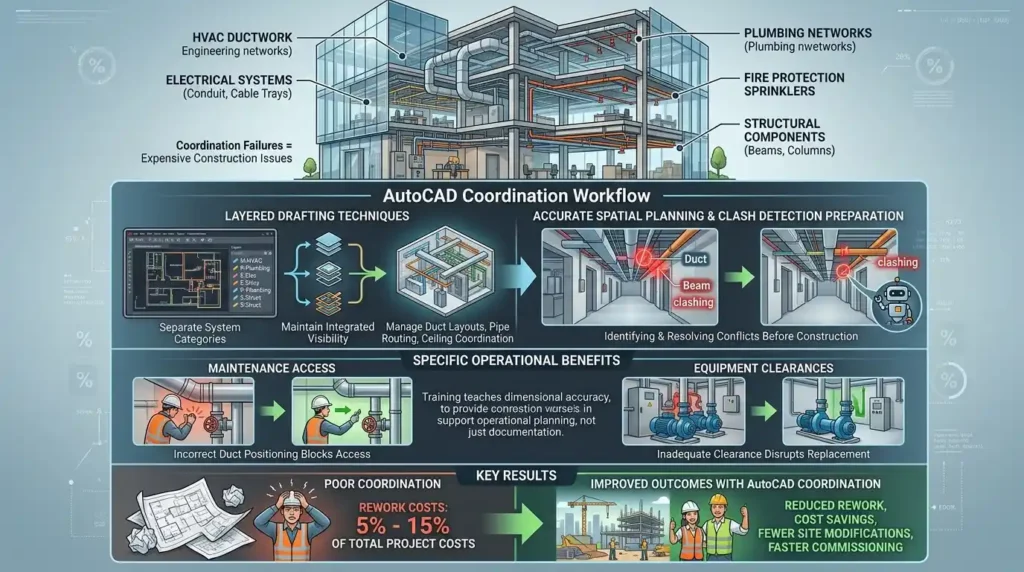
Commercial buildings involve overlapping engineering systems. HVAC equipment shares space with:
- Electrical systems
- Plumbing networks
- Fire protection services
- Structural components
- Architectural constraints
Coordination failures create expensive construction issues.
AutoCAD HVAC training introduces layered drafting techniques that separate system categories while maintaining integrated visibility. Learners understand how to manage:
- Duct layouts
- Pipe routing
- Equipment footprints
- Ceiling coordination
- Access pathways
This structured drafting approach supports multidisciplinary project collaboration.
Training also teaches dimensional accuracy. Small drafting inaccuracies create major construction conflicts during installation phases.
For example:
- Incorrect pump spacing affects valve accessibility
- Poor duct positioning blocks maintenance access
- Inadequate clearance disrupts equipment replacement
AutoCAD workflows therefore support operational planning, not just documentation.
Organisations benefit because coordinated layouts reduce site modifications. Industry studies consistently show that construction rework consumes between 5% and 15% of total project costs in poorly coordinated projects. HVAC coordination training directly addresses this risk.
What Business Skills Are Developed Through HVAC Layout Training?
HVAC layout training develops technical coordination, spatial analysis, problem-solving, compliance interpretation, and multidisciplinary communication skills. These capabilities improve project execution efficiency, support facility lifecycle management, and strengthen workforce readiness for commercial construction and building services environments.
Technical drafting roles increasingly require operational understanding alongside software competence.
Training programmes therefore support broader business outcomes such as:
Reduced Coordination Delays
Employees trained in layout planning identify conflicts earlier during design stages. This improves project scheduling efficiency.
Better Cross-Department Communication
HVAC drafting teams regularly collaborate with:
- Architects
- Electrical engineers
- Plumbing designers
- Project managers
- Facilities teams
Training helps learners interpret technical requirements across disciplines.
Improved Maintenance Planning
Mechanical room layouts affect long-term facility operations. Proper spacing improves maintenance efficiency and reduces downtime.
Facilities management teams therefore value personnel who understand lifecycle considerations during design stages.
Stronger Documentation Standards
Training also improves documentation quality through:
- Accurate dimensioning
- Layer management
- Annotation consistency
- Equipment tagging
- Revision control
These skills support project governance and compliance reporting.
Many HR departments now evaluate technical training based on operational KPIs rather than attendance completion alone. Performance metrics often include:
| KPI | Operational Impact |
|---|---|
| Reduced drawing revisions | Faster approval cycles |
| Lower clash frequency | Reduced construction delays |
| Improved installation coordination | Better contractor productivity |
| Faster maintenance access | Reduced operational downtime |
| Higher documentation accuracy | Improved project compliance |
This shifts HVAC training evaluation toward measurable business contribution.
How Does Mechanical Room Training Support Real Project Environments?
Mechanical room training supports real project environments by replicating commercial coordination challenges, equipment density limitations, and multidisciplinary drafting conditions. Learner’s practise solving installation conflicts, clearance issues, and workflow sequencing problems commonly encountered during HVAC construction and facility operations projects.
Commercial projects rarely involve ideal spatial conditions. Mechanical rooms are constrained by structural limitations, ceiling heights, and architectural requirements.
Training exercises therefore simulate realistic project pressures.
Space-Constrained Layout Challenges
Learners position multiple systems within restricted footprints while maintaining:
- Service access
- Pipe routing efficiency
- Airflow performance
- Safety compliance
This reflects real construction environments.
Multi-System Coordination
Modern buildings involve integrated MEP systems. HVAC training increasingly includes coordination scenarios involving:
- Plumbing systems
- Drainage routing
- Electrical containment
- Fire suppression systems
This prepares learners for collaborative project workflows.
Revision Management
Construction projects evolve continuously. Training therefore includes layout modification exercises that reflect:
- Client changes
- Equipment replacement
- Architectural revisions
- Compliance updates
Learners understand how design changes affect system coordination.
This practical orientation differentiates workplace-focused HVAC training from purely academic instruction.
What Should Organisations Evaluate Before Selecting HVAC Layout Training?
Organisations should evaluate HVAC layout training based on practical drafting depth, coordination exercises, equipment clearance coverage, industry relevance, and measurable workplace application. Effective programmes combine AutoCAD functionality with operational engineering workflows that improve project execution, facility management, and multidisciplinary collaboration.
Training selection affects workforce capability directly. HR and technical managers therefore assess programmes using operational criteria rather than marketing descriptions.
Important evaluation factors include:
Practical Exercise Volume
Effective training includes repeated layout exercises involving real mechanical room configurations.
Programmes limited to command demonstrations provide weaker operational transfer.
Equipment Coordination Coverage
Training should address:
- Chillers
- AHUs
- Pumps
- Boilers
- Pipe systems
- Duct coordination
This ensures broader workplace applicability.
Clearance and Compliance Instruction
Clearance management directly affects installation quality and maintenance accessibility.
Training programmes should therefore explain:
- Manufacturer standards
- Service access requirements
- Safety regulations
- Operational spacing principles
Project-Based Learning
Scenario-based drafting exercises improve retention and applied competence.
Discover More from Our Guide Library:
How Does AutoCAD HVAC Training Teach Coordination With Reflected Ceiling Plans?
How Does AutoCAD HVAC Training Cover Ventilation Layout for Large Commercial Buildings?
Learners develop stronger problem-solving capability when working within realistic project constraints.
Business Alignment
Organisations increasingly expect technical training to support:
- Faster project delivery
- Reduced rework
- Better documentation quality
- Improved maintenance efficiency
This makes applied HVAC layout training strategically valuable.
Professionals evaluating structured learning pathways often review the:
AutoCAD HVAC and Plumbing Design Training Course when comparing programmes focused on coordinated HVAC drafting, mechanical room planning, and practical system layout development.
The strongest programmes connect software workflows with operational engineering outcomes. That alignment improves drafting precision, coordination efficiency, and long-term facility performance across commercial building projects.
Is AutoCAD HVAC training useful for mechanical room layout design?
Yes, the AutoCAD HVAC and Plumbing Design Training Course teaches mechanical room layout planning, equipment spacing, and maintenance clearances. Training includes practical drafting exercises focused on HVAC coordination and efficient space utilisation in building projects.
Who should attend an AutoCAD HVAC and Plumbing Design Training Course?
The course is suitable for HVAC engineers, MEP technicians, plumbing designers, CAD operators, and construction professionals involved in building services projects. It also supports organisations addressing workforce skill gaps in technical drafting and system coordination.
Does AutoCAD HVAC training include ducting and plumbing system coordination?
The AutoCAD HVAC and Plumbing Design Training Course includes duct routing, plumbing layouts, pipe coordination, and clash-aware drafting methods. Learners understand how HVAC and plumbing systems integrate within commercial and industrial building environments.
How does AutoCAD HVAC training improve workplace performance?
AutoCAD HVAC training improves drafting accuracy, system coordination, and project documentation quality. Imperial Corporate Training Institute focuses on practical workflows that help reduce design errors, improve installation planning, and support efficient project execution.