

Mechanical coordination failures in commercial buildings often start above the ceiling. HVAC engineers, architects, electrical designers, and fire protection consultants all compete for limited ceiling space. Reflected Ceiling Plans (RCPs) act as the coordination layer where lighting layouts, ceiling grids, diffusers, sprinkler heads, smoke detectors, and access panels must align without conflicts. AutoCAD HVAC training teaches professionals how to interpret these design relationships and integrate mechanical systems into architectural intent.
Understanding ceiling coordination starts with knowing how reflected ceiling drawings function within building documentation. Professionals comparing HVAC learning pathways often begin with foundational design interpretation before moving into technical drafting workflows. Readers exploring the architectural side of ceiling planning usually review educational resources such as:
What Is a Reflected Ceiling Plan and How Does HVAC Design Fit Into It? before evaluating coordination-focused HVAC drafting methods.
Why does HVAC coordination with reflected ceiling plans matter in commercial projects?
HVAC coordination with reflected ceiling plans prevents clashes between mechanical systems, lighting layouts, fire protection elements, and architectural ceilings. Training teaches engineers how to position ducts, diffusers, and access components accurately within ceiling constraints while maintaining airflow performance, compliance standards, and installation efficiency during project execution.
Commercial construction projects involve multiple disciplines working simultaneously on shared spaces. Ceiling zones become highly congested in offices, hospitals, airports, hotels, retail developments, and educational facilities. HVAC systems occupy large physical volumes inside these restricted spaces.
Without coordination, contractors encounter major issues during installation. Common examples include:
- Diffusers conflicting with light fixtures
- Ductwork intersecting structural beams
- Access panels blocked by piping
- Sprinkler spacing violations
- Ceiling grids disrupted by oversized mechanical layouts
AutoCAD HVAC training addresses these coordination problems through structured drafting workflows. Trainees learn how reflected ceiling plans function as coordination documents rather than purely architectural drawings.
Training programmes explain ceiling-based design hierarchy. In most projects:
- Structural limitations define available ceiling space
- Architectural ceilings define visible layouts
- Lighting systems establish visual alignment
- HVAC systems adapt airflow components around ceiling patterns
- Fire and electrical systems coordinate final placement
This sequencing matters because HVAC engineers rarely control the ceiling layout. Instead, they coordinate within predefined architectural intent.
In modern BIM-supported construction environments, coordination quality directly affects project cost and delivery schedules. Industry reports from large commercial projects consistently show that design clashes increase rework costs significantly during construction phases. Training therefore focuses heavily on coordination accuracy rather than only drafting speed.
How does AutoCAD HVAC training teach reflected ceiling plan interpretation?
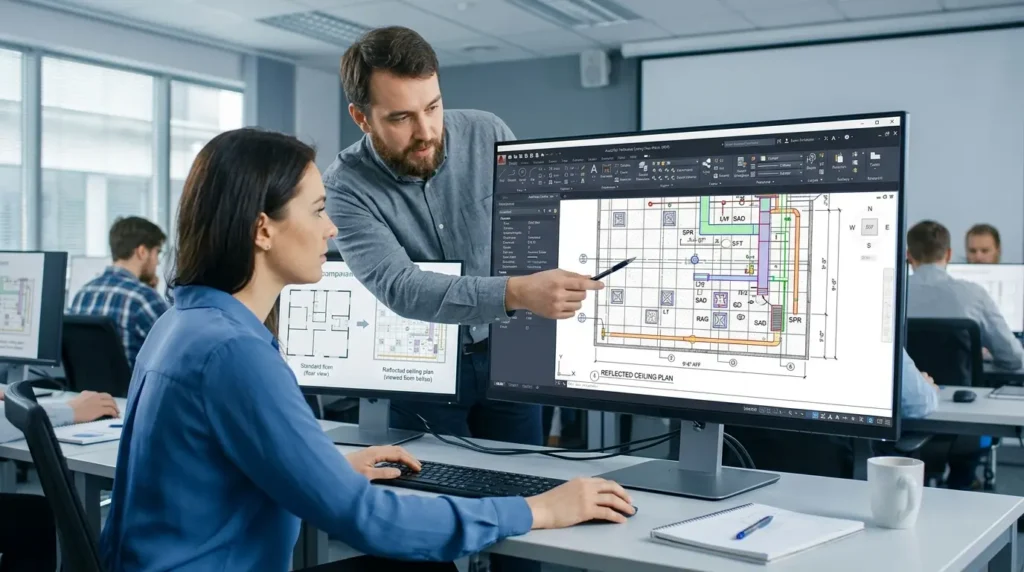
AutoCAD HVAC training teaches reflected ceiling plan interpretation by showing how ceiling grids, fixture layouts, diffuser placement, annotations, and section references interact across architectural and mechanical drawings. Engineers learn to read spatial relationships, ceiling elevations, and service integration requirements before producing coordinated HVAC layouts.
Many mechanical professionals initially struggle with reflected ceiling plans because the drawing perspective differs from standard floor plans. RCPs represent ceilings viewed from below, creating a mirrored interpretation of overhead elements.
Training begins with drawing literacy. Participants learn how to identify:
- Ceiling types and materials
- Suspended ceiling grids
- Bulkheads and soffits
- Lighting fixture families
- Smoke detectors
- Sprinkler layouts
- Return air grilles
- Ceiling elevations
- Access zones
The drafting process then progresses into spatial coordination exercises.
Within the AutoCAD HVAC and Plumbing Design Training Course, trainees typically work on layered drawing environments. Architectural, mechanical, electrical, and plumbing systems are separated into organised CAD layers for coordination visibility.
This training model develops three critical technical competencies:
Drawing Overlay Interpretation
Engineers learn how to overlay HVAC layouts onto reflected ceiling plans without disrupting architectural aesthetics or code compliance.
Ceiling Clearance Analysis
Participants assess vertical spacing between ceiling finishes, duct routes, cable trays, sprinkler systems, and structural components.
Component Alignment Logic
Training explains why diffusers align with ceiling grids, lighting axes, or room geometry. Placement decisions affect both airflow distribution and visual symmetry.
These exercises move beyond simple drafting commands. They train spatial coordination thinking.
What coordination skills are developed during HVAC drafting exercises?
HVAC drafting exercises develop clash detection, airflow distribution planning, ceiling device alignment, layer management, and multidisciplinary coordination skills. Engineers learn how to balance mechanical performance with architectural presentation while maintaining compliance with installation standards and construction documentation procedures.
Coordination training relies heavily on practical project simulations. Instead of isolated drafting tutorials, advanced programmes use real commercial building scenarios.
Typical exercises include:
- Open-plan office ceiling coordination
- Hospital corridor service routing
- Retail diffuser alignment
- Conference room air distribution balancing
- Mechanical room ceiling access planning
These projects teach engineers how design decisions affect multiple stakeholders.
For example, diffuser placement is not solely an airflow calculation. It also affects:
- Lighting symmetry
- Occupant comfort
- Acoustic ceiling layouts
- Fire safety clearances
- Maintenance accessibility
Training therefore integrates drafting accuracy with operational functionality.
One important skill area involves layer discipline. Large commercial projects contain hundreds of CAD layers across multiple consultants. Engineers learn naming standards, visibility controls, xrefs, and coordination overlays to maintain organised documentation.
Another major competency involves clash identification.
Traditional drafting methods relied heavily on manual checking. Modern AutoCAD HVAC workflows integrate coordination reviews earlier in the design process. Engineers identify conflicts before installation drawings reach contractors.
This reduces:
- Site rework
- Material waste
- Installation delays
- Contractor disputes
- Variation costs
HR departments evaluating technical training programmes increasingly prioritise coordination capability because workforce gaps often appear in multidisciplinary collaboration rather than pure drafting proficiency.
How do reflected ceiling plans influence HVAC diffuser and grille placement?
Reflected ceiling plans influence diffuser and grille placement by defining ceiling geometry, lighting alignment, aesthetic balance, and service spacing requirements. HVAC training teaches engineers how airflow devices integrate within ceiling layouts while maintaining ventilation effectiveness, occupant comfort, and architectural consistency across commercial interiors.
Air distribution devices remain visible after construction. Their placement affects both building performance and interior appearance.
Training programmes therefore focus heavily on ceiling-based air terminal coordination.
Engineers learn how diffuser placement depends on several variables:
| Coordination Factor | Impact on HVAC Layout |
|---|---|
| Ceiling grid size | Determines diffuser alignment |
| Lighting fixture positions | Prevents visual imbalance |
| Occupancy zones | Affects airflow coverage |
| Ceiling height | Influences air throw calculations |
| Structural obstructions | Limits duct routing |
| Fire protection layouts | Maintains clearance compliance |
These relationships become increasingly complex in high-density commercial interiors.
For instance, linear slot diffusers often align with architectural ceiling lines in premium office developments. In healthcare environments, airflow placement must additionally support infection control strategies and pressure relationships.
Training exercises demonstrate how poor diffuser placement creates operational problems such as:
- Uneven temperature distribution
- Draft discomfort
- Short-circuit airflow
- Noise issues
- Maintenance access limitations
Programmes also explain ceiling coordination standards used in multidisciplinary review meetings. Engineers learn how architects evaluate visible ceiling elements differently from mechanical contractors.
This perspective helps HVAC professionals communicate effectively during design coordination sessions.
How does AutoCAD HVAC training compare classroom learning with project-based coordination methods?
Project-based coordination methods produce stronger HVAC ceiling coordination skills than theory-only classroom learning because engineers practise real drawing integration, clash resolution, and multidisciplinary workflows. Training effectiveness increases when participants work with live reflected ceiling plan scenarios instead of isolated drafting exercises.
Many organisations evaluating HVAC training compare theoretical instruction against applied project delivery models.
The difference becomes clear in coordination-heavy environments.
| Training Approach | Learning Outcome | Coordination Readiness |
|---|---|---|
| Theory-only CAD instruction | Command familiarity | Limited |
| Software demonstration learning | Basic drafting ability | Moderate |
| Project-based coordination training | Real workflow competency | High |
| Multidisciplinary simulation training | Construction-level coordination capability | Advanced |
Project-based learning develops decision-making skills under realistic constraints.
For example, trainees may receive:
- Architectural floor plans
- Reflected ceiling plans
- Structural layouts
- Lighting schedules
- Mechanical requirements
They then produce coordinated HVAC ceiling layouts while resolving clashes.
This method reflects real consultancy workflows more accurately than command-based teaching alone.
Engineering managers and HR leaders increasingly evaluate technical training using measurable workplace outcomes such as:
- Reduced drawing revision cycles
- Faster coordination review completion
- Lower clash detection rates
- Improved consultant communication
- Increased drafting productivity
These metrics align more closely with project-based learning frameworks.
When organisations assess implementation-focused programmes, evaluation often shifts toward structured engineering coordination methodologies such as:
How Does Imperial’s Programme Prepare Engineers to Coordinate HVAC With Architects? because decision-makers want evidence of readiness for multidisciplinary workflows rather than software familiarity alone.
What role does multidisciplinary coordination play in HVAC ceiling planning?
Multidisciplinary coordination ensures HVAC systems integrate successfully with architectural, electrical, plumbing, and fire protection designs inside ceiling spaces. AutoCAD HVAC training teaches engineers how to communicate through shared drawings, layered documentation, and coordinated installation planning across project teams.
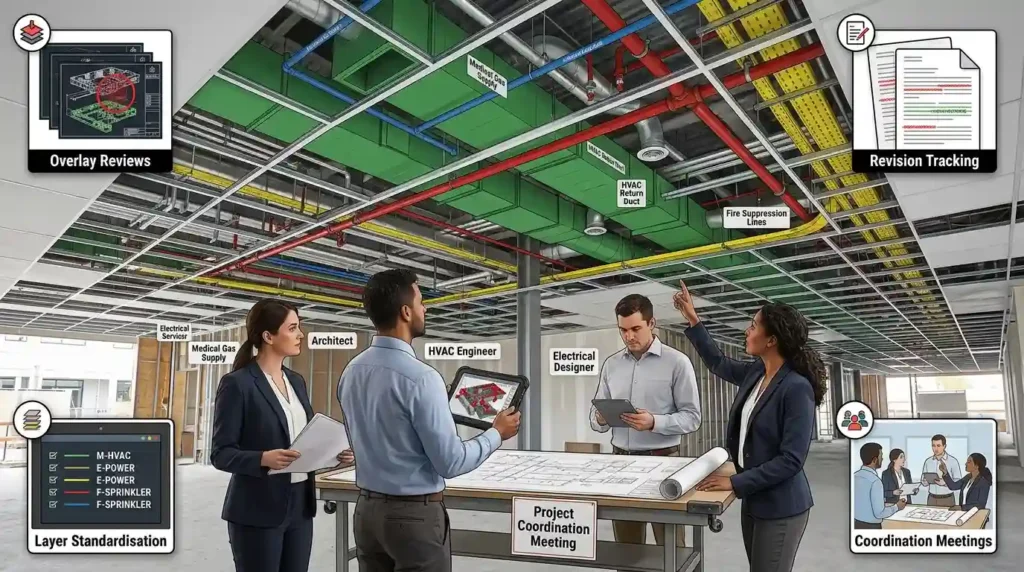
Commercial construction increasingly depends on collaborative coordination environments.
Mechanical engineers no longer work independently from other disciplines. Ceiling planning requires continuous coordination between:
- Architects
- HVAC engineers
- Electrical designers
- Fire protection consultants
- Interior designers
- Structural engineers
- Contractors
AutoCAD HVAC training introduces these collaborative workflows early.
Participants learn common coordination procedures such as:
Overlay Reviews
Multiple consultant drawings are combined to identify spatial conflicts.
Revision Tracking
Engineers document changes between drawing submissions to maintain coordination consistency.
Layer Standardisation
Shared CAD standards improve drawing readability across disciplines.
Coordination Meetings
Trainees understand how technical decisions are reviewed during project discussions.
These skills matter because coordination failures often emerge from communication breakdowns rather than software limitations.
In large developments, ceiling spaces become highly regulated coordination zones. Hospitals provide a strong example. Ceiling areas must accommodate:
- Medical gases
- HVAC ductwork
- Infection control systems
- Electrical containment
- Fire suppression
- Communication cabling
Training therefore focuses on coordination sequencing and documentation clarity.
Organisations hiring HVAC drafters increasingly value professionals who understand consultant workflows rather than purely drafting technicians.
How do training programmes teach clash detection and ceiling conflict resolution?
Training programmes teach clash detection through layered drawing analysis, spatial coordination exercises, and installation simulations. Engineers learn how to identify ceiling conflicts involving ducts, lighting, structural elements, and fire protection systems before construction begins, reducing costly rework and coordination delays on projects.
Clash detection has become one of the most important competencies in modern building services coordination.
Traditional construction workflows often discovered conflicts during installation. Contemporary engineering practice identifies problems earlier during design coordination.
AutoCAD HVAC training introduces structured conflict resolution methods.
Typical training scenarios include:
- Ductwork intersecting lighting fixtures
- Ceiling-mounted equipment exceeding height clearances
- Return air grilles conflicting with sprinkler spacing
- Access doors blocked by cable trays
- Bulkhead limitations affecting duct routes
Participants learn systematic review methods rather than random visual checking.
Training generally follows a staged coordination process:
| Coordination Stage | Objective |
|---|---|
| Architectural review | Understand ceiling intent |
| Mechanical routing | Position primary duct systems |
| Ceiling device layout | Coordinate visible components |
| Interdisciplinary overlay | Detect conflicts |
| Revision coordination | Resolve clashes |
| Final documentation | Issue coordinated drawings |
These exercises improve analytical thinking under realistic project conditions.
Modern programmes also explain how clash prevention affects broader business performance metrics:
- Construction schedule reliability
- Procurement accuracy
- Labour productivity
- Contractor coordination efficiency
- Facility maintenance access
This operational perspective helps organisations evaluate training ROI more effectively.
Why do organisations evaluate HVAC coordination training as a workforce development investment?
Organisations evaluate HVAC coordination training as a workforce investment because coordinated drafting improves project delivery accuracy, reduces construction rework, strengthens consultant collaboration, and increases technical productivity. Training outcomes directly influence engineering efficiency, documentation quality, and multidisciplinary project performance across commercial developments.
The demand for technically coordinated HVAC professionals continues increasing across commercial construction sectors.
Several market trends drive this demand:
- Higher ceiling density in smart buildings
- Increased MEP integration complexity
- Faster project delivery timelines
- Expanded BIM coordination expectations
- Greater emphasis on clash-free documentation
As a result, organisations increasingly evaluate HVAC training through measurable operational outcomes rather than certification volume alone.
Key workforce development metrics include:
| Workforce Objective | Training Impact |
|---|---|
| Faster onboarding | Reduced supervision requirements |
| Better coordination accuracy | Fewer design revisions |
| Improved project delivery | Reduced installation delays |
| Stronger consultant collaboration | Better multidisciplinary communication |
| Higher technical consistency | Standardised documentation quality |
This explains why training evaluation has shifted toward applied coordination capability.
Engineering firms frequently experience workforce gaps in practical coordination experience. Junior drafters often understand software commands but lack exposure to multidisciplinary ceiling integration workflows.
Discover More from Our Guide Library:
How Does AutoCAD HVAC Training Cover Ventilation Layout for Large Commercial Buildings?
How Does AutoCAD HVAC Training Make Graduates More Competitive in the Job Market?
Training programmes addressing reflected ceiling plan coordination close this capability gap more effectively because they simulate real consultancy environments.
For HR departments, this creates clearer performance measurement opportunities. Coordination-focused technical training connects directly to:
- Reduced project risk
- Improved delivery timelines
- Lower rework costs
- Better documentation quality
- Enhanced operational efficiency
These outcomes align closely with strategic workforce development goals in engineering-led organisations.
How does AutoCAD HVAC training improve coordination with reflected ceiling plans?
AutoCAD HVAC training teaches engineers how to position diffusers, ducts, grilles, and plumbing systems within reflected ceiling plans without clashes. Imperial Corporate Training Institute includes coordination exercises that improve multidisciplinary drawing accuracy and installation planning.
Who should attend an AutoCAD HVAC and Plumbing Design Training Course?
This course is suitable for HVAC engineers, MEP drafters, plumbing designers, facility professionals, and technical graduates involved in building services projects. Imperial Corporate Training Institute structures the training for professionals who need practical AutoCAD HVAC and plumbing design skills for workplace applications.
Why is HVAC and plumbing coordination important in commercial buildings?
HVAC and plumbing coordination reduces construction conflicts, improves installation efficiency, and supports accurate building services documentation. The AutoCAD HVAC and Plumbing Design Training Course explains how coordinated MEP drawings help engineers manage ceiling space, routing, and compliance requirements.
What skills are gained from an AutoCAD HVAC and Plumbing Design Training Course?
Participants develop skills in HVAC drafting, plumbing system layout, duct routing, piping coordination, clash detection, and technical drawing interpretation. Imperial Corporate Training Institute also focuses on practical project workflows used in commercial and industrial MEP design environments.