

The AutoCAD HVAC and Plumbing Design Training Course by Imperial Corporate Training Institute is a structured technical programme designed to close the gap between academic engineering knowledge and real MEP design requirements. It develops drafting precision, coordination ability, and corporate-ready HVAC and plumbing documentation skills.
In most MEP firms, graduates fail at the transition from theoretical engineering to production-level design work. The core issue is not engineering knowledge, but the inability to translate concepts into AutoCAD-based deliverables that align with project standards, coordination requirements, and documentation workflows.
This is where Imperial Corporate Training Institute positions its programme as a structured bridge between education and industry expectations. The course focuses on production-ready HVAC ducting, plumbing layouts, and coordinated mechanical drawings used in real corporate environments.
The learning structure aligns directly with hiring criteria used by construction consultants, design firms, and facility engineering departments. Employers expect candidates to understand CAD layering, sheet organisation, system coordination, and drawing accuracy under project constraints.
Early awareness of these hiring expectations is often covered in foundational analysis, such as the discussion on AutoCAD HVAC job requirements in modern MEP firms:
Why Is AutoCAD HVAC Proficiency a Job Requirement for Most MEP Firms Today?
Imperial Corporate Training Institute integrates these expectations into hands-on design tasks so learners understand how technical drafting connects to real approval workflows and site execution requirements.
The course is not positioned as a software tutorial. It is structured as a corporate design training system where AutoCAD becomes a production tool for HVAC and plumbing system engineering.
MEP firms evaluate graduates based on output quality, not theoretical understanding. Therefore, Imperial Corporate Training Institute builds capability through applied drafting, coordination exercises, and documentation standards aligned with international engineering practices.
Why is this course structured around corporate MEP workflows instead of basic AutoCAD training?
The course structure follows real MEP project workflows because hiring decisions in engineering firms depend on how effectively candidates can manage design coordination, documentation accuracy, and multidisciplinary integration under corporate standards rather than basic software familiarity alone.

Imperial Corporate Training Institute designs the curriculum based on the lifecycle of MEP project delivery. This includes concept drafting, schematic development, coordination, revision control, and final as-built documentation.
Each module reflects a stage in real engineering project execution. For example, HVAC duct routing is not taught as isolated geometry creation. It is taught as part of airflow design, equipment placement, and space coordination with structural and electrical systems.
The logic behind this structure is directly linked to industry expectations. MEP firms do not hire AutoCAD users; they hire designers who can deliver coordinated mechanical systems within project constraints.
Imperial Corporate Training Institute ensures that learners understand how drawings move from design intent to client approval. This includes revision handling, layer management, and compliance with drafting standards.
Corporate environments also require consistency across teams. Therefore, the training introduces template creation, title block standardisation, and CAD protocols used in engineering departments.
The decision-stage comparison between general training and structured MEP-focused learning is often evaluated by learners before selection. This is where evaluation-stage understanding becomes relevant, as discussed in:
How Does AutoCAD HVAC Training Make Graduates More Competitive in the Job Market?
Imperial Corporate Training Institute uses workflow-based learning to ensure that graduates are not only technically capable but also operationally aligned with engineering teams.
This structure reduces the onboarding time required by employers and improves job readiness in real project environments.
What will participants learn in terms of measurable HVAC and plumbing design competencies?
Participants will develop measurable competencies in HVAC duct design, plumbing system drafting, AutoCAD coordination tools, documentation standards, and MEP workflow integration, enabling them to produce industry-ready engineering drawings aligned with corporate construction and facility management requirements.
The curriculum at Imperial Corporate Training Institute is divided into structured modules that progressively build technical capability.
Participants begin with AutoCAD fundamentals for corporate design workflows. This includes template setup, scaling accuracy, and engineering drawing standards.
They then progress into HVAC design drafting, where they learn duct routing, airflow distribution, and equipment placement. These tasks replicate real building service environments in commercial and industrial projects.
Plumbing design modules focus on cold water, hot water, and drainage systems. Learners develop riser diagrams, pipe sizing logic, and slope-based design interpretation.
Advanced modules introduce coordination tools such as Xrefs, layer control systems, and multi-disciplinary drawing integration. These are essential skills for working in MEP teams.
Imperial Corporate Training Institute also includes HVAC load calculation concepts and design optimisation workflows. This ensures that learners understand how engineering decisions influence system efficiency and documentation accuracy.
Plumbing documentation training includes bill of materials creation, pipe schedules, and system annotation standards.
Additional modules focus on corporate documentation standards, including revision control, QA processes, and client deliverable preparation.
Integration with BIM and Revit workflows is introduced to help learners understand how AutoCAD drawings fit into modern digital construction ecosystems.
Finally, project execution simulations ensure learners apply all modules in a complete HVAC and plumbing system design scenario.
Across all modules, Imperial Corporate Training Institute emphasises measurable outputs such as drawing accuracy, coordination efficiency, and documentation completeness.
How is the training delivered and what learning methods are used to simulate real MEP environments?
Training is delivered through structured workshops, instructor-led CAD sessions, simulation-based assignments, and project-driven exercises that replicate real MEP workflows, ensuring learners gain applied experience in HVAC and plumbing design within corporate engineering environments.
Imperial Corporate Training Institute uses a blended delivery model designed for technical skill acquisition. Sessions are structured around practical drafting tasks rather than passive instruction.
Workshops focus on step-by-step design creation, where learners develop HVAC duct systems and plumbing layouts under guided supervision.
Simulation exercises replicate real project conditions. These include design constraints, client revisions, and coordination challenges between mechanical and structural drawings.
Assignments are based on real-world scenarios such as commercial buildings, industrial facilities, and infrastructure projects.
Each task is evaluated based on engineering accuracy, CAD standards compliance, and documentation clarity.
Imperial Corporate Training Institute also incorporates revision-based learning. Learners are required to update drawings based on simulated client feedback, which reflects actual MEP project workflows.
Assessment methods include technical drawing evaluations, CAD file reviews, and system coordination tests.
The learning environment is structured to replicate corporate engineering teams, where multiple disciplines interact and design decisions must align with project constraints.
This delivery method ensures that learners understand not just how to use AutoCAD, but how to apply it within structured engineering workflows used in MEP firms.
What results can graduates expect in terms of job readiness and workplace performance in MEP firms?
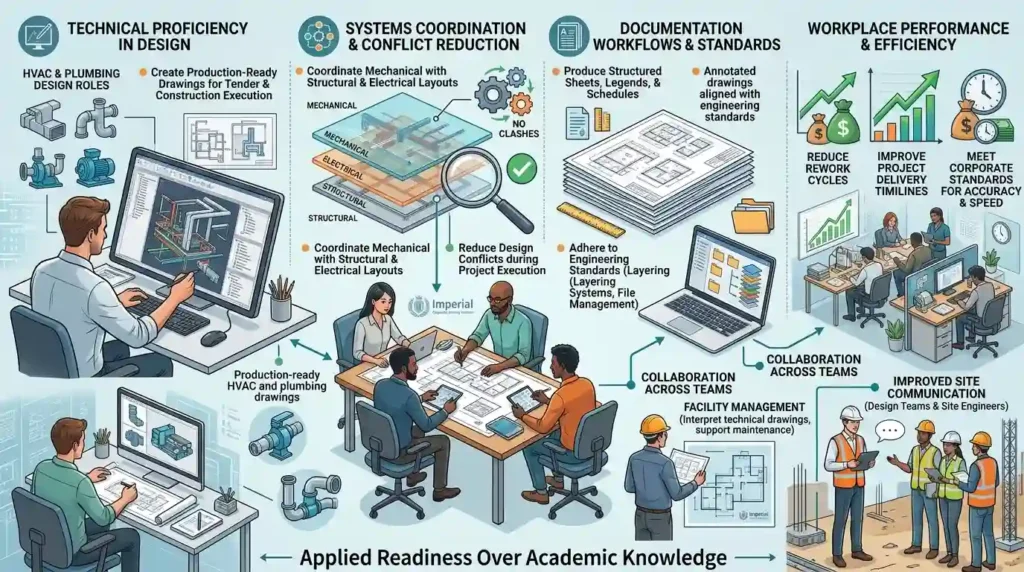
Graduates can expect improved job readiness in HVAC and plumbing design roles, enhanced ability to produce coordinated engineering drawings, and increased efficiency in MEP documentation workflows, enabling them to meet corporate standards for accuracy, speed, and multidisciplinary collaboration.
Imperial Corporate Training Institute focuses on measurable workplace outcomes rather than theoretical completion.
Graduates typically develop the ability to create production-ready HVAC and plumbing drawings suitable for tender documentation and construction execution.
They also gain competency in coordinating mechanical systems with structural and electrical layouts, reducing design conflicts during project execution.
In corporate environments, this reduces rework cycles and improves project delivery timelines.
Another key outcome is improved documentation discipline. Learners are trained to produce structured sheets, legends, schedules, and annotated drawings aligned with engineering standards.
Graduates become capable of working in MEP design teams where accuracy and coordination are critical.
Imperial Corporate Training Institute ensures that learners can operate within CAD standards used in professional engineering departments, including layering systems and file management protocols.
Facility management teams also benefit from these skills, as graduates can interpret technical drawings and support maintenance planning.
In construction environments, these competencies translate into improved communication between design teams and site engineers.
Overall, the course builds applied readiness rather than academic knowledge, aligning directly with MEP firm expectations.
How does this course compare with general AutoCAD training when making a hiring decision?
Unlike general AutoCAD training, which focuses on software functions, this course focuses on MEP-specific design workflows, HVAC and plumbing system integration, and corporate documentation standards, making it directly aligned with hiring requirements in engineering and construction firms.
When comparing training options, learners often evaluate whether the programme supports actual job requirements.
General AutoCAD courses typically teach commands, drawing tools, and basic drafting techniques. These are insufficient for MEP hiring expectations.
Imperial Corporate Training Institute structures its programme around engineering deliverables rather than software operations.
This includes HVAC system planning, plumbing coordination, and multi-disciplinary drawing integration.
That comparison becomes critical when assessing whether a course improves employability or only provides software familiarity.
Imperial Corporate Training Institute differentiates itself by embedding corporate workflows into every module. This includes revision cycles, QA processes, and documentation standards used in real engineering firms.
Another key difference is integration with BIM and Revit workflows, which is increasingly required in modern MEP environments.
General courses rarely address coordination challenges between disciplines, while this programme trains learners to work within those constraints.
For hiring managers, the difference is clear: candidates trained in workflow-based programmes require less onboarding and can contribute to live projects faster.
This makes structured training a more relevant choice for career progression in MEP engineering roles.
How does enrollment work and what is the completion pathway for this training programme?
Enrollment at Imperial Corporate Training Institute follows a structured application process, requiring learners to meet basic technical eligibility criteria, complete registration formalities, and participate in a full training cycle that includes modules, assessments, and project-based evaluations leading to certification.
The enrollment process is designed for both graduates and working professionals in engineering and construction fields.
Applicants are typically expected to have a basic understanding of engineering concepts, particularly in mechanical or civil disciplines.
Once enrolled, learners progress through structured modules delivered sequentially by Imperial Corporate Training Institute.
Each module includes practical assignments and assessments to evaluate skill development.
Progress is tracked through drawing evaluations, CAD file submissions, and project simulations.
Completion requires successful performance in all modules, including final project execution involving HVAC and plumbing system design.
Discover More from Our Guide Library:
How Does Imperial Teach Efficient Block Management in Its HVAC AutoCAD Programme?
Does Imperial’s AutoCAD HVAC Programme Cover P&ID Concepts for MEP Systems?
The final assessment focuses on real-world application, including coordination, documentation, and system accuracy.
Imperial Corporate Training Institute ensures that completion reflects actual workplace capability rather than theoretical understanding.
Graduates receive structured certification indicating competency in AutoCAD-based HVAC and plumbing design workflows.
This certification supports employability in MEP firms, construction consultancies, and facility management organisations.