

The demand for MEP professionals has shifted from basic drafting ability to fully integrated design competence, where engineers are expected to interpret mechanical systems, produce coordinated HVAC layouts, and work within digital construction environments. AutoCAD HVAC training sits at the centre of this transition because it bridges technical engineering knowledge with practical software execution used in real project delivery environments.
Employers no longer evaluate candidates only on academic qualifications. They assess production readiness, coordination accuracy, and ability to contribute to live BIM and CAD workflows without extensive onboarding time. This has increased the importance of structured training programmes that replicate workplace conditions and project constraints rather than theoretical learning models.
Understanding this shift requires evaluating how specific training approaches improve job readiness, influence recruitment decisions, and create measurable advantages in competitive MEP labour markets. The comparison between informal learning and structured HVAC design training is especially relevant in determining career outcomes.
For broader context on why these competencies are now mandatory in industry workflows, refer to this foundational analysis:
Why Is AutoCAD HVAC Proficiency a Job Requirement for Most MEP Firms Today? It explains how digital drafting standards have become embedded in engineering recruitment expectations.
Why does AutoCAD HVAC training directly increase employability in MEP firms?
AutoCAD HVAC training increases employability by equipping graduates with production-ready drafting skills, HVAC system understanding, coordination capability, and familiarity with industry standards used in MEP firms. It reduces onboarding time, improves accuracy in design documentation, and aligns candidate output with real project delivery expectations in engineering environments.
Employability in MEP firms depends on whether a graduate can contribute to active project workflows from day one. AutoCAD HVAC training builds this capability by focusing on system layout interpretation, duct sizing representation, equipment placement logic, and drawing standards compliance.
MEP firms operate on tight delivery schedules. Engineers who require extensive software training after hiring slow down project velocity. A candidate trained in HVAC-specific AutoCAD workflows immediately integrates into drawing production teams, reducing dependency on senior supervision.
This training also strengthens spatial coordination understanding. HVAC systems must align with structural and electrical systems. Graduates trained in HVAC AutoCAD workflows learn to identify clashes, maintain layer discipline, and interpret engineering drawings as interconnected systems rather than isolated components.
The result is a measurable improvement in hiring preference. Recruiters prioritise candidates who demonstrate CAD fluency specific to mechanical environments over general AutoCAD users. This distinction significantly influences entry-level job placement rates in competitive engineering markets.
How does structured AutoCAD HVAC training outperform self-learning methods in job preparation?
Structured AutoCAD HVAC training outperforms self-learning by providing guided project workflows, industry-standard drawing templates, expert feedback, and exposure to real MEP coordination scenarios, which accelerate skill acquisition and ensure alignment with professional engineering documentation standards required in commercial project environments.

Self-learning in AutoCAD typically focuses on tool familiarity rather than engineering application. Learners often develop isolated software skills without understanding HVAC system design logic or documentation standards used in MEP firms.
Structured training solves this gap by introducing workflow sequencing. Trainees progress from basic drafting to system layout design, followed by coordination exercises and final documentation output. This replicates the lifecycle of real engineering projects.
Instructor-led correction is another critical advantage. Errors in HVAC drawings, such as incorrect duct routing or improper equipment placement, are corrected in real time. This prevents the development of inaccurate habits that later reduce employability.
Training environments also simulate industry constraints such as time-bound drafting tasks, revision cycles, and multi-discipline coordination. These conditions are absent in self-learning environments, making structured programmes significantly more effective for job readiness.
What competencies do employers measure after AutoCAD HVAC training?
Employers measure technical drafting accuracy, HVAC system interpretation, coordination ability with other engineering disciplines, documentation compliance, and software efficiency when evaluating candidates who have completed AutoCAD HVAC training in recruitment and project assignment processes.
Recruiters assess competencies beyond software usage. The primary evaluation metric is drafting accuracy under engineering constraints. This includes correct representation of duct layouts, airflow direction logic, and equipment integration.
Another key competency is system interpretation. Candidates must understand how HVAC components function within a building system. Employers test whether graduates can translate engineering concepts into visual representations without supervision.
Coordination ability is also a critical metric. HVAC designs must align with structural beams, electrical conduits, and plumbing systems. Employers evaluate whether candidates can detect spatial conflicts and adjust designs accordingly.
Documentation compliance is measured through adherence to layering standards, annotation clarity, and drawing consistency. Firms operate standardised CAD protocols, and deviations result in rejected deliverables.
Software efficiency is the final benchmark. Speed of execution without compromising accuracy determines productivity value. Graduates trained in structured environments consistently outperform self-taught candidates in this metric.
How does AutoCAD HVAC training align with MEP firm hiring requirements?
AutoCAD HVAC training aligns with MEP hiring requirements by replicating job-based workflows, teaching industry drafting standards, and developing coordination-ready skills that match the exact technical and operational expectations used in engineering recruitment assessments and project-based hiring decisions.
MEP firms hire based on operational readiness. Candidates are expected to contribute to live projects with minimal onboarding. Training that mirrors this expectation directly improves hiring outcomes.
At this stage, candidates often compare structured programmes with employer expectations. This evaluation aligns closely with decision-stage analysis found in:
How Does Imperial’s HVAC Course Help Graduates Meet MEP Firm Hiring Requirements? This explains how training design maps directly to recruitment benchmarks.
The alignment is achieved through three core elements. First, standardised CAD layering systems replicate firm-specific drafting protocols. Second, HVAC design modules reflect real building systems rather than theoretical models. Third, coordination exercises simulate multidisciplinary project environments.
MEP recruitment teams also evaluate adaptability to project revisions. Training that includes iterative drawing updates prepares candidates for real-world client feedback cycles.
The result is reduced hiring risk for employers. Candidates trained in aligned programmes require less supervision, adapt faster to project teams, and demonstrate consistent output quality under deadline pressure.
What role does project-based learning play in HVAC job market competitiveness?
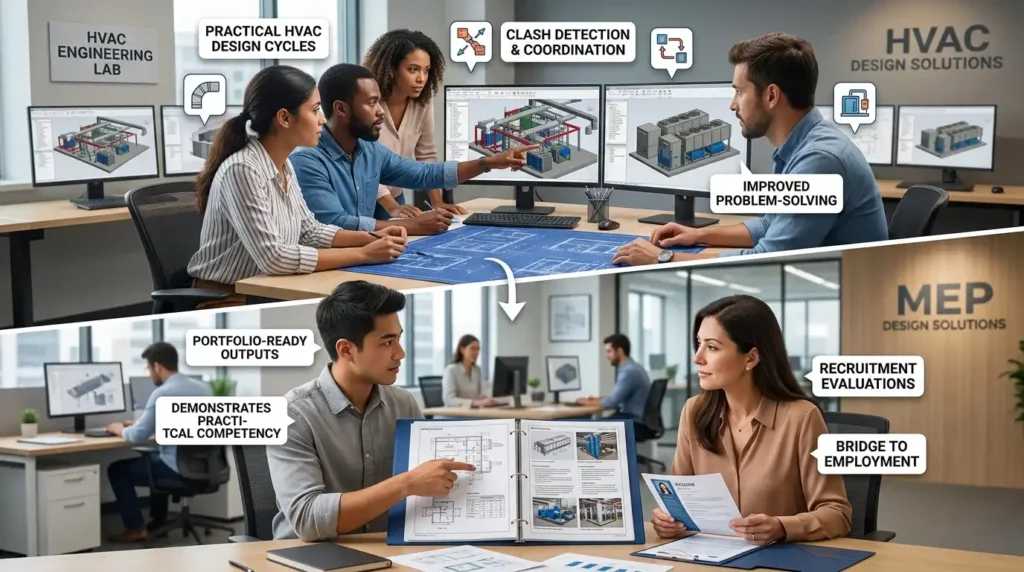
Project-based learning plays a central role by exposing learners to real-world HVAC design challenges, improving problem-solving under constraints, and developing portfolio-ready outputs that demonstrate practical competency to MEP employers during recruitment evaluations.
Project-based learning transforms theoretical knowledge into applied skill. Instead of isolated exercises, learners complete full HVAC design cycles, including system planning, drafting, coordination, and final documentation.
This method improves decision-making speed. Trainees must select duct routes, place equipment efficiently, and maintain compliance with spatial limitations. These decisions mirror real engineering constraints.
It also strengthens error recognition ability. Learners identify clashes between HVAC and structural elements, correct routing inefficiencies, and refine layouts based on feedback loops.
A major advantage is portfolio development. Completed projects serve as evidence of capability during recruitment. Employers evaluate these portfolios to assess readiness for live project work.
Project-based learning therefore functions as a direct bridge between training environments and employment performance expectations in MEP firms.
How does AutoCAD HVAC training influence salary progression and career growth?
AutoCAD HVAC training influences salary progression by increasing technical responsibility, enabling access to coordination roles, improving project contribution value, and accelerating promotion from drafting roles to design engineering positions within MEP firms.
Salary progression in MEP firms is closely linked to responsibility levels. Graduates with HVAC AutoCAD skills transition faster from junior drafting roles to design execution positions.
This transition occurs because trained professionals contribute to higher-value tasks. Instead of only drafting, they participate in system design refinement and coordination problem-solving.
Firms also assign trained individuals to complex projects earlier. Exposure to larger projects increases skill depth and accelerates career development.
Salary increases are tied to productivity metrics such as drawing output accuracy, revision efficiency, and coordination success rate. Trained professionals consistently perform higher across these indicators.
Over time, this creates a structured progression path from CAD technician roles to HVAC design engineer positions, significantly improving long-term earning potential.
Which outcomes from AutoCAD HVAC and Plumbing Design Training Course matter most to recruiters?
Recruiters prioritise outcomes such as integrated HVAC and plumbing drafting capability, coordination accuracy across building systems, industry-standard documentation skills, and ability to deliver complete MEP drawings within commercial project deadlines efficiently.
The AutoCAD HVAC and Plumbing Design Training Course develops combined system understanding, which is highly valued in integrated MEP environments. Recruiters prioritise candidates who can work across multiple building services disciplines.
Integrated drafting capability is essential because HVAC and plumbing systems frequently intersect in design layouts. Candidates who understand both reduce coordination conflicts and improve project efficiency.
Discover More from Our Guide Library:
How Are Blocks Attributes and Dynamic Components Taught in AutoCAD HVAC Training?
How Does AutoCAD HVAC Training Distinguish P&IDs from Schematic Drawings?
Documentation accuracy is another key outcome. Employers expect consistent adherence to engineering drawing standards, including annotation precision and layer management.
Deadline performance is also critical. MEP projects operate under strict delivery schedules. Candidates trained in structured programmes demonstrate higher efficiency in producing complete drawing sets within time constraints.
These outcomes collectively define job readiness and determine placement success in competitive engineering recruitment environments.
How does AutoCAD HVAC and Plumbing training help in MEP jobs?
AutoCAD HVAC and Plumbing training improves job readiness by teaching industry-standard drawing practices and system coordination techniques. It enables learners to produce accurate HVAC layouts and plumbing designs used in real MEP project documentation.
Do I need prior AutoCAD knowledge for HVAC and Plumbing training?
Basic AutoCAD knowledge is helpful but not always required for joining the AutoCAD HVAC and Plumbing Design Training Course at Imperial Corporate Training Institute. The training typically starts with core drafting tools before moving into HVAC and plumbing system design applications.
What skills are gained from AutoCAD HVAC and Plumbing Design training?
Learners gain skills in HVAC duct design, plumbing layouts, CAD documentation, and multi-discipline coordination. The course also develops technical drawing accuracy and understanding of MEP standards used in construction projects.