

Junior engineers produce recurring HVAC AutoCAD errors such as incorrect duct sizing, missing coordination with structural grids, layer mismanagement, and inconsistent annotation standards. These errors disrupt MEP coordination, increase rework cycles, and reduce overall design accuracy in corporate engineering projects.
In corporate MEP departments, HVAC AutoCAD drawings operate as coordination documents between architecture, structure, and mechanical systems. Junior engineers often treat drawings as isolated tasks rather than integrated system outputs.
Common errors include incorrect duct routing, where airflow paths conflict with beams or lighting layouts. Another frequent issue is wrong scaling, where drawings do not match project units, leading to fabrication mismatches on site.
Layer mismanagement creates additional confusion. Engineers place ducts, valves, and annotations on incorrect layers, breaking BIM coordination standards used in modern engineering firms across sectors like construction, oil and gas, and infrastructure development.
Annotation inconsistency also creates interpretation gaps between design teams and contractors. Abbreviations, symbols, and tagging systems often differ from corporate standards.
These errors collectively increase revision cycles by 25–40 percent in structured engineering environments. They also delay approval workflows during design review stages, especially in multi-disciplinary coordination meetings.
Why do junior engineers repeatedly produce HVAC AutoCAD drawing errors in engineering departments?
Junior engineers repeat HVAC AutoCAD errors due to weak standardisation exposure, limited simulation practice, poor understanding of MEP coordination logic, and insufficient training in corporate drafting protocols used in structured engineering environments.
In most engineering organisations, junior staff enter workflows with software familiarity but without system-level design thinking. AutoCAD proficiency alone does not ensure HVAC design accuracy.
A primary cause is lack of exposure to engineering standards such as SMACNA duct design rules and ISO-based drafting conventions. Without these frameworks, engineers rely on visual placement instead of performance-based design logic.
Another key factor is absence of structured review cycles. In many departments, drawings are checked only at final submission stage instead of iterative validation during design development.
Training gaps also create dependency on senior engineers. This slows productivity and creates bottlenecks in design teams where one senior reviewer manages 5–10 junior outputs.
Organisations that do not implement simulation-based learning environments report up to 30 percent higher rework rates compared to structured training environments using case-based HVAC drafting scenarios.
How does HVAC AutoCAD drawing error detection impact project delivery timelines and cost control?
Early detection of HVAC AutoCAD drawing errors reduces rework cycles, shortens design approval timelines by 20–35 percent, and improves cost control by preventing material wastage and coordination conflicts during construction execution phases.
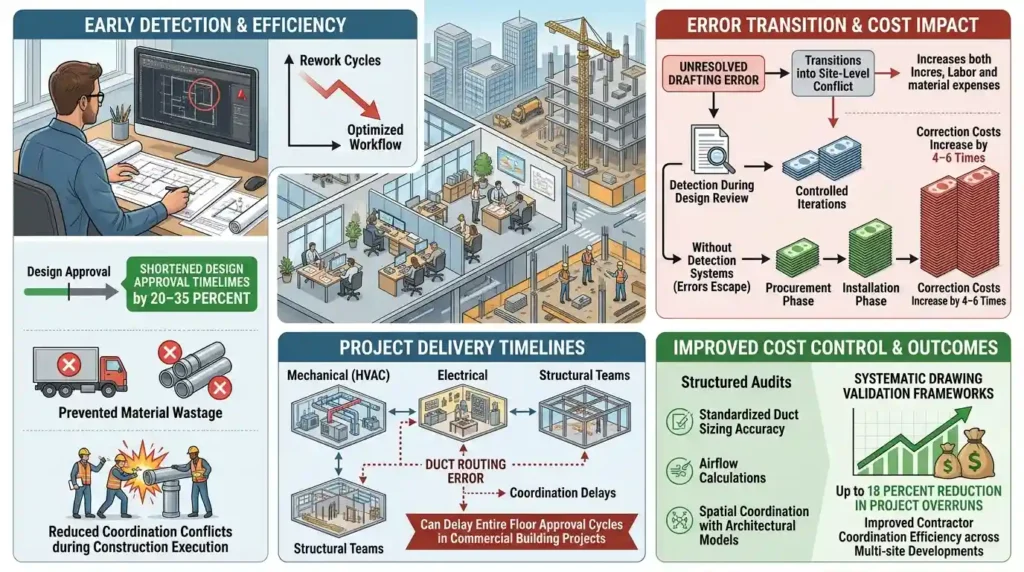
In corporate engineering workflows, error detection is not a corrective activity but a cost control mechanism. Each unresolved drafting error transitions into site-level conflict, increasing both labour and material expenses.
When HVAC drawing errors are detected during design review stages, revision cycles remain within controlled iterations. Without detection systems, errors reach procurement and installation phases, where correction costs increase by 4–6 times.
Project delivery timelines are directly affected by coordination delays between mechanical, electrical, and structural teams. A single duct routing error can delay entire floor approval cycles in commercial building projects.
Cost control improves significantly when organisations implement structured drawing audits. These audits standardise duct sizing accuracy, airflow calculations, and spatial coordination with architectural models.
Organisations using systematic drawing validation frameworks report up to 18 percent reduction in project overruns and improved contractor coordination efficiency across multi-site developments.
What components define structured AutoCAD HVAC and Plumbing Design Training in organisations?
Structured AutoCAD HVAC training includes drafting standards, MEP coordination principles, simulation-based exercises, compliance frameworks, and assessment-driven workflows designed to reduce errors and build consistent engineering output quality across teams.
A structured training system is built on five core components that align with corporate engineering expectations.
The first component is drafting standardisation. This includes layer naming conventions, annotation rules, and symbol consistency aligned with international MEP documentation standards.
The second component is system design logic. Engineers learn airflow distribution, load balancing, and equipment placement principles instead of isolated drawing tasks.
The third component is coordination training. This focuses on conflict detection between HVAC systems and structural or electrical layouts using clash-awareness methods.
The fourth component is simulation-based learning. Engineers replicate real project environments using case studies from commercial buildings, healthcare facilities, and industrial plants.
The fifth component is performance assessment. Organisations measure output accuracy, drawing completion time, and revision rates to evaluate training effectiveness.
These components align training outcomes with measurable corporate KPIs instead of theoretical learning outcomes.
How does corporate AutoCAD HVAC training work step by step in engineering teams?
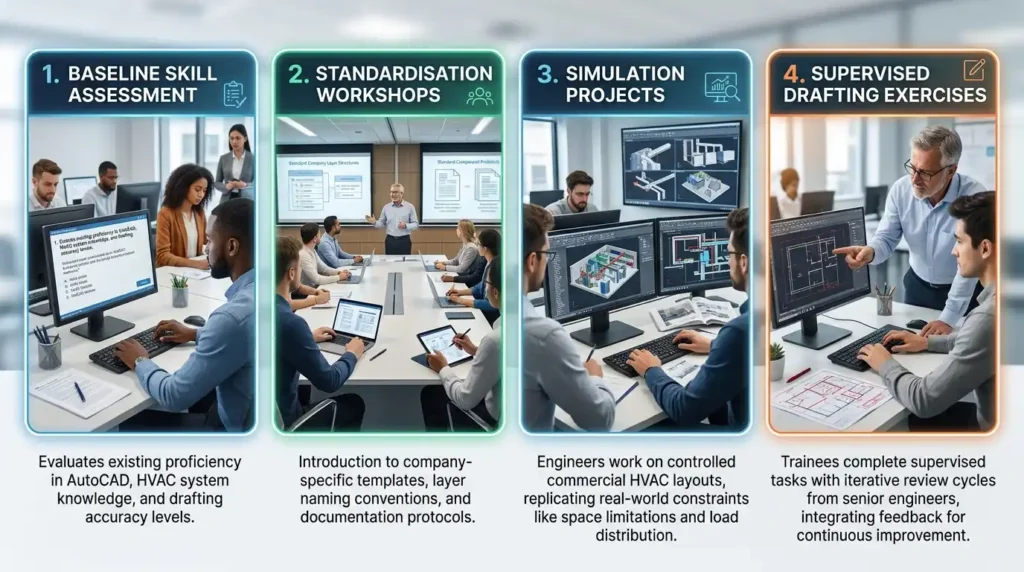
Corporate AutoCAD HVAC training follows a structured workflow involving baseline skill assessment, standardisation workshops, simulation projects, supervised drafting exercises, and performance evaluation aligned with engineering KPIs and project delivery benchmarks.
Training begins with a competency assessment that evaluates AutoCAD proficiency, HVAC system understanding, and drafting accuracy levels. This establishes a baseline for skill gaps.
The second stage involves standardisation workshops where engineers are introduced to company-specific drafting templates, layer structures, and documentation protocols.
The third stage focuses on simulation projects. Engineers work on controlled HVAC layouts for commercial buildings, replicating real engineering constraints such as space limitations and load distribution requirements.
The fourth stage includes supervised drafting tasks. Senior engineers review outputs in iterative cycles, ensuring continuous correction and feedback integration.
For deeper evaluation frameworks and structured capability building approaches, organisations often align training with:
How Does AutoCAD HVAC Training Help Junior Draughtsmen Build Professional Habits? especially when transitioning from awareness-level training to implementation-level competency development.
The final stage is performance evaluation. Metrics include drawing accuracy rate, revision frequency reduction, and average project turnaround improvement.
Organisations implementing this step-by-step model report up to 35 percent improvement in drafting efficiency within 90 days.
For deeper insight, enrol in:
AutoCAD HVAC and Plumbing Design Training Course.
What measurable benefits do organisations gain from reducing HVAC AutoCAD drawing errors?
Organisations reduce project delays, improve design accuracy by 30–45 percent, lower rework costs, and increase engineering team productivity through standardised HVAC AutoCAD training and structured drafting error elimination systems.
Error reduction directly improves engineering throughput. When junior engineers produce accurate drawings, senior engineers shift focus from correction to optimisation.
Productivity increases because revision cycles decrease significantly. In structured environments, drafting time per project reduces by 20–30 percent due to fewer coordination conflicts.
Cost savings occur through reduced material wastage and fewer site-level modifications. In large commercial projects, this translates into measurable savings across procurement and installation phases.
Quality improvement also enhances client satisfaction metrics. Organisations report higher approval rates during design submission reviews when drawing accuracy remains above 90 percent consistency.
Retention rates improve as structured learning environments reduce role frustration among junior engineers. Clear standards eliminate ambiguity in task execution.
These benefits collectively strengthen organisational engineering maturity and improve delivery predictability across multi-project portfolios.
Where is HVAC AutoCAD training applied across industries and project types?
HVAC AutoCAD training is applied in construction, healthcare infrastructure, industrial manufacturing, data centres, and commercial real estate projects where precision-driven MEP coordination and system efficiency define operational performance outcomes.
In construction, training supports high-rise residential and commercial developments where HVAC systems must integrate with dense structural frameworks.
In healthcare, precision becomes critical due to airflow control requirements in operating theatres and isolation units. Drawing accuracy directly impacts compliance and safety standards.
Industrial manufacturing facilities require HVAC systems designed for temperature regulation and process control environments. Errors in these systems affect production stability.
Data centres rely on precision cooling systems where airflow imbalance leads to equipment failure risks. Engineering accuracy directly impacts uptime reliability.
Commercial real estate projects prioritise energy efficiency and occupant comfort, requiring accurate load calculations and duct distribution planning.
Across these industries, AutoCAD HVAC training ensures that junior engineers contribute to consistent, standards-aligned outputs.
What implementation challenges occur when organisations ignore structured drafting standards?
Organisations without structured drafting standards experience high rework rates, inconsistent design outputs, delayed project approvals, increased coordination conflicts, and reduced engineering efficiency across HVAC and MEP project teams.
The absence of structured standards leads to fragmented design practices. Each engineer develops individual drafting habits, resulting in inconsistent outputs across teams.
Rework rates increase significantly because errors are detected late in the project lifecycle. This shifts correction costs from design teams to construction teams.
Discover More from Our Guide Library:
How Does AutoCAD HVAC Handle Chiller Plant and Cooling Tower System Design?
Why Is AutoCAD HVAC Design Training Increasingly Important for MEP Engineers?
Coordination conflicts become frequent in multi-disciplinary projects. HVAC systems clash with electrical trays and structural beams due to lack of integrated design logic.
Approval delays occur because stakeholders receive non-standardised documentation, making review cycles longer and less predictable.
Engineering efficiency decreases as senior engineers spend excessive time correcting junior outputs instead of focusing on design optimisation and project strategy.
Organisations that fail to implement structured training frameworks experience up to 40 percent lower design throughput compared to standardised engineering environments.
What is AutoCAD HVAC and Plumbing Design Training used for in engineering companies?
AutoCAD HVAC and Plumbing Design Training is used to develop accurate mechanical and piping drawings for building services projects. At Imperial Corporate Training Institute, it helps engineers understand HVAC layouts, ducting systems, and plumbing coordination within real construction workflows.
How does AutoCAD HVAC training improve drafting accuracy for junior engineers?
It improves drafting accuracy by teaching standardised layers, symbols, and MEP coordination rules used in professional projects. Imperial Corporate Training Institute focuses on reducing common errors like incorrect scaling, duct clashes, and annotation inconsistencies through structured practice.
What skills are included in AutoCAD HVAC and Plumbing Design training?
The training includes HVAC system drafting, duct sizing concepts, plumbing layouts, and coordination with architectural and structural drawings. It also covers industry standards, drawing interpretation, and real project-based simulation exercises for better technical understanding.
How does AutoCAD HVAC training support project coordination in MEP design?
It improves coordination by teaching engineers how to align HVAC systems with electrical and structural components in shared project environments. The training at Imperial Corporate Training Institute emphasises clash detection, workflow standardisation, and documentation consistency.