
AutoCAD HVAC and plumbing designers in the UK earn between £28,000 and £65,000 depending on experience, project complexity, software proficiency, and sector demand. Salary growth is linked to labour shortages, the adoption of digital construction, and compliance-driven requirements in building services engineering across commercial and infrastructure projects.
The UK construction and engineering market has shifted towards digitally managed building services systems. Mechanical, electrical, and plumbing coordination now depends heavily on computer-aided drafting and modelling. Organisations require professionals who can produce accurate HVAC and plumbing drawings aligned with British Standards, sustainability targets, and project delivery deadlines.
AutoCAD HVAC and plumbing designers work within building services engineering teams. Their role involves preparing technical drawings, coordinating layouts, identifying clashes, and supporting installation teams during project execution. Employers across industries like healthcare, education, oil and gas, residential development, logistics, and commercial real estate rely on these professionals to reduce construction errors and improve operational efficiency.
Salary increases are also connected to the growth of smart buildings and energy-efficient infrastructure. UK regulations now require improved ventilation standards, sustainable plumbing systems, and energy-performance compliance. Organisations therefore invest in technical staff who understand HVAC workflows, ducting systems, pipe sizing, airflow calculations, and coordinated design documentation.
A junior AutoCAD HVAC and plumbing designer with 1–2 years of experience typically earns £28,000–£35,000 annually. Mid-level designers working on commercial or industrial projects earn £38,000–£50,000. Senior specialists involved in multidisciplinary coordination, BIM integration, and project supervision earn between £55,000 and £65,000 or more.
What does an AutoCAD HVAC and plumbing designer do inside a corporate engineering environment?
An AutoCAD HVAC and plumbing designer creates technical drawings, system layouts, and coordinated construction documentation used by engineers, contractors, and project managers to install mechanical and plumbing systems accurately within commercial, industrial, and residential buildings.
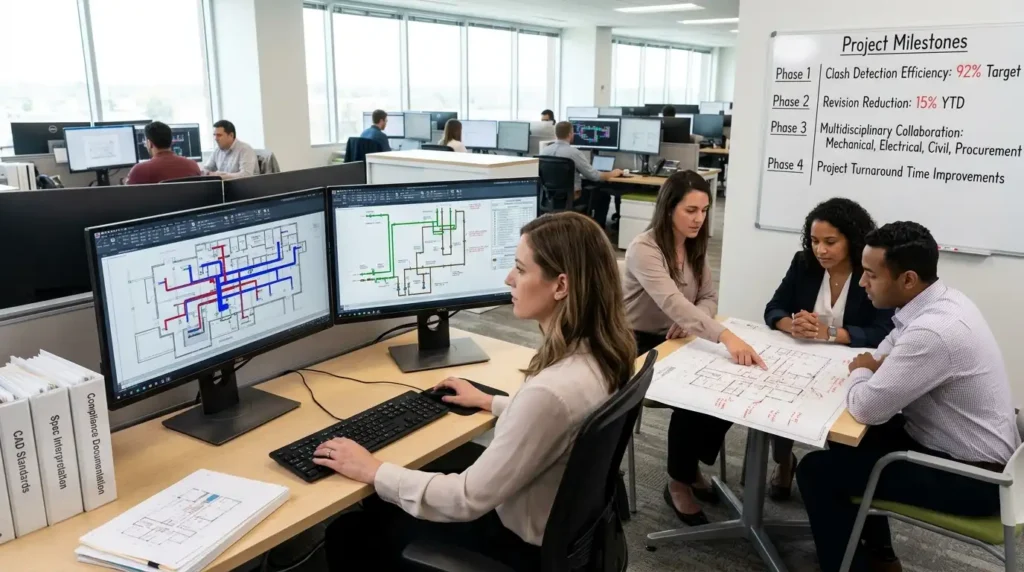
The role extends beyond drafting. Designers participate in project coordination meetings, interpret engineering specifications, and support compliance documentation. In corporate engineering environments, design accuracy directly affects project timelines, installation quality, and operational safety.
HVAC design tasks include preparing duct layouts, ventilation schematics, chilled water systems, air distribution plans, equipment schedules, and plant room drawings. Plumbing design tasks include water supply systems, drainage networks, sanitary layouts, riser diagrams, and piping coordination.
Organisations structure these workflows through multidisciplinary collaboration. HVAC designers work closely with civil engineers, architects, procurement teams, quantity surveyors, and commissioning specialists. Every drawing affects procurement schedules, installation sequencing, and site operations.
Large engineering firms use standardised workflows to maintain consistency. Drawing templates, layer conventions, annotation standards, revision controls, and naming structures ensure efficient communication across departments and project phases.
Training programmes focus on technical execution and operational alignment. Corporate learning environments prioritise measurable competencies such as drawing accuracy rates, revision reduction percentages, clash detection efficiency, and project turnaround time improvements.
For deeper insight enrol in:
AutoCAD HVAC and Plumbing Design Training Course.
How do organisations use AutoCAD HVAC and plumbing design training to close workforce skill gaps?
Organisations use structured AutoCAD HVAC and plumbing training to standardise technical competencies, improve drawing accuracy, reduce rework costs, and strengthen project coordination capabilities across engineering, facilities management, and construction departments.
Many organisations experience skill gaps when transitioning from traditional drafting processes to digitally coordinated workflows. Teams often understand basic AutoCAD functions but lack specialised HVAC and plumbing design knowledge. This creates delays during construction coordination and increases revision cycles.
Training programmes address these operational weaknesses through structured learning pathways. Companies assess employee capabilities using technical evaluations, drawing reviews, and workflow analysis. Learning and development teams then map training outcomes against project requirements.
Corporate training delivery commonly includes:
Workshops and instructor-led sessions
Engineering teams participate in practical drafting exercises using live project examples. Sessions focus on HVAC layouts, piping systems, duct routing, and equipment placement.
Online learning modules
Digital modules provide flexible access for geographically distributed teams. Organisations use these modules for command practice, drawing standardisation, and revision management.
Hybrid learning models
Hybrid delivery combines classroom instruction with digital simulations and project-based assignments. This format improves knowledge retention and supports operational continuity.
Assessment-driven learning
Technical assessments measure drafting accuracy, layer management, annotation quality, and system coordination. Organisations use assessment data to track competency development and workforce readiness.
Training effectiveness is measured through operational KPIs. Companies monitor drawing approval times, coordination errors, project delays, and installation discrepancies before and after implementation.
Engineering firms that standardise CAD training often report measurable improvements in workflow efficiency. Reduced rework percentages and faster drawing approvals improve project profitability and resource allocation.
Which AutoCAD skills have the highest value in HVAC and plumbing design roles?
The highest-value AutoCAD HVAC and plumbing skills include layered drawing management, system coordination, block creation, annotation standards, clash reduction, piping layouts, duct routing, and multidisciplinary drawing integration within commercial construction environments.
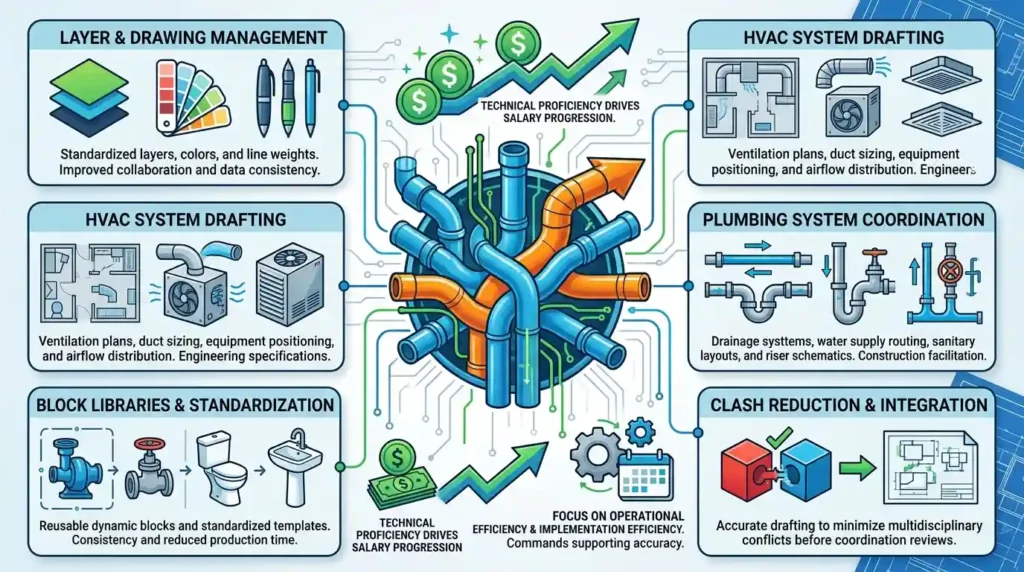
Technical proficiency directly influences salary progression. Employers prioritise designers who understand both software operation and building services engineering principles.
Key competencies include:
Layer and drawing management
Designers organise drawings using standardised layers, colours, line weights, and naming conventions. This improves collaboration between departments and contractors.
HVAC system drafting
Teams produce ventilation layouts, duct sizing plans, equipment positioning, and airflow distribution drawings aligned with engineering specifications.
Plumbing system coordination
Designers prepare drainage systems, water supply routing, sanitary layouts, and riser schematics for construction and maintenance teams.
Block libraries and standardisation
Companies use reusable dynamic blocks and templates to improve drawing consistency and reduce production time.
Annotation and documentation
Clear labelling, dimensions, schedules, and technical notes improve installation accuracy and reduce communication errors.
Clash detection preparation
Although clash detection often occurs within BIM environments, accurate AutoCAD drafting reduces conflicts before coordination reviews begin.
At this stage of workforce development, many organisations evaluate the operational relevance of specialised drafting workflows and technical command proficiency.
Teams analysing implementation efficiency often review topics such as:
Which AutoCAD commands support HVAC and plumbing drawing accuracy during project delivery.
This transition from foundational awareness to technical evaluation reflects how organisations align training investments with measurable engineering outcomes.
How does AutoCAD HVAC and plumbing design training work in corporate learning environments?
Corporate AutoCAD HVAC and plumbing design training follows a structured process involving competency assessment, technical instruction, guided project work, practical simulations, performance evaluation, and post-training operational measurement aligned with business objectives and engineering standards.
Training implementation starts with organisational analysis. Learning and development teams identify performance gaps affecting project execution, drawing quality, and coordination efficiency.
The process generally follows five stages.
Stage 1: Skills assessment
Employees complete technical evaluations covering drafting fundamentals, HVAC concepts, and plumbing coordination. Managers identify capability gaps affecting project performance.
Stage 2: Technical instruction
Participants learn AutoCAD workflows used in real engineering environments. Training covers drawing standards, system layouts, annotation methods, and revision management.
Stage 3: Simulation-based practice
Learners complete practical exercises using project-style scenarios. Simulations improve workflow familiarity and strengthen technical confidence.
Stage 4: Project application
Teams apply skills within supervised assignments. Trainers review layouts, layer structures, and coordination accuracy using measurable benchmarks.
Stage 5: Performance evaluation
Organisations track post-training KPIs such as drawing turnaround times, revision frequencies, and coordination efficiency rates.
Corporate learning methodologies focus heavily on practical execution. Case-based learning helps employees understand how design decisions affect procurement, installation, maintenance, and compliance activities.
Engineering organisations also integrate collaborative learning strategies. Team-based projects improve communication between HVAC designers, plumbing specialists, architects, and site engineers.
What business benefits do organisations gain from skilled HVAC and plumbing design teams?
Organisations with skilled HVAC and plumbing design teams achieve lower rework costs, faster project delivery, improved compliance accuracy, reduced installation conflicts, stronger cross-department coordination, and higher operational efficiency across engineering and construction projects.
Technical drafting quality affects every stage of construction delivery. Poorly coordinated drawings increase procurement delays, installation errors, and project disputes.
Well-trained design teams improve operational performance through several measurable outcomes.
Reduced project delays
Accurate drawings improve contractor understanding and reduce clarification requests during construction.
Lower rework costs
Early coordination reduces clashes between ducting, piping, electrical systems, and structural components.
Improved compliance performance
Designers trained in industry standards produce documentation aligned with UK building regulations and engineering specifications.
Faster approval cycles
Consistent drafting standards improve communication between consultants, clients, and approval authorities.
Better resource allocation
Efficient design workflows reduce overtime requirements and improve project scheduling accuracy.
Stronger multidisciplinary collaboration
Standardised documentation improves communication across engineering, procurement, facilities, and operations teams.
Many organisations calculate training ROI using operational performance metrics. Common indicators include:
- Drawing approval turnaround time
- Installation error frequency
- Revision percentage reduction
- Coordination meeting duration
- Labour productivity improvement
- Project delivery variance
Engineering firms increasingly connect workforce capability development with strategic business performance. Skilled technical teams strengthen competitiveness during tendering, infrastructure expansion, and digital transformation initiatives.
Which industries in the UK hire AutoCAD HVAC and plumbing designers most frequently?
Industries with the highest demand for AutoCAD HVAC and plumbing designers include commercial construction, healthcare infrastructure, manufacturing, oil and gas, residential development, transportation, facilities management, and data centre engineering sectors throughout the UK.
Demand varies according to infrastructure investment, sustainability regulations, and building modernisation requirements.
Commercial construction
Office developments, retail centres, and mixed-use buildings require coordinated HVAC and plumbing systems for occupant comfort and operational efficiency.
Healthcare facilities
Hospitals and laboratories require complex ventilation systems, pressure-controlled environments, and specialist plumbing infrastructure.
Manufacturing and industrial facilities
Factories depend on process ventilation, cooling systems, compressed air routing, and industrial drainage layouts.
Residential developments
Large housing projects require scalable plumbing coordination, ventilation planning, and utility integration.
Data centres
Data centres use advanced cooling systems and precision airflow management to maintain operational stability.
Transportation infrastructure
Airports, rail facilities, and logistics hubs require integrated mechanical systems supporting large-scale occupancy and operational continuity.
Facilities management companies also recruit skilled designers for refurbishment projects, maintenance planning, and system upgrades. Retrofitting older buildings for sustainability compliance has significantly increased demand for technical drafting specialists.
What common misconceptions reduce the effectiveness of AutoCAD HVAC and plumbing training?
The most common misconceptions include treating AutoCAD as only drafting software, focusing on theory instead of workflows, ignoring industry standards, using generic training content, and failing to measure operational outcomes after workforce development programmes.
Many organisations implement ineffective technical training because learning objectives are disconnected from operational requirements.
One major misconception is that software familiarity equals engineering competence. Employees often understand basic commands but lack knowledge of HVAC coordination, system integration, and construction workflows.
Another issue involves generic course structures. Broad CAD training without sector-specific application fails to prepare employees for commercial engineering environments.
Ineffective programmes also rely heavily on passive learning. Lecture-only delivery reduces knowledge retention and limits practical application. Organisations achieve stronger outcomes through project simulations, case-based learning, and performance-driven assessments.
Some companies neglect post-training measurement entirely. Without operational KPIs, learning teams cannot evaluate workforce improvement or justify training investment.
Effective workforce development aligns technical education with measurable business outcomes. Organisations therefore integrate learning frameworks directly into engineering operations, project delivery standards, and performance management systems.
Why does AutoCAD HVAC and plumbing expertise support long-term workforce transformation?
AutoCAD HVAC and plumbing expertise supports workforce transformation by strengthening digital engineering capabilities, improving technical standardisation, enabling multidisciplinary collaboration, and preparing organisations for modern construction technologies including BIM-integrated project delivery environments.
The construction and engineering industries continue to adopt digital delivery systems. Technical teams now work within integrated environments combining CAD drafting, BIM coordination, sustainability analysis, and facilities management data.
Workforce transformation depends on adaptable technical capability. Organisations therefore prioritise practical learning systems that combine software proficiency with operational understanding.
AutoCAD HVAC and plumbing expertise also supports succession planning. Experienced designers often progress into BIM coordination, project supervision, facilities engineering, and technical management roles.
Discover More from Our Guide Library:
How Does AutoCAD Help Engineers Produce Compliant Plumbing Design Drawings?
What Types of Projects Require AutoCAD HVAC and Plumbing Design Skills?
Learning and development strategies increasingly focus on scalable capability building rather than isolated software instruction. Organisations invest in structured technical education because operational efficiency, compliance performance, and project profitability depend heavily on workforce competence.
Training frameworks aligned with real-world engineering requirements create measurable organisational impact. Standardised workflows, practical learning methodologies, and assessment-driven implementation strengthen both project delivery and long-term business resilience.
What is included in the AutoCAD HVAC and Plumbing Design Training Course at Imperial Corporate Training Institute?
The AutoCAD HVAC and Plumbing Design Training Course at Imperial Corporate Training Institute covers HVAC duct design, plumbing layouts, piping systems, and technical drawing standards. It also includes AutoCAD commands, layer management, annotation, and project-based drafting for building services engineering.
Who should take an AutoCAD HVAC and Plumbing Design Training Course?
This course is designed for CAD technicians, mechanical engineers, HVAC designers, plumbing designers, and construction professionals. It also suits graduates entering building services engineering roles and teams involved in MEP coordination projects.
What skills will I gain from AutoCAD HVAC and Plumbing Design Training?
Learners gain skills in HVAC system drafting, plumbing network design, AutoCAD command usage, and technical documentation. The training also develops competence in coordinated building services drawings used in construction and infrastructure projects.
How is AutoCAD HVAC and Plumbing Design Training delivered in corporate environments?
In corporate environments, Imperial Corporate Training Institute delivers the training through instructor-led sessions, workshops, and project-based simulations. The focus is on real engineering workflows, drawing standards, and practical application in HVAC and plumbing design projects.