

BIM stands for Building Information Modelling, a digital process that creates and manages 3D models of HVAC and plumbing systems integrated with building data. In corporate environments, it addresses skill gaps in MEP design by enabling teams to collaborate on accurate, data-rich models that reduce errors by 20-30% in construction projects.
BIM represents a shift from 2D drawings to intelligent 3D models. Each element in the model, such as ducts, pipes, or valves, carries attributes like material specifications, dimensions, and performance data. HR managers and L&D professionals use BIM training to equip MEP engineers with tools that align designs with project timelines and budgets.
In workplaces, BIM tackles employee skill gaps where traditional drafting fails to capture system interactions. Teams in construction firms build parametric models that update automatically when changes occur. This process supports corporate goals like faster project delivery and lower rework costs.
Organizations implement BIM through structured training programs. These programs last 40-60 hours and include online modules and workshops. Delivery formats range from virtual simulations to on-site case studies, ensuring engineers apply models to real HVAC layouts with plumbing integrations.
BIM vs AutoCAD in HVAC and Plumbing Design
BIM uses intelligent 3D models with embedded data for clash detection and lifecycle management, while AutoCAD relies on 2D/3D drafting without parametric links. BIM cuts coordination time by 40% in HVAC-plumbing projects; AutoCAD requires manual updates, increasing errors by 25%.
AutoCAD serves as vector-based drafting software for precise 2D line work and basic 3D modelling. Engineers draw HVAC ducts or plumbing pipes as static lines without inherent data connections. In corporate teams, this limits scalability for large projects spanning multiple disciplines.
BIM, by contrast, employs object-oriented modelling. A pipe in BIM links to flow rates, insulation types, and installation schedules. This integration reveals clashes, such as a duct intersecting a plumbing riser, before construction starts. Departments in engineering firms report 15-20% fewer field changes.
Training distinguishes the tools clearly. AutoCAD courses focus on commands like LINE and HATCH for layouts. BIM training covers software like Revit, teaching families—reusable parametric components—for HVAC diffusers and plumbing fixtures. L&D teams select formats like hybrid learning to bridge these differences.
Misconceptions arise when firms view BIM as an AutoCAD upgrade. AutoCAD excels in quick sketches but lacks BIM’s federated models, where HVAC data merges with architectural and structural inputs. Businesses waste resources on rework without BIM’s simulation capabilities.
Why Do Corporate Teams Need BIM Training Over AutoCAD for MEP Work?
BIM training builds interdisciplinary collaboration skills, reducing HVAC-plumbing conflicts by 35% through shared models. AutoCAD training limits teams to isolated drawings, leading to 20% higher coordination costs in corporate projects.
Employee skill gaps emerge in MEP departments handling complex buildings. Traditional AutoCAD users redraw sections after changes, delaying approvals by 2-3 weeks. BIM training instills model-based workflows, where updates propagate across views instantly.
Organizations deliver BIM training in 5-day workshops with hands-on simulations. Engineers model a hospital HVAC system, integrating plumbing risers and detecting clashes via automated tools. Assessments measure proficiency through KPI metrics like model accuracy rates above 95%.
Performance metrics track ROI. Firms achieve 25% productivity gains post-training, with KPIs including reduced RFIs (requests for information) by 30%. Team leaders monitor these via dashboards in BIM platforms.
Common problems include generic AutoCAD programs that ignore BIM’s data layers. Ineffective training yields low retention rates of 40%, as employees revert to familiar 2D habits. BIM programs use case-based learning to embed skills permanently.
How Does BIM Work in Corporate HVAC and Plumbing Design Processes?
BIM works through a collaborative workflow: create 3D models, add data parameters, run clash checks, and simulate performance. In organizations, this process shortens design cycles by 30% and integrates with fabrication via CNC outputs.
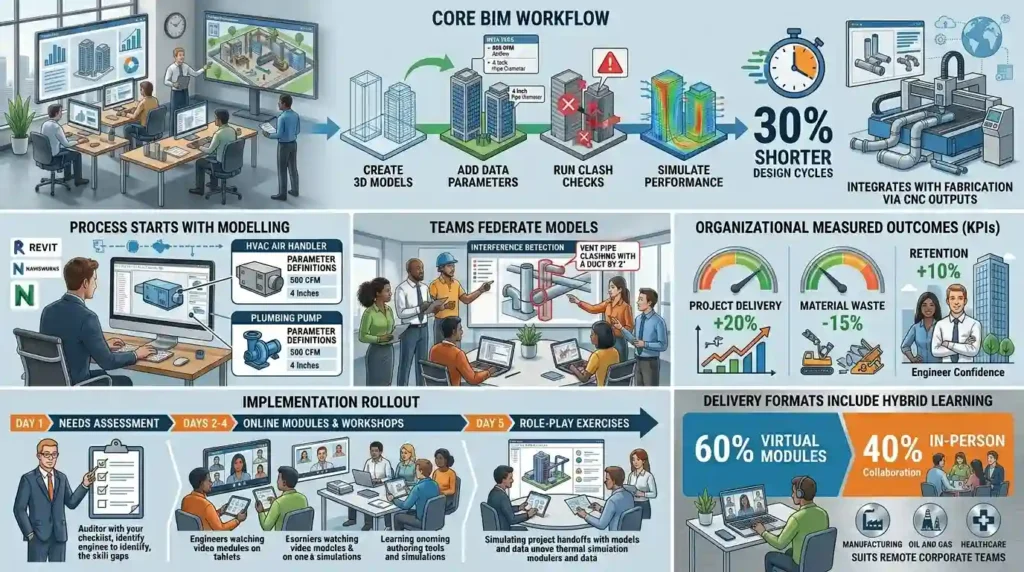
The process starts with modelling. Engineers build HVAC air handlers and plumbing pumps as linked objects in Revit or Navisworks. Parameters define airflow rates at 500 CFM or pipe diameters of 4 inches.
Next, teams federate models. HVAC files import into a central model with plumbing and electrical data. Software detects interferences, flagging a vent pipe clashing with a duct by 2 inches.
Implementation follows a step-by-step rollout. Day 1: Needs assessment identifies skill gaps via audits. Day 2-4: Online modules teach authoring tools; workshops cover simulations. Day 5: Role-play exercises simulate project handoffs.
Organizations measure outcomes with KPIs. Post-implementation, project delivery improves by 20%, with 15% cuts in material waste. Retention rises 10% as engineers gain confidence in data-driven decisions.
Delivery formats include hybrid learning: 60% virtual modules for flexibility, 40% in-person for collaboration. This suits remote corporate teams in industries like manufacturing, oil and gas, and healthcare.
What Key Components Make Up Effective BIM Training for MEP Teams?
Key components include parametric modelling tools, clash detection software, data interoperability standards like IFC, and assessment modules. Training spans 50 hours, covering simulations and case studies for 90% skill mastery.
Parametric modelling forms the core. Engineers learn to create families for VAV boxes in HVAC or sanitary stacks in plumbing, embedding LOD (level of development) specs from 200 to 500.
Clash detection tools like Solibri run Navisworks exports. These identify 500+ issues per model, prioritised by severity.
Frameworks such as ISO 19650 guide implementation. Organizations adopt common data environments (CDEs) for version control, reducing errors by 25%.
Delivery formats feature workshops (20 hours), online modules (20 hours), and simulations (10 hours). Role-play scenarios mimic site coordination meetings.
Assessments use quizzes (70% pass rate) and project submissions scoring on accuracy. Tools include Revit, AutoCAD MEP, and FabTools for fabrication.
Learning methodologies incorporate case-based studies from real projects, like a 10-storey office tower with integrated HVAC-plumbing runs.
How Do Organizations Implement BIM in HVAC and Plumbing Workflows?
Organizations implement BIM via phased rollouts: pilot on one project, train 20-50 staff in 6 weeks, integrate with ERP systems, and scale firm wide. This yields 18% ROI within 12 months.
Phase 1 involves pilot selection. A team designs an HVAC system for a commercial building, modelling 200 ducts and 150 pipes.
Phase 2 delivers training. L&D schedules 40-hour programs with hybrid formats: weekly online sessions plus monthly workshops.
Phase 3 integrates tools. BIM models link to ERP for scheduling, auto-generating BOMs (bills of materials) accurate to 98%.
Business owners track KPIs like cycle time reductions of 25% and error rates dropping to under 5%. Team efficiency rises as coordination meetings shorten from 4 to 2 hours.
Common misconceptions centre on high costs. Initial setup costs £50,000 but recoups via 30% less rework. Generic programs fail; targeted BIM training aligns with corporate BIM execution plans (BEPs).
For deeper insights into practical applications, explore:
How AutoCAD HVAC training supports MEP engineers on construction projects. This bridges awareness of differences to evaluating targeted skill-building.
Enrol today:
AutoCAD HVAC and Plumbing Design Training Course.
What Measurable Outcomes Does BIM Produce for Corporate Teams?
BIM delivers 25-40% productivity boosts, 20% cost savings, and 15% faster project timelines. KPIs show 95% clash resolution pre-construction and 12% higher employee retention through skill enhancement.
Productivity metrics track design hours. Pre-BIM, HVAC teams spent 300 hours on coordination; post-training, this drops to 180 hours.
Cost savings stem from waste reduction. Plumbing material overages fall 22%, as models optimise pipe runs.
Timelines compress by simulating commissioning. Virtual airflow tests predict issues, avoiding 10-day delays.
Organizational impact includes stronger leadership pipelines. Trained engineers lead BIM coordination, improving team efficiency by 28%.
Retention improves with practical learning. Firms report 12-15% lower turnover in MEP departments, as skills match industry demands like net-zero buildings.
ROI calculations use formulas: (Benefits – Costs) / Costs × 100. A £100,000 program yields £180,000 savings, for 80% ROI in year one.
What Use Cases Show BIM’s Impact in Corporate Environments?
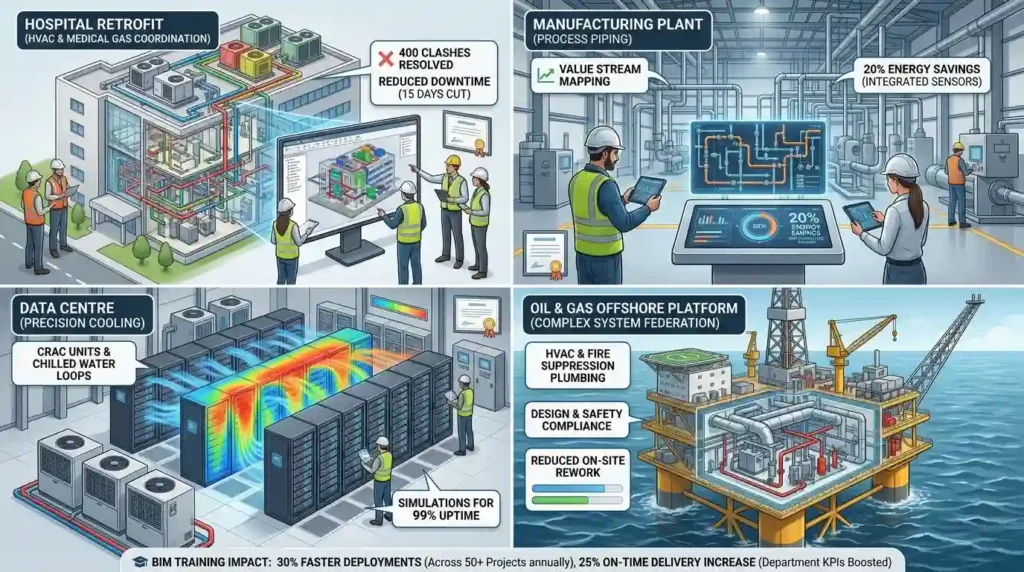
Use cases span construction firms retrofitting hospitals (HVAC upgrades with plumbing integration), manufacturing plants (process piping), and data centres (precision cooling). Training enables 30% faster deployments across 50+ projects annually.
In hospitals, BIM models coordinate rooftop HVAC units with medical gas plumbing, resolving 400 clashes and cutting downtime by 15 days.
Manufacturing uses BIM for value stream mapping of pipe networks, integrating sensors for 20% energy savings.
Data centres employ BIM for CRAC units and chilled water loops, achieving 99% uptime through simulations.
Corporate teams in oil and gas design offshore platforms, federating HVAC with fire suppression plumbing for compliance.
L&D professionals tailor training to these cases via simulations, boosting department KPIs like 25% on-time delivery.
How Do You Address Common Problems and Misconceptions in BIM Adoption?
Address problems by selecting outcome-based training with 90% completion rates, avoiding generic programs that yield 30% ROI shortfalls. Misconceptions like “BIM replaces AutoCAD” ignore their complementary roles in hybrid workflows.
Ineffective training plagues 40% of initiatives, with low engagement from lecture-only formats. Switch to simulations and role-play for 85% knowledge retention.
Lack of ROI stems from unmeasured KPIs. Track metrics like RFI reductions (40%) and productivity gains (25%) quarterly.
Discover More from Our Guide Library:
Why Do Plumbing Designers Use AutoCAD Instead of Manual Drafting Methods?
What Are the Basic Components of an HVAC System That Engineers Must Know?
Generic programs overlook industry specifics. Customise for HVAC-plumbing with real datasets from sectors like healthcare and finance.
Firms misconception BIM as software-only. It demands process changes, including CDE setups and BEP enforcement.
Overcome resistance with pilot successes: one project demonstrates 20% savings, scaling adoption firm-wide.
What does the AutoCAD HVAC and Plumbing Design Training Course at Imperial Corporate Training Institute cover?
The course covers 2D drafting, 3D modelling, HVAC ductwork layout, plumbing piping systems, and MEP coordination. Participants learn commands for symbols, annotations, and layer management specific to building services. It includes practical exercises on real-world designs like commercial HVAC systems.
Who should enrol in Imperial Corporate Training Institute’s AutoCAD HVAC training?
MEP engineers, drafters, and technicians in construction, architecture, and facilities management benefit most. The course suits professionals addressing skill gaps in precise HVAC and plumbing documentation. Beginners to intermediate users gain hands-on proficiency for project workflows.
What software skills do you gain from Imperial Corporate Training Institute’s AutoCAD plumbing design training?
Learners master pipe routing, fixture placement, isometric views, and bill of materials generation in AutoCAD MEP. Skills extend to clash avoidance and integration with HVAC elements. Outputs support fabrication and installation accuracy.