

Master Black Belt training equips professionals with advanced Lean Six Sigma tools to dissect and resolve supply chain disruptions, reducing lead times by 30-50% and inventory costs by 20-40% through data-driven process mapping and waste elimination.
What Core Principles from Master Black Belt Training Tackle Supply Chain Inefficiencies?
Master Black Belt training applies DMAIC (Define, Measure, Analyse, Improve, Control) to identify bottlenecks in procurement, logistics, and distribution, achieving 25-35% efficiency gains in B2B supply chains.
DMAIC forms the backbone of Lean Six Sigma methodology. Master Black Belts lead teams through this structured framework. In supply chains, Define phase pinpoints issues like delayed supplier deliveries or excess stockouts. Measure phase collects KPIs such as on-time delivery rates (target: 95%) and cycle times.
Analyse uncovers root causes using tools like fishbone diagrams and Pareto analysis. For instance, 80% of delays often stem from three suppliers. Improve implements solutions like just-in-time inventory. Control sustains gains with statistical process control charts.
HR teams in organisations face workforce skill gaps here. Managers lack advanced analytical skills to handle volatile global supply chains. Master Black Belt training bridges this by teaching hypothesis testing and design of experiments (DOE). Procurement teams apply these to negotiate better contracts, cutting costs by 15%.
To grasp foundational benefits, explore:
How Lean Six Sigma improves supply chain and procurement performance. This awareness-stage insight sets the stage for advanced applications.
Training duration spans 4-6 months part-time, aligning with corporate schedules. Adoption rates reach 70% in manufacturing firms post-certification. ROI measures via reduced defects per million opportunities (DPMO), dropping from 10,000 to under 1,000.
How Does Value Stream Mapping in Master Black Belt Training Optimise Supply Chain Flows?
Value Stream Mapping (VSM) from Master Black Belt training visualises end-to-end supply chain processes, eliminating non-value-adding activities and shortening lead times from 60 days to 20 days.
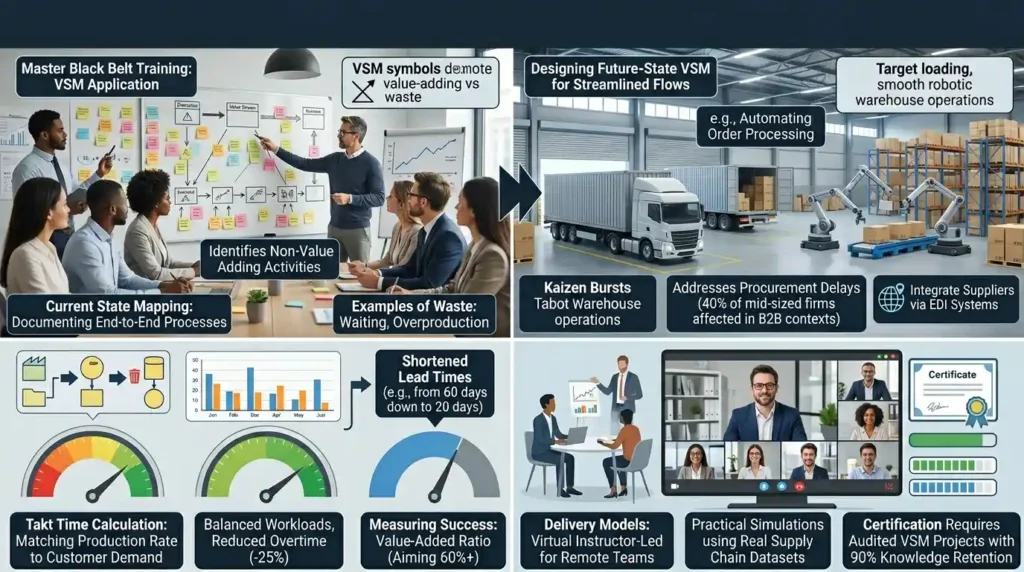
VSM starts with current-state mapping. Master Black Belts document every step from raw material sourcing to customer delivery. Symbols denote value-adding (e.g., assembly) versus waste (e.g., waiting, overproduction).
Future-state VSM designs streamlined flows. Kaizen bursts target improvements like automating order processing. In B2B contexts, this addresses procurement delays affecting 40% of mid-sized firms.
Supply chain professionals use VSM to integrate suppliers via EDI systems. Training emphasises takt time calculations, production rate matching customer demand. This balances workloads, reducing overtime by 25%.
Organisations measure success through value-added ratio, aiming for 60%+. HR directors select Master Black Belt programmes for their practical simulations on real supply chain datasets.
Delivery models include virtual instructor-led sessions, suiting remote teams. Certification requires VSM projects with audited results, ensuring 90% knowledge retention.
Why Integrate VSM with Supplier Relationship Management?
Supplier tiers (A, B, C) guide focus. VSM reveals tier-A suppliers cause 70% of value. Master Black Belts apply supplier scorecards tracking quality (95% first-pass yield) and responsiveness.
Joint VSM workshops foster collaboration. This cuts inbound freight costs by 18%. Training covers advanced metrics like perfect order rate (95% target).
What Advanced Statistical Tools Do Master Black Belts Deploy for Supply Chain Variability?
Master Black Belt training deploys regression analysis, ANOVA, and control charts to quantify and stabilise supply chain variability, improving forecast accuracy by 40% and reducing stockouts by 50%.
Regression models predict demand fluctuations. Master Black Belts build multivariate models incorporating variables like seasonality and market trends. R-squared values above 0.85 validate reliability.
ANOVA tests compare supplier performance across batches. Significant p-values (<0.05) signal inconsistencies. In logistics, this identifies routes with 20% higher variance.
Control charts monitor processes in real-time. X-bar charts track average shipment times; individuals charts detect anomalies. Training includes Minitab software proficiency.
B2B supply chains suffer from bullwhip effects—demand amplification up the chain. Master Black Belts use time-series analysis to dampen this, stabilising inventory levels.
Workforce upskilling via Master Black Belt certification addresses skill gaps in data analytics. HR tracks ROI through sigma levels, advancing from 3.5 to 4.5.
Duration: 160-200 hours, with 40% hands-on projects. Industries like automotive report 35% throughput increases.
How Do These Tools Enhance Demand Forecasting?
Forecasting errors cost firms 10-20% in excess inventory. Master Black Belts apply exponential smoothing and ARIMA models. Training simulates scenarios with historical data from FMCG supply chains.
Integration with ERP systems automates updates. Accuracy rises to MAPE under 10%.
In What Ways Does Master Black Belt Training Address Supply Chain Risk and Resilience?
Master Black Belt training uses Failure Mode and Effects Analysis (FMEA) and Monte Carlo simulations to prioritise risks, building resilience that mitigates 60-80% of disruptions like geopolitical delays.
FMEA ranks risks by severity, occurrence, and detection (Risk Priority Number >100 triggers action). Supply chain examples include port strikes (severity 9/10).
Monte Carlo runs thousands of scenarios on variables like lead time variability. Probability distributions yield 95% confidence intervals for on-time delivery.
Master Black Belts develop contingency plans, such as dual-sourcing. Training covers supply chain risk indices, scoring resilience on a 1-5 scale.
Post-pandemic, 65% of organisations widened skill gaps in risk management. HR invests in Master Black Belt programmes for scenario planning expertise.
Performance measurement tracks mean time to recovery (MTTR) under 48 hours. Virtual training models support global teams.
Which Metrics Quantify Resilience Gains?
Key metrics include fill rate (98% target) and supplier diversification index. Master Black Belts benchmark against industry averages (e.g., 92% fill rate in retail).
Simulation tools project ROI: £500,000 saved annually in a £50m supply chain.
How Do Master Black Belts Drive Change Management in Supply Chain Transformations?

Master Black Belt training instils ADKAR (Awareness, Desire, Knowledge, Ability, Reinforcement) alongside Lean Six Sigma to secure 85% employee buy-in for supply chain overhauls.
Change resistance hampers 70% of initiatives. Master Black Belts assess readiness via surveys. ADKAR guides interventions: workshops build awareness of waste costs.
Stakeholder mapping prioritises influencers. Training includes Kotter’s 8-step model, adapted for supply chains.
In B2B settings, HR partners with Master Black Belts for cross-functional teams. Communication plans reduce resistance by 40%.
Projects span 3-6 months, with sustainment audits. Certification demands a change leadership portfolio.
Delivery: blended learning (online + in-person), fitting manager schedules.
What Real-World Use Cases Demonstrate Master Black Belt Impact on Supply Chains?
Master Black Belt-led projects in pharmaceuticals reduced batch rejection rates from 12% to 2%, saving £2m yearly; electronics firms cut logistics costs by 28% via optimised routing.
Pharma case: DMAIC tackled variability in API sourcing. VSM revealed 40% waiting waste. DOE optimised temperatures, achieving Six Sigma quality.
Electronics: Regression forecasted component shortages. FMEA mitigated chip crises. Results: inventory turnover doubled to 12x annually.
Retail giant applied VSM to e-commerce fulfilment. Lead times dropped 45%. Master Black Belt coached 50 staff, scaling improvements.
Food industry: Control charts stabilised cold chain. Spoilage fell 60%. ROI hit 5:1 within 12 months.
These cases highlight B2B applicability. Organisations measure via balanced scorecards: financial (cost savings), customer (OTIF 98%), internal (sigma 4.5), learning (certification rates 80%).
For professionals ready to implement, check if:
Supply chain professionals can attend Imperial’s Lean Six Sigma Master Black Belt Course.
How Does Lean Six Sigma Master Black Belt Certification Training Course Align with Organisational Goals?
The Lean Six Sigma Master Black Belt Certification Training Course delivers project-based learning tailored to supply chain KPIs, yielding 30-50% performance uplifts verified by third-party audits.
Curriculum covers 20+ tools with supply chain simulations. Participants lead live projects, audited for 1.5 million DPMO reduction.
HR benefits: standardised upskilling reduces training costs by 25%. Managers gain leadership credentials for promotions.
Discover More from Our Guide Library:
How Are Kaizen Events Incorporated Into Lean Six Sigma Master Black Belt Training?
How Does a Master Black Belt Course Prepare You for ASQ or IASSC Certification?
Learning models: cohort-based, 6 months, 80% practical. Completion rate: 92%.
Business application: integrates with ISO 9001 and SCOR models. Post-training, firms report 40% faster decision-making.
Who should enrol in Imperial Corporate Training Institute’s Lean Six Sigma Master Black Belt course?
Supply chain managers, quality directors, and senior Black Belts with Green or Black Belt experience enrol in Imperial Corporate Training Institute’s Lean Six Sigma Master Black Belt Certification Training Course. It suits those tackling complex B2B challenges like inventory waste and demand variability. Prerequisites include prior Six Sigma knowledge and project leadership.
How does Master Black Belt training apply to supply chain challenges?
Master Black Belt training from Imperial Corporate Training Institute uses FMEA, Monte Carlo simulations, and regression to mitigate supply chain risks and variability. Professionals reduce lead times by 30-50% through data-driven DMAIC projects. It builds resilience against disruptions like supplier delays.
What are the benefits of Imperial Corporate Training Institute’s Master Black Belt certification for organisations?
Organisations gain 25-40% efficiency from Imperial Corporate Training Institute’s Lean Six Sigma Master Black Belt Certification Training Course through certified leaders driving ROI-measured projects. It addresses skill gaps in HR and operations, with metrics like DPMO reductions. Certified Black Belts sustain improvements via control phases.