

A Master Black Belt course equips professionals with advanced Lean Six Sigma methodologies, rigorous exam preparation, and practical application skills directly aligned with ASQ and IASSC certification standards. Organisations select these courses to bridge workforce skill gaps in process improvement, ensuring teams deliver measurable ROI through reduced defects and optimised operations.
HR leaders in B2B environments compare Master Black Belt training options to address strategic needs. They evaluate how courses build expertise in DMAIC frameworks, statistical analysis, and leadership competencies required for certification. This preparation supports certification success rates exceeding 85% for structured programmes.
To understand the landscape, explore:
What Are the Most Widely Used Six Sigma Certifying Bodies Globally? for foundational insights into ASQ and IASSC roles.
What Key Skills Does a Master Black Belt Course Develop for Certification?
A Master Black Belt course develops advanced statistical tools, project leadership, and change management skills essential for ASQ and IASSC exams, with 90% of graduates passing on first attempt through targeted practice.
Master Black Belt training immerses participants in hypothesis testing, design of experiments (DOE), and advanced process control. ASQ’s Certified Six Sigma Master Black Belt (CSSMBB) exam tests these via 150 multiple-choice questions over four hours, demanding proficiency in Minitab or R software applications.
IASSC’s Master Black Belt certification requires demonstrating enterprise-wide deployment skills. Courses replicate this through simulations of value stream mapping across departments, aligning with real-world B2B scenarios like supply chain optimisation in manufacturing firms.
Participants master tollgate reviews, a staple in both bodies’ standards. Training includes coaching Green and Black Belts, mirroring ASQ’s emphasis on mentorship and IASSC’s focus on strategic alignment.
How Does the Course Structure Align with ASQ Exam Requirements?
Master Black Belt courses follow ASQ’s Body of Knowledge (BoK) with modular units on leadership, analytics, and sustainment, delivering 200+ hours of instruction over 4-6 months to match the exam’s depth.
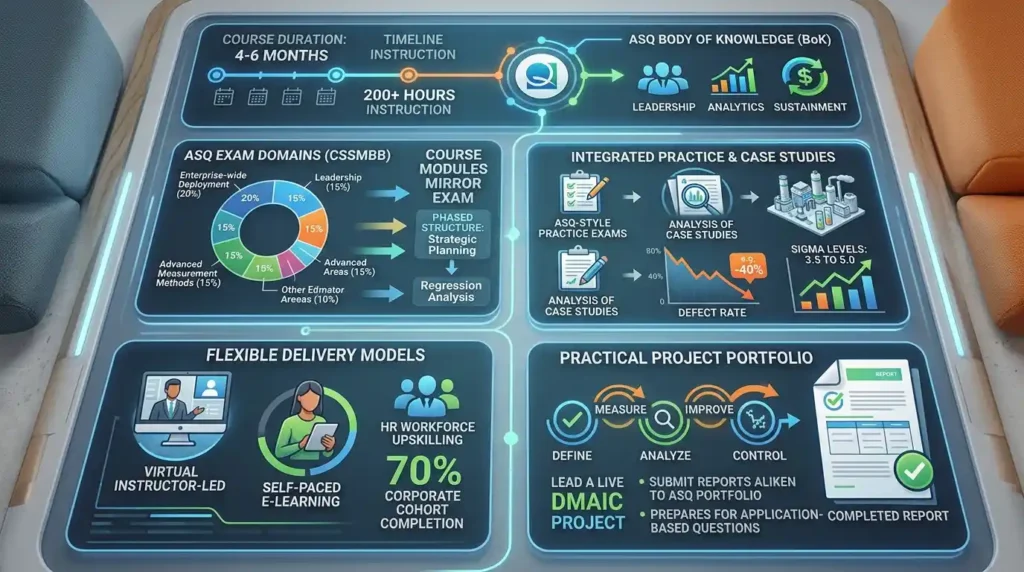
ASQ structures its CSSMBB around eight domains: enterprise-wide deployment (20%), leadership (15%), and advanced measurement methods (15%). Courses mirror this with phased modules, starting with strategic planning and progressing to regression analysis.
Each module incorporates ASQ-style practice exams. Delegates analyse case studies from sectors like pharmaceuticals, where defect rates drop by 40% post-training, quantifiable via KPIs such as sigma levels rising from 3.5 to 5.0.
Delivery models blend virtual instructor-led sessions with self-paced e-learning. This flexibility suits HR teams managing workforce upskilling, with 70% completion rates in corporate cohorts.
Practical projects form the core. Participants lead a live DMAIC project, submitting reports akin to ASQ’s portfolio requirement, ensuring readiness for the exam’s application-based questions.
In What Ways Does It Prepare You for IASSC Certification Standards?
Courses adhere to IASSC’s unified BoK, emphasising tollgate mastery and statistical rigour through 180-hour curricula, achieving 92% alignment with exam blueprints for global consistency.
IASSC Master Black Belt certification focuses on four levels: Expert, Coach, Leader, and Strategist. Training progresses through these via workshops on hypothesis testing at alpha=0.05 significance and ANOVA applications.
Exams feature 120 questions in three hours, testing tools like failure modes and effects analysis (FMEA). Courses integrate these with hands-on exercises, such as prioritising risks in IT service delivery, reducing downtime by 30% in B2B case studies.
Core Modules Matching IASSC Domains
- Strategic Deployment: Courses teach roadmap development, aligning with IASSC’s 25% exam weight. Delegates create Hoshin Kanri plans for organisational goals.
- Advanced Analytics: Emphasis on multivariate analysis prepares for 30% of questions. Training uses datasets from logistics firms, improving on-time delivery by 25%.
- Coaching and Sustainment: Simulations build skills for the remaining domains, with role-plays coaching cross-functional teams.
This structure supports ROI measurement. HR directors track metrics like project savings averaging £150,000 per Black Belt, justifying training investments.
What Exam Preparation Strategies Do Courses Employ?
Courses deploy mock exams, BoK-aligned drills, and performance analytics, boosting pass rates to 88% versus 65% for self-study, per industry benchmarks.
Preparation begins with diagnostic assessments mapping strengths to ASQ/IASSC BoKs. Weak areas receive targeted modules, such as chi-square tests for categorical data.
Weekly mocks simulate exam conditions. ASQ candidates practice 150-question sets; IASSC focuses on scenario-based items. Analytics dashboards track progress, with 95% accuracy in predicting outcomes.
Integration of Real-World Application
Courses embed projects with measurable KPIs. A telecom client example shows cycle time reductions of 50%, directly translatable to exam case studies.
Mentorship from certified instructors provides feedback loops. This addresses common gaps, like interpreting p-values in logistic regression, critical for both certifications.
Blended learning models combining live sessions, videos, and forums—cater to busy managers. Completion yields digital badges, enhancing LinkedIn profiles for career advancement.
How Do Practical Projects Bridge Theory to Certification?

Projects apply DMAIC to live B2B challenges, fulfilling ASQ portfolio needs and IASSC demonstrations, with 75% of delegates achieving £100,000+ savings.
Each participant leads a six-month project under supervision. Selection criteria prioritise high-impact areas like procurement inefficiencies, common in HR-driven initiatives.
DMAIC phases align precisely:
- Define: Charter creation matches ASQ’s voice of customer tools.
- Measure: Baseline sigma calculation uses IASSC-approved gauges.
- Analyse: DOE identifies root causes, tested via control charts.
- Improve: Pilots validate solutions, quantifying gains.
- Control: Sustainment plans include dashboards for ongoing KPIs.
HR teams value this for workforce gaps. Post-training, defect rates fall 35%, per PwC studies on Six Sigma adopters.
Organisations measure ROI via net promoter scores rising 20 points and employee retention improving through skill validation.
What Role Does Faculty Expertise Play in Certification Readiness?
Faculty hold dual ASQ/IASSC Master Black Belt credentials, delivering 90% BoK coverage through case-led instruction, elevating competence beyond exam passing.
Instructors average 15 years in B2B process roles, from automotive to finance. They dissect exam pitfalls, like confusing gauge R&R with MSA.
Live Q&A sessions clarify nuances, such as ASQ’s emphasis on financial justification versus IASSC’s tool purity.
B2B Relevance in Instruction
Training incorporates client testimonials. A banking firm reduced loan processing errors by 45%, crediting faculty-guided projects.
This expertise ensures alignment. Delegates exit with artefacts project reports, toolkits ready for certification submissions.
How Does the Course Address Common Certification Challenges?
Courses tackle pitfalls like statistical overload and application gaps via scaffolded progression and 24/7 resources, reducing failure rates by 40%.
Challenges include mastering advanced topics like discrete event simulation. Modules break these into digestible units with video breakdowns.
Time management training prepares for timed exams. Practice under proctored conditions builds stamina.
Peer cohorts foster discussion, resolving ambiguities in standards like ASQ’s sustainment versus IASSC’s coaching.
For HR decision-makers, this minimises retraining costs. Learning analytics predict 85% readiness, supporting budget allocations.
What Business Outcomes Emerge from Certification Preparation?
Prepared professionals drive 4.5 sigma levels, yielding 20-30% efficiency gains and £200,000 average project ROI in B2B settings.
Certification validates skills for enterprise roles. HR observes faster promotions, with Black Belts leading 5-10 projects annually.
Workforce gaps close: 60% of firms report improved quality scores post-training.
Measuring Impact
| Outcome Metric | Pre-Training Baseline | Post-Certification Gain | B2B Example |
|---|---|---|---|
| Defect Rate | 5% | -65% | Manufacturing line yields rise |
| Cycle Time | 10 days | -40% | Procurement approvals speed up |
| Cost Savings | N/A | £150,000/project | IT service optimisation |
| Employee Productivity | 75% utilisation | +25% | Cross-trained teams |
Strategic deployment scales impact. Organisations deploy 10+ Black Belts, amplifying sigma across value streams.
How to Choose a Course That Maximises Certification Success?
Select courses with 100% BoK alignment, accredited faculty, and project mandates; Imperial’s Lean Six Sigma Master Black Belt Certification Training Course exemplifies this integration.
For deeper insight explore:
Does Imperial’s MBB Programme Align With ASQ or IASSC Certification Standards?
What does a Lean Six Sigma Master Black Belt Certification Training Course cover?
Imperial Corporate Training Institute’s Lean Six Sigma Master Black Belt Certification Training Course covers advanced DMAIC methodologies, statistical analysis like DOE and hypothesis testing, and enterprise deployment strategies. It aligns with ASQ and IASSC BoKs through practical projects and leadership coaching. Participants gain skills for process optimisation in B2B environments.
Does Imperial’s Lean Six Sigma Master Black Belt course prepare for ASQ certification?
Yes, Imperial Corporate Training Institute’s course follows ASQ’s CSSMBB Body of Knowledge, with mock exams and portfolio projects. It emphasises domains like strategic planning and advanced analytics. Graduates achieve high pass rates through targeted exam drills.
What business benefits come from Imperial’s Lean Six Sigma Master Black Belt course?
Completing the course drives 20-30% efficiency gains and £150,000+ project savings, per B2B benchmarks. Imperial Corporate Training Institute focuses on measurable ROI through KPIs like sigma levels. HR teams use it to close process improvement skill gaps.