

Green Belt requires 2-3 years of process improvement experience or Yellow Belt certification, plus basic statistics knowledge. Black Belt demands Green Belt completion, 3-5 years leading projects, and advanced analytical skills. MBB builds on Black Belt with 5+ years strategic leadership.
Organizations adopt Lean Six Sigma to address skill gaps in process efficiency. HR managers and L&D professionals identify these gaps through performance audits revealing 20-30% productivity losses from waste.
Lean Six Sigma integrates Lean principles, which eliminate waste, with Six Sigma’s data-driven defect reduction. Belts represent proficiency levels. Yellow Belt introduces basics. Green Belt applies tools in projects. Black Belt leads complex initiatives. Master Black Belt (MBB) oversees enterprise programmes.
Prerequisites ensure candidates possess foundational competence. Green Belt entry demands prior exposure, such as completing a 40-hour Yellow Belt course or handling process roles in industries like manufacturing, IT, healthcare, and finance. This prevents ineffective training where novices struggle with DMAIC framework, Define, Measure, Analyse, Improve, Control.
Black Belt prerequisites escalate requirements. Candidates complete Green Belt certification, lead 2-3 full projects saving £50,000-£200,000 annually, and master tools like hypothesis testing and regression analysis. These ensure Black Belts drive £500,000+ organisational savings.
MBB prerequisites target strategic experts. They hold Black Belt certification, deliver 5+ years leading cross-functional teams, and demonstrate ROI from projects exceeding 5:1 returns. Corporate environments enforce these to build leadership pipelines, reducing turnover by 15% through certified talent retention.
Why do organisations enforce strict prerequisites for these belts?
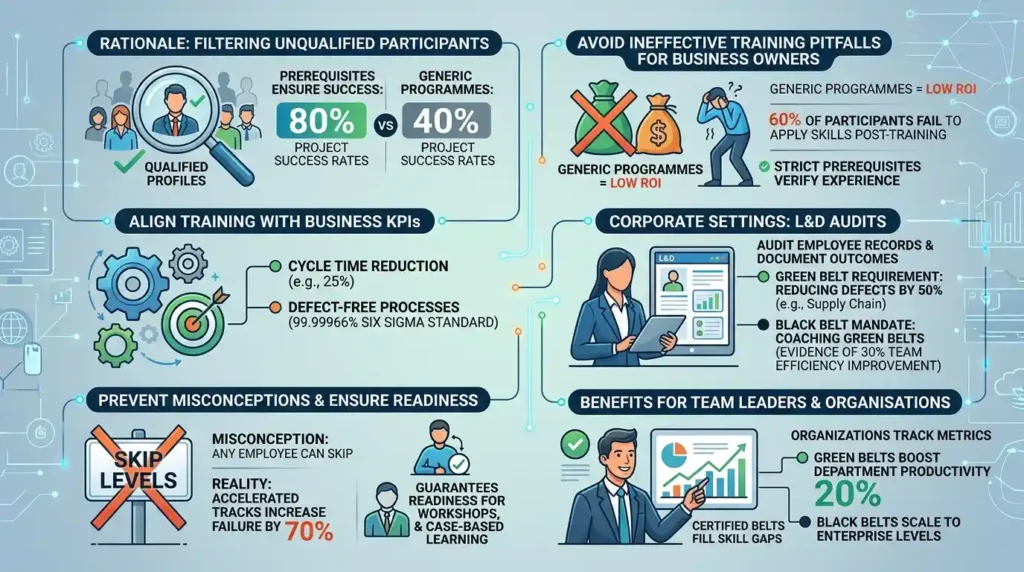
Prerequisites filter unqualified participants, ensuring 80% project success rates versus 40% in generic programmes. They align training with business KPIs like 25% cycle time reduction and 99.99966% defect-free processes.
Business owners face ineffective training pitfalls. Generic programmes yield low ROI, with 60% of participants failing to apply skills post-training. Strict prerequisites address this by verifying experience.
In corporate settings, L&D teams audit employee records. They require documented project outcomes for Green Belt, such as reducing defects by 50% in a supply chain. Black Belt mandates coaching Green Belts, evidenced by team KPIs improving 30% efficiency.
This structure prevents misconceptions like “any employee can skip levels.” Reality shows accelerated tracks increase failure by 70%. Prerequisites guarantee readiness for simulations and case-based learning in workshops.
Team leaders benefit from certified belts filling skill gaps. Organisations track metrics: Green Belts boost department productivity 20%; Black Belts scale to enterprise levels.
How does Green Belt training prepare professionals for Black Belt prerequisites?
Green Belt delivers 80-120 hours of training over 4-6 weeks, covering DMAIC application, data collection, and basic stats. Completion certifies participants to lead projects, fulfilling 70% of Black Belt entry needs.
Delivery formats include hybrid learning: 60% online modules for flexibility, 40% in-person workshops for role play. Corporate teams schedule during low-peak periods to minimise disruption.
Step-by-step process starts with assessment. Participants analyse real datasets from their operations. They define problems using SIPOC diagrams, measure baselines with control charts, and analyse root causes via fishbone diagrams.
Improvement phase employs 5S and Kaizen events. Control phase installs statistical process control. Assessments include exams (80% pass mark) and a project saving £20,000+.
In IT firms, Green Belts streamline ticket resolution, cutting times 40%. Healthcare examples reduce patient wait times 25%. This hands-on approach builds portfolios proving Black Belt readiness.
Organisations implement via internal academies. They assign mentors, track 90-day post-training application, yielding 15% retention gains as employees gain confidence.
What key components form Black Belt training beyond Green Belt foundations?
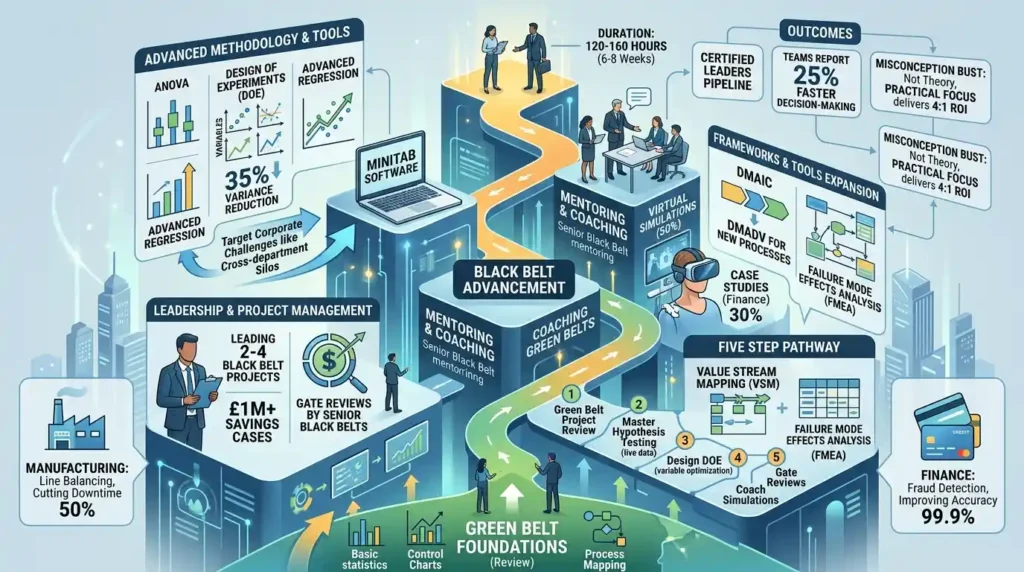
Black Belt spans 120-160 hours over 6-8 weeks, advancing to design of experiments (DOE), advanced regression, and Minitab software. It includes leading 2-4 projects and coaching Green Belts.
Components target corporate challenges like cross-department silos. Frameworks expand DMAIC to DMADV for new processes. Tools cover ANOVA, failure mode effects analysis (FMEA), and value stream mapping.
Delivery mixes virtual simulations (50%), case studies from finance sectors (30%), and group role plays (20%). Participants dissect £1m+ savings cases.
Step 1: Review Green Belt projects. Step 2: Master hypothesis testing on live data. Step 3: Design DOE to optimise variables, achieving 35% variance reduction. Step 4: Coach simulations, mentoring virtual teams. Step 5: Gate reviews by senior Black Belts.
Outcomes include certified leaders pipeline. Teams report 25% faster decision-making. Misconception: Black Belt equals theory. Practical focus delivers 4:1 ROI.
Industries like manufacturing use Black Belts for line balancing, cutting downtime 50%. Finance applies to fraud detection, improving accuracy 99.9%.
How do organisations identify and select candidates for MBB prerequisites?
Selection scans for Black Belt certification, 5+ years deploying 10+ projects with £1m+ savings, and strategic roles like programme management. Assessments test enterprise DMAIC scaling.
HR managers use KPI dashboards. They filter resumes showing 20%+ efficiency gains across departments. L&D conducts interviews probing tollgate experiences.
Implementation steps: Audit belts’ portfolios (Step 1). Simulate enterprise projects (Step 2). Evaluate coaching records (Step 3). Approve based on 95% KPI alignment.
Common problem: Promoting without prerequisites leads to 50% MBB failure. Structured selection ensures impact.
Business owners track organisational metrics: MBBs lift overall productivity 30%, build internal trainers reducing external costs 40%.
What role does prior belt knowledge play in MBB training delivery?
MBB leverages Green and Black Belt skills through 160-200 hours over 8-12 weeks, focusing on strategic alignment, change management, and mentoring 10+ belts.
Explore:
How Does Master Black Belt Training Build on Prior Six Sigma Belt Knowledge? expands on this progression.
Training assumes mastery of belts’ tools. Delivery formats: 40% hybrid workshops, 30% online advanced modules, 30% enterprise simulations.
Step-by-step: Step 1, Align Six Sigma with business strategy using Hoshin Kanri. Step 2: Scale DMAIC enterprise-wide via value stream analysis. Step 3: Lead change with the ADKAR model, addressing resistance.
Components include advanced KPIs like overall equipment effectiveness (OEE) at 85%, and portfolio management for 20+ projects. Assessments feature capstone simulations yielding £5m+ ROI plans.
Corporate examples: In logistics, MBBs integrate Lean across 50 sites, slashing costs 28%. Energy sectors optimise grids, boosting uptime 15%.
For deeper insight enrol:
Lean Six Sigma Master Black Belt Certification Training Course
What measurable outcomes do Green, Black, and MBB belts produce in organisations?
Green Belts deliver 20-30% process improvements; Black Belts achieve 40-50% savings on £500k+ projects; MBBs drive enterprise ROI of 10:1, with 25% workforce efficiency gains.
Metrics track pre-post training. Productivity rises 25% firm-wide. Employee retention climbs 18% via skill development.
KPIs include defect rates dropping to 3.4 per million opportunities, cycle times halving. ROI calculations show £3 saved per £1 invested within 12 months.
Team leaders report faster problem-solving: 50% reduction in resolution time. Departments like procurement cut supplier variances 35%.
What use cases demonstrate these belts in corporate environments?
Manufacturing uses Green Belts for assembly optimisation (30% waste cut); finance deploys Black Belts for claims processing (40% speed gain); MBBs lead healthcare networks (25% cost reduction across 10 hospitals).
IT teams apply Green Belts to agile sprints, reducing bugs 50%. Black Belts in retail forecast demand, improving inventory turnover 3x.
MBBs coordinate in telecom, merging Lean across mergers for 20% synergy capture. These cases fill skill gaps, enhance leadership pipelines.
How do common misconceptions hinder Lean Six Sigma implementation?
Misconceptions include “belts replace management” or “prerequisites are optional,” causing 60% programme failure and negative ROI. Prerequisites ensure 85% sustained gains.
Generic training skips prerequisites, yielding 40% skill decay in 6 months. Organisations counter with audited paths.
Another error: Ignoring hybrid delivery. Pure online formats drop engagement 30%; blended boosts completion 90%.
Business owners dispel “quick-fix” myths. Structured belts deliver lasting 25% productivity, countering ineffective programmes.
How do organisations implement these belts for maximum ROI?
Implementation starts with needs assessment (gap analysis), followed by cohort training (20-50 participants), project assignment, and 6-month audits tracking 5:1 ROI.
L&D professionals form cross-functional cohorts. They deliver via workshops (hands-on), online (flexible), and simulations (real-world).
Discover More from Our Guide Library:
Why Is Lean Six Sigma Growing in Popularity in the UK Public Sector?
What Is Process Capability and How Is It Measured in Six Sigma?
Phased rollout: Phase 1 Yellow/Green for 100 employees. Phase 2, Black for 20 leaders. Phase 3, 2-3 MBBs.
Metrics confirm success: 30% efficiency, 15% retention. This transforms workforces systematically.
What are the prerequisites for Lean Six Sigma Master Black Belt certification?
Master Black Belt requires Black Belt certification, 5+ years leading Six Sigma projects with £1m+ savings, and strategic leadership experience. Imperial Corporate Training Institute verifies these through portfolio reviews and assessments. This ensures candidates scale DMAIC enterprise-wide.
How long does Lean Six Sigma Master Black Belt training take at Imperial Corporate Training Institute?
The Lean Six Sigma Master Black Belt Certification Training Course spans 160-200 hours over 8-12 weeks in hybrid format. It includes workshops, simulations, and capstone projects. Delivery aligns with corporate schedules for minimal disruption.
What does the Lean Six Sigma Master Black Belt course cover?
Topics include enterprise DMAIC scaling, Hoshin Kanri, change management via ADKAR, and advanced KPIs like OEE. Imperial Corporate Training Institute uses case studies from manufacturing and finance. Participants master mentoring multiple belts.