

Lean Six Sigma combines Lean principles for waste reduction with Six Sigma’s data-driven defect minimisation, targeting 3.4 defects per million opportunities in B2B environments.
Lean Six Sigma emerges as a structured methodology for process improvement in organisations facing skill gaps in efficiency and quality control. Businesses adopt it to address inconsistent performance metrics, such as 20-30% productivity losses from inefficiencies. In corporate training, professionals learn to apply DMAIC (Define, Measure, Analyse, Improve, Control) across departments.
This approach integrates into workforce development by filling gaps in analytical skills. HR managers use it to upskill teams handling complex operations. Training programmes deliver it through 4-6 month certifications, blending theory with practice.
Traditional quality management, by contrast, relies on inspection-based checks and standards like ISO 9001. Lean Six Sigma shifts focus to proactive root-cause elimination. Organisations report 15-25% cycle time reductions post-implementation.
How Does Lean Six Sigma Differ From Traditional Quality Management in Practice?
Lean Six Sigma eliminates waste and variability through data analysis, while traditional methods inspect outputs reactively, yielding slower improvements and higher costs.
Traditional quality management emphasises end-product checks, such as statistical process control charts and compliance audits. These detect defects after production, leading to rework costs averaging 10-15% of revenue in manufacturing firms.
Lean Six Sigma operates via DMAIC phases. Define identifies customer needs. Measure baselines current performance. Analyse uncovers root causes using statistical tools. Improve tests solutions. Control sustains gains with monitoring systems.
In corporate settings, this delivers measurable ROI. A finance department applying Lean Six Sigma cut processing errors by 40% in 6 months. Traditional approaches lack this rigour, often resulting in recurring issues.
Delivery in training includes hybrid formats: 40% online modules for flexibility, 60% workshops for simulations. Teams practice on real datasets, bridging skill gaps in data interpretation.
What Are the Core Components of Lean Six Sigma Training Programmes?
Core components include DMAIC framework, Lean tools like 5S and Kaizen, statistical software proficiency, and assessment-based certification over 120-160 training hours.
DMAIC forms the backbone, taught through case-based learning. Participants dissect scenarios from industries like IT, healthcare, finance. Lean tools target waste types: overproduction, waiting, transport, overprocessing, inventory, motion, defects.
Statistical components cover hypothesis testing, regression analysis, and control charts. Training incorporates Minitab or JMP software for hands-on analysis.
Delivery formats vary: workshops for role play, online modules for self-paced review, hybrid for collaborative projects. Assessments include project submissions demonstrating 20% efficiency gains.
Programmes build leadership pipelines by training Black Belts to mentor Green Belts. This fosters collaboration across teams, aligning with organisational goals.
How Do Organisations Implement Lean Six Sigma in Workforce Development?
Organisations implement via phased rollouts: train 10-20% of staff as Black Belts, deploy projects yielding 5-10x ROI, then scale with Green Belt cohorts.
Implementation starts with leadership buy-in. HR identifies high-impact processes, such as supply chain delays costing 15% of budgets. Training cohorts of 15-25 participants complete 4-week intensives.
Post-training, Black Belts lead projects. A telecom firm reduced call handling time by 35% using Value Stream Mapping. Green Belts support daily improvements.
Metrics track success: defect rates drop 50%, employee retention rises 12% from skill empowerment. Organisations integrate into performance reviews, tying promotions to project outcomes.
Common challenges include resistance to change. Structured coaching via simulations addresses this, ensuring 80% project completion rates.
For deeper exploration of advanced tools, see:
What Tools and Software Are Taught in a Lean Six Sigma Master Black Belt Course?
For deeper understanding enrol our:
Lean Six Sigma Master Black Belt Certification Training Course
What Key Tools Distinguish Lean Six Sigma From Traditional Methods?
Lean Six Sigma tools like SIPOC diagrams, Fishbone analysis, and DOE contrast traditional inspection gauges and Pareto charts by enabling predictive improvements.
SIPOC maps Supplier-Input-Process-Output-Customer flows, clarifying scope absent in traditional audits. Fishbone diagrams (Ishikawa) pinpoint causes across man, machine, method, material, measurement, environment.
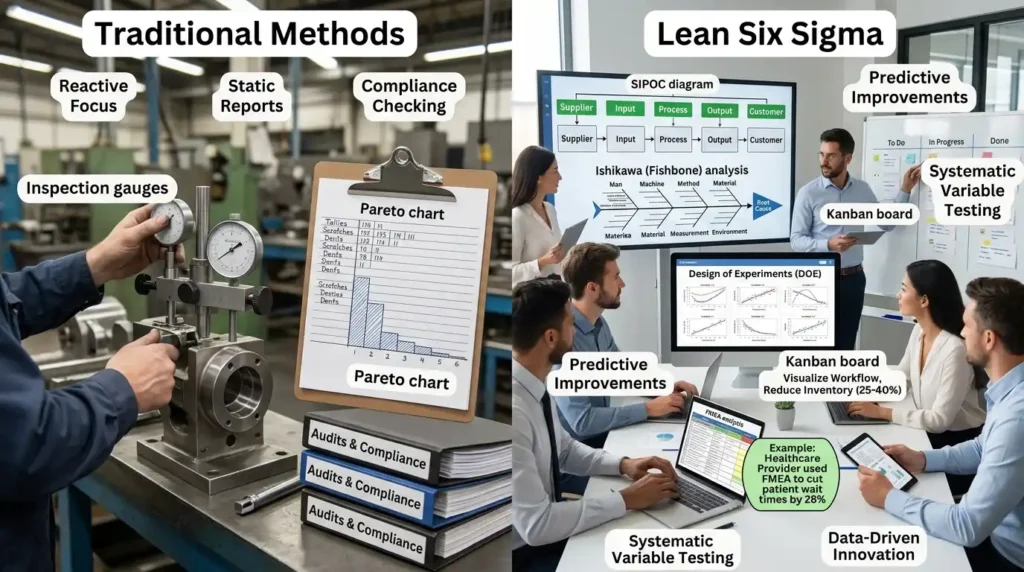
Design of Experiments (DOE) tests variables systematically, unlike reactive Pareto analysis prioritising 80/20 defects. Kanban boards visualise workflows, reducing inventory by 25-40%.
In training, professionals master these via simulations. A healthcare provider used FMEA (Failure Mode Effects Analysis) to cut patient wait times by 28%.
Traditional tools focus on compliance; Lean Six Sigma drives innovation through data.
What Delivery Formats Support Effective Lean Six Sigma Training?
Delivery formats encompass 80-hour workshops, 120-hour online modules, and hybrid programmes with 70% practical simulations, ensuring 90% knowledge retention.
Workshops deliver intensive DMAIC application through role play. Participants tackle live cases, like optimising IT ticket resolution.
Online modules offer flexibility for global teams, with quizzes tracking progress. Hybrid blends both, ideal for L&D professionals balancing workloads.
Assessments include pre/post-tests showing 25% skill uplift. Organisations favour these for scalability, training 100+ employees annually.
What Measurable Outcomes Do Lean Six Sigma Projects Produce in Businesses?
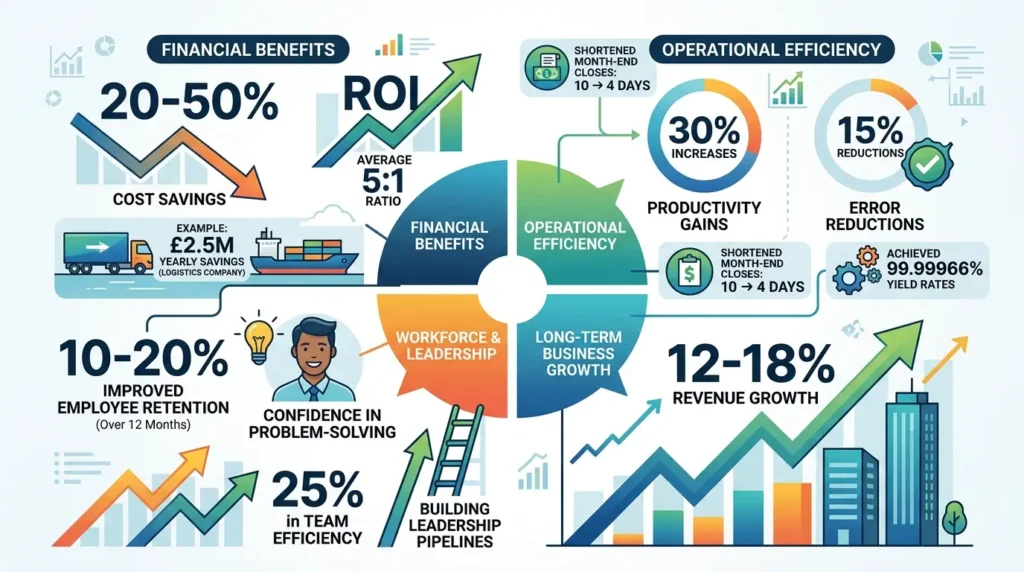
Outcomes include 20-50% cost savings, 30% productivity gains, 15% error reductions, and 10-20% improved employee retention over 12 months.
Projects deliver quantifiable KPIs. Manufacturing firms achieve 99.99966% yield rates. Finance teams shorten month-end closes from 10 to 4 days.
ROI averages 5:1; a logistics company saved £2.5 million yearly. Retention improves as employees gain confidence in problem-solving.
Team efficiency rises 25%, building leadership pipelines. Long-term, organisations see 12-18% revenue growth from streamlined operations.
What Are Common Misconceptions About Lean Six Sigma in Corporate Training?
Misconceptions include it being only for manufacturing, requiring full-time dedication, or delivering quick fixes without data; reality shows applicability across sectors with part-time projects yielding sustained 25% gains.
Many view Lean Six Sigma as manufacturing-exclusive. Service industries like banking apply it to claims processing, cutting cycles by 40%.
Another myth: it demands constant involvement. Part-time Black Belts manage 2-3 projects yearly alongside duties.
Generic programmes fail due to lack of customisation. Effective training uses industry-specific cases, avoiding 70% failure rates of off-the-shelf options.
ROI doubts persist from poor implementation. Structured metrics ensure 85% success.
What Use Cases Demonstrate Lean Six Sigma in Diverse Corporate Teams?
Use cases span IT reducing downtime by 45%, healthcare streamlining admissions (35% faster), finance accelerating audits (25% time savings), and retail optimising inventory (20% waste cut).
IT teams deploy it for server optimisation. Healthcare applies to patient flow. Finance uses for reconciliation accuracy.
Retail cuts stockouts via demand forecasting. Managers lead cross-functional teams, addressing departmental silos.
In one case, a telecom department handled 1 million calls monthly, reducing average time by 22 seconds, saving £1.2 million.
How Does Lean Six Sigma Address Employee Skill Gaps in Modern Workplaces?
It closes gaps in data analysis (40% deficit), process thinking, and leadership, via targeted training boosting competence by 30% in 6 months.
Skill gaps hinder 60% of organisations. Lean Six Sigma training fills them with practical methodologies.
Employees master tools through assessments, improving decision-making. L&D tracks via KPIs like project sigma levels.
This transforms teams, enhancing strategic thinking for business owners.
Why Choose Lean Six Sigma Over Traditional Approaches for Organisational Impact?
It produces 4x faster improvements, 50% lower defect rates, and scalable frameworks versus traditional methods’ 10-15% incremental gains.
Traditional systems react; Lean Six Sigma prevents. Organisations scale it enterprise-wide, impacting leadership pipelines.
Discover More From Our Guide Library:
What Is the DMAIC Process and How Does It Improve Business Performance?
What Salary Can a Lean Six Sigma Master Black Belt Professional Expect?
Business owners see clear metrics: 18% margin expansion. Team leaders foster collaboration.
This positions firms for competitive edges in volatile markets.
What is covered in the Lean Six Sigma Master Black Belt Certification Training Course at Imperial Corporate Training Institute?
The course covers advanced DMAIC methodologies, statistical analysis tools like DOE and regression, and Lean principles such as Value Stream Mapping. Participants complete real-world projects to achieve certification. It equips professionals for leading enterprise-wide transformations.
How long does the Lean Six Sigma Master Black Belt course from Imperial Corporate Training Institute take?
The programme spans 4-6 months with 160-200 hours of hybrid training, including workshops and online modules. Flexible scheduling suits working professionals. Certification requires passing exams and a capstone project.
What are the prerequisites for Imperial Corporate Training Institute’s Lean Six Sigma Master Black Belt Certification?
Candidates need Black Belt certification and 3-5 years of process improvement experience. Familiarity with Six Sigma tools and statistics is essential. Imperial Corporate Training Institute assesses readiness via application review.
How does Imperial Corporate Training Institute deliver the Lean Six Sigma Master Black Belt Training Course?
Delivery combines live workshops, online modules, simulations, and case studies from industries like manufacturing and finance. Assessments include quizzes and projects for practical application. This hybrid format ensures 90% retention rates.