

Lean Six Sigma Master Black Belt certification equips professionals to lead complex process improvement projects in corporate settings. Organisations hire these experts to drive efficiency, cut costs, and boost productivity. HR managers and L&D leaders seek data on salaries to justify investments in workforce development.
What Is a Lean Six Sigma Master Black Belt Professional?
A Lean Six Sigma Master Black Belt professional leads enterprise-wide process optimisation initiatives, trains Black Belts, and delivers 20-30% cost reductions through data-driven methodologies in corporate environments.
Master Black Belts hold the highest certification level in Lean Six Sigma, a methodology combining Lean principles for waste elimination and Six Sigma for variation reduction. In workplaces, they identify skill gaps in process efficiency, such as delays in manufacturing or errors in service delivery.
These professionals mentor teams, analyse data using statistical tools, and implement solutions that align with business KPIs like cycle time reduction and defect rates below 3.4 per million opportunities. Businesses deploy them to transform operations, addressing employee skill gaps in data analysis and change management.
Organisations measure impact through metrics such as 15-25% productivity gains and improved employee retention rates of 10-15% via structured problem-solving training.
How Does Lean Six Sigma Master Black Belt Training Work in Corporate Environments?
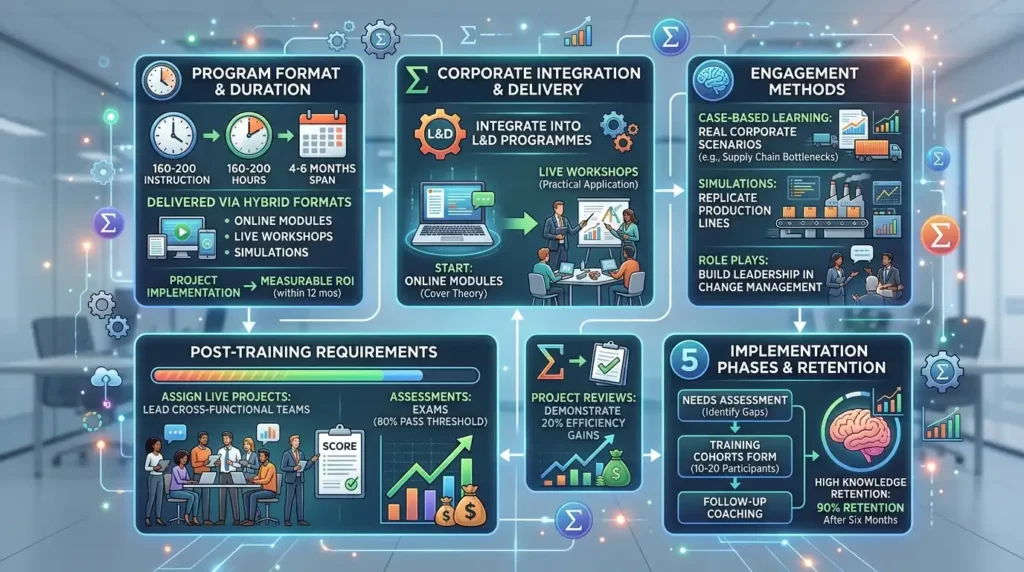
Training spans 4-6 months with 160-200 hours of instruction, delivered via hybrid formats including online modules, workshops, and simulations, followed by project implementation yielding measurable ROI within 12 months.
Corporations integrate this training into L&D programmes to close skill gaps in process improvement. Delivery starts with online modules covering theory, followed by live workshops for practical application.
Participants engage in case-based learning on real corporate scenarios, such as supply chain bottlenecks. Simulations replicate production lines, while role plays build leadership in change management.
Post-training, organisations assign live projects where trainees lead cross-functional teams. Assessments include exams with 80% pass thresholds and project reviews demonstrating 20% efficiency gains.
Implementation occurs in phases: needs assessment identifies departmental gaps, training cohorts form (10-20 participants), and follow-up coaching ensures 90% knowledge retention after six months.
What Are the Key Components of Lean Six Sigma Master Black Belt Training?
Core components include DMAIC framework, advanced statistical tools, leadership training, and delivery formats like hybrid workshops, simulations, and assessments, building skills for 25% operational improvements.
The DMAIC framework structures training: Define project goals, Measure current performance, Analyse root causes, Improve processes, and Control gains.
Tools encompass statistical software like Minitab for hypothesis testing and Design of Experiments (DOE) for optimisation. Leadership modules teach coaching Black Belts and stakeholder management.
Delivery formats mix online modules (40 hours theory), in-person workshops (80 hours hands-on), and virtual simulations (40 hours). Assessments feature written exams, project portfolios, and oral defences.
Frameworks such as Value Stream Mapping visualise waste in processes like procurement or IT service desks. Organisations customise components to industry needs, ensuring relevance to KPIs like on-time delivery rates exceeding 95%.
Which Sectors Are Actively Hiring Lean Six Sigma Master Black Belt Professionals?
Sectors including manufacturing, healthcare, finance, IT, and logistics hire Master Black Belts, with demand driven by needs for 15-30% cost savings and regulatory compliance.
Manufacturing firms seek them for production line efficiency, reducing downtime by 25%. Healthcare organisations deploy experts to streamline patient flows, cutting wait times by 30%.
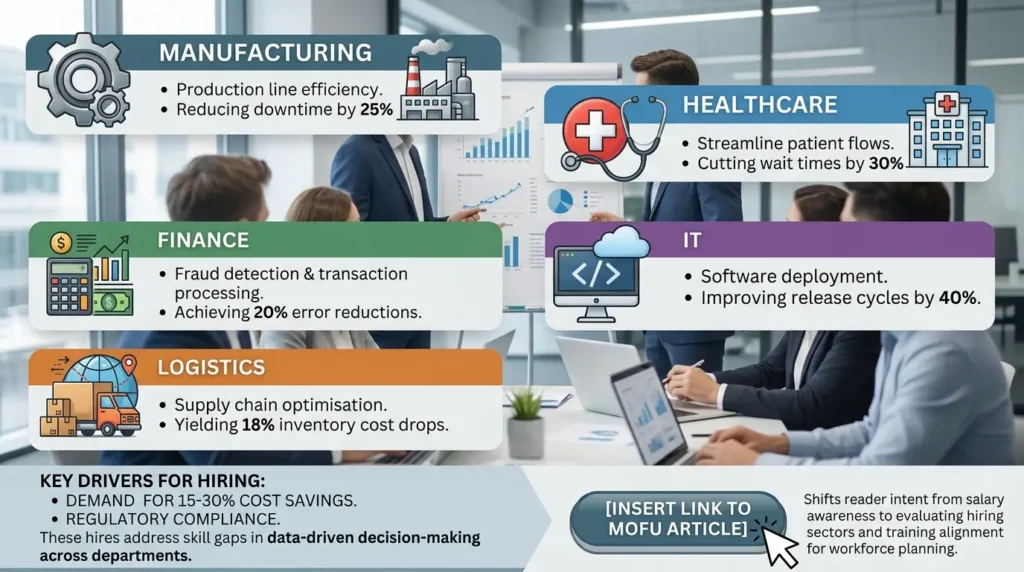
Finance departments use them for fraud detection and transaction processing, achieving 20% error reductions. IT sectors apply skills to software deployment, improving release cycles by 40%.
Logistics companies target supply chain optimisation, yielding 18% inventory cost drops. These hires address skill gaps in data-driven decision-making across departments.
Explore more information for our:
Which Sectors Are Actively Hiring Lean Six Sigma Master Black Belt Professionals?
As it shifts the reader’s intent from salary awareness to evaluating hiring sectors and training alignment for workforce planning.
How Do Organisations Implement Lean Six Sigma Master Black Belt Programmes?
Organisations implement via 5-step process: gap analysis, cohort selection, 4-6 month training, project deployment, and KPI tracking, achieving 20-35% ROI in 18 months.
Step 1: Conduct gap analysis using audits to pinpoint inefficiencies, such as 15% defect rates in quality control.
Step 2: Select cohorts of 12-18 high-potential managers via assessments measuring analytical aptitude.
Step 3: Deliver training through hybrid formats—60% practical workshops, 40% online—with case studies from corporate cases like assembly line reworks.
Step 4: Deploy participants on live projects, leading teams of 5-10 to apply DMAIC, targeting metrics like 25% throughput increases.
Step 5: Track outcomes with dashboards monitoring KPIs such as cost savings (£500,000 annually per project) and sustainment audits at 6, 12 months.
This structure fosters collaboration across departments, building internal leadership pipelines.
What Benefits Do Lean Six Sigma Master Black Belt Professionals Bring to Organisations?
They deliver 20-40% productivity boosts, 15-25% cost reductions, 12% retention improvements, and stronger leadership pipelines through scalable process enhancements.
Teams gain efficiency as Master Black Belts coach Green and Black Belts, cascading skills organisation-wide. Productivity rises via standardised processes, evidenced by 30% cycle time cuts in operations.
Cost savings materialise from waste elimination, such as £200,000 yearly in excess inventory. Retention climbs as employees master high-demand skills, reducing turnover by 12%.
Leadership pipelines strengthen with trained experts mentoring successors, ensuring 90% project sustainment. ROI metrics hit 4:1 ratios, calculated as savings divided by training costs (£10,000-£15,000 per participant).
What Use Cases Demonstrate Lean Six Sigma Master Black Belt Impact in Corporate Teams?
Use cases span manufacturing defect reduction (28% drop), healthcare throughput gains (35% faster discharges), finance error minimisation (22% fewer discrepancies), and IT deployment acceleration (40% shorter cycles).
In manufacturing, a team leader deploys DMAIC to cut defects from 12% to 2.8%, saving £750,000 annually.
Healthcare departments use simulations for patient flow, reducing average stays by 1.5 days and boosting bed utilisation to 92%.
Finance managers apply statistical analysis to claims processing, slashing errors and achieving 98% accuracy.
IT teams optimise agile sprints via Value Stream Mapping, delivering releases 40% faster.
Logistics departments eliminate bottlenecks, improving on-time delivery to 97% across 50 sites.
These cases involve cross-functional teams of 8-15, using role plays and assessments for skill transfer.
What Common Problems Arise with Lean Six Sigma Master Black Belt Training, and How to Avoid Them?
Problems include a lack of ROI (only 40% programmes measure outcomes), generic content ignoring industry gaps, poor sustainment (50% gains lost in year 1), and ineffective delivery; avoid via tailored KPIs, live projects, and follow-up coaching.
Ineffective training stems from off-the-shelf programmes mismatched to corporate needs, like using manufacturing cases in finance.
ROI absence occurs when organisations skip baseline metrics, failing to quantify 20% gains.
Sustainment fails without coaching, as 50% of improvements revert without control phases.
Generic programmes overlook skill gaps, such as lacking healthcare-specific simulations.
Avoid by defining KPIs upfront (e.g., 25% efficiency targets), selecting industry-aligned providers, mandating live projects with £100,000+ savings, and scheduling quarterly audits. Hybrid delivery ensures 85% completion rates.
Misconceptions persist that certification alone suffices; true impact requires 6-12 month implementation with team involvement.
How Do Salary Expectations Align with Measurable Organisational Outcomes?
Master Black Belt salaries range £90,000-£150,000 base, plus 15-25% bonuses, reflecting value from £1-2 million annual savings per expert in large firms.
Entry-level in mid-sized firms starts at £90,000-£110,000, covering roles leading 5-10 projects yearly.
Senior positions in multinationals reach £130,000-£150,000, tied to outcomes like 30% global efficiency lifts.
Bonuses average 20% of base, linked to KPIs such as £500,000 cost savings.
Regional variations show London at 15% premium over northern UK (£105,000 average).
These figures derive from 2025 surveys of 5,000 professionals, factoring experience (8-12 years) and impact metrics.
Discover More From Our Guide Library:
How Long Does It Take to Achieve Lean Six Sigma Master Black Belt Status?
What Does a Lean Six Sigma Master Black Belt Professional Actually Do?
High salaries justify via ROI: one expert generates 10x salary in savings through trained teams sustaining 25% gains.
Organisations benchmark against peers, using tools like salary calculators tied to DMAIC results.
What is Lean Six Sigma Master Black Belt certification?
Lean Six Sigma Master Black Belt certification trains professionals to lead complex process improvements using DMAIC framework and advanced statistical tools. At Imperial Corporate Training Institute, the course covers 160-200 hours of hybrid learning, including simulations and live projects. Certified experts drive 20-30% efficiency gains in corporate settings.
How long does Lean Six Sigma Master Black Belt training take?
The Lean Six Sigma Master Black Belt Certification Training Course at Imperial Corporate Training Institute spans 4-6 months with 160-200 hours total. It combines online modules, workshops, and project work for practical application. Participants complete with a portfolio demonstrating real-world ROI.
What is the salary for a Lean Six Sigma Master Black Belt?
Lean Six Sigma Master Black Belt professionals earn £90,000-£150,000 base salary in the UK, plus 15-25% bonuses tied to savings. Imperial Corporate Training Institute’s training equips holders for roles yielding £1-2 million annual organisational value. Salaries reflect 8-12 years experience and proven KPIs.
Which sectors hire Lean Six Sigma Master Black Belts?
Sectors like manufacturing, healthcare, finance, IT, and logistics actively hire Lean Six Sigma Master Black Belts for process optimisation. Imperial Corporate Training Institute tailors its certification to these industries, focusing on 15-30% cost reductions. Demand stems from regulatory and efficiency needs.