

Master Black Belts apply DMAIC methodology in their training programmes through structured, hands-on projects that mirror real-world process improvements. They lead teams in dissecting business challenges using Define, Measure, Analyse, Improve, and Control phases across simulated and live organisational scenarios.
DMAIC forms the backbone of Lean Six Sigma methodologies. Organisations deploy it to drive data-driven transformations in operations, quality, and efficiency. HR leaders select Master Black Belt training to equip senior professionals with expertise to champion these initiatives.
For a foundational overview, explore:
What Is the DMAIC Process and How Does It Improve Business Performance?
Master Black Belt programmes immerse participants in applying DMAIC to complex, cross-functional problems. Training providers like Imperial Corporate Training Institute structure this around practical application. Participants tackle industry-specific case studies, from manufacturing defects to service delays.
What Does the Define Phase Entail in Master Black Belt Training?
In the Define phase of Master Black Belt training, participants identify project goals, scope business problems, and align objectives with organisational strategy using tools like SIPOC diagrams and project charters within the first 20% of programme time.
Trainers assign real B2B scenarios drawn from sectors like finance, healthcare, and logistics. Participants draft project charters that specify problem statements, business case justifications, and stakeholder expectations. They quantify high-level benefits, such as 30-50% reduction in cycle times or 20% cost savings.
SIPOC maps outline Suppliers, Inputs, Process, Outputs, and Customers. This tool clarifies boundaries early. Master Black Belt candidates practise voice-of-the-customer analysis through surveys and interviews. They establish critical-to-quality metrics tied to KPIs like customer satisfaction scores or defect rates.
Teams present charters to peers for critique. Feedback sharpens focus on measurable outcomes. Programmes dedicate 1-2 weeks to this phase, ensuring alignment with executive priorities. HR decision-makers value this rigor, as it bridges skill gaps in strategic problem-solving.
VoC prioritisation matrices rank customer needs. Participants link these to financial impacts, such as £500,000 annual savings from reduced rework. Define phase outputs feed directly into subsequent stages, creating a robust project foundation.
How Do You Implement the Measure Phase During Training?
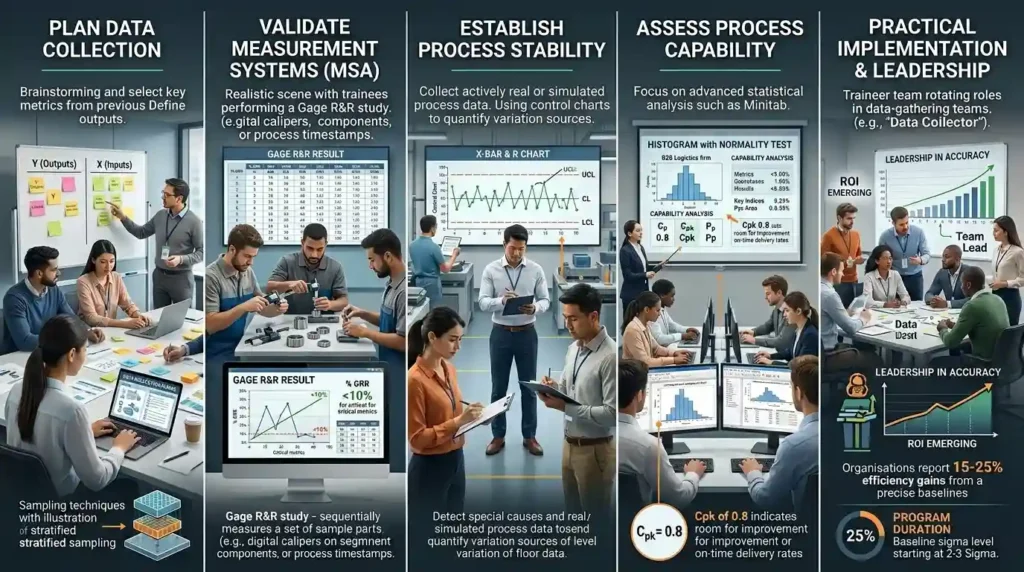
Master Black Belt trainees implement the Measure phase by collecting baseline data, validating measurement systems, and establishing process capability using statistical tools like Gage R&R and control charts over 25% of the programme duration.
Participants select key metrics from Define outputs. They design data collection plans targeting process inputs and outputs. Training emphasises sampling techniques to ensure representative data without excessive costs.
Gage R&R studies assess measurement system reliability. Trainees calculate %GRR values, aiming for under 10% for critical metrics. Software like Minitab supports histograms, run charts, and normality tests.
Process capability analysis follows. Indices like Cp, Cpk, and Pp reveal current performance against specifications. For instance, a B2B logistics firm might measure on-time delivery rates, finding a Cpk of 0.8 indicating room for improvement.
Teams baseline sigma levels, often starting at 2-3 sigma in untrained organisations. This phase spans workshops and simulations. Participants rotate roles in data-gathering teams, building leadership in measurement accuracy.
Control charts monitor stability. X-bar and R charts detect special causes. Training quantifies variation sources, preparing candidates for data-rich Analyse phases. ROI emerges here: organisations report 15-25% efficiency gains from precise baselines.
In What Ways Does the Analyse Phase Unfold in a Master Black Belt Programme?
During the Analyse phase, Master Black Belt candidates root-cause complex issues using hypothesis testing, regression analysis, and DOE over 25% of training, pinpointing variation drivers in multi-variable processes.
Trainers provide datasets from live B2B projects. Participants form hypotheses based on Measure findings. Fishbone diagrams and 5 Whys narrow potential causes.
Statistical tests confirm relationships. T-tests compare means; ANOVA handles multiple groups. Non-parametric tests like Mann-Whitney suit skewed data. P-values under 0.05 validate significance.
Regression models quantify impacts. Multiple linear regression identifies dominant variables, such as how supplier delays contribute 40% to production variance. Scatter plots visualise correlations.
Design of Experiments (DOE) accelerates learning. Factorial designs test interactions, like temperature and pressure on yield. Trainees optimise using response surface methods, achieving 2-3 sigma lifts in simulations.
Pareto charts prioritise vital few causes. Training integrates failure mode effects analysis (FMEA) for risk assessment. Participants present findings to executive panels, honing communication for workplace adoption.
This phase equips leaders to address workforce skill gaps in analytics. Programmes track progress via interim sigma shifts, demonstrating training efficacy.
How Is the Improve Phase Executed in Master Black Belt Training?
Master Black Belt training executes the Improve phase through solution generation, piloting, and optimisation using brainstorming, Poka-Yoke, and full factorial DOE, targeting 20% programme time for verified enhancements.
Teams brainstorm solutions with techniques like TRIZ and SCAMPER. They evaluate via Pugh matrices, scoring against criteria like feasibility and impact.
Pilots test top ideas on scaled processes. For a call centre, scripting improvements might reduce handle time by 18%. Kanban or value stream mapping eliminates waste.
DOE refines solutions. Trainees design 2^k factorials, analysing main effects and interactions. Software optimises parameters, such as machine speeds yielding 25% throughput gains.
Poka-Yoke devices prevent errors. Training covers mistake-proofing in B2B contexts, like automated checks in procurement workflows.
Solution selection ties to business cases. Participants calculate NPV and IRR, projecting £1M+ ROI over three years. Peer reviews ensure robustness.
Who Are the Trainers Delivering Imperial’s Lean Six Sigma Master Black Belt Course? highlights experts guiding these pilots. Their industry tenure ensures practical, outcome-focused execution.
This phase bridges theory to application. HR teams observe 40% faster project completion post-training.
What Control Phase Strategies Are Applied in Master Black Belt Programmes?
In the Control phase, trainees deploy statistical process control, standard work, and audit systems to sustain gains, allocating 10% of programme time to response plans and dashboard development.
Control charts monitor post-Improve stability. Individuals and moving range charts track key variables. Out-of-control action plans (OCAPs) specify responses to signals.
Standard operating procedures (SOPs) document optimised processes. Visual management boards display metrics in real-time.
Training emphasises response plans for special causes. Dashboards integrate KPIs like DPMO (defects per million opportunities), often reducing from 10,000 to under 3,500.
Audit schedules verify adherence. Statistical tolerance intervals predict future performance. Teams calculate control limits dynamically.
Sustainability links to leadership. Master Black Belts train Green and Yellow Belts, scaling DMAIC across organisations. Case studies show 70% gain retention after 12 months.
ROI measurement uses balanced scorecards. Programmes culminate in control phase presentations, certifying competence.
How Does DMAIC Application Vary Across Training Delivery Models?
DMAIC application adapts to delivery models like in-person workshops, virtual cohorts, and blended formats, with in-person excelling in team simulations (80% adoption rate) and virtual suiting data analysis (90% flexibility for global teams).
In-person programmes foster collaboration. Participants run live workshops, achieving deeper insights through group dynamics. Duration spans 4-6 weeks, with 40-hour immersion blocks.
Virtual models leverage digital tools. Zoom breakouts enable Measure phase data shares; shared Minitab files support Analyse. Flexibility aids HR scheduling, with 60% uptake in remote workforces.
Blended approaches combine both. Initial in-person Define builds rapport; online Improve pilots allow real-time workplace testing. Hybrid yields 25% higher completion rates.
| Delivery Model | DMAIC Strengths | Typical Duration | B2B Fit |
|---|---|---|---|
| In-Person | Team simulations, hands-on DOE | 4-6 weeks full-time | Manufacturing, high-stakes ops |
| Virtual | Data-heavy phases, global access | 3-5 months part-time | Service, distributed teams |
| Blended | Balanced application, pilot integration | 2-4 months | Most organisations, skill gap closure |
HR leaders compare models against workforce needs. In-person suits leadership development; virtual addresses cost constraints (£5,000-£15,000 range).
Effectiveness metrics include sigma project lifts (3.5 average post-training) and 85% certification pass rates.
Why Integrate Real-World Projects in Master Black Belt DMAIC Training?
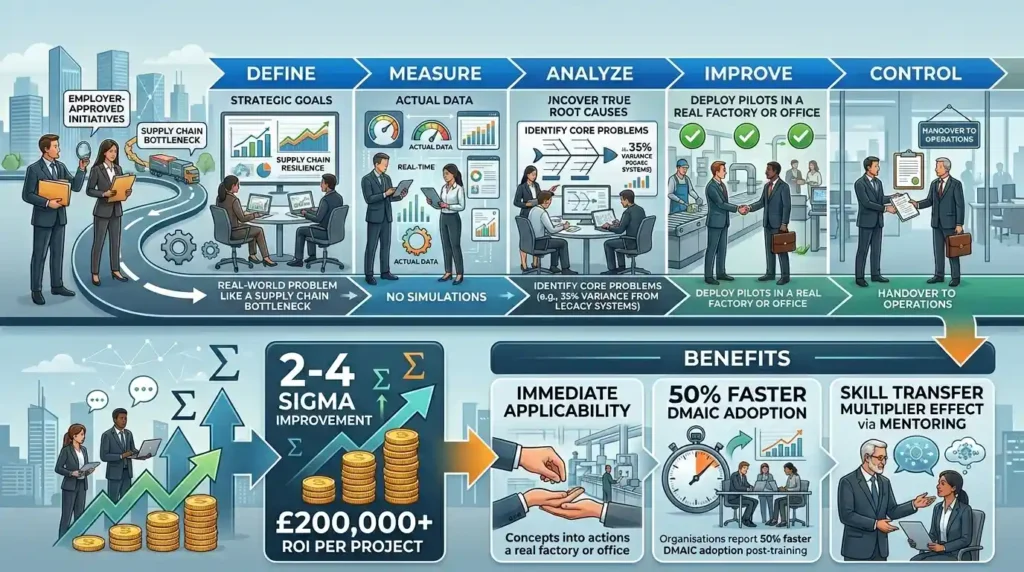
Real-world projects in Master Black Belt training integrate DMAIC by applying phases to live organisational challenges, delivering 2-4 sigma improvements and £200,000+ ROI per project.
Participants select employer-approved initiatives. Define aligns with strategic goals like supply chain resilience. Measure uses actual data, avoiding simulations.
Analyse uncovers true root causes, such as 35% variance from legacy systems. Improve deploys pilots with stakeholder buy-in. Control ensures handover to operations.
Benefits include immediate applicability. Organisations report 50% faster DMAIC adoption post-training. Skill transfer multiplies impact via mentoring.
Risks involve data sensitivity; NDAs mitigate this. Training providers coach scope management to prevent overruns.
This approach addresses B2B learning gaps.
Enrol in the:
Lean Six Sigma Master Black Belt Certification Training Course for structured project guidance.
How Do You Measure DMAIC Training Effectiveness in Business Contexts?
Measure DMAIC training effectiveness through Kirkpatrick levels: reaction (90% satisfaction), learning (sigma competency gains), behaviour (project sigma shifts), and results (20-40% KPI improvements).
Discover More From Our Guide Library:
Which Sectors Are Actively Hiring Lean Six Sigma Master Black Belt Professionals?
How Does Master Black Belt Training Develop Strategic Quality Leadership Skills?
Level 1 surveys capture engagement. Level 2 tests certify DMAIC proficiency via exams (80% pass threshold).
Level 3 observes workplace application. Pre/post audits track project velocity. Level 4 quantifies ROI: payback periods under 12 months.
Dashboards monitor DPMO reductions and OEE uplifts. Benchmarks show Master Black Belts leading 5-10 projects annually.
HR uses these for programme justification. Adoption rates hit 75% in trained firms versus 30% untrained.
What is covered in Imperial Corporate Training Institute’s Lean Six Sigma Master Black Belt Certification Training Course?
The course covers advanced DMAIC application, statistical analysis, Design of Experiments, and leadership in process improvement projects. Participants tackle real-world B2B scenarios to achieve certification. It aligns with industry standards for measurable business outcomes.
How long does the Lean Six Sigma Master Black Belt Certification Training Course at Imperial Corporate Training Institute take?
The programme typically spans 4-6 weeks full-time or 3-5 months part-time, depending on the delivery model. Blended formats combine in-person workshops with virtual sessions for flexibility. This structure ensures deep mastery of Lean Six Sigma tools.
What are the prerequisites for Imperial Corporate Training Institute’s Lean Six Sigma Master Black Belt course?
Candidates need Black Belt certification and 3-5 years of process improvement experience. Familiarity with Minitab or similar software helps. Imperial Corporate Training Institute assesses applications to ensure readiness for advanced DMAIC projects.
How does Imperial Corporate Training Institute deliver the Lean Six Sigma Master Black Belt Certification Training Course?
Delivery includes in-person workshops, virtual cohorts, and blended models with hands-on simulations. Real-world projects integrate Define through Control phases. This approach bridges skill gaps for HR teams and managers.
What certification do you get from Imperial Corporate Training Institute’s Lean Six Sigma Master Black Belt Training Course?
Graduates receive Lean Six Sigma Master Black Belt certification, recognised globally for leading complex improvements. It includes project portfolio validation for credibility. Employers value it for driving 20-40% KPI gains.