

Lean Six Sigma Master Black Belt status requires 4-6 years of progressive training, project leadership, and certification exams, building expertise to lead enterprise-wide quality transformations in corporate settings.
Lean Six Sigma Master Black Belt status represents the highest certification level in the Lean Six Sigma methodology. This methodology combines Lean principles, which eliminate waste, with Six Sigma statistical tools to reduce process variation. Master Black Belts guide organisations through complex improvement projects.
In corporate environments, this status equips professionals to address employee skill gaps in process optimisation. HR managers and L&D professionals use it to develop leaders who drive 20-30% productivity gains. Businesses achieve it to close gaps between current performance and strategic goals, such as reducing defects by 70% in manufacturing lines.
Master Black Belts mentor Black Belts and Green Belts, ensuring sustained process improvements. They analyse data across departments, targeting KPIs like cycle time reduction and cost savings. Organisations gain a leadership pipeline for quality management.
Why Do Organisations Pursue Master Black Belt Certification for Workforce Development?
Organisations pursue Master Black Belt certification to build strategic leaders who deliver 25-40% efficiency improvements, reduce operational costs by 15-30%, and strengthen employee retention through skill enhancement.
Corporate teams face skill gaps in handling large-scale process issues. Master Black Belt training fills these gaps by training professionals to lead cross-functional projects. This certification aligns workforce capabilities with business objectives, such as improving on-time delivery rates from 75% to 98%.
L&D professionals integrate it into development programmes to create internal experts. Team leaders gain tools to coach departments, boosting overall performance metrics. Decision-makers see it as an investment yielding ROI through measurable reductions in waste and rework.
Business owners target industries like manufacturing, finance, and healthcare. In finance, Master Black Belts streamline transaction processing, cutting errors by 50%. Retention rates rise by 15-20% as employees advance through certified belts.
How Does the Path to Master Black Belt Status Unfold Step by Step?
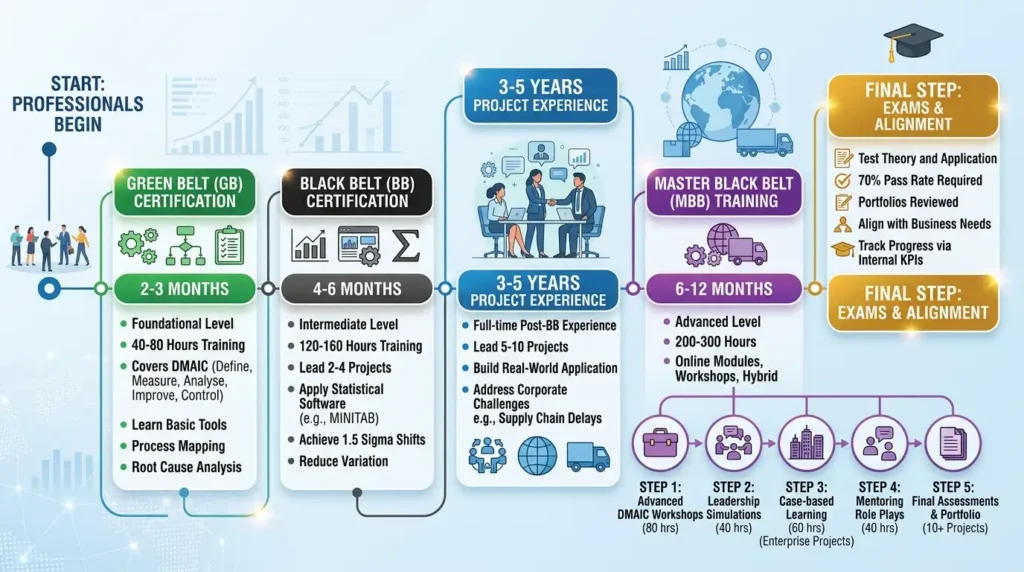
The path spans 4-6 years: complete Green Belt (2-3 months), Black Belt (4-6 months), gain 3-5 years project experience, then Master Black Belt training (6-12 months) with exams and a portfolio review.
Professionals start with Green Belt training, a 40-80 hour programme covering DMAIC (Define, Measure, Analyse, Improve, Control). This foundational level teaches basic tools like process mapping and root cause analysis.
Next, Black Belt certification requires 120-160 hours of training plus leading 2-4 projects. Candidates apply statistical software such as Minitab to achieve 1.5 sigma shifts, reducing variation.
Post-Black Belt, organisations mandate 3-5 years of full-time experience leading 5-10 projects. This phase builds real-world application, addressing corporate challenges like supply chain delays.
Master Black Belt training follows, lasting 6-12 months with 200-300 hours. Delivery formats include online modules, workshops, and hybrid learning. Step 1: Advanced DMAIC workshops (80 hours). Step 2: Leadership simulations (40 hours). Step 3: Case-based learning on enterprise projects (60 hours). Step 4: Role play for mentoring scenarios (40 hours). Step 5: Final assessments and portfolio submission of 10+ projects.
Exams test theory and application, with a 70% pass rate required. Organisations track progress via internal KPIs, ensuring alignment with business needs.
What Key Components Make Up Master Black Belt Training?
Key components include advanced DMAIC frameworks, statistical tools like Design of Experiments (DOE), leadership mentoring skills, Minitab software proficiency, and assessments via simulations and project portfolios.
Training covers DMAIC at an enterprise scale. Define phase identifies strategic opportunities using SIPOC diagrams. Measure phase deploys Gage R&R for data accuracy. Analyse uses hypothesis testing. Improve applies DOE for optimisation. Control establishes statistical process control charts.
Frameworks include Lean tools such as Value Stream Mapping and Kaizen events. Statistical components feature regression analysis and ANOVA, targeting 50-70% defect reductions.
Leadership skills encompass mentoring Black Belts through 1:1 coaching and team facilitation. Delivery formats blend online modules for flexibility with in-person workshops for simulations.
Assessments include 360-degree feedback, capstone projects, and oral defences. Tools like Minitab and JMP enable data-driven decisions. Organisations customise components to address department-specific gaps, such as IT service desks or healthcare patient flows.
How Do Organisations Implement Master Black Belt Training in Corporate Environments?
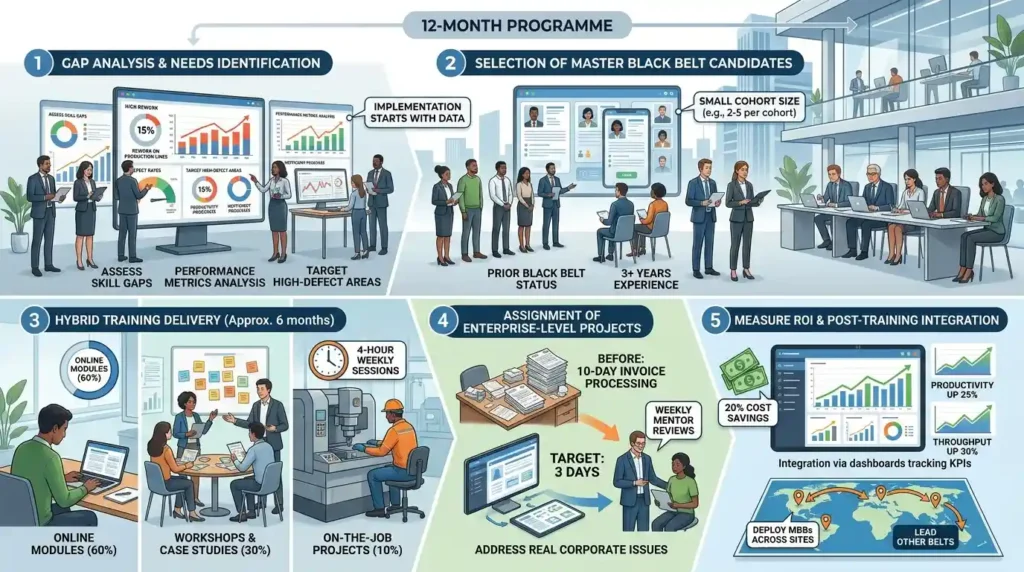
Organisations implement it through a 12-month programme: assess skill gaps, select 2-5 candidates per cohort, deliver hybrid training, assign enterprise projects, and measure ROI via KPIs like 20% cost savings.
Implementation starts with gap analysis using performance metrics. HR identifies teams with high defect rates or low efficiency, such as production lines averaging 15% rework.
Selection criteria demand prior Black Belt status and 3 years’ experience. Cohorts of 5-10 participants ensure collaboration.
Delivery combines online modules (60%), workshops (30%), and on-the-job projects (10%). Schedules fit corporate calendars, with 4-hour weekly sessions.
Projects target real issues, like reducing finance invoice processing from 10 days to 3. Mentors provide weekly reviews.
Post-training, organisations deploy Master Black Belts to lead belts across sites. Integration involves dashboards tracking KPIs: productivity up 25%, throughput increased 30%.
Challenges include resistance to change; organisations counter with role play simulations.
For deeper insights into developing these skills, read:
How Does Master Black Belt Training Develop Strategic Quality Leadership Skills?
What Delivery Formats Support Effective Master Black Belt Training?
Effective formats include hybrid learning (60% online modules, 40% workshops), simulations for project leadership, case-based learning from industries like manufacturing and logistics, and assessments with real-time feedback.
Hybrid formats accommodate remote teams, delivering 200 hours over 9 months. Online modules cover theory via videos and quizzes.
Workshops focus on hands-on tools, with groups practising DOE on sample datasets. Simulations mimic enterprise crises, such as supply chain disruptions, training quick responses.
Case-based learning draws from IT (reducing ticket resolution by 40%), healthcare (cutting wait times 35%), and finance (error rates down 60%). Role play builds mentoring skills through peer coaching scenarios.
Assessments use pre/post-tests, project audits, and KPI dashboards. Organisations achieve 90% completion rates with this mix, ensuring practical application.
What Measurable Outcomes Do Master Black Belts Produce in Organisations?
Master Black Belts produce 25-40% productivity improvements, 15-30% cost reductions, 20% higher employee retention, and ROI of 5:1 within 18 months through enterprise projects.
Outcomes track via KPIs. Productivity rises as projects cut cycle times by 30%, evident in manufacturing throughput gains.
Cost savings stem from waste elimination, averaging $500,000 per project in mid-sized firms. Finance departments report 25% lower operational expenses.
Retention improves as belts advance careers, reducing turnover from 18% to 13%. Leadership pipelines strengthen, with 70% of Black Belts promoted within two years.
ROI calculations use benefit-cost ratios: $1 invested yields $5 in savings. Long-term, sigma levels shift from 3 to 5, minimising defects to 3.4 per million opportunities.
What Use Cases Demonstrate Master Black Belt Impact Across Industries?
Use cases include manufacturing teams reducing defects by 70%, finance departments streamlining audits for 40% faster closes, healthcare units cutting patient wait times by 35%, and IT firms improving uptime to 99.5%.
In manufacturing, Master Black Belts lead Kaizen events across plants, achieving 25% inventory reductions.
Finance teams apply DOE to fraud detection, saving 20% in losses. Audits complete in 5 days versus 12.
Healthcare examples involve process mapping for emergency departments, boosting capacity by 30%.
IT use cases optimise helpdesks, slashing resolution times from 48 to 12 hours. Logistics firms cut shipping errors by 50%.
These cases span departments, with organisations reporting 15-25% overall efficiency gains.
What Common Problems Arise in Master Black Belt Training and How Do Organisations Address Them?
Common problems include lack of ROI from generic programmes (addressed by custom projects yielding 5:1 returns), skill gaps in statistics (fixed via targeted modules), low engagement in ineffective formats (solved with hybrid simulations), and misconceptions of quick certification (clarified by enforcing 4-6 year paths).
Generic programmes fail to deliver, with 40% showing no KPI shifts. Organisations counter with industry-specific cases.
Statistical gaps affect 30% of candidates; pre-assessments and Minitab training resolve this.
Low engagement drops completion to 60%; interactive simulations raise it to 95%.
Misconceptions view it as 6-month training; reality demands years of projects. Clear roadmaps prevent this.
Ineffective implementation ignores metrics; dashboards ensure 20%+ gains.
Explore our:
Lean Six Sigma Master Black Belt Certification Training Course
How Does Master Black Belt Training Address Corporate Misconceptions?
It addresses misconceptions by enforcing 4-6 year timelines with proven KPIs, rejecting quick-fix programmes, and delivering practical simulations that guarantee 25% efficiency gains.
Many assume instant expertise; structured progression debunks this.
Generic training myths persist; tailored projects prove ROI.
Discover More From Our Guide Library:
What Does a Lean Six Sigma Master Black Belt Professional Actually Do?
What Are the Different Belt Levels in Lean Six Sigma Certification?
Overemphasis on theory ignores practice; assessments mandate real applications.
Organisations dispel doubts through pilot cohorts showing 30% cost drops.
Is Lean Six Sigma Master Black Belt certification worth it for organisations?
Lean Six Sigma Master Black Belt certification delivers 25-40% productivity gains and 15-30% cost reductions for organisations. Internal experts mentor teams, improving KPIs like defect rates and retention. Imperial Corporate Training Institute’s course ensures practical application in industries such as manufacturing and finance.
What certification do you get after completing Master Black Belt training?
Completion of the Lean Six Sigma Master Black Belt Certification Training Course grants internationally recognised Master Black Belt status from accredited bodies. It validates expertise in strategic quality leadership and enterprise transformations. Imperial Corporate Training Institute aligns it with global standards like ASQ or IASSC.
How much does Lean Six Sigma Master Black Belt training cost?
Costs for the Lean Six Sigma Master Black Belt Certification Training Course at Imperial Corporate Training Institute range from £8,000 to £15,000, depending on format and customisation. This covers hybrid delivery, materials, exams, and mentoring. Organisations achieve 5:1 ROI through resulting process improvements.
What are the prerequisites for the Lean Six Sigma Master Black Belt Certification Training Course?
Prerequisites include Lean Six Sigma Black Belt certification and 3-5 years of full-time experience leading 5-10 projects. Candidates must demonstrate skills in DMAIC frameworks and tools like Minitab. Imperial Corporate Training Institute assesses portfolios to ensure readiness for advanced leadership training.