

A Lean Six Sigma Master Black Belt Professional leads complex process improvement projects, trains Black Belts and Green Belts, and drives enterprise-wide operational excellence in organisations, reducing waste by 30-50% and boosting efficiency across departments.
Organisations face persistent skill gaps in process optimisation. HR managers and L&D professionals address these gaps through structured training hierarchies. Lean Six Sigma forms the foundation. It combines Lean principles, which eliminate waste, with Six Sigma methods, which minimise variation using data-driven analysis.
A Master Black Belt occupies the top tier in this hierarchy. Green Belts handle basic projects. Black Belts lead moderate initiatives. Master Black Belts oversee strategic deployments. They integrate these roles into corporate strategy.
In workplaces, Master Black Belts identify inefficiencies in supply chains, manufacturing lines, or service operations. They deploy the DMAIC framework, Define, Measure, Analyse, Improve, Control, to achieve measurable results. Businesses gain 20-40% productivity increases from such interventions.
This role ensures alignment with corporate goals like cost reduction and quality enhancement. Teams in manufacturing report 25% defect reductions after Master Black Belt guidance. Finance departments cut processing times by 35%.
How Does Lean Six Sigma Master Black Belt Training Work in Corporate Environments?
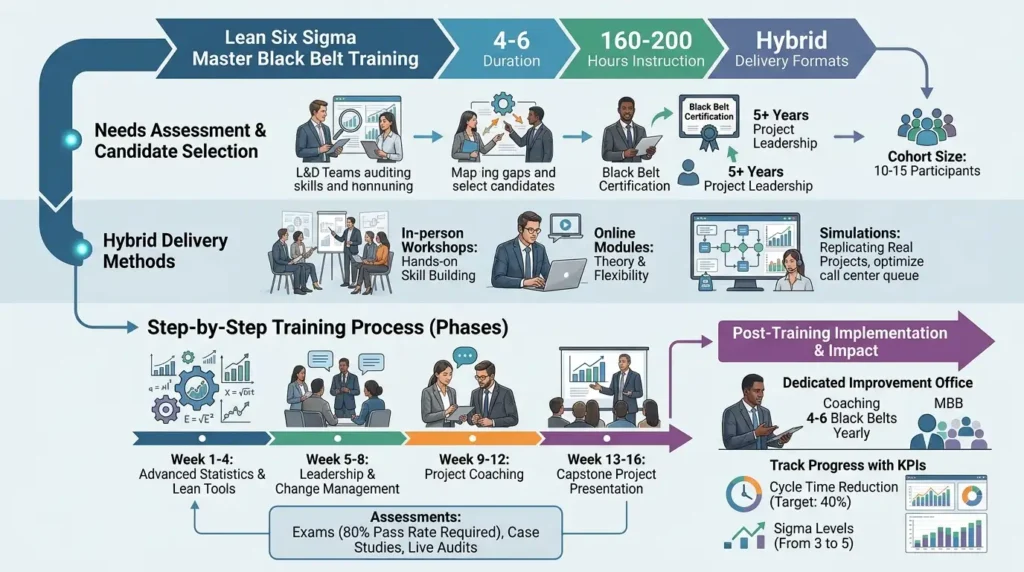
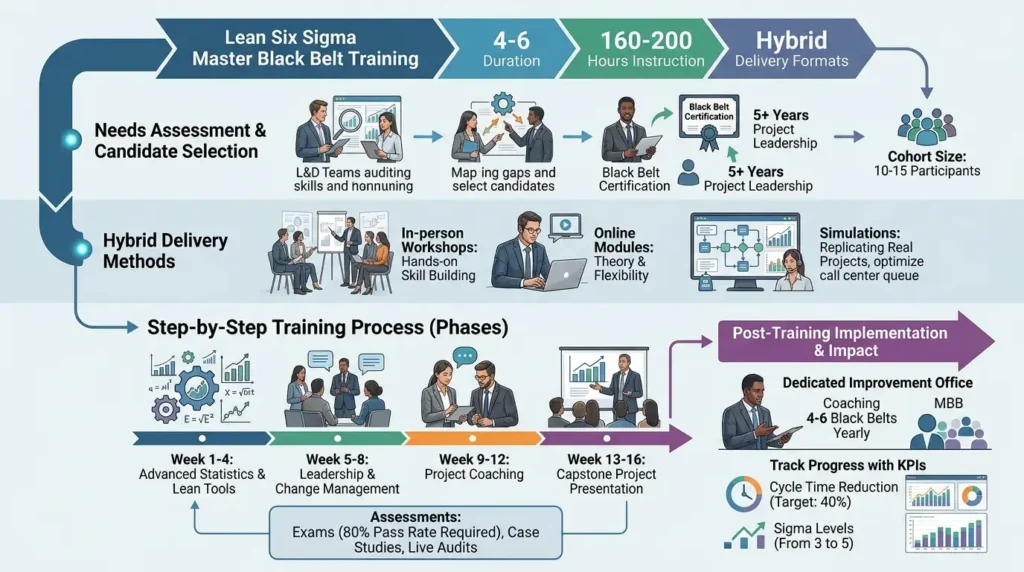
Lean Six Sigma Master Black Belt training spans 4-6 months with 160-200 hours of instruction, delivered via hybrid formats including workshops, online modules, and simulations, equipping professionals to implement DMAIC across 10-20 projects annually.
Training begins with assessing organisational needs. L&D teams map skill gaps using audits. They select candidates with Black Belt certification and 5+ years of project leadership. Programs run in cohorts of 10-15 participants.
Delivery mixes formats. In-person workshops build hands-on skills. Online modules cover theory for 4 hours weekly. Hybrid learning allows flexibility for busy executives. Simulations replicate real projects, such as optimising a call centre queue.
Step-by-step process unfolds in phases. Week 1-4: Advanced statistics and Lean tools. Week 5-8: Leadership and change management. Week 9-12: Project coaching. Week 13-16: Capstone project presentation. Assessments include exams (80% pass rate required), case studies, and live audits.
Organisations implement post-training via dedicated improvement offices. Master Black Belts coach 4-6 Black Belts yearly. They track progress with KPIs like cycle time reduction (target: 40%) and sigma levels (from 3 to 5).
What Key Components Make Up Lean Six Sigma Master Black Belt Training?
Core components include DMAIC framework, advanced statistical tools like Design of Experiments (DOE), Lean techniques such as Value Stream Mapping, leadership modules, and delivery formats like case-based learning and role-play simulations.
DMAIC anchors the curriculum. Define phase sets project charters. Measure establishes baselines. Analysis uncovers root causes. Improve test solutions. Control sustains gains.
Statistical tools dominate technical modules. Participants master DOE for optimizing variables, Hypothesis Testing for validation, and Control Charts for monitoring. Software like Minitab or JMP supports analysis.
Lean components target waste. Value Stream Mapping visualises flows. Kaizen events drive rapid improvements. 5S methodology organises workspaces.
Leadership training builds soft skills. Change management uses the ADKAR model Awareness, Desire, Knowledge, Ability, Reinforcement. Coaching modules teach mentoring Black Belts through 20 live sessions.
Delivery formats ensure retention. Case-based learning dissects real scenarios from industries such as IT, healthcare, and finance. Simulations run virtual factories. Role-play handles stakeholder resistance. Assessments gauge 90% competency in tools.
How Do Organisations Implement Master Black Belt Professionals Effectively?
Organisations implement Master Black Belts by establishing a central excellence centre, assigning them to coach 20-30 projects yearly, integrating with leadership teams, and measuring ROI through 15-25% cost savings within 12 months.
Implementation starts with the structural setup. Companies create Process Excellence Centres housing 3-5 Master Black Belts. These hubs report to C-suite for strategic alignment.
Deployment follows a phased rollout. Phase 1: Pilot in one department, targeting 10% efficiency gain. Phase 2: Scale to enterprise, training 50 Green Belts. Phase 3: Sustain with annual audits.
Master Black Belts coach daily. They review project pipelines, approve charters, and intervene in stalled initiatives. Integration with teams occurs via cross-functional workshops.
For those evaluating program fit, explore:
What prerequisites are required to join a Master Black Belt training programme to ensure candidates meet entry criteria
Also Explore Our:
Lean Six Sigma Master Black Belt Certification Training Course
Metrics drive accountability. Organisations track project savings (average $500K per Black Belt project), throughput increases (30%), and employee engagement scores (up 20%).
What Measurable Outcomes Do Master Black Belt Professionals Produce?
Master Black Belt professionals deliver 20-40% productivity gains, 25-50% waste reductions, 15% improvements in employee retention, and an ROI of 5:1 within 18 months through optimised processes and trained teams.
Productivity surges from streamlined workflows. Manufacturing firms report 35% output increases after cycle time cuts. Service sectors achieve 28% faster resolutions.
Waste reductions hit financials hard. Lean interventions eliminate overproduction and waiting, yielding 40% inventory drops. Healthcare examples show 30% supply cost savings.
Retention improves as employees gain skills. Trained teams report 18% lower turnover. Leadership pipelines strengthen, with 60% of Black Belts promoted internally.
ROI calculations use standard formulas: (Savings – Training Costs) / Training Costs. A $50K programme generates $250K returns via 5 projects.
KPIs include sigma levels rising from 3.5 to 4.5, defect rates falling 50%, and on-time delivery hitting 98%.
What Are Real-World Use Cases for Master Black Belts in Corporate Teams?
Master Black Belts deploy in manufacturing for line balancing, healthcare for patient flow optimisation, finance for transaction processing, IT for software deployment cycles, and logistics for supply chain efficiency, impacting 100-500 employees per initiative.
Manufacturing teams use them for defect elimination. A automotive plant balanced assembly lines, cutting downtime 45%.
Healthcare applications focus on throughput. Hospitals optimize ER triage, reducing wait times 50% and boosting patient satisfaction 25%.
Finance departments streamline approvals. Banks automate claims, achieving 60% faster processing and 20% error reductions.
IT sectors tackle deployment delays. Tech firms shorten release cycles from 6 weeks to 2, increasing feature velocity 3x.
Logistics examples include warehouse optimization. Distributors map flows, slashing picking errors 40% and freight costs 15%.
Cross-industry, Master Black Belts lead digital transformations, integrating AI with DMAIC for 30% efficiency gains.
What Common Problems Arise with Lean Six Sigma Master Black Belt Deployments?
Common problems include a lack of executive buy-in, causing 70% project abandonment, generic training yielding 10% skill retention, ignoring cultural resistance, leading to 40% adoption failures, and poor KPI tracking,an resulting in invisible 5:1 ROI.
Executive buy-in falters without C-suite mandates. Projects stall when leaders prioritise short-term gains over 12-month transformations.
Generic programs fail corporate needs. Off-the-shelf courses ignore industry specifics, like healthcare regulations, dropping effectiveness to 15%.
Discover More From Our Guide Library:
What Are the Different Belt Levels in Lean Six Sigma Certification?
What Is Lean Six Sigma and Why Does Every Business Need It?
Cultural resistance blocks change. Employees view Lean as job threats, causing 35% rollback rates without ADKAR training.
KPI neglect hides value. Teams track outputs, not sigma levels, masking true 25% productivity lifts.
Misconceptions persist. Many see Master Black Belts as statisticians only, overlooking their 50% time in coaching and strategy.
Ineffective training wastes budgets. Programs without simulations retain 20% less knowledge than hybrid formats.
Organisations counter these by piloting small, tying to bonuses, and auditing quarterly.
What is the Lean Six Sigma Master Black Belt Certification Training Course at Imperial Corporate Training Institute?
The Lean Six Sigma Master Black Belt Certification Training Course at Imperial Corporate Training Institute equips professionals with advanced skills to lead enterprise-wide process improvements using DMAIC and Lean tools. It spans 160-200 hours over 4-6 months in hybrid formats, including workshops and simulations. Participants complete capstone projects to achieve certification.
What are the prerequisites for the Lean Six Sigma Master Black Belt Certification Training Course?
Candidates need prior Lean Six Sigma Black Belt certification and at least 5 years of project leadership experience. Imperial Corporate Training Institute requires a skills audit to confirm readiness for advanced statistical tools and coaching roles. This ensures participants can handle complex deployments effectively.
How long does the Lean Six Sigma Master Black Belt Certification Training Course take?
The course at Imperial Corporate Training Institute lasts 4-6 months, totalling 160-200 hours. It combines online modules, in-person workshops, and practical simulations for flexible corporate learning. Assessments and a capstone project mark completion.
What does a Lean Six Sigma Master Black Belt do after certification from Imperial Corporate Training Institute?
Certified Master Black Belts coach Black Belts on 20-30 projects yearly, deploy DMAIC frameworks, and drive 20-40% efficiency gains. They lead Process Excellence Centres and integrate Lean Six Sigma into business strategy. Imperial Corporate Training Institute training emphasises real-world application in industries like manufacturing and healthcare.