

Lean Six Sigma Master Black Belt training covers advanced process optimisation, leadership in DMAIC methodologies, statistical analysis, change management, and strategic deployment of Lean principles across enterprise operations.
Organisations pursue Master Black Belt certification to bridge skill gaps in complex process improvements. HR leaders evaluate these programmes to equip senior managers with tools that deliver measurable ROI, such as 20-30% reductions in operational waste reported in manufacturing and service sectors.
To grasp the foundation, readers first explore:
What Is Lean Six Sigma and Why Does Every Business Need It. This awareness sets the stage for advanced training topics.
Master Black Belts lead cross-functional teams in high-stakes projects. Training emphasizes practical application over theory. Programs typically span 120-160 hours, blending virtual instructor-led sessions with hands-on simulations.
What Core Methodologies Form the Foundation of Master Black Belt Training?

Master Black Belt training builds on DMAIC (Define, Measure, Analyze, Improve, Control) and DMADV (Define, Measure, Analyze, Design, Verify) frameworks, integrating Lean tools for waste elimination and variation reduction in enterprise processes.
DMAIC drives existing process improvements. Trainees master project selection using business case development and stakeholder analysis. They learn to define project charters with clear objectives, scope, and success metrics tied to organizational KPIs like cycle time or defect rates.
Measure phase covers data collection strategies. Topics include process mapping with SIPOC diagrams and value stream mapping. Statistical tools such as gauge R&R ensure measurement system reliability.
Analyze delves into root cause identification. Training teaches hypothesis testing with chi-square, ANOVA, and regression analysis. Non-parametric tests handle non-normal data distributions common in real-world B2B operations.
Improve focuses on solution generation. Participants design experiments using DOE (Design of Experiments) to optimize variables. Lean techniques like Kaizen events and 5S implementation accelerate gains.
Control establishes sustainment. Topics include statistical process control charts, control plans, and response plans for deviation management. Master Black Belts train Green and Yellow Belts to embed these practices.
DMADV supports new process design. Training contrasts it with DMAIC for innovation projects, such as launching digital supply chain systems. HR teams value this duality for workforce upskilling in agile environments.
Which Statistical and Analytical Tools Do Master Black Belts Master?
Training equips Master Black Belts with advanced Minitab, JMP, or R-based tools for hypothesis testing, multivariate analysis, regression modeling, and predictive analytics to quantify process capabilities.
Statistical process control forms the core. Trainees interpret control charts like X-bar R, I-MR, and p-charts to detect special cause variation. They calculate process capability indices such as Cp, Cpk, Pp, and Ppk, targeting values above 1.33 for six sigma levels.
Hypothesis testing receives deep coverage. Paired t-tests, two-sample tests, and ANOVA validate improvements. Training includes power analysis to ensure test validity, with 80% power as standard for B2B projects.
Regression analysis predicts outcomes. Multiple linear regression, logistic regression, and Poisson models address count data in defect tracking. Trainees build models with R-squared above 0.7 for reliable forecasting.
Design of Experiments (DOE) optimizes multifactor processes. Full factorial, fractional factorial, and response surface methods identify interactions. Simulations demonstrate 15-25% efficiency gains in production lines.
Predictive analytics introduces machine learning basics. Topics cover decision trees, random forests, and neural networks for anomaly detection. Integration with ERP systems supports real-time monitoring.
These tools align with HR priorities for data-driven decisions. Organizations report 25% faster project completion after upskilling managers in these analytics.
How Does Leadership and Change Management Training Prepare Master Black Belts?
Master Black Belt programs dedicate 20-30% of curriculum to leadership skills, covering team coaching, stakeholder alignment, change acceleration processes (CAP), and organizational transformation strategies.
Leadership starts with coaching Green Belts. Training teaches tollgate reviews, mentoring techniques, and performance feedback models. Master Black Belts facilitate 10-15 projects annually, scaling improvements enterprise-wide.
Change management draws from Kotter’s 8-step model and ADKAR framework. Participants develop communication plans, resistance management strategies, and sustainment roadmaps. Case studies highlight 40% higher adoption rates in trained teams.
Strategic deployment covers Lean Six Sigma maturity models. Topics include Hoshin Kanri for policy deployment and balanced scorecards linking LSS to business strategy. HR leaders use this for training ROI measurement, targeting 5-10x returns on certification investments.
Executive sponsorship training builds buy-in. Master Black Belts learn to present dashboards with financial impacts, such as $500K annual savings from a single project.
Virtual delivery models, like blended learning with simulations, ensure scalability. Programs emphasize practical workshops over lectures, with 70% hands-on time.
What Advanced Lean Principles Are Emphasized in the Training?
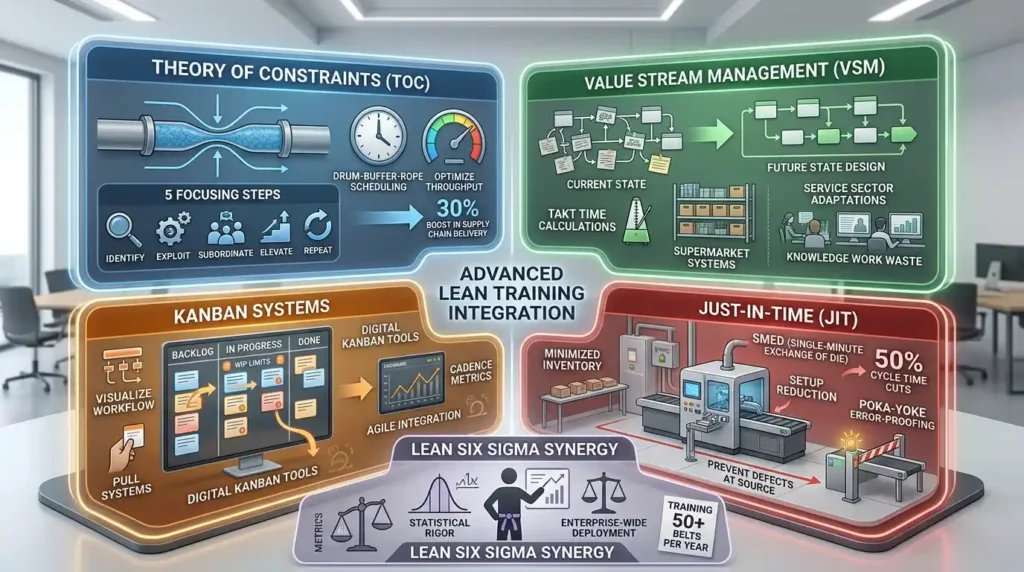
Training integrates advanced Lean tools like Theory of Constraints (TOC), Value Stream Management, Kanban systems, and Just-In-Time (JIT) to eliminate waste and synchronize enterprise flows.
Theory of Constraints identifies bottlenecks. Trainees apply the five focusing steps: identify, exploit, subordinate, elevate, and repeat. Drum-Buffer-Rope scheduling optimizes throughput, boosting on-time delivery by 30% in supply chains.
Value Stream Mapping evolves to future-state design. Advanced topics include supermarket systems and takt time calculations for paced production. Service sector adaptations address knowledge work waste.
Kanban visualizes workflows. Training covers WIP limits, pull systems, and cadence metrics. Digital Kanban tools integrate with Agile for hybrid environments.
JIT principles minimize inventory. Participants study SMED (Single-Minute Exchange of Die) for setup reduction, achieving 50% cycle time cuts. Poka-Yoke error-proofing prevents defects at source.
Lean Six Sigma synergy combines these with statistical rigor. Master Black Belts deploy enterprise-wide, training 50+ belts per year.
Which Project Management and Financial Analysis Topics Are Included?
Master Black Belts study project portfolio management, risk analysis, cost-benefit modeling, and ROI calculations using NPV, IRR, and payback period to justify multimillion-dollar initiatives.
Project management follows PMBOK integration with DMAIC. Topics include critical path method (CPM), Gantt charting, and earned value management (EVM). Risk matrices prioritize threats with probability-impact scoring.
Financial analysis quantifies value. Training teaches activity-based costing (ABC) to allocate overheads accurately. Net Present Value (NPV) and Internal Rate of Return (IRR) evaluate projects, with thresholds like IRR >15% for approval.
ROI frameworks link to KPIs. Trainees build dashboards tracking sigma levels, OEE (Overall Equipment Effectiveness), and first-pass yield. B2B examples show 3-5x ROI within 18 months.
Portfolio management balances projects by risk-reward. Master Black Belts prioritize using prioritization matrices aligned with strategic goals.
How Does Training Address Industry-Specific Applications and Case Studies?
Programs include sector-tailored modules for manufacturing, healthcare, finance, and IT, with real-world case studies demonstrating 20-40% efficiency gains and $1M+ savings.
Manufacturing covers line balancing and TPM (Total Productive Maintenance). Case studies from automotive suppliers show defect reductions from 5% to 0.1%.
Healthcare focuses on patient flow and throughput. Training analyzes ED wait times, reducing lengths by 25% via DMAIC.
Finance tackles transaction processing. Topics include fraud detection models and claims cycle optimization, cutting processing time by 40%.
IT addresses software deployment. Agile-DevOps integration with LSS improves release frequency by 3x.
Case studies emphasize scalable replication. Participants dissect failures, like incomplete control phases causing regression, and successes tied to leadership.
These applications help HR close skill gaps, with 85% of certified Black Belts leading promotions per industry surveys.
What Certification Preparation and Advanced Topics Complete the Curriculum?
Training culminates in ASQ or IASSC exam prep, covering body of knowledge review, mock exams, and advanced topics like DFSS (Design for Six Sigma) and sustainability integration.
Certification modules review 400+ knowledge areas. Practice exams simulate 4-hour formats with 150 questions. Pass rates exceed 90% for structured programs.
DFSS extends DMADV for robust design. Training includes tolerance design and robust parameter design using Taguchi methods.
Sustainability links LSS to ESG goals. Topics cover carbon footprint reduction via waste minimization, aligning with corporate net-zero targets.
Lean Six Sigma Master Black Belt Certification Training Course from providers like Imperial ensures alignment with these standards.
For decision-stage readers evaluating programs, explore:
Why Should You Enroll in Imperial’s Lean Six Sigma Master Black Belt Course? This resource details program specifics and outcomes.
Question: Answer:
How does Imperial’s Master Black Belt course differ from other programs?
Imperial Corporate Training Institute’s Lean Six Sigma Master Black Belt Certification Training Course emphasizes industry-specific case studies, hands-on simulations, and integration with business KPIs for measurable outcomes. Unlike generic programs, it focuses on practical leadership training with 70% applied learning. This aligns with HR needs for workforce upskilling.
Is Lean Six Sigma Master Black Belt certification worth it for career growth?
Earning a Lean Six Sigma Master Black Belt Certification Training Course from Imperial Corporate Training Institute boosts career prospects with skills in strategic deployment and ROI-driven projects, leading to roles like process excellence directors. Certified professionals see 20-30% salary increases and lead multimillion-dollar savings. It addresses B2B skill gaps in optimization.
What are the prerequisites for Master Black Belt training?
Participants in Imperial Corporate Training Institute’s Lean Six Sigma Master Black Belt Certification Training Course need prior Black Belt certification and 3-5 years of process improvement experience. Familiarity with Green Belt projects ensures readiness for advanced leadership roles. Organizations often require this for senior managers.
How long does it take to complete Lean Six Sigma Master Black Belt certification?
Imperial Corporate Training Institute’s Lean Six Sigma Master Black Belt Certification Training Course typically spans 120-160 hours over 4-6 months, blending live sessions, self-paced modules, and project work. This structure accommodates working professionals while building mastery. Completion includes exam preparation for ASQ or IASSC certification.