

AutoCAD HVAC drafting depends on standardised symbol libraries and reusable blocks to maintain consistency across commercial, industrial, and residential building projects. These libraries define how ductwork, air terminals, pipe systems, equipment layouts, and control components appear within technical drawings. In large-scale projects, standard blocks reduce drafting errors, improve coordination between engineering teams, and accelerate project delivery timelines.
Professionals learning HVAC drafting often begin with duct layout principles before progressing into symbol standards and reusable design systems. Teams comparing drafting workflows frequently study how symbols integrate with airflow calculations, spatial coordination, and construction documentation.
This progression becomes clearer when reviewing educational resources such as:
How Is AutoCAD Used to Design Ductwork Layouts in Commercial Buildings? explains how duct systems are structured inside commercial HVAC drawings.
Why are symbol libraries important in AutoCAD HVAC drafting?
Symbol libraries create consistency between HVAC engineers, drafters, contractors, and facility managers. Standard blocks reduce repetitive work, improve drawing readability, support multidisciplinary coordination, and ensure that construction teams interpret mechanical layouts accurately across complex building projects and long-term facility operations.
HVAC drafting projects involve thousands of repeated components. A single commercial office tower can contain hundreds of supply diffusers, return grilles, dampers, access panels, and control devices. Without standardised symbols, drawings become inconsistent and difficult to interpret.
Symbol libraries solve this problem by storing predefined drafting elements inside reusable collections. Each block contains graphical geometry, scaling behaviour, layer properties, annotation standards, and insertion parameters. This creates uniformity throughout project documentation.
In professional engineering environments, HVAC symbols follow recognised drafting conventions. Organisations commonly align with standards such as:
- ASHRAE drawing conventions
- ISO mechanical drafting standards
- BS EN building services documentation standards
- National CAD standards
- Company-specific BIM execution plans
These standards improve communication between stakeholders. Mechanical engineers, electrical designers, architects, and construction contractors all rely on predictable symbols during project coordination.
Training departments within engineering organisations also benefit from standardised libraries. New employees learn drafting procedures faster because the graphical language remains consistent across projects. HR teams evaluating technical training programmes often prioritise courses that teach industry-standard symbol management instead of isolated software commands.
The shift towards digital construction workflows has increased the importance of standard blocks. Modern HVAC documentation integrates with BIM coordination systems, clash detection platforms, and facilities management databases. Consistent symbols support accurate data exchange between departments.
The transition from manual drafting to intelligent drafting systems also influences workforce development decisions.
Many technical teams evaluating structured HVAC drafting programmes review implementation-focused training such as: “
Does Imperial’s AutoCAD HVAC Course Cover Commercial Building Ductwork Projects?” because commercial projects demand practical understanding of reusable drafting standards during live project delivery.
What types of HVAC symbols are commonly included in AutoCAD libraries?
AutoCAD HVAC libraries include symbols for duct systems, air distribution devices, mechanical equipment, plumbing interfaces, control systems, and annotation standards. These symbols support drafting accuracy, design coordination, installation planning, maintenance workflows, and construction documentation across commercial engineering environments.
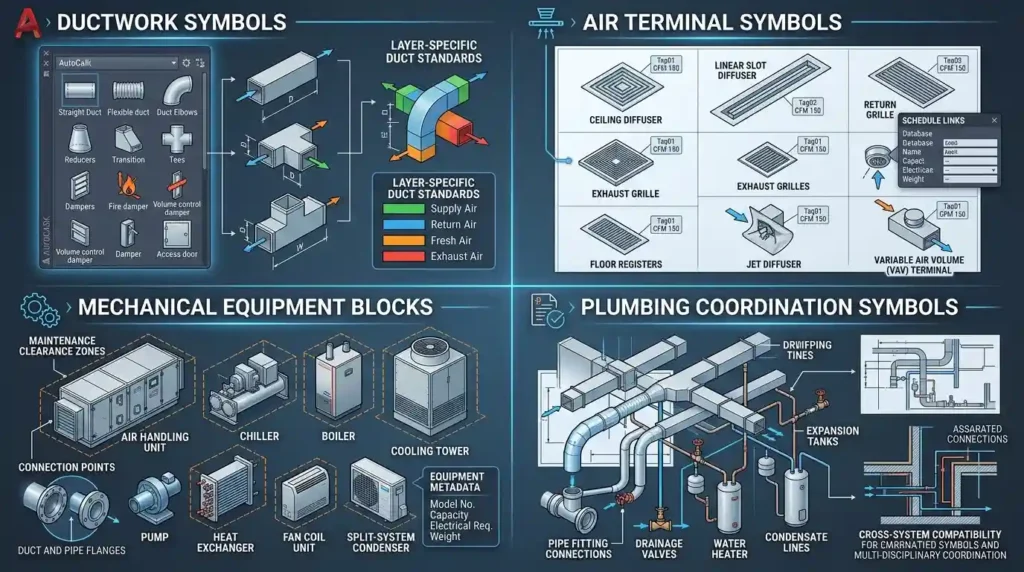
HVAC symbol libraries are organised into functional categories. Each category supports a specific stage of mechanical system design and documentation.
Ductwork symbols
Duct drafting symbols form the foundation of HVAC layouts. These include:
- Straight duct sections
- Flexible duct connections
- Duct elbows
- Reducers and transitions
- Tee connections
- Dampers
- Fire dampers
- Volume control dampers
- Access doors
These components define airflow pathways throughout the building. Standard blocks maintain dimensional consistency and support airflow calculations.
Commercial drafting teams also use layer-specific duct standards. Supply air, return air, fresh air, and exhaust air systems each follow separate colour and line-type conventions to improve drawing readability.
Air terminal symbols
Air terminals control air delivery into occupied spaces. Libraries typically include:
- Ceiling diffusers
- Linear slot diffusers
- Return grilles
- Exhaust grilles
- Floor registers
- Jet diffusers
- Variable air volume terminals
Each symbol includes airflow tagging conventions and equipment references. Large commercial projects often connect these symbols directly to schedules and specification databases.
Mechanical equipment blocks
Mechanical equipment libraries contain larger system components such as:
- Air handling units
- Chillers
- Boilers
- Cooling towers
- Pumps
- Heat exchangers
- Fan coil units
- Split-system condensers
These blocks contain more detailed information than simple symbols. Many include connection points, maintenance clearance zones, and equipment metadata.
Plumbing coordination symbols
Integrated building services projects require coordination between HVAC and plumbing systems. Combined drafting environments therefore include:
- Pipe fittings
- Valves
- Drainage connections
- Expansion tanks
- Water heaters
- Condensate lines
This integration becomes essential in multidisciplinary mechanical projects. Programmes such as the:
AutoCAD HVAC and Plumbing Design Training Course typically address this coordination because commercial construction increasingly depends on cross-system compatibility.
Control system symbols
Modern HVAC systems rely heavily on automation. Symbol libraries therefore include building management system components such as:
- Thermostats
- Sensors
- Actuators
- Control panels
- Smoke detectors
- Pressure switches
- Flow meters
These symbols support integration between mechanical and electrical documentation.
How do standard blocks improve drafting efficiency?
Standard blocks reduce repetitive drafting tasks, improve production speed, minimise human error, support version control, and create scalable workflows for large engineering teams managing complex HVAC documentation across multiple commercial construction projects simultaneously.
Manual drafting consumes significant project hours. Recreating identical components repeatedly increases labour costs and introduces inconsistencies. Standard blocks eliminate this inefficiency.
AutoCAD blocks operate as reusable objects. Once inserted, they maintain predefined geometry and properties. Updates to master blocks automatically propagate throughout drawings when dynamic references are used.
Engineering consultancies measure drafting productivity using metrics such as:
- Drawing completion time
- Coordination revision frequency
- Clash detection rates
- Rework percentage
- Documentation accuracy scores
Standard blocks improve performance across all these indicators.
Reduced drafting time
Large-scale projects require extensive repetitive detailing. Standard blocks eliminate repeated redrawing of equipment and fittings.
A drafting team producing hospital HVAC documentation can reduce layout production time significantly by using centralised symbol libraries. This efficiency improves project scheduling and resource allocation.
Improved multidisciplinary coordination
Standard blocks also improve collaboration between departments. Architects, structural engineers, and MEP consultants interpret drawings faster when symbols remain consistent.
Coordination meetings become more efficient because graphical communication is standardised. This reduces misunderstandings during design reviews.
Better training scalability
Organisations managing graduate engineering programmes often struggle with inconsistent drafting practices across teams. Standardised libraries simplify onboarding processes.
Training managers evaluating workforce development frameworks frequently compare drafting education based on operational efficiency outcomes rather than software familiarity alone. Structured learning pathways support faster competency development across technical departments.
Dynamic block advantages
Advanced HVAC drafting environments increasingly rely on dynamic blocks. These blocks contain adjustable parameters such as:
- Duct size
- Rotation
- Visibility states
- Connection variations
- Annotation scaling
Dynamic blocks reduce library size while increasing drafting flexibility. Instead of maintaining separate symbols for every variation, teams modify parameters within a single intelligent object.
What standards govern HVAC drafting symbols?
HVAC drafting symbols follow industry standards developed by engineering bodies, construction authorities, and CAD management frameworks. These standards ensure consistent communication, regulatory compliance, project interoperability, and reliable construction documentation across multidisciplinary building services environments and international project teams.
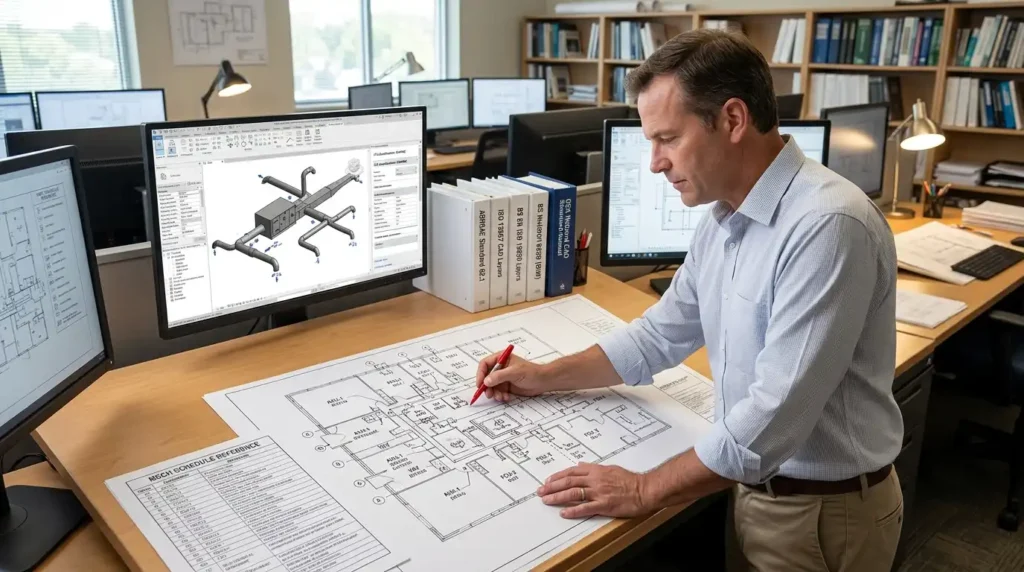
Different regions use different drafting conventions. International engineering firms therefore maintain detailed CAD standards manuals.
ASHRAE standards
ASHRAE establishes widely recognised HVAC engineering guidelines. Many drafting symbols align with ASHRAE documentation standards.
ASHRAE guidance influences:
- Mechanical schedules
- Airflow notation
- Equipment identification
- System abbreviations
- Ventilation documentation
Commercial engineering consultancies frequently adopt ASHRAE conventions because they support international project collaboration.
ISO and BS standards
International and British standards also influence HVAC drafting.
Relevant frameworks include:
- ISO technical drawing standards
- BS EN mechanical documentation standards
- Building services coordination standards
- Fire protection integration standards
British commercial projects often combine ISO conventions with local compliance requirements.
National CAD standards
Large public-sector projects frequently mandate national CAD standards. These define:
- Layer naming conventions
- Annotation structures
- File management systems
- Object classification rules
- Drawing sheet organisation
Compliance improves interoperability across government infrastructure projects.
BIM integration standards
Modern HVAC drafting increasingly overlaps with BIM workflows. Symbol libraries therefore align with:
- IFC object classification systems
- COBie data standards
- BIM execution plans
- Digital asset management protocols
This shift changes training requirements significantly. Technical professionals now require competency in both drafting geometry and information management systems.
How do organisations manage HVAC symbol libraries internally?
Organisations manage HVAC libraries through centralised CAD standards, version-controlled repositories, BIM coordination systems, and technical governance procedures that maintain consistency, reduce project risk, and support scalable engineering workflows across distributed design teams and contractors.
Engineering firms rarely allow uncontrolled symbol usage. Most organisations maintain strict governance systems.
Central CAD repositories
Companies typically store approved blocks in central databases. Access permissions control who can create, edit, or distribute symbols.
This governance structure prevents duplication and maintains consistency across projects.
Version control systems
Symbol updates occur regularly because regulations, project requirements, and equipment standards evolve over time.
Version-controlled systems track:
- Block revisions
- Approval dates
- Authorised users
- Deprecated symbols
- Compliance updates
This reduces coordination errors during long-term projects.
BIM and cloud integration
Cloud-based collaboration platforms now support shared HVAC libraries across global teams. Engineers working in different countries access identical symbol sets in real time.
This improves:
- Remote collaboration
- Quality assurance
- Coordination speed
- Documentation consistency
Large enterprises increasingly integrate CAD management into broader digital transformation strategies.
Internal training requirements
Organisations implementing standardised drafting systems also require structured workforce training.
Technical competency frameworks often include:
- CAD standards compliance
- Symbol interpretation
- Dynamic block usage
- Layer management
- BIM coordination
HR teams comparing technical training programmes increasingly evaluate measurable operational outcomes such as drafting accuracy improvements, reduced onboarding time, and lower revision frequencies.
What should professionals evaluate when learning HVAC drafting standards?
Professionals evaluating HVAC drafting education should assess symbol standard coverage, commercial project realism, multidisciplinary coordination skills, BIM compatibility, and workflow efficiency outcomes rather than focusing only on software interface familiarity or isolated drafting exercises.
Many introductory AutoCAD courses focus heavily on commands while ignoring engineering workflows. Commercial employers, however, prioritise drafting competency within real project environments.
Commercial project exposure
Effective HVAC drafting education includes realistic project documentation such as:
- Office buildings
- Hospitals
- Hotels
- Industrial facilities
- Mixed-use developments
These projects expose learners to practical coordination challenges.
Standard library usage
Professionals should evaluate whether training includes:
- HVAC block libraries
- Mechanical standards
- Annotation systems
- Dynamic block configuration
- Layer management frameworks
These skills transfer directly into workplace environments.
Coordination-based learning
Modern building services projects require cross-disciplinary collaboration. Strong training therefore includes interaction between:
- HVAC systems
- Plumbing layouts
- Electrical services
- Fire protection systems
- Architectural constraints
This integrated approach reflects real engineering workflows.
BIM readiness
BIM adoption continues to reshape mechanical drafting roles. Professionals therefore benefit from understanding:
- BIM-compatible drafting practices
- Object-based modelling
- Metadata integration
- Coordination platforms
- Clash detection principles
Organisations investing in workforce development increasingly compare training providers based on operational readiness rather than software certification alone.
How are symbol libraries evolving with modern HVAC design technology?
HVAC symbol libraries are evolving from static drafting references into intelligent data-driven objects integrated with BIM systems, automation workflows, digital twins, and facilities management platforms that support lifecycle building operations and advanced engineering coordination.
Traditional CAD blocks focused primarily on visual representation. Modern intelligent objects contain operational data that supports construction and facility management processes.
Intelligent BIM objects
Contemporary HVAC objects now include:
- Equipment specifications
- Maintenance data
- Airflow parameters
- Manufacturer information
- Energy performance attributes
This transforms drafting into a data management process.
Automation and AI integration
Automation tools increasingly generate repetitive drafting components automatically. HVAC software now supports:
- Automated duct routing
- Parametric equipment layouts
- Rule-based annotation
- Smart scheduling systems
These technologies reduce manual drafting workloads.
Digital twin compatibility
Commercial property management increasingly relies on digital twins. HVAC documentation therefore supports ongoing operational monitoring rather than only construction delivery.
Discover More from Our Guide Library:
How Does AutoCAD HVAC Training Teach Engineers to Avoid Common Design Errors?
How Does AutoCAD HVAC Training Cover Sanitary and Stormwater Design?
Libraries now connect with:
- IoT sensors
- Building management systems
- Energy monitoring platforms
- Predictive maintenance tools
This evolution changes skill requirements for drafting professionals.
Workforce implications
Engineering employers increasingly prioritise:
- BIM literacy
- Data coordination skills
- Standards management
- Digital collaboration competency
- Integrated workflow understanding
Training decisions therefore focus less on isolated software knowledge and more on end-to-end project capability development.
What topics does Imperial Corporate Training Institute cover in the AutoCAD HVAC and Plumbing Design Training Course?
The course covers HVAC and plumbing symbol libraries, dynamic/parametric blocks, drafting standards, metadata attributes, duct and pipe layout workflows, and export/coordination for BIM. It emphasises practical lab exercises and deliverable-ready templates for commercial projects.
Who should attend the AutoCAD HVAC and Plumbing Design Training Course at Imperial Corporate Training Institute?
The course targets HVAC and plumbing designers, MEP CAD technicians, BIM coordinators, and engineering managers responsible for drawing standards and coordination. It suits HR-led upskilling programmes focused on reducing rework and improving drafting productivity.
How does the course improve drafting efficiency and coordination for commercial building projects?
The training teaches standardised naming, metadata population, and parametric block creation that reduce duplicate blocks and speed drawing updates. Measured outcomes include faster sheet production and fewer cross-discipline clashes during coordination.
What practical assessments and deliverables come with Imperial Corporate Training Institute’s AutoCAD HVAC and Plumbing Design Training Course?
Assessments include parametric block creation tasks, template audits, export and schedule validation, and a project-based drawing set for end-to-end coordination. Deliverables typically include standardised block libraries, a DWT template, and exported schedules for procurement and BIM use.