
Key points
- As reported by Protium Green Solutions, Protium has produced its first green hydrogen at Pioneer 2, its second green hydrogen production facility in South Wales.
- According to the company’s own updates, Pioneer 2 is one of Wales’s largest electrolysers and among the UK’s most advanced proton‑exchange membrane (PEM) systems.
- Business News Wales and H2‑View News note that Pioneer 2 is built around a 2.5 MWe Nel PEM electrolyser and, at full capacity, will produce up to one tonne of green hydrogen per day – roughly 25 times the output of Protium’s first facility, Pioneer 1.
- Protium states that the facility is containerised and modular, enabling faster deployment and easier scaling as demand for green hydrogen grows.
- The firm emphasises that the move to full commercial operations at Pioneer 2 this year will strengthen supply‑chain confidence and demonstrate that large‑scale green hydrogen production is commercially viable in the UK.
- In line with wider decarbonisation goals, Protium highlights that the new facility will help avoid the emission of around 156,000 tonnes of carbon dioxide annually, equivalent to taking roughly 37,000 cars off UK roads.
- As covered by H2‑Tech, Protium has also used 100 per cent green hydrogen to power construction activities at the Pioneer 2 site, deploying fuel‑cell generators supplied by Taylor Construction Plant (TCP) to replace diesel‑powered plant.
What is the significance of Protium’s second green hydrogen facility?
In a notable development for the UK energy transition, Protium Green Solutions has announced that its second green hydrogen production facility, Pioneer 2, has begun producing green hydrogen in South Wales. As reported by Protium, Pioneer 2 is now operational and marks the company’s evolution from a pilot‑scale project at Pioneer 1 to a much larger, commercially‑focused asset.
Business News Wales explains that Protium describes Pioneer 2 as one of the largest containerised PEM electrolyser systems in the UK, underlining its role in scaling up domestic green hydrogen capacity. H2‑View News notes that the project originally targeted a fourth‑quarter 2024 opening but has since come online in early 2026 after completing planning and permitting.
How does Pioneer 2 differ from the first facility?
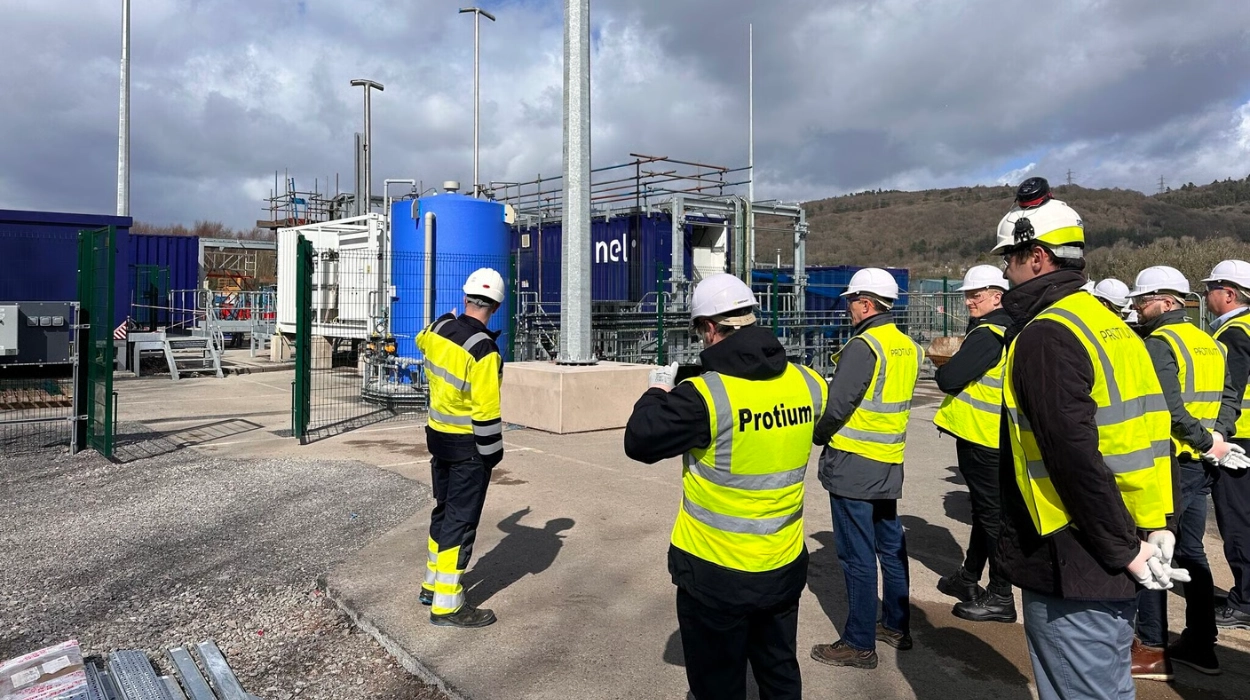
Protium’s public communications outline that the new facility is located in South Wales and is based on a 2.5 MWe PEM electrolyser supplied by Nel, which the company characterises as among the UK’s most advanced installed PEM systems. According to Protium, when running at full capacity, Pioneer 2 will generate up to one tonne of green hydrogen per day, a 25‑fold increase over the output of Pioneer 1.
On its project page, Protium states that the facility’s containerised design allows for quicker deployment and more flexible expansion, helping to overcome the long lead times typically associated with traditional energy infrastructure. The company also stresses that the modular approach aligns with the UK’s need to rapidly build out hydrogen infrastructure to support heavy transport, logistics, off‑grid power and energy‑intensive industries.
Who is Protium and what is its broader mission?
Protium positions itself as one of the UK’s leading green hydrogen energy companies focused on delivering “green hydrogen made simple” for industrial and transport customers. The firm’s own materials indicate that Pioneer 1, the first South Wales facility, has already been supplying hydrogen for vehicle trials and off‑grid power applications, testing the commercial model that Pioneer 2 now seeks to scale.
In a series of updates, Protium explains that Pioneer 2 is intended to prove that large‑scale green hydrogen can be built and operated safely, reliably and responsibly, thus strengthening investor and customer confidence. The company adds that the project has been in the works since 2022, with site‑visit programmes scheduled for early 2026 to showcase the facility to industrial operators, broadcasters, live‑event organisers and others.
What are the environmental and economic impacts?
According to Protium’s project documentation, Pioneer 2 alone is expected to cut around 156,000 tonnes of carbon dioxide emissions annually, a figure the firm equates to removing roughly 37,000 cars from UK roads. This aligns with wider UK and devolved government ambitions to decarbonise hard‑to‑electrify sectors where green hydrogen is seen as a key alternative to fossil‑based fuels.
The company further argues that each additional megawatt of green hydrogen production helps relax supply constraints that currently limit the pace of hydrogen‑based decarbonisation. By demonstrating a working, profitable facility so soon after construction, Protium aims to persuade more industrial and fleet customers to commit to green hydrogen contracts, which in turn can underpin future projects.
How is hydrogen being used even during construction?
H2‑Tech reports that Protium has taken the step of powering construction activities at Pioneer 2 with 100 per cent green hydrogen, using fuel‑cell generators supplied by Taylor Construction Plant (TCP). The temporary system provides both electricity and heat, with battery storage integrated to manage fluctuations in demand and to avoid the need for conventional diesel‑powered generators.
Protium explains that the fuel‑cell setup converts gaseous hydrogen into power on site, emitting only water vapour at the point of use and producing zero CO₂ during construction operations. The company frames this as a practical demonstration of how green hydrogen can already replace diesel in industrial and construction settings, particularly where grid capacity is limited.
What does this mean for the UK’s hydrogen strategy?
In the context of the UK’s broader hydrogen ambitions, Protium’s operational debut of Pioneer 2 reinforces the view that modular, rapidly deployable facilities can play a central role in the energy transition. Other players, such as RWE with its Pembroke Green Hydrogen project and MorGen Energy’s planned Milford Haven plant, are also progressing large‑scale hydrogen schemes, but Protium’s dual‑facility model is currently unique in having two operational renewables‑based hydrogen plants producing for commercial customers.
Protium’s statement to the market is that operating multiple facilities reduces the “supply constraint” on UK green hydrogen adoption and strengthens customer confidence that hydrogen supply is real and reliable rather than theoretical. For industrial operators exploring energy‑transition Corporate Training and Occupational Health & Safety programmes, the project offers a tangible case study in how hydrogen infrastructure can be integrated into existing operations while managing safety, logistics and workforce upskilling.
How does this tie into workforce and skills development?
As the UK scales up hydrogen infrastructure, commentators and industry bodies have repeatedly highlighted the need for trained technicians, engineers and site‑managers who understand hydrogen handling, safety protocols and energy management. Protium’s own communications stress that the company is inviting organisations across industrial sectors to tour Pioneer 2, suggesting that the facility will serve as a live training ground for operators and planners.
For employers and training providers, this underlines the growing relevance of Corporate Training and Health & Safety programmes focused on hydrogen‑enabled sites, heavy transport and off‑grid power. By embedding hydrogen‑specific modules into broader operational training, companies can better prepare their workforce for the kinds of projects exemplified by Pioneer 2, from fuel‑cell‑powered construction sites to large‑scale distribution and dispensing networks.