

Organisations rely on data to make operational, financial, and strategic decisions. Data quality depends on the accuracy and consistency of measurement systems. Gage Repeatability and Reproducibility (Gage R&R) studies provide a structured method for evaluating whether measurement systems produce reliable results. Within Six Sigma, Gage R&R is a core component of Measurement System Analysis (MSA), helping organisations identify measurement variation before making process improvement decisions.
Companies across industries such as manufacturing, healthcare, automotive, aerospace, pharmaceuticals, logistics, and energy use Gage R&R studies to ensure that performance data reflects actual process conditions rather than measurement errors. Understanding how these studies work helps organisations strengthen quality control, improve process capability, and support evidence-based decision-making.
Why Are Gage Repeatability and Reproducibility Studies Important in Six Sigma?
Gage Repeatability and Reproducibility studies measure the amount of variation introduced by a measurement system. They help organisations determine whether data is reliable enough for quality control, process improvement, compliance requirements, and operational decision-making.
Six Sigma focuses on reducing variation and improving process performance. Improvement efforts depend on accurate measurements. If a measurement system produces inconsistent results, teams cannot determine whether process changes have improved performance or simply altered measurement outcomes.
A Gage R&R study evaluates the quality of a measurement system by examining two primary sources of variation:
- Repeatability
- Reproducibility
These measurements help organisations assess whether observed variation originates from the process itself or from the measurement method.
Without a validated measurement system, organisations risk making decisions based on inaccurate information. This creates defects, increases operational costs, and reduces confidence in quality data.
What Is Gage Repeatability in a Measurement System?
Gage repeatability measures variation that occurs when the same operator uses the same measurement instrument to measure the same item multiple times under identical conditions. It evaluates equipment consistency and measurement precision.
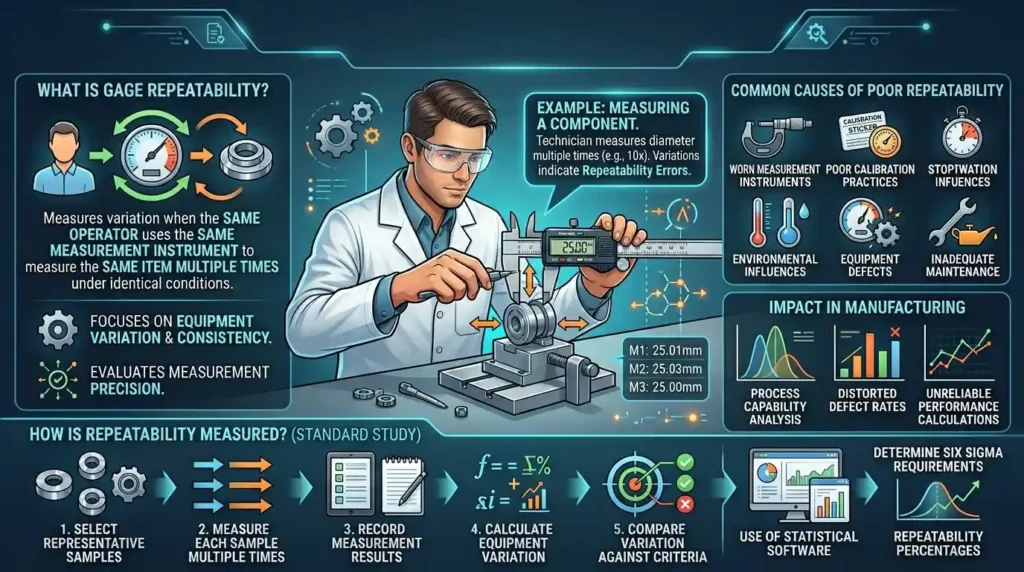
Repeatability focuses on equipment variation.
For example, a quality technician measures the diameter of a machined component ten times using the same digital calliper. If the measurements vary significantly despite identical conditions, the measurement device introduces repeatability errors.
Common causes of poor repeatability include:
- Worn measurement instruments
- Poor calibration practices
- Environmental influences
- Equipment defects
- Inadequate maintenance procedures
In manufacturing environments, repeatability directly influences process capability analysis because measurement variation can distort defect rates and process performance calculations.
How Is Repeatability Measured?
A standard study involves:
- Selecting representative samples
- Measuring each sample multiple times
- Recording measurement results
- Calculating equipment variation
- Comparing variation against acceptance criteria
Many organisations use statistical software to calculate repeatability percentages and determine whether measurement systems meet Six Sigma requirements.
What Is Gage Reproducibility in a Measurement System?
Gage reproducibility measures variation that occurs when different operators measure the same item using the same instrument. It evaluates consistency between people performing measurement activities.
Reproducibility focuses on operator variation.
For example, three inspectors measure the same product dimensions using identical tools. If measurement results differ significantly among inspectors, reproducibility problems exist.
Common causes include:
- Different measurement techniques
- Inconsistent procedures
- Varying levels of training
- Human interpretation errors
- Lack of standardisation
Reproducibility becomes especially important in organisations with multiple shifts, locations, or inspection teams.
A pharmaceutical manufacturer, for example, requires laboratory technicians across different facilities to achieve consistent measurement outcomes. Reproducibility studies ensure measurement standards remain aligned throughout the organisation.
How Is Reproducibility Evaluated?
A reproducibility assessment typically includes:
- Multiple operators
- Common measurement equipment
- Standardised samples
- Controlled testing conditions
- Statistical comparison of results
The objective is to quantify operator-related variation and identify opportunities for standardisation.
How Do Gage R&R Studies Work in Corporate Environments?
Gage R&R studies follow a structured process that evaluates measurement system performance through sample selection, repeated measurements, statistical analysis, and improvement actions. The results support data-driven quality management practices.
Most organisations perform Gage R&R studies during quality improvement initiatives, new product launches, process validation projects, and regulatory compliance activities.
The implementation process generally follows several stages.
Define the Measurement Process
The organisation identifies:
- Measurement objectives
- Critical quality characteristics
- Measurement instruments
- Inspection procedures
- Responsible personnel
This stage establishes study boundaries and ensures alignment with business requirements.
Select Representative Samples
Teams choose samples that represent expected process variation.
A manufacturing facility measuring shaft diameters, for example, selects components from different production batches to capture realistic operating conditions.
Conduct Measurement Trials
Operators measure the selected samples multiple times.
Each operator follows standard procedures to ensure consistent testing conditions.
Data collection often includes:
- 10 sample parts
- 3 operators
- 2 to 3 measurement repetitions
This structure provides sufficient data for statistical analysis.
Analyse Measurement Variation
Statistical software calculates:
- Repeatability variation
- Reproducibility variation
- Total Gage R&R percentage
- Part-to-part variation
Results reveal whether measurement systems contribute excessive variation.
Implement Improvement Actions
Organisations address identified weaknesses through:
- Equipment upgrades
- Calibration improvements
- Operator training
- Standardised work instructions
- Process redesign
These actions strengthen measurement reliability and support continuous improvement initiatives.
What Components Are Included in a Gage R&R Study?
A comprehensive Gage R&R study includes measurement equipment, operators, samples, statistical analysis methods, acceptance criteria, and improvement plans. Together these components evaluate overall measurement system capability.
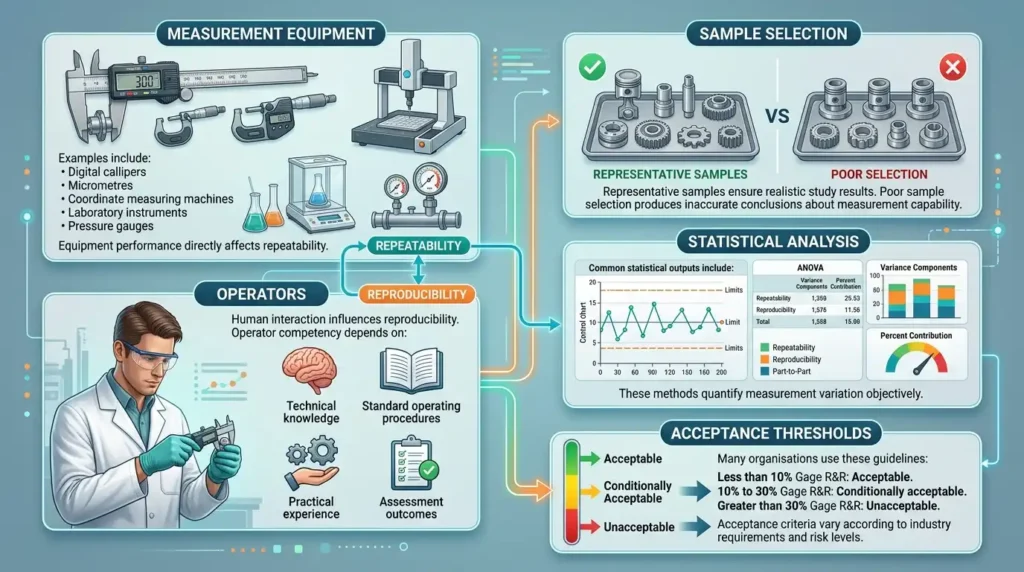
Measurement systems involve more than instruments alone.
Several interconnected components influence measurement quality.
Measurement Equipment
Examples include:
- Digital callipers
- Micrometres
- Coordinate measuring machines
- Laboratory instruments
- Pressure gauges
Equipment performance directly affects repeatability.
Operators
Human interaction influences reproducibility.
Operator competency depends on:
- Technical knowledge
- Standard operating procedures
- Practical experience
- Assessment outcomes
Sample Selection
Representative samples ensure realistic study results.
Poor sample selection produces inaccurate conclusions about measurement capability.
Statistical Analysis
Common statistical outputs include:
- Percent contribution
- Variance components
- Control charts
- Analysis of variance (ANOVA)
These methods quantify measurement variation objectively.
Acceptance Thresholds
Many organisations use these guidelines:
- Less than 10% Gage R&R: Acceptable
- 10% to 30% Gage R&R: Conditionally acceptable
- Greater than 30% Gage R&R: Unacceptable
Acceptance criteria vary according to industry requirements and risk levels.
How Does Gage R&R Support Organisational Performance Improvement?
Gage R&R studies improve data reliability, reduce quality risks, support process improvement projects, strengthen compliance efforts, and increase confidence in operational decision-making across departments and business functions.
Reliable measurements support organisational excellence.
When measurement systems perform consistently, organisations gain accurate insights into process behaviour.
Benefits include:
Improved Process Improvement Outcomes
Six Sigma projects depend on trustworthy baseline data.
Accurate measurements allow teams to identify root causes and verify improvement results.
Reduced Quality Costs
Measurement errors contribute to:
- Scrap
- Rework
- Warranty claims
- Customer complaints
Reducing measurement variation lowers these costs.
Better Regulatory Compliance
Industries such as healthcare, pharmaceuticals, aerospace, and food manufacturing operate under strict quality requirements.
Validated measurement systems support compliance audits and documentation requirements.
Enhanced Operational Efficiency
Reliable measurements reduce unnecessary inspections and repeated testing activities.
This improves workflow efficiency and resource utilisation.
Stronger Data Governance
High-quality measurement systems strengthen reporting accuracy and performance monitoring frameworks.
Executives gain greater confidence in operational KPIs and strategic planning decisions.
How Is Measurement System Analysis Applied in Master Black Belt Training?
Master Black Belt training teaches Measurement System Analysis through advanced statistical methods, practical case studies, project-based learning, and real-world quality improvement scenarios that develop organisational problem-solving capability.
Measurement System Analysis forms an important part of advanced Lean Six Sigma education.
Participants learn how to:
- Design measurement studies
- Conduct Gage R&R analyses
- Interpret statistical outputs
- Improve measurement systems
- Lead quality improvement initiatives
Training programmes frequently combine:
- Instructor-led workshops
- Statistical software exercises
- Process simulations
- Case-based learning
- Performance assessments
When organisations evaluate advanced implementation methods, understanding how measurement system analysis is incorporated into higher-level Six Sigma education provides valuable context.
Readers seeking a deeper understanding can explore:
How Measurement System Analysis is taught in Master Black Belt programmes to examine the practical learning frameworks used during advanced Lean Six Sigma development.
For more information, enrol in:
Lean Six Sigma Master Black Belt Certification Training Course
What Common Misconceptions Exist About Gage R&R Studies?
Many organisations incorrectly assume calibrated equipment guarantees accurate measurements. Gage R&R studies reveal that operator variation, procedural inconsistencies, and system design issues significantly affect measurement reliability.
Several misconceptions reduce the effectiveness of measurement improvement efforts.
Calibration Eliminates All Measurement Problems
Calibration verifies instrument accuracy at a specific point in time.
It does not evaluate operator behaviour or process variation.
Gage R&R Is Only for Manufacturing
Many sectors use measurement systems.
Examples include:
- Healthcare patient assessments
- Financial auditing processes
- Laboratory testing
- Service quality evaluations
Measurement variation exists wherever data collection occurs.
One Study Is Sufficient Forever
Measurement systems change over time.
Equipment wear, workforce changes, and process modifications require periodic reassessment.
Measurement Errors Have Minimal Business Impact
Even small measurement errors influence:
- Quality decisions
- Process capability studies
- Customer satisfaction metrics
- Compliance outcomes
Reliable measurements remain essential for effective organisational performance management.
How Do Organisations Use Gage R&R Results to Drive Continuous Improvement?
Organisations use Gage R&R results to improve measurement processes, standardise procedures, strengthen workforce capability, optimise quality systems, and support long-term operational excellence initiatives.
Continuous improvement depends on accurate feedback mechanisms.
Gage R&R studies provide that feedback.
Organisations use findings to:
- Improve standard operating procedures
- Enhance employee training programmes
- Upgrade measurement technologies
- Strengthen quality assurance frameworks
- Improve process capability performance
As measurement systems become more reliable, organisations gain clearer visibility into operational performance.
Discover More from Our Guide Library:
What Is the Difference Between Lean Six Sigma and Agile Methodologies?
How Is Lean Six Sigma Used to Improve Customer Satisfaction Scores?
This enables better resource allocation, faster problem resolution, stronger quality outcomes, and more effective process improvement programmes across departments and business functions.
Reliable measurement systems form the foundation of Six Sigma success because process improvement begins with trusted data. Gage Repeatability and Reproducibility studies ensure organisations measure performance accurately, identify genuine sources of variation, and build continuous improvement strategies based on evidence rather than assumptions.
Frequently Asked Questions
Who should attend a Lean Six Sigma Master Black Belt Certification Training Course?
This course is designed for senior quality professionals, process improvement leaders, operational excellence managers, and experienced Six Sigma practitioners. Imperial Corporate Training Institute delivers training that supports strategic improvement and organisational performance objectives.
What topics are covered in a Lean Six Sigma Master Black Belt Certification Training Course?
The curriculum typically includes advanced DMAIC methodology, Measurement System Analysis, Design of Experiments, statistical modelling, Lean principles, and project leadership. Participants also learn how to coach Black Belts and align improvement projects with business goals.
How does a Lean Six Sigma Master Black Belt Certification Training Course benefit organisations?
Organisations gain stronger process governance, improved operational efficiency, reduced waste, and enhanced quality performance. The Lean Six Sigma Master Black Belt Certification Training Course helps establish a culture of continuous improvement and data-driven decision-making.
How is Lean Six Sigma Master Black Belt training delivered?
Training is commonly delivered through classroom sessions, virtual learning, workshops, case studies, simulations, and practical project work. Imperial Corporate Training Institute combines theoretical knowledge with real-world applications to develop advanced improvement capabilities.