

Junior draughtsmen entering HVAC design workflows face a structured environment where accuracy, coordination, and documentation discipline define output quality. AutoCAD-based HVAC training builds these behaviours systematically by embedding drafting standards, layer control logic, annotation consistency, and engineering coordination practices directly into daily design routines used in real project environments.
Early exposure to structured drafting practice reduces informal habits that typically develop during on-the-job learning. These habits include inconsistent scaling, unstructured layer naming, and poor revision control.
Understanding these early gaps is essential when analysing foundational issues in drawing accuracy, a topic further explored in this awareness-stage guide on:
Are Common HVAC AutoCAD Drawing Errors That Junior Engineers Make?
The transition from informal drafting to professional-grade output requires structured intervention through training systems designed around engineering workflows, not just software tools. One such structured development pathway is introduced through:
How Does Imperial’s HVAC Programme Accelerate Junior Engineer Development? delivered by Imperial Corporate Training Institute, which integrates workflow discipline, design logic, and production standards into one structured learning framework.
What professional habits are developed through AutoCAD HVAC training for junior draughtsmen?
AutoCAD HVAC training builds structured drafting discipline by embedding standardised layer management, coordinated drawing practices, annotation consistency, and revision control habits. It transforms junior draughtsmen from software users into workflow-aware designers who consistently produce engineering-compliant drawings aligned with industry documentation standards and project coordination requirements.
Professional habits in HVAC drafting are not developed through repetition alone. They are formed through structured exposure to engineering documentation systems. AutoCAD HVAC training introduces standard operating procedures for drawing creation, modification, and validation.
Junior draughtsmen learn how to interpret HVAC system layouts in relation to architectural constraints. This includes duct routing logic, equipment placement discipline, and load-based spatial planning. These behaviours reduce reliance on guesswork.
A critical habit formed early is layer discipline. Each HVAC element is assigned structured layer naming conventions. This ensures drawings remain readable across teams and reduces coordination errors during multidisciplinary reviews.
Another essential habit is annotation standardisation. Training enforces consistent text height, symbol usage, and dimension formatting. This improves clarity during cross-team communication between mechanical engineers, MEP coordinators, and site execution teams.
File management discipline is also introduced. Version control, revision tracking, and drawing submission protocols become embedded into daily practice. This reduces duplication errors and eliminates outdated file usage in live projects.
These structured habits collectively define professional drafting behaviour in real-world engineering environments.
How does structured HVAC drafting training change error patterns in early-career engineers?
Structured HVAC drafting training reduces repetitive drawing errors by replacing unregulated trial-and-error methods with defined drafting protocols, standard templates, and validation checkpoints. It shifts junior engineers from reactive correction cycles to proactive accuracy control through systematic drawing verification practices.
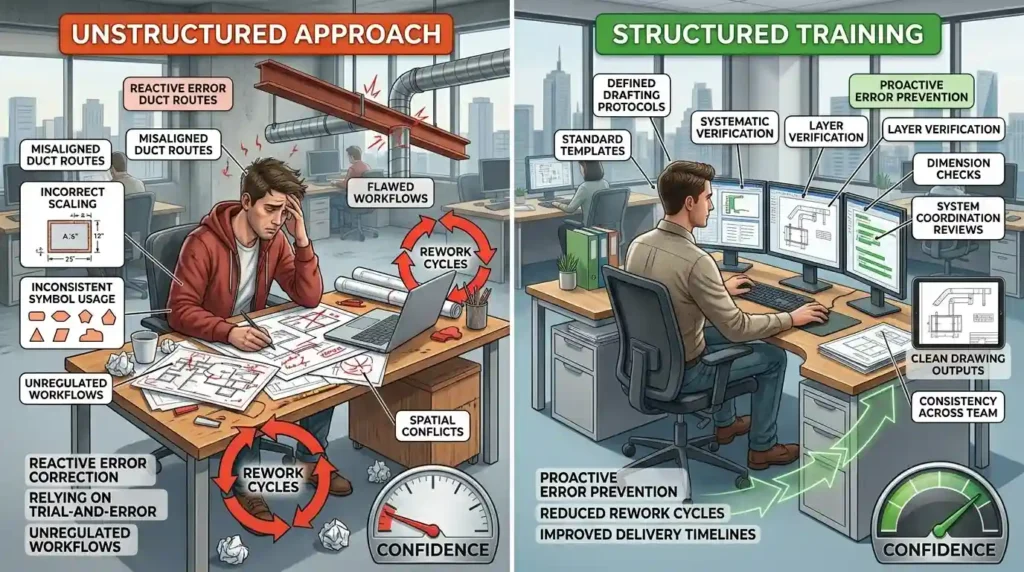
Structured training reshapes how junior engineers approach drawing creation. Instead of correcting errors after completion, they begin preventing them during production.
This shift reduces common issues such as misaligned duct routes, incorrect scaling, and inconsistent symbol usage. These errors often arise from unstructured learning environments.
Training introduces validation checkpoints at each drafting stage. These include layer verification, dimension checks, and system coordination reviews before submission.
Junior draughtsmen also learn how HVAC systems interact with architectural drawings. This reduces spatial conflicts and improves integration accuracy between mechanical and structural elements.
By standardising workflows, training eliminates personal interpretation variations. Every draughtsman follows the same drafting logic, which improves consistency across teams.
This structured approach reduces rework cycles, improves delivery timelines, and increases confidence in drawing outputs during project execution stages.
Why do junior draughtsmen struggle with consistency in HVAC AutoCAD drawings?
Junior draughtsmen struggle with consistency because they rely on fragmented learning sources, lack standardised drafting frameworks, and operate without defined engineering documentation rules, leading to variations in layer structure, annotation style, and system representation across different drawings.
Consistency issues emerge when drafting knowledge is acquired informally. Many junior professionals learn AutoCAD commands without understanding HVAC design logic.
This results in drawings that vary significantly between projects. One drawing may follow structured layer naming, while another uses inconsistent or missing classification systems.
Another contributing factor is lack of exposure to engineering standards. HVAC drafting requires adherence to mechanical design codes and documentation practices that ensure interoperability between teams.
Without structured training, draughtsmen also struggle with scale management. Incorrect scaling leads to misinterpretation of system sizes during execution phases.
Consistency improves only when training introduces repeatable drafting frameworks. These frameworks define how systems are represented visually, how annotations are applied, and how revisions are documented.
Standardisation reduces dependency on individual interpretation and ensures that every drawing follows predictable engineering logic.
How does training improve coordination between drafting teams and engineering workflows?
Training improves coordination by aligning draughtsmen with engineering communication protocols, enabling them to interpret design intent accurately, apply standardized documentation practices, and integrate seamlessly into multidisciplinary HVAC project workflows involving architects, structural engineers, and site execution teams.
Coordination breakdowns often occur when draughtsmen operate in isolation from engineering intent. Training bridges this gap by integrating design interpretation into drafting practice.
Junior engineers learn how HVAC systems fit within broader MEP coordination frameworks. This includes understanding load distribution, air flow logic, and equipment integration constraints.
Communication improves when drawings follow standardised formats. Engineers and site teams can interpret layouts without clarification cycles, reducing delays in decision-making.
Training also introduces coordination checkpoints. These ensure drawings are reviewed against architectural and structural references before submission.
Digital collaboration becomes more efficient when all teams use consistent drafting standards. This reduces revision conflicts and improves workflow integration across departments.
Over time, this coordination discipline reduces project friction and improves overall delivery accuracy in complex engineering environments.
What role does software discipline play in AutoCAD HVAC professional development?

Software discipline ensures junior draughtsmen use AutoCAD HVAC tools systematically rather than randomly, applying command efficiency, layer control, block usage, and template management to produce structured engineering drawings that meet professional drafting and documentation standards.
Software discipline is not about memorising commands. It is about using tools within a structured engineering framework.
Junior draughtsmen learn how to use blocks for repeated HVAC components such as diffusers, grilles, and valves. This improves consistency and reduces drafting time.
Layer management becomes a critical discipline. Each system element is assigned a defined layer structure, ensuring clarity and reducing coordination errors.
Command efficiency improves productivity. Training focuses on using shortcuts and automation features to streamline repetitive drafting tasks.
Template usage also plays a key role. Standard templates ensure every drawing begins with predefined settings, reducing setup inconsistencies.
Software discipline transforms AutoCAD from a drawing tool into an engineering production system that supports scalable HVAC design workflows.
How do companies measure ROI of AutoCAD HVAC training for junior staff?
Companies measure ROI through reduced rework rates, improved drafting speed, higher drawing accuracy, fewer coordination errors, and improved project delivery timelines, all of which translate into lower engineering costs and improved utilisation of junior draughtsman productivity across HVAC project cycles.
ROI measurement in HVAC training is directly linked to operational efficiency. Organisations evaluate performance before and after training implementation.
One key metric is reduction in drawing revisions. Fewer revisions indicate improved first-time accuracy in drafting outputs.
Another metric is production speed. Trained draughtsmen complete drawings faster due to improved command efficiency and structured workflows.
Error reduction is also measured. This includes fewer clashes between HVAC systems and architectural or structural elements.
Project delivery timelines improve when coordination issues decrease. This reduces delays in construction phases and improves client satisfaction.
Training ROI is also reflected in reduced supervision requirements. Senior engineers spend less time correcting junior outputs, increasing overall team productivity.
These measurable outcomes justify structured investment in HVAC AutoCAD training programs.
How should organisations select the right HVAC training framework for draughtsmen?
Organisations should select HVAC training frameworks based on curriculum depth, industry alignment, workflow integration, practical drafting exposure, and measurable skill outcomes that directly map to engineering project requirements and long-term workforce capability development needs.
Selecting the right framework requires evaluating how closely training aligns with real engineering environments.
A structured programme such as the:
AutoCAD HVAC and Plumbing Design Training Course provides workflow-based learning instead of isolated software instruction.
Organisations should prioritise training that includes real project simulations. This ensures draughtsmen experience HVAC system design in practical contexts.
Curriculum structure must include drafting standards, coordination workflows, and documentation protocols. These elements define professional readiness.
Discover More from Our Guide Library:
How Are Chiller Plant Drawings Produced and Detailed in AutoCAD HVAC Training?
What Is the Long-Term Career Value of AutoCAD HVAC Certification for MEP Engineers?
Training duration and intensity also matter. Short courses often fail to build discipline, while structured programmes develop long-term behavioural change.
Another selection factor is alignment with business KPIs. Training should improve measurable outcomes such as accuracy, efficiency, and coordination performance.
When these criteria are met, organisations achieve stronger workforce development outcomes and reduced engineering inefficiencies.
How does AutoCAD HVAC training improve drafting accuracy?
AutoCAD HVAC training improves accuracy by teaching structured drafting methods, standard layer systems, and error-checking workflows. Learners at Imperial Corporate Training Institute develop consistency in HVAC drawings and reduce common design coordination mistakes.
What skills do you gain from HVAC and plumbing AutoCAD training?
Participants gain skills in HVAC ducting layouts, plumbing system design, CAD standards, and technical drawing interpretation. The training also builds competency in engineering documentation and multidisciplinary coordination.
Who should take an AutoCAD HVAC and Plumbing Design training course?
This course is designed for junior draughtsmen, MEP engineers, and CAD technicians who want to develop HVAC and plumbing design skills. It is also suitable for professionals transitioning into building services drafting roles.